

A single mechanical failure during a high-profile tour isn't just a technical glitch; it's a structural breakdown of the entire production's ROI. You understand that the transition from the warehouse to the stage is the most vulnerable period for sensitive AV assets. Constant vibrations, improper load distribution, and rapid temperature shifts can compromise expensive electronics before the first case is even opened.
This guide provides a comprehensive analysis of live event staging equipment protection, focusing on the engineering standards and logistical strategies required to maintain zero-failure performance. We'll explore the technical specifications of ATA 300 Category 1 testing, the structural advantages of Santosom engineering, and how standardized dimensions in TruckPaX™ systems optimize truck packs for maximum efficiency. By prioritizing material science and mechanical precision, you can extend the operational lifespan of your production assets while ensuring every load-in is fast, safe, and secure. This methodical approach to gear management transforms logistics from a liability into a professional asset.
Key Takeaways
- Mitigate equipment depreciation and prevent mechanical failure by implementing professional protection systems designed for high-vibration transit.
- Adopt ATA 300 Category 1 engineering standards to ensure transport containers maintain structural integrity throughout rigorous multi-city tours.
- Develop a specialized framework for live event staging equipment protection that addresses the specific weight, balance, and shock-absorption requirements of different gear classes.
- Optimize logistical efficiency by utilizing standardized case dimensions to create stable, high-density truck packs that prevent load-shifting.
- Leverage custom engineering solutions from Santosom and ZCASE to provide precision-fit protection for high-value consoles and sensitive electronic components.
Why Rigorous Staging Equipment Protection is Non-Negotiable
Professional live event staging equipment protection is a calculated engineering system designed to manage shock absorption and maintain structural integrity. In the professional production environment, gear is exposed to continuous mechanical stress. Transit involves persistent low-frequency vibrations and high-impact shocks that can dislodge sensitive internal components or fracture delicate circuit boards. Establishing touring-grade reliability means anticipating these physical demands before the equipment ever leaves the warehouse. By adopting a rigorous approach to live event staging equipment protection, you ensure that every asset arrives in the same condition it left the shop.
The engineering behind these systems focuses on the controlled dissipation of kinetic energy. Without a sophisticated dampening strategy, the friction between internal components leads to accelerated hardware depreciation. This isn't just a matter of cosmetic wear; it's a fundamental degradation of the asset's operational reliability. When a show is live, there's no margin for error. Equipment failure isn't an option when the reputation of a production depends on consistent performance.
The Real Cost of Equipment Damage
The financial impact of equipment damage is often underestimated. While the price of a replacement digital mixer or LED panel is clear, the secondary costs are more substantial. A technical failure during a performance results in show delays, potential safety hazards, and significant damage to professional credibility. Repairing sensitive electronics is a specialized process that often involves long lead times and high labor costs. By investing in high-specification protection, companies protect their bottom line. Properly maintained gear retains a significantly higher resale value, allowing production houses to recoup more capital when refreshing their inventory for newer technology; for firms looking to leverage this asset stability for further growth, check out PP-X for specialized advisory on strategic acquisitions.
Transitioning from Storage to Touring Protection
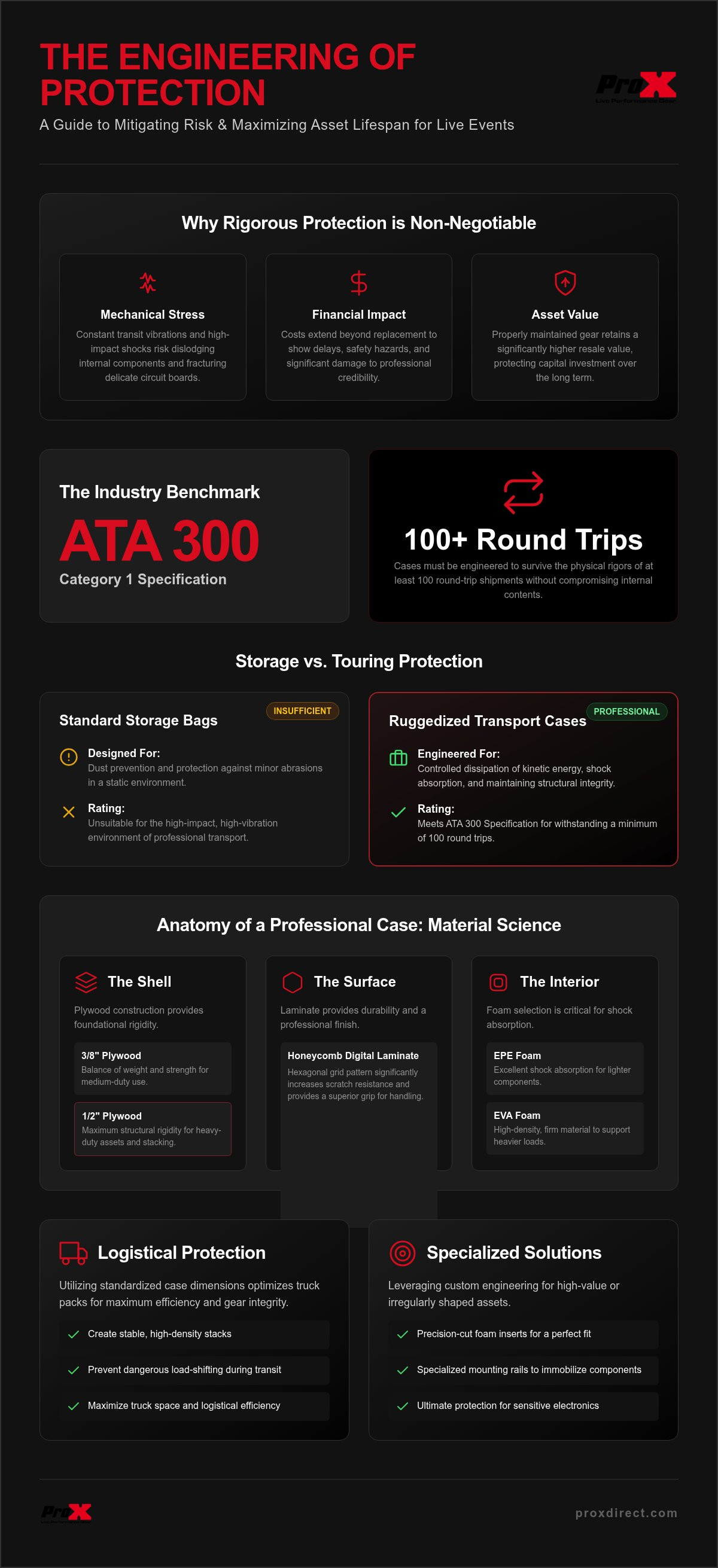
Standard storage bags are designed for dust prevention and minor abrasions. They are insufficient for the high-impact environment of professional touring. Ruggedized transport cases are engineered to meet the ATA 300 Specification, which defines the requirements for reusable containers capable of withstanding at least 100 round trips. These cases utilize 3/8" or 1/2" plywood shells reinforced with aluminum extrusions and steel ball corners to ensure the exterior remains rigid under pressure.
While universal cases provide a baseline of safety, high-value or irregularly shaped gear often requires custom engineering. Precision-cut foam inserts and specialized mounting rails ensure that sensitive components remain stationary during transit. For a comprehensive breakdown of how these materials interact to protect your gear, consult The Ultimate Guide to Flight Cases. Transitioning to these professional standards is essential for any operation moving beyond local storage and into the rigors of multi-city logistics.
Engineering Standards: ATA 300 and Material Science
Engineering standards provide the technical foundation for live event staging equipment protection. The ATA 300 Category 1 specification is the industry benchmark for reusable transport containers. To meet this standard, a case must survive the physical rigors of 100 round-trip shipments without compromising the internal contents. Achieving this level of durability requires specific material selections. Most professional cases utilize 3/8" or 1/2" plywood. While 3/8" plywood offers a balance of weight and strength for medium-duty applications, 1/2" plywood provides the maximum structural rigidity required for heavy-duty touring assets. Heavy panels prevent the shell from bowing under the weight of stacked gear in a truck pack.
Surface protection is equally critical for long-term asset management. Honeycomb digital laminates feature a hexagonal grid pattern that significantly increases scratch resistance compared to traditional flat laminates. This textured surface maintains the professional appearance of the fleet over years of use and provides a superior grip during handling. For internal protection, the choice between Expanded Polyethylene (EPE) and Ethylene-vinyl acetate (EVA) foam depends on the weight of the gear. EPE provides excellent shock absorption for lighter components, while EVA is a high-density, firmer material designed to support heavier loads like amplifiers or large-format consoles. If you are building a professional inventory, exploring the full range of ProX Cases ensures your gear meets these rigorous engineering requirements.
Hardware and Mechanical Assembly
The mechanical assembly of a case determines its operational longevity. Recessed butterfly latches are essential because they sit flush with the case surface, which prevents them from catching on other cases or being sheared off during loading. Similarly, spring-loaded handles remain retracted when not in use to maintain a clean profile. Impact redirection is managed by heavy-duty steel ball corners. These components are engineered to absorb and distribute the energy of a drop across the case frame rather than through the equipment. Aluminum extrusion profiles with a tongue-and-groove fitment create a mechanical seal that resists dust and moisture ingress, preserving the internal environment in diverse climates.
Internal Shock Mounting Techniques
Internal layouts must be tailored to the specific mechanical vulnerabilities of the gear. Custom foam inserts provide a precision fit that eliminates movement, which is superior to generic pick-and-pluck solutions that often degrade over time. For high-performance electronics, floating rack systems utilize rubber shock mounts to isolate the internal rack frame from the external shell. G-force attenuation refers to the foam's capacity to reduce the peak acceleration experienced by the equipment during a sudden impact or drop. By minimizing these forces, professional protection systems prevent the internal structural failures that occur when sensitive components are subjected to rapid deceleration during transit.
Categorical Protection for Audio, Lighting, and Truss
Effective live event staging equipment protection requires a differentiated strategy based on the mechanical and electronic vulnerabilities of the gear. A universal approach fails to account for the distinct physics of various production assets. High-density power amplifiers, for instance, generate significant heat and require thermal management even during short-haul transport to prevent component stress. For productions in specialized or hazardous settings where industrial-grade power and ventilation are required, exsafe.shop provides certified solutions that meet these rigorous safety demands. Conversely, aluminum truss segments demand protection against structural deformation and surface abrasion. Cable management is another critical factor; specialized cases should include dedicated pathways to prevent connector strain and port fatigue during the repetitive cycles of load-in and load-out.
Large-format consoles represent some of the highest-value assets in any production inventory. These units are susceptible to fader misalignment and screen damage from vertical impacts. Utilizing Flip Ready designs made by ZCASE allows for rapid, single-person deployment, which significantly reduces the risk of accidental drops during manual lifting. These cases feature internal support structures that isolate the console from the outer shell, ensuring the chassis remains square and the internal connections stay secure. For more technical specifications on selecting the right housing for your setup, refer to the Professional DJ Equipment Case Purchase Guide.
Truss and Staging Hardware Safety
While truss segments appear rugged, they're vulnerable to aluminum abrasion and structural denting. When segments are stacked without proper separation, the friction during transit can compromise the integrity of the chords and webbing. Specialized cases for heavy base plates and truss segments provide secure mounting points that prevent metal-on-metal contact. This is essential for maintaining the load-bearing certifications of your staging components over long-term use. You'll find a deeper analysis of these logistical challenges in Engineering Excellence: The Ultimate Guide to Stage Truss and Base Plate Cases.
Lighting and LED Video Wall Logistics
Lighting fixtures, particularly moving heads, require precision calibration that persistent vibrations can easily disrupt. High-quality lighting cases use multi-compartment designs to keep fixtures upright and isolated, preserving the mechanical alignment of the motors. For LED video walls, the primary concern is protecting the delicate diodes on the panel edges. Cases for these assets must include shock-absorbing dividers that prevent panel-to-panel contact. If you're managing large-scale displays, you can Browse LED Video Panel Wall Support solutions designed to maintain the mechanical alignment of your video tiles throughout the rigors of live event staging equipment protection.
Logistical Protection: Optimizing Truck Packs for Gear Integrity
Strategic live event staging equipment protection extends beyond the individual container to the entire logistical ecosystem. A case that's structurally sound but improperly secured in a transport vehicle remains at risk. Load-shifting is a primary cause of gear damage, occurring when lateral or vertical movement allows cases to impact one another or the vehicle walls. Implementing a "Truck Pack" philosophy ensures that every cubic inch of transport space is utilized to create a friction-locked, stable mass. This density doesn't just maximize fuel efficiency; it provides a secondary layer of protection by eliminating the dead space that allows kinetic energy to build during sudden braking or cornering.
Standardizing Case Footprints
Uniformity is the cornerstone of professional logistics. Industry-standard truck widths are typically 90 or 96 inches. By utilizing case footprints of 22.5 or 45 inches, you can create rows that fit perfectly across the trailer without gaps. This precision fitment prevents the side-to-side shifting that often leads to crushed extrusions or sheared latches. Stacking cups and integrated wheel wells further enhance this stability by locking cases together vertically. This prevents the top-heavy swaying that can compromise the structural integrity of cases at the bottom of the stack. To see how these dimensions integrate into a professional fleet, explore TruckPaX™ Truck Pack Cases: Engineering Logistical Efficiency.
Safe Handling and Personnel Protection
The physical safety of the crew is inseparable from the safety of the equipment. Heavy-duty casters are essential for facilitating safe load-ins, particularly when navigating uneven terrain or steep loading docks. High-quality casters with integrated brakes provide the necessary resistance to prevent runaway cases on sloped surfaces. Ergonomic handle placement is another critical engineering detail; it allows for proper lifting technique, which reduces crew fatigue and the likelihood of accidental drops. Standardized case weight and dimensions improve loading predictability, allowing logistical managers to calculate axle weight distribution with higher precision. Efficient logistics rely on these predictable variables to maintain a safe working environment. If you're looking to upgrade your logistical standards, you can Browse ProX Case Solutions to find standardized options for your entire inventory.
ProX Engineering: Specialized Solutions for Touring Pros
Achieving a zero-failure performance record requires more than standard housing; it demands a partnership with a manufacturer that understands the mechanical realities of the road. ProX positions itself as a reliable backbone for the industry, providing engineering-grade live event staging equipment protection since 1984. By focusing on structural capabilities and material science, we ensure that every production asset, from a small-format mixer to complex broadcasting arrays, remains operational throughout its intended lifecycle. Long-term case maintenance is supported by a comprehensive inventory of ProX Cases replacement parts. This allows professionals to refresh hardware components and extend the utility of their fleet for years without requiring full case replacements.
ZCASE Custom Build Capabilities
High-value consoles and sensitive broadcasting equipment often require bespoke configurations that universal cases cannot provide. ZCASE Custom Build Cases, manufactured in Poland, represent the pinnacle of precision engineering for the touring professional. These cases are designed with the "Flip Ready" mechanism, a mechanical innovation that allows for rapid, secure deployment of large-format consoles by a single operator. This system integrates safety and speed into the structural design, which significantly reduces the risk of chassis torque or accidental drops during setup. For professionals managing unique technical requirements or non-standard hardware, you can View Custom Case Options that prioritize functional excellence over standard specifications.
Santosom and UltronX: Extreme Environment Protection
Touring environments often subject gear to environmental variables that exceed the limits of standard plywood construction. Santosom Cases are engineered for the most demanding global tours, utilizing specialized materials and assembly techniques to withstand extreme physical stress. When a production moves to outdoor festivals or coastal environments, moisture and particulate ingress become the primary threats to sensitive circuitry. The UltronX™ line of watertight cases provides a hermetic seal against dust and water, ensuring that sensitive electronics remain protected in the most hostile climates. These solutions are critical for maintaining the integrity of high-stakes productions where environmental failure is not an option. You can Explore AV Broadcasting Cases and other specialized lines designed for rigorous professional use. By integrating these advanced engineering standards into your logistical strategy, you secure the future of your production assets and ensure consistent performance on every stage.
Securing the Future of Your Production Inventory
Professional production requires a shift from reactive repairs to proactive engineering. By implementing rigorous live event staging equipment protection, you ensure that every asset maintains its mechanical integrity through the most demanding tours. We've examined how ATA 300 standards and standardized truck pack dimensions create a stable logistical environment. These systems don't just protect gear; they optimize show deployment and preserve long-term asset value.
ProX has been engineering performance gear since 1984. Our global dealer network provides professional support wherever the tour leads, while custom ZCASE engineering offers bespoke solutions for high-value broadcasting and audio gear. Whether you're managing a local stage or a global stadium run, the technical precision of your housing determines the reliability of your show. It's the difference between a successful performance and a costly mechanical failure.
Explore Professional Touring-Grade Cases at ProX and invest in the structural security your equipment deserves. We're here to support your next load-in with the precision of a meticulous engineering partner.
Frequently Asked Questions
What is the difference between ATA 300 Category 1 and Category 2 cases?
ATA 300 Category 1 cases are engineered for a minimum of 100 round-trip shipments, while Category 2 cases are designed for only 10. Category 1 containers utilize heavy-duty materials like 3/8" or 1/2" plywood and steel hardware to withstand rigorous touring. Category 2 cases typically use lighter materials suitable for infrequent transport. For professional live event staging equipment protection, Category 1 is the mandatory standard to ensure long-term asset survival in high-impact environments.
How does honeycomb laminate improve equipment protection compared to standard plywood?
Honeycomb digital laminate features a hexagonal grid pattern that provides superior scratch and scuff resistance compared to standard flat plywood finishes. This textured surface increases the structural integrity of the outer layer and offers better grip during manual handling. It also helps maintain a professional aesthetic by hiding minor abrasions that occur during truck loading. Standard plywood surfaces are more prone to deep gouges and splinters, which can compromise the case's exterior over time.
Why are recessed latches preferred for touring-grade staging equipment?
Recessed butterfly latches are preferred because they sit flush within the case shell, which prevents them from being sheared off during transport. When cases are packed tightly in a truck, protruding hardware can catch on adjacent containers or vehicle walls, leading to mechanical failure. Recessed designs ensure a clean exterior profile that facilitates safer stacking and sliding. This mechanical choice is essential for maintaining the structural integrity of the case throughout its operational lifespan.
Can I use universal cases for sensitive digital mixing consoles?
Universal cases are generally insufficient for high-value digital mixing consoles due to the lack of precision internal support. These consoles have delicate faders and touchscreens that require custom-cut foam to prevent any internal movement. A custom-engineered case, such as those from the ZCASE line, provides specific load-bearing points that isolate the chassis from vibration. Using generic protection often leads to fader misalignment or screen fractures when the console is subjected to sudden vertical impacts.
What maintenance is required to keep road cases in transport-safe condition?
Regular maintenance involves inspecting all mechanical fasteners and moving parts for signs of fatigue. You should verify that rivets remain secure and that aluminum extrusions haven't shifted. Casters require periodic cleaning and lubrication to ensure smooth rotation on ramps. Inspect internal foam for compression or degradation, as worn foam loses its shock-absorption capacity. Replacing damaged butterfly latches or spring-loaded handles immediately ensures the case remains secure and provides consistent live event staging equipment protection.
How do standardized case dimensions improve truck pack safety?
Standardized case dimensions, such as the 22.5" and 45" footprints used in TruckPaX™ systems, allow for a precision fit across standard 90" or 96" truck widths. This eliminates dead space between cases, which prevents lateral shifting and tipping during transit. A tight, uniform pack acts as a single mass, reducing the kinetic energy build-up that causes impact damage. This logistical strategy significantly improves both equipment safety and the speed of professional load-outs during multi-city tours.
What foam density is best for protecting heavy staging hardware?
High-density Ethylene-vinyl acetate (EVA) foam is the optimal choice for protecting heavy staging hardware like base plates or truss segments. Unlike softer foams, EVA provides the firm support necessary to prevent heavy items from bottoming out against the case shell. It maintains its shape under significant pressure and offers superior resistance to chemical degradation. For lighter electronics, a combination of EVA and softer EPE foam is often used to balance structural support and shock absorption.
Are watertight cases necessary for indoor live event production?
Watertight cases like the UltronX™ line are beneficial even for indoor production environments. They protect sensitive electronics from high humidity, dust accumulation, and accidental liquid spills during stage setup. Additionally, these cases provide an airtight seal that prevents oxidation of internal connectors during long-term storage or transit between venues with varying climates. While not always mandatory for indoor use, the added protection against environmental variables ensures a higher level of reliability for critical AV assets.
Disclaimer
Any trademarks, trade names or brand names appearing herein that do not belong to ProX are the property of their respective owners and/or companies, and such appearance doesn't and shall not constitute or imply endorsement, sponsorship or recommendation by ProX.


