

With global TV shipments hitting a post-pandemic high of 47.12 million units in early 2026, the logistical risk for high-value displays has never been higher. A single hairline fracture on a 65-inch OLED panel can result in a total loss exceeding $1,500, often because of a failure to understand the physics of lateral pressure. You understand that standard retail packaging is not engineered for the rigors of professional logistics, which is why learning how to ship a large screen TV safely is a critical competency for any AV professional.
The frustration of unboxing a spider-webbed screen or facing a denied insurance claim due to insufficient protection is a constant threat in high-stakes production environments. This guide provides the definitive engineering protocols for transporting high-value displays using industrial-grade standards that neutralize vibration and impact. We'll examine ATA 300 Category 1 requirements, the structural advantages of reusable hard-shell systems like Santosom or ZCASE builds, and the specific material science required to protect advanced MiniLED and OLED panels during interstate transit. By adopting these professional standards, you ensure zero-damage delivery and maximize the operational lifespan of your display inventory.
Key Takeaways
- Understand the physics of lateral pressure and the "thin-glass" vulnerability inherent in large-format LED and LCD panels to prevent spider-webbing during transit.
- Implement ATA 300 Category 1 engineering standards to ensure your shipping containers meet the rigorous requirements for repeated professional use.
- Analyze the long-term ROI of high-density polyethylene and plywood cases over retail cardboard packaging that degrades after a single deployment.
- Master the technical protocol for how to ship a large screen TV safely by utilizing static-dissipative materials and non-abrasive screen protection.
- Select precision-engineered cases from Santosom or ZCASE that match your display’s specific dimensions to eliminate internal movement and panel stress.
The Structural Vulnerabilities of Large Format LED and LCD Displays
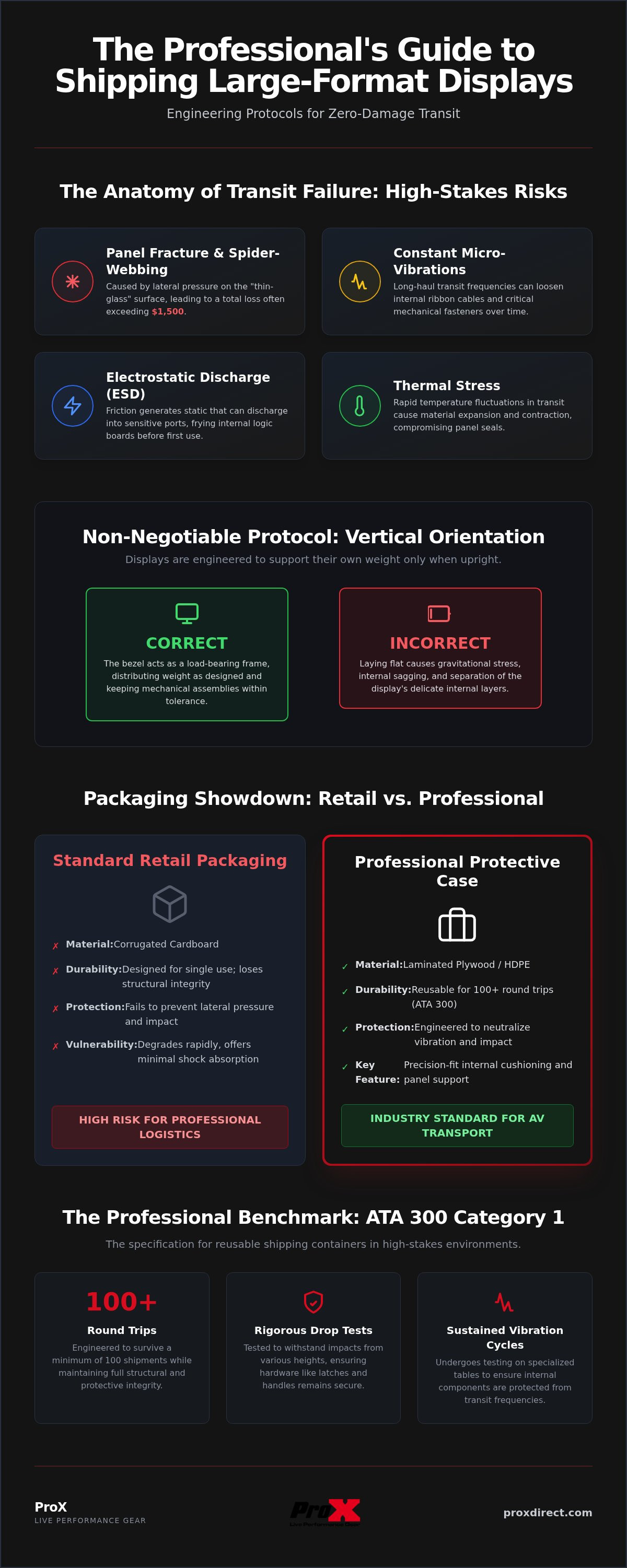
Large-format displays're engineered for visual performance, not structural rigidity. As screen sizes increase, the ratio of glass surface area to bezel thickness creates a significant engineering challenge. A 77-inch OLED panel, part of a market segment expected to grow at an 8% CAGR through 2030 according to Counterpoint Research, possesses a structural vulnerability known as the thin-glass problem. These panels are under constant internal tension. Any deviation in the plane of the glass can lead to catastrophic failure. Learning how to ship a large screen TV safely requires a deep understanding of these panel physics.
Lateral pressure is the primary cause of panel failure during transport. When pressure is applied to the center of a large screen, it compresses the layers of the LED backlighting array. This results in delamination or spider-webbing, where the internal crystal structure fractures without the outer glass necessarily breaking. Professional Flat Panel LED TV Cases are designed to neutralize this pressure by ensuring the screen remains suspended without contact on the display face.
Long-haul transit introduces constant micro-vibrations. These frequencies can loosen internal ribbon cables or mechanical fasteners over time. Environmental factors like temperature fluctuations also pose a risk. Rapid changes in cargo bay temperatures cause materials to expand and contract at different rates, which can compromise the integrity of the panel seal. High-grade protective cases provide the thermal mass necessary to slow these temperature shifts.
Why Vertical Orientation is Non-Negotiable
Displays're designed to support their own weight only when positioned vertically. The bezel acts as a load-bearing frame in this orientation. If it's stored horizontally, the center of the panel lacks support, leading to internal sagging. This gravitational stress causes the layers of the display to separate. It's critical to follow "This Side Up" indicators, as different panel technologies have varying centers of gravity. Proper orientation ensures the mechanical assembly remains within its designed tolerances.
The Hidden Danger of Static Discharge
Transit creates friction between the screen and its protective packaging. This friction generates significant electrostatic buildup. Don't overlook these electrical risks; without specialized anti-static foam or static-dissipative covers, this charge can discharge into sensitive HDMI and control ports. This surge can fry internal logic boards before the unit is even powered on. Mastering how to ship a large screen TV safely involves neutralizing these risks through proper material selection and port protection.
Engineering Standards for Professional AV Transport
Consumer-grade shipping methods fail because they rely on corrugated materials that lose structural integrity after a single use. Professional logistics demand rigid engineering that can withstand the repetitive stresses of loading docks and freight elevators. To understand how to ship a large screen TV safely in a high-stakes environment, you must transition from disposable packaging to technical enclosures designed for longevity. Professional Flat Panel LED TV Cases utilize a combination of material science and mechanical hardware to create a protective shell that neutralizes external forces.
The choice between high-density polyethylene (HDPE) and laminated plywood depends on the specific weight and dimensions of the display. HDPE offers superior impact resistance and weight reduction for smaller screens. Laminated plywood remains the industry standard for larger displays due to its exceptional shear strength and ability to support heavy hardware. Both materials provide a rigid barrier that prevents the lateral compression responsible for panel delamination.
ATA 300-Style Protection Explained
ATA 300 Category 1 is the benchmark for reusable AV protection. This specification requires a container to survive a minimum of 100 round-trip shipments while maintaining complete equipment functionality. Testing protocols involve rigorous drop tests from varying heights and sustained vibration cycles on specialized tables. These standards ensure that the case hardware, such as recessed latches and spring-loaded handles, won't shear off or fail during intense logistical maneuvers.
Internal Cushioning and Panel Support
Internal foam engineering is just as critical as the outer shell. Professional cases utilize high-density plank foam, a closed-cell polyethylene material, rather than softer ester foams. Plank foam possesses the compressive strength required to support displays exceeding 75 inches without bottoming out. The design must "float" the screen, ensuring the bezel carries the load while the fragile glass surface remains completely untouched by the case walls. Custom-cut inserts are then used to secure peripheral items like power cables and remotes, preventing loose components from impacting the screen during transit. For those managing complex inventories, investing in precision-engineered solutions like ZCASE or Santosom builds provides the necessary technical assurance for how to ship a large screen TV safely every time.
Retail Packaging vs. Professional Protective Cases
Consumer shipping guides often recommend retaining the original retail box as the gold standard for transport. While this advice suffices for a single residential move, it fails to address the logistical demands of professional AV production. Corrugated cardboard is engineered for one-way, palletized delivery where it remains shrink-wrapped and undisturbed. In a touring environment, the structural integrity of cardboard degrades rapidly during repeated handling cycles. Understanding how to ship a large screen TV safely requires a transition from disposable materials to rigid, reusable enclosures.
The long-term ROI of professional cases is significant when compared to the recurring cost of sourcing replacement boxes and the high probability of panel damage. Professional cases provide a standardized footprint that allows for predictable truck pack density. This logistical efficiency reduces load-in times and ensures that high-value displays aren't subjected to the uneven stacking pressures common in mixed-freight environments. A hard-shell case also simplifies insurance claims; carriers frequently deny payouts for equipment shipped in cardboard due to "insufficient packaging" clauses.
The Limitations of Original Retail Boxes
Retail boxes lack the external puncture resistance required to survive contact with stage weights, trussing, or other heavy equipment. Standard cardboard also acts as a desiccant, absorbing moisture in humid storage or during outdoor load-outs. This absorption softens the fibers, leading to "box crush" when other items are stacked on top. The foam inserts found in retail packaging are typically expanded polystyrene (EPS), which is brittle and loses its shock-absorption capabilities after a single significant impact. These materials simply aren't designed for the mechanical assembly requirements of professional gear.
Advantages of Heavy-Duty Multi-Use Containers
Professional enclosures utilize integrated casters and reinforced steel ball corners to maximize impact deflection and maneuverability. These features allow a single technician to move large-format displays safely across uneven surfaces. Utilizing TruckPaX™ Truck Pack Cases ensures that every square inch of cargo space is optimized through standardized dimensions. These cases provide several engineering advantages:
- Impact Deflection: Steel ball corners distribute the force of collisions away from the internal panel.
- Structural Rigidity: Laminated plywood walls prevent the lateral compression that destroys LED backlighting arrays.
- Handling Safety: Spring-loaded handles and heavy-duty wheels reduce the risk of drops during manual handling.
Investing in a reusable system is the only way to guarantee how to ship a large screen TV safely over the lifespan of the equipment. By adopting these industrial-grade protocols, you eliminate the fragility inherent in retail packaging.
Step-by-Step Protocol for Securing Large Displays
Professional logistics require a standardized procedure to eliminate human error during the packing phase. Before the display enters its enclosure, you must perform a comprehensive pre-shipping inspection. Document the physical condition of the panel and the mechanical integrity of all connection ports. Identifying bent pins or loose HDMI housings before transit prevents disputes over when damage occurred. This documentation serves as a baseline for your quality control process and is a prerequisite for mastering how to ship a large screen TV safely.
Cable management is where many technicians fail, often leading to avoidable screen damage. Loose connectors can vibrate against the panel, causing micro-fractures or permanent surface scratches. Secure all XLR and power cables in designated accessory compartments rather than leaving them in the main screen cavity. Use internal hook-and-loop straps to anchor the main unit within the foam blocks. The tension should be firm enough to prevent shifting but not so tight that it applies localized pressure to the display bezel.
Panel Preparation and Cleaning
Surface contaminants become abrasives under the constant vibration of long-haul transit. Remove all fingerprints, dust, and oils using a technician-grade microfiber cloth and an alcohol-free cleaning solution. Once the screen is clear, apply a protective thin-film foam layer or a specialized static-dissipative cover over the entire display surface. This barrier prevents friction between the panel and the case’s internal foam. Ensure all external stands and mounting brackets are removed; these protruding elements create uneven weight distribution and can puncture internal foam supports during handling.
Loading and Securing the Case
Don't attempt to load a display over 55 inches alone. Use a synchronized two-person lift to maintain the vertical orientation required for panel integrity. Lower the unit slowly into the case, ensuring it's perfectly centered within the support system. The display should be suspended by its bezel, with the glass surface "floating" to avoid direct impact. Double-check the compartment for loose screws or tools before sealing. Verify that the latch tension is uniform across all points to ensure the lid provides consistent compression. For high-volume operations, selecting precision-engineered ProX Cases ensures that every component of this protocol is supported by the hardware itself.
Selecting the Right Professional Case for Your Display
Precision fit is the technical foundation of display protection. A case that is too large allows for internal movement and kinetic energy buildup, which negates the effectiveness of the foam support system. When determining how to ship a large screen TV safely, you must measure the unit’s depth, width, and height with all mounting brackets and external stands removed. Single-unit cases offer maximum maneuverability for smaller crews, while dual-unit cases optimize cargo space for large-scale deployments. These units often integrate seamlessly into a broader AV Broadcasting Cases workflow, ensuring that monitoring equipment remains protected alongside cameras and switching gear.
ProX Flat Panel LED TV Case Features
ProX utilizes 3/8-inch or 1/2-inch plywood combined with a honeycomb laminate to provide superior shear strength. This construction deflects impacts that would otherwise reach the panel. Industrial-grade casters are essential for maintaining the vertical orientation required for panel safety. These hardware specifications are compatible with major display brands, providing a standardized solution for diverse rental inventories. The inclusion of recessed latches and spring-loaded handles ensures that the case remains a low-profile, high-durability asset in any truck pack. This combination of material science and mechanical hardware meets the rigorous touring demands of the modern AV industry.
To ensure you have the highest quality components for your next project, you can discover HDTV Supply for professional-grade audio-visual equipment and distribution systems.
Custom Engineering and Bespoke Solutions
Standardizing Your Display Logistics for Long-Term Reliability
Transitioning from disposable packaging to industrial-grade enclosures is the only way to mitigate the inherent risks of large-format display transport. You now understand that neutralizing lateral pressure and managing micro-vibrations are technical requirements, not optional precautions. By adhering to ATA 300 Category 1 standards and implementing a rigorous two-person loading protocol, you eliminate the variables that lead to panel failure and denied insurance claims. Standardizing your logistics is a strategic investment in equipment longevity.
This rigorous approach is also essential for specialized sectors; for example, Synergy Medical Inc. distributes high-performance surgical, radiology, and mammography screens that rely on precise transport to maintain their diagnostic accuracy.
Mastering how to ship a large screen TV safely ensures your equipment remains operational for every event, maximizing your long-term ROI. ProX has been engineering performance gear for touring professionals since 1984, utilizing precise material science to protect high-value production assets. With a global dealer network and a commitment to functional excellence, our cases provide the structural backbone your inventory requires. You can rely on the integrity of our builds to support your most demanding production schedules.
Explore ProX Professional Flat Panel LED TV Cases to find the exact engineering solution for your display fleet.
Frequently Asked Questions
Can I ship a large screen TV on its side if it's in a professional case?
Vertical orientation is mandatory regardless of the enclosure type. Horizontal positioning places the full weight of the panel layers on the internal support structure, which isn't designed for lateral stress. This orientation often leads to delamination or screen sagging over time. Even with the superior dampening of a professional case, you must maintain an upright position to ensure the bezel carries the load as intended during transit.
What is the difference between ATA 300 and standard shipping boxes?
ATA 300 Category 1 containers are engineered for a minimum of 100 round-trip shipments. Standard corrugated boxes are disposable, one-way solutions that degrade rapidly under humidity and physical impact. Professional cases use high-density polyethylene or laminated plywood with reinforced steel hardware. This creates a rigid shell that maintains its structural integrity through years of logistical handling, whereas cardboard offers zero puncture resistance in production environments.
How much foam padding is required for a 75-inch LED TV?
For a 75-inch display, you should utilize at least two inches of high-density closed-cell plank foam. This material provides the necessary compressive strength to support the unit's weight without bottoming out. Unlike soft ester foams, plank foam maintains its shape under the constant vibrations of road transit. This is a key technical requirement for how to ship a large screen TV safely while keeping the glass surface suspended.
Is it better to ship a TV with the stand attached or removed?
Always remove external stands and mounting brackets before packing the unit. These components create irregular pressure points and can shift during transit, potentially puncturing internal foam supports or impacting the screen surface. Secure these accessories in a separate compartment within the case. This practice ensures a uniform weight distribution across the foam blocks and prevents loose hardware from causing mechanical damage to the display ports.
How do I protect the screen from scratches during a multi-city tour?
Begin by removing all dust and contaminants with a technician-grade microfiber cloth. Once cleaned, apply a layer of static-dissipative thin-film foam or a non-abrasive screen cover. This barrier prevents friction between the panel and the case’s internal padding. On multi-city tours, this protocol reduces the risk of surface scratches caused by micro-vibrations and ensures your equipment arrives in show-quality condition at every venue on the schedule.
What should I do if my display was exposed to extreme cold during shipping?
Allow the unit to acclimate to room temperature for several hours before applying power. Rapidly heating a cold display can cause internal condensation, which leads to short circuits on sensitive logic boards. If you are learning how to ship a large screen TV safely, you must account for these environmental variables. Verify that the panel is completely dry and has reached thermal equilibrium to avoid damaging the internal electronic components.
Are custom cases worth the investment for a single trade show?
High-value displays often require custom engineering even for single events. The replacement cost of a high-end 65-inch OLED often exceeds $1,500, making the investment in a Santosom or ZCASE build a practical form of insurance against shipping damage. Custom builds provide a zero-tolerance fit that standard cases cannot match. This precision is essential for specialized broadcast monitors that possess non-standard dimensions or delicate external controls that require specific foam cutouts.
Can I stack other equipment on top of a professional TV case?
You can safely stack other equipment on cases built with ATA 300-style construction. These enclosures utilize reinforced steel ball corners and laminated plywood walls to distribute downward force throughout the frame rather than the panel. This structural rigidity allows for high truck pack density in professional production environments. Always verify the weight limits of your specific case model to ensure you don't exceed the mechanical tolerances of the casters or hardware.
Disclaimer
Any trademarks, trade names or brand names appearing herein that do not belong to ProX are the property of their respective owners and/or companies, and such appearance doesn't and shall not constitute or imply endorsement, sponsorship or recommendation by ProX.


