

Choosing esports tournament equipment cases starts with more than a device list. Displays, gaming stations, control equipment, and broadcast gear have different dimensions, handling needs, and protection requirements. A case that does not fit the full equipment profile can leave components poorly supported or make packing and setup harder.
Tournament crews handle gear in different ways throughout an event. Screens need careful handling, while production equipment and accessories need clear organization so teams can load in, deploy, and tear down consistently. The case plan affects both equipment protection and event workflow.
This guide shows how to identify which components need dedicated cases and choose formats based on equipment dimensions, handling, transport workflow, and exposure risks. It covers how flat-panel display, AV broadcasting, mixer, rack, and custom-built cases can support different parts of an esports setup. Use it to build a practical plan that protects equipment and makes packing and teardown more consistent.
Key Takeaways
- Group tournament equipment by role so each case plan reflects how the gear is handled and used during the event.
- Specify esports tournament equipment cases using complete equipment measurements, including protrusions, connectors, and attached components.
- Compare case formats by equipment type, access pattern, and handling needs. Plan separately for audio, broadcast, and large displays.
- Assess internal organization and protection requirements alongside the event’s load-in, setup, and teardown workflow.
- Consider custom case engineering when standard dimensions don’t suit specialized equipment. ProX’s live-event case experience can help inform your plan.
Why esports tournament equipment cases need to follow the full event workflow
Treating a tournament setup as one undifferentiated collection of gear can lead to poor fit, difficult handling, and delays during setup. A display has different dimensions and handling needs from a mixer, computer, or cable kit. Effective esports tournament equipment cases account for those differences, where each item travels, and when the crew needs it.
Map equipment by operational role: computing and workstations, displays and video-wall components, audio, broadcast, lighting, and accessories. Tournament formats and production requirements vary, as outlined in this Esports Overview, so base the inventory on the actual event rather than a generic checklist. ProX offers case categories for professional event equipment, including AV broadcasting cases for production components.
Which tournament equipment should have dedicated cases?
Prioritize dedicated cases for high-value, fragile, or frequently handled equipment. This may include display panels, broadcast hardware, mixer consoles, microphones, lighting fixtures, and rack-mounted production components. Group cables, adapters, and small accessories by station or function in clearly identifiable storage instead of leaving them loose among general supplies. Keep related items together, but separate components crews need at different stages or locations.
How case planning supports repeatable event operations
Connect each case label and contents list to a crew role and destination, such as a broadcast position, player station, or lighting area. Consider the route from the vehicle or storage area to the venue floor, including doorways, stairs, and staging space. Then sequence cases around setup and teardown. Items needed first should be accessible without unloading gear that stays packed until later.
Case planning should reflect equipment flow and handling from departure through setup, operation, and teardown. This makes the case plan part of the production workflow, not just a storage decision. A case may fit the item but still create friction if it obstructs access or complicates movement.
Start with an equipment inventory and map each item to its use, handling method, and setup order. Record which components travel together and which need separate access or protection. This gives the team a practical basis for selecting case formats and organizing contents, while making load-in and pack-down more consistent across events.
How to specify esports tournament equipment cases around real gear
Case dimensions should follow the equipment, not an estimate based on its category. A compact audio processor, a display with attached connectors, and a workstation with protruding handles each have different fit and access requirements. A useful case specification covers the complete item, its protection needs, and how the crew will access it during the event.
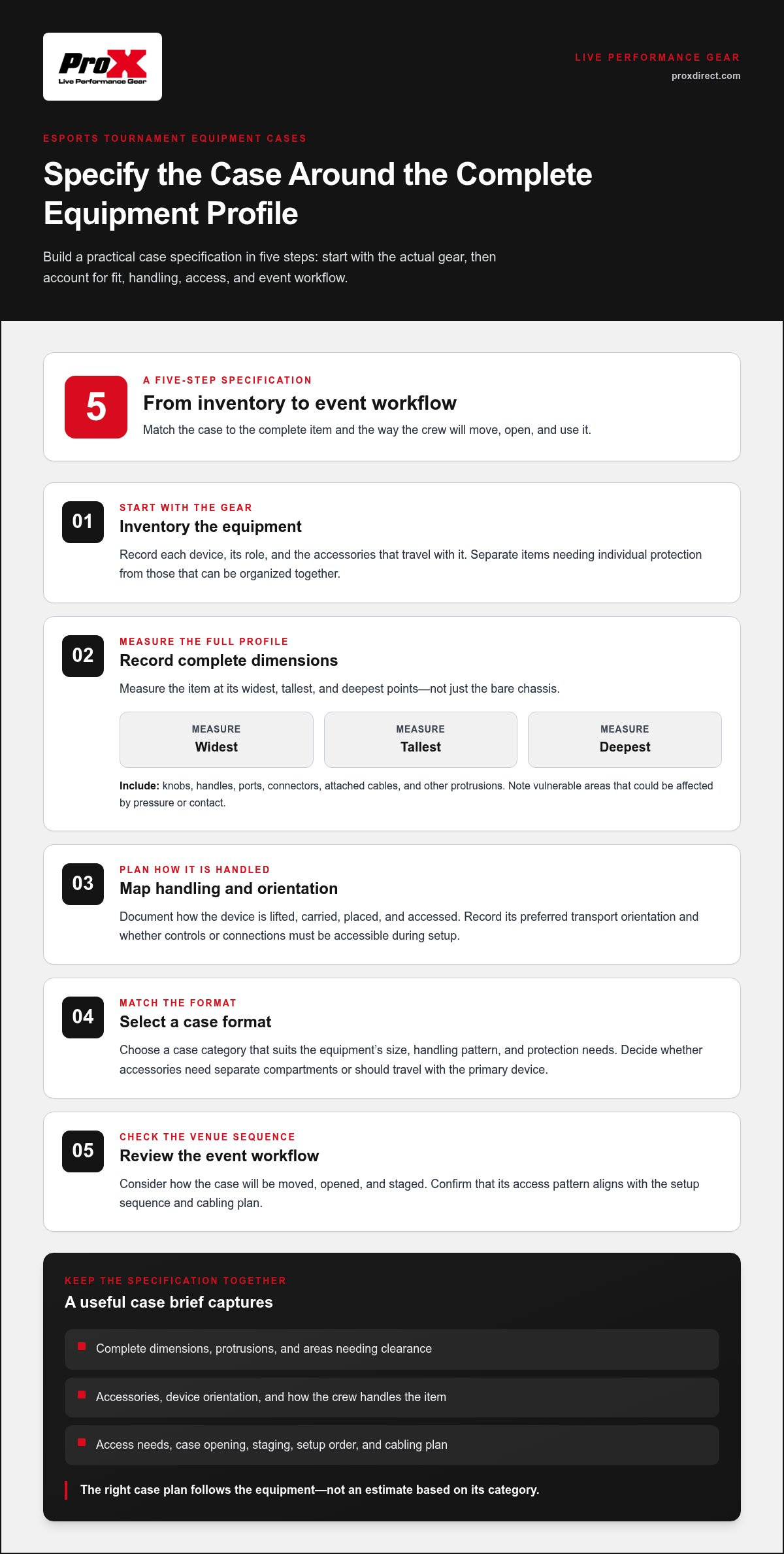
Build each specification in sequence. This makes it easier to compare case formats with equipment needs before choosing a layout.
- Inventory the equipment. Record each device, its role, and any accessories that travel with it. Separate components needing individual protection from those that can be organized together.
- Record complete dimensions. Measure the item at its widest, tallest, and deepest points, including knobs, handles, ports, connectors, attached cables, and other protrusions. Note parts that could be vulnerable to pressure or contact.
- Map handling and orientation. Document how the device is lifted, carried, placed, and accessed. Record its preferred transport orientation and whether the crew needs access to controls or connections during setup.
- Select a case format. Match the case category to the equipment’s size, handling pattern, and protection needs. Decide whether accessories need separate compartments or should travel with the primary device.
- Review the event workflow. Consider how the case will be moved, opened, and staged at the venue. Confirm that its access pattern aligns with the setup sequence and cabling plan.
What measurements belong in a case specification?
Measure the complete equipment profile rather than relying on the bare chassis dimensions. Include protruding controls, handles, ports, and attached components, then note which areas need clearance to avoid pressure against the case interior. List accessories separately and identify whether they need dedicated storage. Record the device orientation and the access needed to connect, configure, or remove it during setup.
How to plan case access for fast setup
Identify what crews need first during load-in, then consider how the case opens in the available space. Lids, removable sections, and work surfaces affect where a case can be staged and how equipment is transferred to its station. Keep the interior layout consistent with the team’s cabling and station plan so accessing an item does not require rearranging connected gear.
For specialized equipment, custom case engineering can address dimensions and protection needs that standard formats do not accommodate. ProX’s professional equipment cases offer a starting point for comparing case categories with a measured inventory. Document dimensions, protrusions, accessory placement, orientation, and access requirements together. This gives case selection a clear, practical basis.
Which esports equipment case format fits each part of the setup?
Choose case formats based on equipment dimensions, handling demands, and access patterns, not the event label. A tournament may combine compact control devices, rack-mounted production hardware, microphones, large screens, and video-wall components. These items have different transport and setup requirements. Assess each equipment group separately before deciding whether related components should travel together.
Use this comparison as a starting point. The right format depends on the equipment and how the crew moves and deploys it.
| Equipment group | Handling need | Access pattern | Case format to investigate |
|---|---|---|---|
| Computing and workstations | Protect complete devices and attached components during movement | Access at a player or control station | Workstation or equipment case sized to the measured setup |
| Audio equipment | Separate delicate devices and accessories where needed | Controls and connections accessed at an audio position | Mixer console, microphone, speaker, or rack case by device type |
| Broadcast and control hardware | Keep production components organized for coordinated handling | Access based on control-room or broadcast setup sequence | AV broadcasting or rack case suited to the component layout |
| Displays and video-wall components | Plan for large, exposed screen surfaces and supporting hardware | Access according to display installation sequence | Flat-panel display case or dedicated video-wall support |
| Lighting and accessories | Group gear by fixture or function while keeping small items identifiable | Retrieve by lighting position or crew task | Lighting or utility and storage case |
Cases for audio, control and broadcast equipment
Match audio and production case categories to the device and the access it needs during operation. A mixer console used at a dedicated station may need a different layout from microphones or rack-mounted signal equipment. Decide whether related components travel together or go to separate crew positions. Comparing professional case categories can help narrow the options by equipment type.
Broadcast hardware deserves separate consideration from general audio gear. Its connections, controls, and operating position determine how the crew needs to access it. AV broadcasting cases suit production components that need to be handled as part of the broadcast system, rather than grouped indiscriminately with unrelated equipment.
Cases for tournament displays and video-wall components
Large displays call for a different planning approach from compact signal or control devices. Treat screen protection and supporting components as separate requirements, then coordinate their case formats with the display’s dimensions and deployment sequence. For setups with video-wall infrastructure, consider how the supporting components will be organized and moved alongside the display cases.
Select esports tournament equipment cases against the actual inventory, not a generic tournament checklist. Standard categories can suit familiar equipment types. Custom-built protection may be appropriate when specialized dimensions or handling requirements do not fit a standard format. The deciding factors are the measured gear, how it moves, and how crews need to access it during the event.
How to evaluate protection, handling and custom dimensions before buying
A case needs to suit more than an equipment outline. Evaluate the fit, internal organization, handling, and how often the device moves between events. Consider the full workflow: packing, loading, movement through the venue, access during operation, and storage or repacking afterward. These factors help clarify the protection and access requirements for your esports tournament equipment cases.
When does a custom-built case make sense?
Consider custom case engineering for unusually shaped equipment, fixed system layouts, or specialized access requirements that a standard format cannot accommodate. A device with attached components may need a different interior arrangement from the same device packed separately. Dimensions and protection requirements guide the design-and-build project. This custom-built case engineering guide explains how tailored dimensions can address equipment-specific needs.
Custom design is not automatically necessary. If a standard case category accommodates the complete equipment profile and the crew’s access pattern, it may be the more straightforward fit. Compare the actual layout and handling requirements instead of assuming either a standard or custom format is preferable for every component.
What should the team review before committing?
Check the proposed case plan against the equipment and accessories that will actually travel in each case. Confirm that the layout accounts for vulnerable areas, internal organization, and how the device is removed or accessed. Review each phase of use: movement from storage to load-in, positioning at the station, access during operation, and repacking during teardown. A layout that works only while stationary may complicate event handling.
- Fit: Does the plan account for the complete equipment profile and any attached components?
- Organization: Are accessories separated or grouped so they remain identifiable and accessible?
- Handling: Can the crew move, open, and stage the case along the venue workflow?
- Use pattern: Does the case plan suit the equipment’s expected event handling and storage routine?
Choose a standard format for common needs, and consider custom design when the equipment requires a specific fit. This keeps the decision grounded in practical requirements, not assumptions about event type. It also gives the production team a clear basis for reviewing case layouts before committing.
For equipment with unusual dimensions or access needs, ProX offers custom case engineering tailored to equipment dimensions and protection requirements. Use your equipment inventory and workflow to plan the case design. Explore ProX case options as you compare formats and engineering needs.
Build a tournament case plan with ProX case and engineering options
A practical case plan turns equipment information into a repeatable system for packing, transport, setup, and teardown. Start with the inventory and complete measurements for each item, then connect every case category to an equipment group and event task. Prioritize items by value, fragility, handling frequency, and position in the setup sequence. This helps the team distinguish essential protection and access requirements from preferences.
- Inventory the equipment. Group computing, display, audio, broadcast, lighting, and accessory items. Note which components travel or operate together.
- Record dimensions and access needs. Include protrusions and attached components, plus how the crew needs to reach or remove each item.
- Map handling and workflow. Trace movement from storage or vehicle to venue position, then through operation and teardown.
- Select case categories. Match each group to a suitable standard category, and identify equipment with fit or protection needs that call for custom engineering.
How ProX case categories fit a tournament production plan
Different case categories help crews separate equipment by function and handling pattern. AV broadcasting cases suit production and broadcast equipment, while mixer, microphone, lighting, display, rack, and utility or storage cases address other equipment groups. Explore AV broadcasting cases as one part of a broader plan. Tournament inventories include different equipment configurations, so do not assume a single case model will fit every setup.
ProX has engineered performance gear since 1984, with experience in professional live-event equipment and case engineering. Standard case categories provide options for common equipment requirements. When a device’s dimensions, fixed layout, or access needs call for a more specific fit, custom case engineering offers a design tailored to equipment dimensions and protection requirements.
How to move from equipment list to case plan
Use the inventory to build a case schedule showing what travels together, where each case belongs, and when its contents are needed. A sensitive broadcast component used early in setup may need a different access priority from accessories used later. Align the plan with crew responsibilities and station locations so cases support the work instead of creating extra sorting during load-in.
For broader principles behind protective case design, consult this flight case engineering guide. Apply those considerations to the equipment’s actual dimensions and event handling pattern. A clear case plan gives teams a repeatable packing reference and makes it easier to review whether each category suits its assigned gear.
Explore ProX case options to compare your tournament inventory with professional case categories and engineering options.
Make the next event easier to manage
Use your case plan as a working document, not a one-time purchasing list. When equipment or venue layouts change, review the effect on packing, access, and crew movement. This keeps esports tournament equipment cases aligned with the production system they support and helps teams refine their process from event to event.
Start with the equipment that creates the greatest handling or setup challenge, then extend the plan across the production system. A consistent approach gives crews a clearer basis for organizing gear and preparing for the next load-in.
Explore ProX case options to compare case categories and engineering options with your equipment plan.
Frequently Asked Questions
What equipment should esports tournament equipment cases protect?
Prioritize equipment whose damage or absence could interrupt play or production. List each station’s computer and display separately from shared control and broadcast components, so the crew can distinguish station-specific gear from equipment used across the event. Include accessories and connection components in the inventory. A protected device may still be unusable if a required adapter or cable is packed elsewhere or overlooked during return packing.
How do I choose the right size case for esports equipment?
Compare the equipment’s full profile with the case’s usable interior and the space available for storage and handling. Catalog dimensions may not account for attached cabling, protruding controls, or the required orientation. For example, a rear connector may need clearance to avoid pressure during movement. Consider how the case will be stored and opened at the venue, not only whether the device fits inside.
Are custom cases worth considering for esports tournaments?
Custom cases can help when standard formats do not accommodate a fixed equipment arrangement or recurring access need. Consider custom engineering if crews repeatedly have to rearrange components, separate attached equipment, or adapt the packing layout between events. Compare that need with the practicality of a suitable standard case category. A clear, recurring fit or workflow problem is a stronger reason to consider custom engineering than the event type alone.
Can one case hold multiple pieces of tournament equipment?
Yes, if the items can be organized and handled together without obstructing access or creating a poor fit. A control device and its dedicated accessories, for example, may belong together if they go to the same station and are used as a set. Don’t combine equipment only to reduce the case count. Items needed at different times or locations may be easier to retrieve and repack separately.
What is the difference between an AV case and a display case?
An AV case is organized around production or broadcast equipment, such as control components that need access to specific connections or operating surfaces. A display case plan focuses on screens and related display hardware, which have different size and handling considerations. A tournament may use both. Keep display support components distinct from signal or control equipment when their crew roles or deployment stages differ.
How can equipment cases make tournament setup more efficient?
Cases support efficient setup when the packing system reflects how the crew works. Assign a consistent contents list to each case and reconcile it during pack-down, so missing components are easier to identify before the next event. For esports tournament equipment cases, this closeout step can complement station-based packing and reduce uncertainty about whether equipment has been returned to its assigned case.
When should an esports event team consider custom case engineering?
Consider custom engineering when the equipment’s arrangement, attached components, or operating access creates a defined fit problem with standard formats. Before planning a tailored design, document how the item is stored, moved, and used at the venue, and note which components must stay together. This gives the design process a practical basis and keeps customization focused on a specific equipment or workflow requirement.
Explore ProX case categories and custom engineering options for your tournament equipment.
Disclaimer
Any trademarks, trade names or brand names appearing herein that do not belong to ProX are the property of their respective owners and/or companies, and such appearance doesn't and shall not constitute or imply endorsement, sponsorship or recommendation by ProX.


