

A rugged exterior alone doesn’t make a heavy duty transport case suitable for professional equipment. If the load can shift inside, or the case is awkward to lift and open, repeated moves can still create problems. Protection depends on how the enclosure, interior support, closures, and handling features work together.
Choosing a case means balancing protection, fit, access, weight, and the demands of the working environment. Start with the equipment: its full dimensions, vulnerable parts, accessories, and the way it will be packed, moved, and used.
This guide explains how to define your requirements before comparing case options. You’ll learn how construction, interior fit, and handling features affect a case’s suitability, and how to compare general-purpose, equipment-specific, and custom-built formats. ProX designs and manufactures rugged cases for audio, lighting, DJ, and broadcast equipment. For equipment that needs a more specific fit, ProX’s custom case engineering can address its dimensions and protection requirements.
Key Takeaways
- Match a heavy duty transport case to the load, handling frequency, and operating environment, not just its exterior appearance.
- Assess how the structure, closures, hardware, and interior restraint work together to protect equipment and limit movement.
- Compare general-purpose, equipment-specific, and custom-built formats against your load, access, and handling needs.
- Before selecting a case, document the complete load, external dimensions, weight, vulnerable points, and accessories.
- Account for the distinct case requirements of professional audio, lighting, DJ, and broadcast equipment.
What Makes a Heavy Duty Transport Case Suitable for Professional Gear?
A heavy duty transport case is an enclosure selected for the equipment it carries and the handling conditions it will face. Size and a rugged appearance don’t determine suitability on their own. Equipment weight, vulnerable components, overall shape, transport frequency, and the chance of contact with other loads all influence the type of protection needed. A case is suitable when its construction, interior, and handling features fit the complete load and its real transport context.
Protection requirements depend on how the case will be used. A case used mainly for storage may need to keep equipment organized and shield it from incidental contact. Routine transport adds movement and handling during loading and unloading. Repeated production moves make consistent packing, removal, and handling more important, especially when equipment moves between different work areas.
Assess the actual load rather than relying on a broad equipment category. A heavy component may need support that prevents it from shifting, while sensitive controls or connectors need clearance from the case walls and other contents. If the case will carry accessories as well as the main unit, give each item a defined position. Loose accessories can move and strike sensitive surfaces if they aren’t restrained.
Which equipment needs a heavy duty transport case?
Professional audio, lighting, broadcast, and production equipment can all benefit from a case selected around its shape and use. Mixer consoles may have exposed control surfaces. Lighting equipment can include protruding handles or hardware. Broadcast equipment may combine a rigid chassis with delicate connectors. These features affect where the equipment can be supported and how it should be packed.
A case for one item has different interior needs from a case carrying several components. For a single item, look for support that holds it securely while keeping vulnerable areas clear. For a multi-component load, plan the position of each item and accessory, with enough separation to limit contact during movement. Also consider the packing sequence: the arrangement should make it practical to place and remove each item without disturbing the rest of the load. Similar care is essential in other technical hobbies; for example, players transporting precision gear and accessories from Socom Tactical Airsoft rely on comparable multi-compartment setups to protect sensitive parts from impact during travel.
What should a transport case protect against?
Consider the stresses the equipment may encounter in its actual operating context. Movement inside the case can bring components into contact. Handling impacts may occur during loading or transfer. Surfaces can be abraded if they rub against other objects, and surrounding cargo can place pressure on the enclosure. The right protection depends on the load, packing arrangement, and handling routine, not on a generic label.
Transit cases are commonly discussed in terms of their construction and protective features. What is a Transit Case? provides general background. For production equipment, compare those general principles with the specific needs of the load. Professional equipment case options cover applications with different shapes and handling demands. A closer look at flight-case engineering can also help explain how case design responds to repeated use, but the selection criteria should begin with the equipment itself.
How Case Construction and Interior Fit Protect Equipment in Transit
A heavy duty transport case protects equipment through a system of parts, not through its shell alone. The exterior structure forms a barrier around the load. Closures keep the case shut, while hinges, latches, corners, and edges affect how it handles routine use. Inside, padding, dividers, or shaped supports position the equipment and separate components. Each part has a distinct role, and poor fit or awkward access can reduce the practical value of the rest.
Construction materials involve trade-offs in weight, stiffness, and suitability for the working environment. A rigid enclosure provides a defined boundary around the load, while a lighter construction may be easier to handle but provide a different level of structural support. Choose based on the equipment and expected handling, rather than the material label alone. Closures should engage securely, and hardware should be accessible for inspection and operation.
Exterior construction, materials, and hardware
Inspect the areas most exposed during handling: corners, edges, closure points, and handle or wheel attachment points. These features need to work together. A strong panel won’t secure the load if the closure is difficult to engage, and hardware that interferes with stacking or access can complicate everyday use. Consider the case’s total mass as well as the equipment weight, since both affect lifting and movement.
Choose handling features to suit the workflow. Handles should work for the way the case will be lifted and carried. Wheels may help move a load that would otherwise be awkward to maneuver. Access points should let users pack and remove equipment without repeated repositioning that could place stress on controls or connectors. Consider where the case will be opened and moved, then check whether its layout supports those steps.
Foam, dividers, and equipment restraint
The interior should suit the equipment’s shape and protection needs. Foam can provide contact surfaces around a unit; dividers can separate components and accessories. Plan around connectors, controls, protruding parts, and the orientation in which the equipment will be packed. General guidance on shock-absorbing foam in protective packaging explains how interior materials can contribute to impact management.
Correct interior fit holds equipment in its intended position while preserving appropriate clearance around vulnerable features. Equipment shouldn’t have to be forced into place, nor should the layout leave enough room for it to shift. Before finalizing an interior, check that:
- Controls and connectors don’t bear against the case wall.
- Accessories have defined positions and won’t contact sensitive surfaces.
- Dividers separate items without blocking access or disrupting the packing sequence.
- Equipment can be placed and removed in its intended orientation.
For professional audio, lighting, broadcast, and production loads, ProX equipment case categories provide a starting point for comparing formats. When a standard interior doesn’t suit the equipment’s dimensions or protection needs, ProX custom case engineering can tailor the layout to the load.
How to Compare Heavy Duty Transport Case Options for Your Load
Compare case formats by the job they need to do, not only by their external dimensions. A straightforward load may fit a general-purpose format. Equipment with dedicated controls or several components may benefit from an application-specific layout. Unusual dimensions or a specialized arrangement can make custom engineering a better fit. Choose the option that meets the load’s protection, access, and handling requirements without adding features the workflow doesn’t need.
Use this comparison to narrow the options before reviewing specific products:
General-purpose versus equipment-specific case formats
General-purpose formats may suit loads with straightforward dimensions and no unusual access or organization needs. They can be a practical starting point when the equipment can be positioned securely without specialized interior features. Equipment-specific formats are designed around a type of gear, which can make access and component organization more direct. Compare how each format accommodates controls, connections, and accessories. A category label alone doesn’t establish that the case fits your equipment.
Routine transport and specialized production use call for different comparisons. For predictable movement of a straightforward load, focus on fit, closure, and handling. For equipment used across production setups, consider how quickly it can be accessed and repacked, and whether the layout keeps associated components organized. Browse ProX professional case categories to compare formats for audio, lighting, DJ, and broadcast applications.
When a custom-built transport case makes sense
Custom case engineering can suit equipment with unusual dimensions, several components that need distinct positions, or specific protection and access requirements. It allows the design to follow the equipment and project needs instead of forcing an atypical load into a general layout. Consider a custom-built case when standard formats can’t accommodate the complete arrangement or handling workflow.
As a final check, rank your requirements: secure positioning, convenient access, practical handling, and efficient organization. Compare each case approach against that order. Custom engineering isn’t automatically necessary, and a standard format isn’t automatically sufficient. The comparison should show which approach addresses the actual load with the fewest compromises.
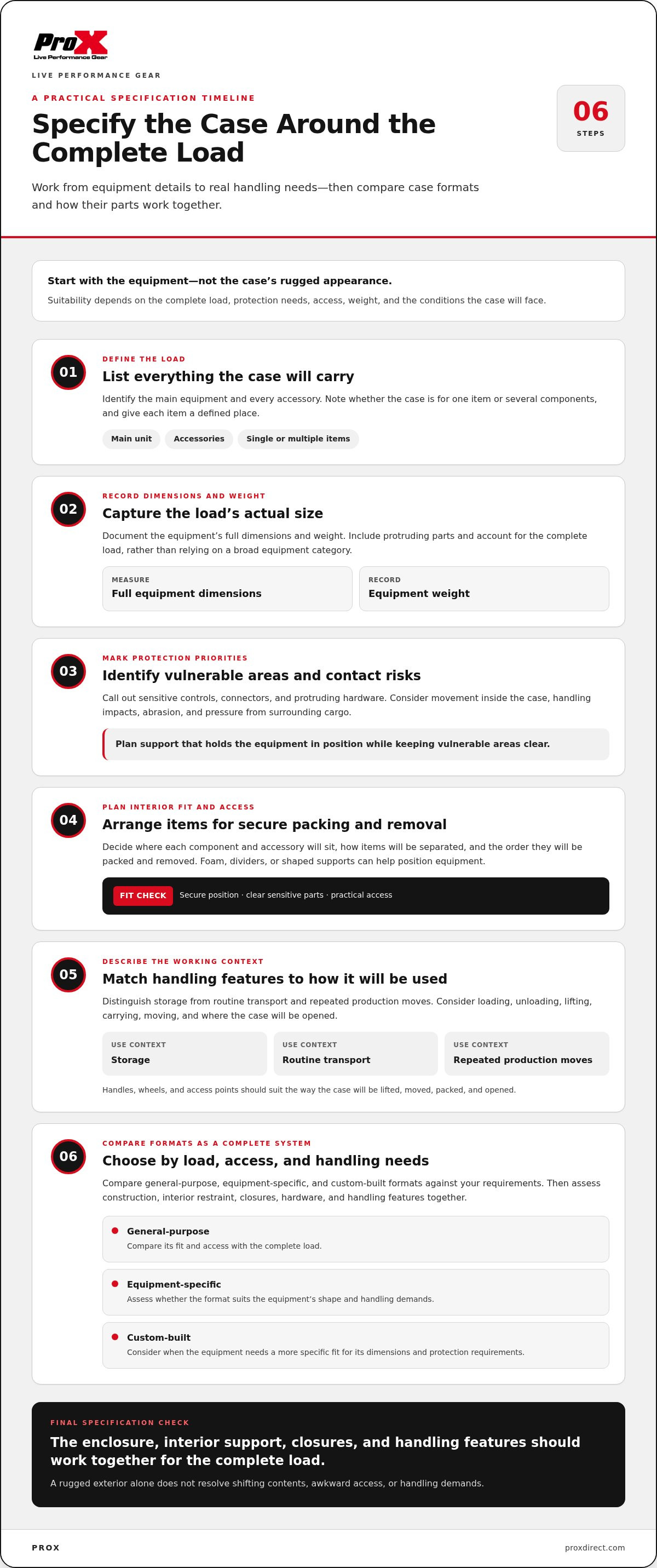
How to Specify a Heavy Duty Transport Case Before Purchase
A useful case specification turns the equipment and working conditions into clear design requirements. Before comparing options, document the complete load and how it will move through storage, transport, and setup. This gives you a practical basis for assessing dimensions, interior arrangement, handling features, and case format.
Measurements and load details to record
Measure the equipment in the orientation it will occupy inside the case. Include connectors, handles, knobs, and other protrusions in the dimensions. List every accessory and component that needs to travel with it. The combined load may affect the interior layout and the space required.
Use this numbered process to build the specification:
- 1. Define the complete load. Identify each equipment item and accessory intended to travel in the case. Separate items that need their own position from those that can be grouped.
- 2. Record dimensions and orientation. Note the equipment’s external measurements, including protruding parts and connectors. State whether it must remain in a particular position during packing and transport.
- 3. Document weight and vulnerable areas. Record the weight of each item and the combined load. Mark fragile points, exposed controls, connectors, or surfaces that need clearance, separation, or additional restraint.
- 4. Describe the transport method. Note whether the case will be carried, lifted between people, moved on wheels, loaded into a vehicle, or handled through a combination of methods. Identify who typically moves it and how often.
- 5. Specify access and storage needs. Describe where the case will be opened, how equipment is removed for setup, and whether accessories need to remain organized for repacking. Include storage conditions that affect the layout or access points.
Transport and workflow requirements to document
Handling frequency helps distinguish occasional movement from regular production packing. Record the transitions that matter to the workflow, such as moving equipment from storage to a vehicle, transferring it at a venue, or opening it during setup. For production loads packed with other gear, note the loading sequence and how the case will be positioned within the larger arrangement. This can help determine whether a standard format supports the workflow or the layout needs to be tailored.
Keep the specification factual and easy to review. An equipment list, dimension record, weight summary, and handling description make trade-offs clearer before purchase. They also give a case design process a more precise starting point than a general equipment category alone.
Use your completed requirements to explore ProX case solutions for professional equipment and production workflows.
ProX Heavy Duty Transport Cases for Professional Production Workflows
ProX designs and manufactures rugged cases for professional audio, lighting, DJ, broadcast, and live-event equipment. A case in a production environment has to suit more than the equipment category. A mixer console, lighting fixture, broadcast component, and group of production accessories each present different requirements for dimensions, interior organization, access, and handling. A heavy duty transport case should reflect those practical differences.
Case applications across live production
Audio equipment may need a layout that allows access to controls and connections. Protruding components on lighting equipment can affect how it fits and is removed. DJ equipment may travel with related components, while broadcast gear can combine equipment with different shapes and access needs. The application helps define the case format, but the complete load determines the detailed design.
For broadcast equipment, ProX offers AV broadcasting cases. Other professional production applications include microphone, mixer console, lighting, speaker, and mobile DJ cases. These categories offer a starting point for considering how each load should be positioned and accessed. Don’t assume one format suits every setup.
Translate the workflow into case requirements. Decide whether equipment will be handled as a single unit or packed alongside accessories, how it will be lifted or moved, and how it will be accessed during setup. A case that fits an item but makes routine removal awkward may not suit the workflow. For repeated production moves, practical handling and a consistent packing arrangement matter alongside the case’s protective function.
From equipment requirements to a case solution
A documented load gives case design a precise starting point. Dimensions, weight, vulnerable areas, accessories, transport method, handling frequency, and access needs together describe the job the enclosure must perform. These details help distinguish a suitable standard format from a project that calls for a more tailored arrangement.
ProX custom case engineering can address equipment dimensions and protection requirements that don’t fit a general-purpose layout. This approach is useful when a project involves unusual shapes, combined components, or specific positioning and access needs. The design focus stays on the equipment and its use, rather than adding features without a clear purpose.
ProX products are available through a worldwide dealer network, connecting professional users with case solutions for production equipment. Use the application categories and your documented requirements to narrow the options, then compare whether a standard case format or custom engineering better fits the load.
Explore ProX transport case solutions for professional production workflows.
Set the Next Case Decision in Motion
Before selecting a heavy duty transport case, turn your notes into a short decision brief. Identify must-haves, acceptable trade-offs, and the conditions that would make a case unsuitable. This keeps the decision focused on the working setup rather than appearance or generic claims. Keep the brief with equipment records so it can be revisited when the load, crew, or production workflow changes.
Treat the case as part of the equipment plan, not an afterthought. A change in accessories, configuration, or handling routine can alter what the enclosure needs to accommodate. Revisit the specification whenever the kit changes, then compare available case formats against the updated requirements. This gives teams a consistent basis for selecting and maintaining equipment protection across projects.
For shared production kits, record the approved configuration and make the packing sequence clear to everyone who handles it. Review the reference after a change rather than assuming the previous setup still fits. Explore ProX transport case solutions for your production setup and compare them against your documented requirements.
Frequently Asked Questions
What makes a transport case heavy duty?
A heavy duty transport case is selected and constructed to suit demanding loads and repeated handling, not identified by its label alone. Assess the enclosure as a complete system: it must accommodate the load, close securely, and support the way it will be moved and stored. A case intended for frequent production moves faces different demands from one used mainly for stationary storage. Match the design to the actual use.
How do I choose the right transport case size for my equipment?
Compare the equipment’s full dimensions with the usable interior space, including room for its intended support and orientation. Don’t judge fit from external dimensions alone; the case walls and interior layout take up space. Check that the opening allows equipment to be placed and removed without catching controls or connectors. Also consider where the case will be stored and whether its overall footprint fits the available vehicle or work area.
Are foam interiors necessary in a heavy duty transport case?
No. Foam is one interior option, not a requirement for every load. It can suit equipment that needs shaped contact areas, while dividers or other supports may work better for grouped components or kits that change configuration. The choice depends on the equipment’s surfaces, geometry, and packing routine. For frequently updated kits, consider whether a fixed interior will still suit the contents, or whether a more adaptable arrangement is appropriate.
Can a custom transport case be built around multiple equipment items?
Yes. ProX custom case engineering can design a case for several items that need to travel together, with an interior arrangement planned around the complete set. List each component, its dimensions, and how often it is accessed. The layout can account for separation between items and a practical order for packing and removal. This approach can suit a production kit combining core equipment, accessories, and components with different shapes.
What should I measure before ordering a transport case?
Measure each item at its widest, tallest, and deepest points, including fixed handles, knobs, feet, and connectors. If a removable component or cable will travel in the case, record its dimensions too and state whether it will be attached or packed separately. Note the required packing orientation and identify areas that need clearance. These details distinguish the equipment’s actual space needs from its basic chassis measurements.
How do I protect heavy equipment from shifting inside a case?
Use an interior arrangement that supports the equipment at stable contact points and gives accessories defined positions. Before transport, pack the load as intended, close the case, and carefully reposition it to check for noticeable movement. If components shift, adjust their supports or separation rather than filling gaps with loose items that can move independently. Keep the load balanced and make sure the packing method doesn’t place pressure on controls or connectors.
When is a wheeled transport case useful for production equipment?
A wheeled case can be useful when equipment is heavy or awkward to carry and the route includes a suitable continuous surface, such as a venue floor or loading area. Consider the full journey: stairs, uneven ground, tight turns, and vehicle access may still require lifting or carrying. Check that the case can be controlled along the route and that handles remain usable for repositioning where wheels aren’t practical.
Disclaimer
Any trademarks, trade names or brand names appearing herein that do not belong to ProX are the property of their respective owners and/or companies, and such appearance doesn't and shall not constitute or imply endorsement, sponsorship or recommendation by ProX.


