

The most protective guitar case for air travel isn’t automatically the heaviest. Choosing the best case for flying with a guitar means matching its construction and interior fit to handling risks, including compression, impact, and movement inside the case.
It makes sense to focus on padding and a rigid exterior, but those features work together. A close fit helps limit shifting, while padding and impact protection help cushion the instrument. Airline handling practices and changes in temperature or humidity also matter when deciding what level of protection suits your trip.
This guide explains how to assess crush resistance, fit, padding, climate regulation, and impact protection, and how to weigh airline experiences without relying on a single anecdote. You’ll get a practical framework for comparing case construction and identifying the trade-offs that matter for your guitar, travel plans, and handling conditions.
Key Takeaways
- Assess how the case shell resists compression, and consider how it will be handled during your trip.
- Choose an interior that supports the guitar securely without leaving room for it to shift.
- Use airline travel accounts as context, not as a guarantee of how another trip will go.
- Consider temperature and humidity changes alongside the case’s protective structure.
- Match impact protection and case accessories to the handling demands your guitar is likely to face.
Crush resistance
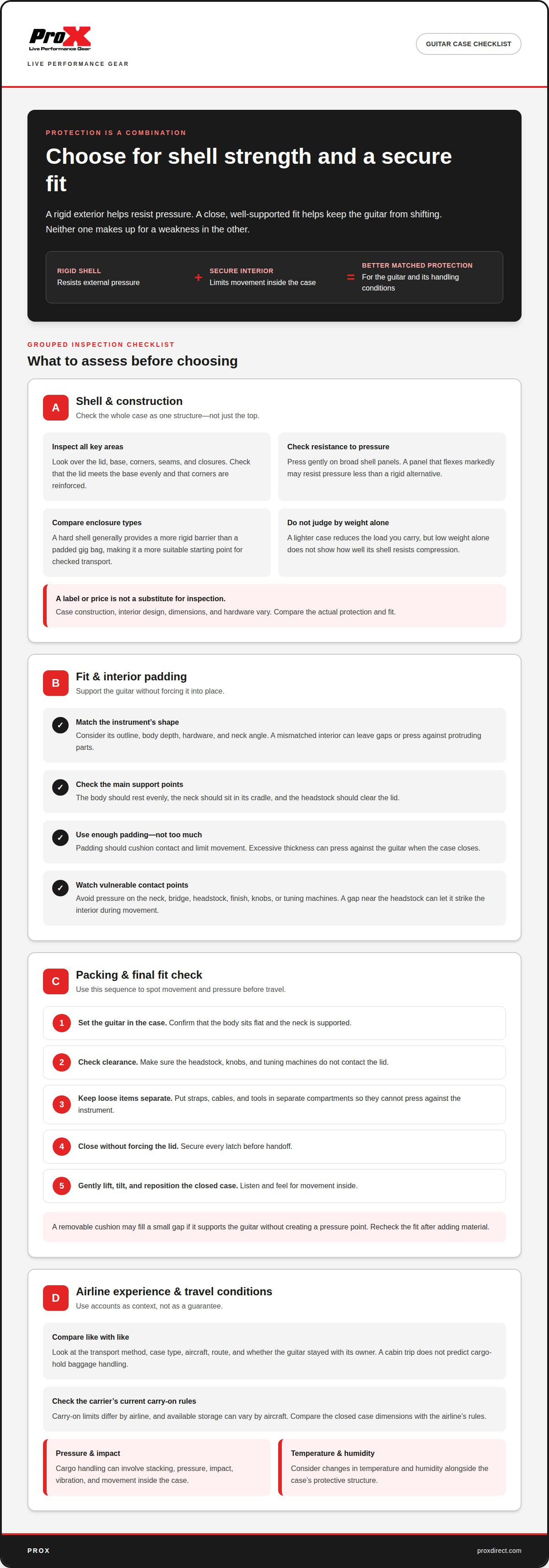
Crush resistance describes how well a case shell resists deformation under external pressure. It matters when a guitar travels in a cargo hold, where baggage may be stacked or pressed against other items. A rigid shell helps distribute force across its surface, while a weak panel can transfer pressure toward the instrument. Inspect the lid, base, corners, seams, and closures as one structure. A strong-looking top alone doesn’t show how the complete case will perform.
For an electric guitar, choose a case with a rigid shell and an interior that keeps the neck and body from shifting. The right fit depends on the instrument’s shape, including features such as a protruding bridge or angled headstock. Acoustic guitars also need shell stability and close support around the body and neck. Their broad soundboards and hollow bodies make pressure placement especially important. In either case, a close fit complements the shell but can’t compensate for a panel that buckles.
A lightweight case reduces the load you carry, but low weight alone says nothing about crush resistance. Compare shell stiffness, corner construction, lid alignment, and latch engagement. A hard-shell case generally provides a more rigid barrier than a soft gig bag, which usually relies on fabric and padding rather than a rigid enclosure. A hard shell is therefore a more suitable starting point for checked transport. A padded gig bag may still suit travel where you keep control of the instrument.
There is no single price for TSA-approved guitar flight cases. The term doesn’t define a standard case construction, and cost varies with shell material, interior design, dimensions, and hardware. Compare the actual protection and fit rather than treating a label or price as a substitute for those details.
In airplane cargo, a guitar can face compression, impact, vibration, and movement inside its case. The case may also be set down abruptly or struck during loading. Reduce these risks by securing the instrument so it can’t shift, protecting vulnerable contact points, and closing every latch before handoff. Keep loose accessories away from the guitar: a cable or tool can become a hard contact point if the case moves.
Use this inspection sequence before choosing a case: press gently on broad shell panels, check that the lid meets the base evenly, and inspect the corners for reinforcement. Close each latch, then handle the case as you would when carrying it. A shell that flexes markedly under gentle pressure, for example, may offer less resistance than a rigid alternative, even if both interiors are padded. These checks reveal construction differences that appearance alone can hide.
The best case for flying with a guitar balances shell rigidity with secure internal support. Match both to your guitar’s dimensions and the handling conditions expected during the trip.
Custom fit and interior padding
A guitar should sit securely in its case without concentrated pressure on the neck, bridge, or headstock. Fit depends on the instrument’s outline, body depth, hardware, and neck angle. A case designed for a different shape can leave gaps around the body or press the lid against protruding parts. For example, a wide-bodied acoustic guitar may move inside an interior shaped for a narrower model.
Check the support points with the guitar positioned normally. The body should rest evenly, the neck should sit in its cradle, and the headstock should clear the lid. Close the case gently. If the lid presses on a tuning machine or the guitar rocks when the case moves, the fit needs attention. Padding should limit movement without bending the neck or pressing hard against the finish.
Interior padding cushions contact during handling, fills small clearances, and separates vulnerable parts from hard case surfaces. More padding isn’t automatically better: excessive thickness can press against the guitar when the case closes. Look for consistent support around the lower bout, upper bout, neck, and headstock. A gap near the headstock, for instance, can let it strike the interior during movement.
To pack a guitar for air travel, place it in a fitted case, secure the neck and body, and remove loose accessories. Keep straps, cables, and tools in separate compartments so they can’t press against the instrument. Close the lid without forcing it, then gently reposition the case to check for internal movement.
Before a trip, use this practical fit check:
- Set the guitar in the case and confirm that its body sits flat.
- Inspect the neck cradle and ensure the headstock has clearance.
- Close the lid slowly, watching for contact with knobs or tuning machines.
- Lift and tilt the closed case gently; listen and feel for movement.
A removable cushion can fill a small gap if it supports the instrument without creating a pressure point. Don’t place it beneath a fragile component or where it pushes against the strings. For example, padding around the neck should support it evenly, not lift one section while leaving another unsupported. Recheck the fit after adding material.
If the guitar has an unusual body shape, extended hardware, or a nonstandard neck profile, a custom-built interior can provide a closer match. Explore custom case options for a case configured around the instrument’s dimensions and support requirements.
Customer experiences with airline travel
Travel accounts are useful when they describe the same transport method you plan to use. A story about a guitar carried in the cabin doesn’t predict what happens to an instrument checked at the counter. Compare details such as case type, aircraft, route, and whether the guitar stayed with its owner. A cabin trip, for example, offers little evidence about cargo-hold baggage handling.
There isn’t one carry-on dimension that applies to every U.S. airline and aircraft. Each carrier sets its own cabin baggage limits, and available storage can vary by aircraft. Compare your closed case dimensions with the airline’s current carry-on rules before departure. A guitar that exceeds those limits may need another arrangement, even if a similar instrument traveled in another passenger’s cabin.
You may bring a guitar as carry-on if the airline accepts its case dimensions and cabin storage is available. Otherwise, it may need to be checked or accommodated under another arrangement permitted by that carrier. A customer report is most useful when it names the airline and aircraft, gives the case dimensions, and describes the outcome.
Customer accounts can reveal practical complications beyond damage. One traveler might describe a gate check after the cabin fills, while another describes fitting a compact case into an overhead compartment. Treat these examples as context, not a promise of policy. Aircraft type, boarding conditions, and external case dimensions can change the result.
Major U.S. airlines don’t share one standard charge for checking a guitar. The amount depends on the carrier’s baggage rules, the ticket’s baggage allowance, and how the case is classified. An instrument treated as standard checked baggage may be handled differently from one assessed as oversized. Read the baggage terms that apply to your itinerary rather than relying on an older traveler report.
Use this sequence to assess travel accounts and prepare:
- Separate cabin-carried examples from checked-instrument examples.
- Compare the case dimensions in a report with your own closed case.
- Look for the airline and aircraft details, not just the trip destination.
- Review your ticket’s baggage allowance and the carrier’s instrument rules.
- Photograph the guitar and case before handing them over as checked baggage.
These steps make anecdotes more useful without treating them as guarantees. A report about a small-bodied guitar in a compact case, for instance, may not apply to a larger acoustic guitar. Focus first on handling method and case size, the details that connect the experience to your travel plan.
Keep a record of the airline’s instructions and your baggage arrangements before travel. If the case must be checked, secure its contents and remove loose items that could move inside. Recording the case’s condition, dimensions, and travel arrangement also helps you describe the situation accurately if handling differs from expectations.
Humidity and temperature regulation
A guitar case can slow environmental changes, but an ordinary case doesn’t actively control humidity or temperature. Solid-wood acoustic guitars are especially responsive to moisture changes because their bodies expand or contract as surrounding conditions shift. Rapid transitions can affect tuning, action, joints, and finish. A case shields the instrument from direct exposure and buffers sudden changes; it doesn’t create a stable climate on its own.
Temperature changes matter during travel too. Moving a cold case into a warm terminal can cause condensation as surfaces warm. Opening the case immediately exposes the guitar to the new environment. Keep it closed during the initial transition, then open it gradually after the instrument has had time to adjust. Avoid placing a guitar beside a heater, in direct sun, or against a cold aircraft-hold surface.
Before traveling, assess conditions at departure, arrival, and any extended stop. A dry indoor venue, a humid outdoor location, and an air-conditioned terminal can expose the guitar to different environments during one journey. Note whether the instrument will be checked or stay with you, since that affects how much control you have over its surroundings. This route-based assessment helps you decide whether additional humidity management is appropriate.
Use a simple preparation sequence:
- Inspect the guitar for existing cracks, loose joints, or finish damage.
- Store it in its case before moving between sharply different environments.
- Use a case-compatible humidity control device when appropriate for the instrument.
- Keep any device away from direct contact with the guitar’s finish or wood.
- After arrival, let the closed case adjust before opening it in a warmer space.
A humidity-control device can help moderate moisture inside a case, but placement and maintenance matter. A leaking or saturated device, for example, can expose nearby wood to excess moisture. Follow the device maker’s instructions and inspect its condition before packing. Avoid makeshift solutions such as wet cloths or open water containers, which can spill during handling and create localized moisture.
Case materials also affect how quickly outside conditions reach the interior. A sealed, insulated design can slow exchange, while gaps around the lid or damaged seals may allow faster changes. No case is a substitute for climate control. Inspect the closure alignment and interior condition, then consider the guitar’s construction and route when choosing your setup.
For a valuable acoustic guitar, record its usual setup and condition before departure. Note any changes in string height, tuning stability, or visible seams after travel. These observations help distinguish an environmental change from an existing setup issue and guide your next inspection.
Impact and drop protection
A case can resist broad pressure yet leave a guitar vulnerable to a sharp impact. A corner strike, hard set-down, or sudden jolt can transfer force through the shell. The interior determines whether that force reaches the instrument at a contact point. A loose headstock, for example, may strike the case wall during an abrupt stop even if the exterior remains intact.
Trace the impact path from the outer surface to the guitar. Reinforced corners can help manage edge strikes, while padded contact areas cushion the body and neck. Hinges, handles, and latches matter too: they connect shell sections and experience force during carrying. Check these parts for looseness or misalignment. A secure handle, for instance, helps you control the case when lifting it over a threshold.
Drop protection depends on more than shell thickness. A rigid exterior can distribute force, but hard contact points inside may pass impact directly to the instrument. Soft padding, in turn, can’t compensate for a case that collapses or opens under stress. Assess the shell, closures, interior support, and instrument position as one system. A case landing on its side may load the neck differently from one landing flat.
Use this inspection routine before travel:
- Check corners and edges for damage that could weaken the structure.
- Close each latch and confirm that the lid remains aligned.
- Inspect handles and hinges for movement, cracks, or loose fasteners.
- With the guitar secured, gently tilt the closed case and feel for internal movement.
- Look for hard accessories that could strike the guitar if the case shifts.
These checks reveal visible weaknesses, but they don’t establish how a case will perform in every impact. Don’t test it by dropping it with a guitar inside. Instead, review its construction and use the case as intended. After handling, inspect any mark on the exterior, especially near a latch, hinge, or corner.
Transport conditions influence which impact features matter most. A case carried by its owner encounters different handling from one transferred as checked baggage. Stairs and vehicle loading, for example, involve repeated lifting and set-downs, while baggage handling can mean contact with other luggage. Choose protection based on the actual route and handling method, not appearance alone.
After a hard knock, inspect both the case and guitar before continued use. Check the shell, closures, neck position, and visible instrument surfaces. If the case no longer closes evenly, its protective function may be compromised. Explore protective case options suited to the handling demands of your equipment.
Racks & Case Accessories
This range includes Racks & Case Accessories for setups that need accessories alongside protective equipment. First identify your priorities: guitar dimensions, interior support, handling conditions, and environmental exposure. These factors help clarify whether you need a dedicated guitar case or accessories for your broader equipment setup.
For guitar transport, focus on the case before adding accessories. Secure fit and suitable construction are central to protecting the instrument. The range also includes cases for other equipment and storage needs.
For assistance with your case and accessory needs, get in touch.
Make Your Guitar Travel Plan Specific
Choose the best case for flying with a guitar by matching its protection and fit to the instrument and how it will travel. Build your packing plan around the route, airline arrangements, and equipment you need to carry. A suitable case supports the full travel setup without adding unnecessary bulk or leaving essential needs unaddressed.
For broader production equipment, consider cases and utility or storage cases for different equipment and storage needs. Keep the guitar’s protection requirements distinct from the rest of your load.
Use your instrument’s dimensions and travel conditions to define the case requirements before choosing. This gives you a practical basis for narrowing your options and preparing for the journey.
Discuss guitar case requirements and move forward with a setup suited to your instrument and travel plan.
Frequently Asked Questions
What features make a guitar case best for air travel?
Choose a case with a rigid shell, secure closures, and an interior shaped to support your specific guitar. Check clearance around the headstock, bridge, and tuning machines so the lid doesn’t press against the hardware. A guitar with a protruding bridge, for example, may need more internal clearance than a flatter design. Consider the case’s weight and dimensions alongside its protection, especially if you plan to carry it into the cabin.
Prices, specifications, and images are subject to change without notice. We are not responsible for typographical or illustrative errors.
How much do TSA-approved guitar flight cases cost?
There is no single price for TSA-approved guitar flight cases. Cost varies with shell material, interior design, dimensions, and hardware. Compare the case’s actual construction and fit rather than relying on the label.
What are airline carry-on size limits for guitars in the United States?
There is no single carry-on size limit for guitars across U.S. airlines. Each carrier sets its own limits, and cabin storage can vary by aircraft. Compare your closed case dimensions with the airline’s current rules.
Disclaimer
Any trademarks, trade names or brand names appearing herein that do not belong to ProX are the property of their respective owners and/or companies, and such appearance doesn't and shall not constitute or imply endorsement, sponsorship or recommendation by ProX.


