
A sales demo case should be designed around the products it carries. A custom mobile sales demo kit case can be sized to its contents, with an organized interior for samples and supporting materials. Start with the products’ dimensions, shapes, and handling needs.
That fit shapes more than storage. It informs the case materials, interior layout, protective features, and construction, helping keep items separated and accessible during demonstrations and transit. This article covers the decisions involved, the information needed to plan a case, and how custom construction can accommodate products from compact components to larger demonstration equipment. Consider sizing, compartments, cushioning, materials, and construction so the finished case suits how your team presents and transports its products.
Key Takeaways
- Match case dimensions and layout to the products, samples, and supporting materials carried to each demonstration.
- Plan the interior to keep components organized, separated, and accessible during product presentations.
- Consider how materials and manufacturing methods affect the case’s structure and suitability for its intended use.
- Assess protective features, portability, and presentation needs together rather than treating them as separate design choices.
- Use the case type that best fits your equipment and transport requirements, including options for mobile DJ gear.
Can I get a custom sales demo case made to fit my products?
Yes. A mobile sales demo kit case can be sized around the products, samples, and supporting materials it carries. A custom design can assign each item a place, keeping components organized between transit and presentation.
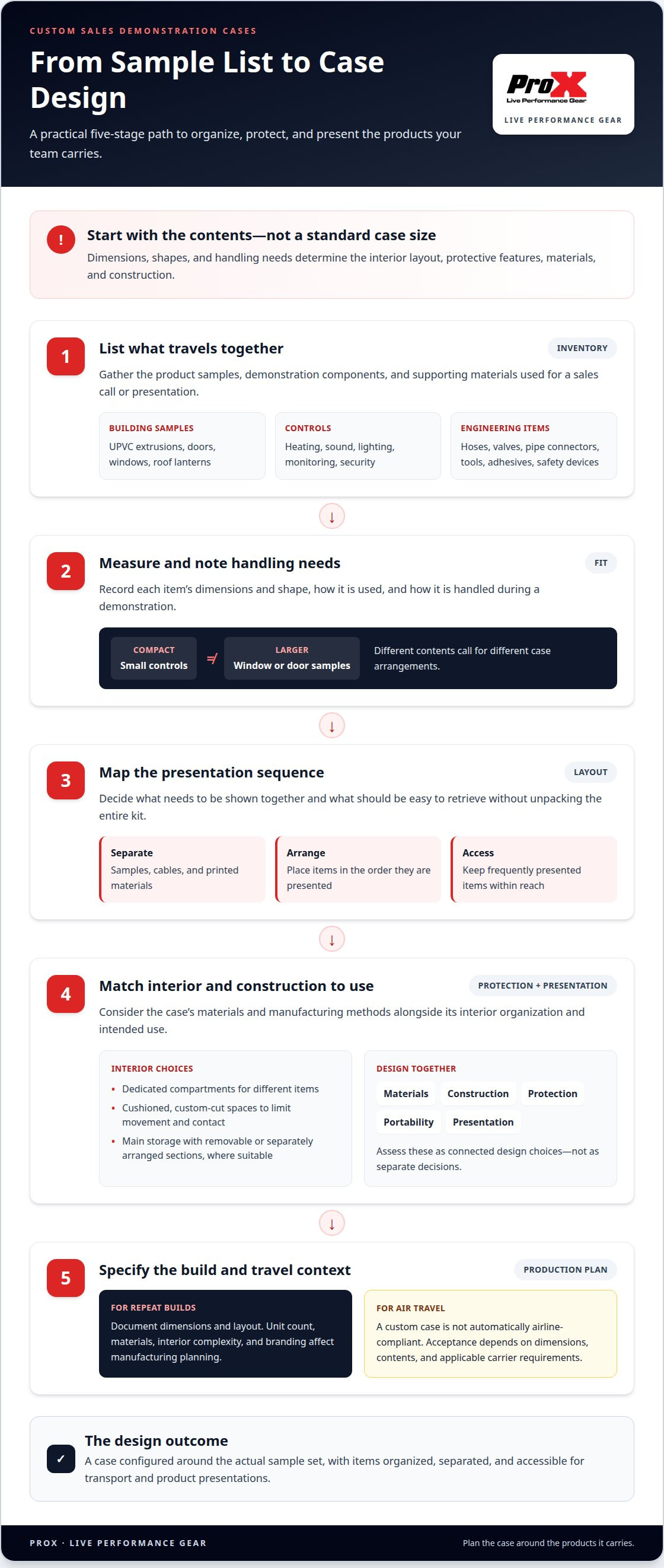
There is no single standard size or configuration for every sales kit. Plan the layout around the contents’ dimensions and shapes, allowing space for samples, product literature, and demonstration components. A compact kit of small controls needs a different arrangement from a larger display carrying window or door samples.
Start by identifying what travels together and how each item is used during a sales call. Separate compartments can hold sample parts, cables, and printed materials, keeping the presentation sequence clear. Cushioned, custom-cut spaces can limit movement and contact between components in transit. Make frequently presented items accessible without requiring the entire kit to be unpacked.
Demonstration kits serve varied industries. Contents may include UPVC extrusions, doors, windows, and roof lanterns; heating, sound, lighting, monitoring, and security controls; or engineering samples such as hoses, valves, pipe connectors, tools, adhesives, and safety devices. IT and audio visual, sport and leisure, beauty, health care, and test and measurement businesses also use demo kits. Each product type affects the required compartment shapes and presentation sequence.
Production planning changes with quantity. A single case can be arranged around one product set, while repeat builds need consistent layouts and documented dimensions. Unit count, materials, interior complexity, and branding all affect manufacturing planning. A clear specification helps guide repeatable assembly and consistent organization.
Print-on-demand and in-house production describe ways to produce phone cases, not custom demo cases. Print-on-demand providers handle production, packaging, and shipping; in-house production gives a business more control over product quality, branding, and unboxing. For a sales demo case, the relevant question is whether its structure, interior, and presentation details suit the sample set and production quantity.
UV printers can apply graphics to compatible phone-case surfaces, making them one branding method in that separate product category. Custom demo-case manufacturing may use different materials and processes. Consider branding alongside the case material, surface, and intended use rather than assuming phone-case printing methods apply.
A custom case is not automatically TSA- or airline-compliant. Acceptance depends on its dimensions, contents, and applicable carrier requirements, so account for travel plans when designing and packing the case.
Cases can be sized to the products and materials they carry rather than made to one standard size. Configurations can include dedicated compartments and cushioned, custom-cut spaces to keep items organized and accessible during presentations.
Purpose of sales demonstration cases
A sales demonstration case organizes product samples for transport and presentation. It keeps representative items accessible and arranged to support a clear product discussion.
Demonstration Case Uses
Demo cases carry products to sales calls, trade shows, and other customer presentations. Contents may include a sample, supporting literature, and components needed to demonstrate how a product works. A useful layout follows the presentation sequence rather than simply grouping items by size. For example, controls for heating, sound, lighting, monitoring, or security may need distinct positions.
Assess which products need to be shown together and how they are handled during a demonstration. Inserts and compartments can separate samples and supporting parts, making items easier to find. A case for window or door samples may display physical material choices; one for specialist tools or connectors may keep related components organized.
Sales Representative Sample Cases
Sales representatives use sample cases to carry product examples between customer meetings. The case should accommodate the actual sample range, from small pipe connectors and valves to larger material pieces. A defined place for each sample helps maintain order as items are removed and returned. It also lets representatives prepare a presentation around the products relevant to each customer.
Supporting materials matter, too. A catalogue, product sheet, or demonstration component can sit alongside samples if the layout keeps each accessible. Account for how the representative carries the case and retrieves its contents. For a sales set featuring adhesives and safety devices, separate spaces can distinguish product examples from related components.
Medical demonstration kits show why contents determine a case’s function. Examples include surgical instruments, catheters, syringes, dialysis machines, and blood analysis machines. These products vary in shape and handling needs, so their layouts differ. A kit for small instruments has different organizational needs from one displaying larger equipment. The case holds selected demonstration items in an orderly arrangement; its design should not be taken to imply clinical or protective performance beyond its intended purpose.
A hybrid modular case concept can combine a main storage area with removable or separately arranged sections. This may suit a sales team presenting different sample groups, such as lighting controls and monitoring components. Plan the configuration around which items travel together and which need separate access. A layout that avoids a single fixed purpose can adapt as the sample assortment changes, depending on the case’s construction.
In each application, the case serves a specific task: carrying, organizing, and presenting product examples. Start with the sample list, then map the presentation order and the space each item requires. This helps determine whether the case should prioritize quick access, clear separation, or both. A representative carrying window samples, for example, has different presentation priorities from one demonstrating compact security controls.
Interior organization and equipment protection
Interior design determines how samples and equipment sit inside a case during handling and transit. Separate spaces and cushioning can limit movement and keep contents arranged for retrieval.
Interior Organization
Assign each item a defined position, such as a sample unit, its accessory, and its documentation. Custom-cut foam can separate and cushion contents, while compartments group related components. Reflect the order in which a representative uses the items. If a presentation starts with a primary sample, place it where it can be reached first.
Protection for Samples and Equipment
Customizable foam inserts can help protect samples and equipment from damage during transport and use. Match their shape and spacing to the contents so components stay separated instead of colliding or shifting freely. Delicate finishes, protruding controls, and irregular profiles each affect the cutout. Account for how items are removed and returned during repeated demonstrations.
Durability depends on the complete case design, not the insert alone. The outer structure, interior support, and placement of heavier equipment all contribute to how contents are carried. A compact electronic unit and its loose cable, for example, need separate spaces to prevent the cable from rubbing against the unit. A case designer can translate these use conditions into an organized interior specification.
Mobile Case Features
For mobile use, consider how the case is carried, opened, and positioned during a presentation. Handles and access points should suit the loaded case and the representative’s handling routine. An opening that reveals the required samples without disturbing adjacent items can make setup more controlled. Branding can also be part of the exterior design if it suits the surface and construction method.
Interior planning also affects how a kit adapts when its contents change. A revised sample set may need new cutouts, extra space, or a different arrangement for supporting materials. Before manufacturing, define which items are fixed and which may change. Where the design allows, a modular layout can separate stable equipment from replaceable samples.
Investment in printing equipment is separate from case construction. That figure concerns phone-case production, not the cost of a demo case. For a demonstration kit, the practical question is whether production belongs in-house or with a print-on-demand provider, which handles production, packaging, and shipping.
Match the insert layout to the actual contents, then assess access, separation, and handling as one system. This keeps the interior organized without assuming one configuration suits every sample set.
Case materials and manufacturing methods
Choose materials and construction to suit the contents and working conditions. A kit carrying compact electronic controls has different structural demands from one displaying larger samples. The case design should reflect product dimensions, handling routines, and presentation needs, shaping the exterior, interior support, and access points.
A case designer can assess the contents, how they are used, and how the case will be handled. For electronics, samples, or sales equipment, those requirements guide material selection, case structure, and interior organization. A control unit with cables, for example, needs a different arrangement from a set of flat product samples.
Start with the outer construction. The case should accommodate its contents and suit how representatives carry, open, and display them. A larger sample may need a broad, accessible space; a compact electronic device may need a fitted position to limit unnecessary movement. Leave room for supporting components that travel with the primary product.
Material decisions depend on intended use, required structure, and presentation. Consider how often the case will be transported, whether it will be opened repeatedly, and whether its exterior will be visible during demonstrations. A case used at trade shows, for example, may need a finish that supports a clean product display, while one used mainly for transit may prioritize practical handling.
Manufacturing starts with a clear specification. Product dimensions and contents guide the case footprint; the opening and interior arrangement guide assembly. The exterior construction can then be coordinated with inserts, compartments, and access requirements. If a sales kit contains a sample device, cables, and literature, document each item so the finished layout accounts for secondary components, too.
Production quantity also affects the manufacturing plan. A single case can be configured around one demonstration set, while multiple matching cases need repeatable dimensions and assembly details. If the sample assortment changes, the interior may need revision. Identify fixed components and replaceable samples before construction so the case can remain useful as the presentation evolves.
Phone-case printing uses a separate production process and should not be confused with demo-case construction. One method decorates a matte or clear TPU base with layered graphics or three-dimensional charms, then secures them with UV resin or epoxy. Those techniques apply to phone-case designs; they do not define materials or manufacturing methods for a sales demonstration case.
What features should a mobile sales demo kit case have?
Choose features to suit the contents, travel conditions, and presentation sequence. A mobile kit carrying sample controls, cables, and literature needs different access and compartments from one displaying a single large product sample. Coordinate size, interior organization, carrying method, and exterior presentation.
Start with the products. The case should fit their dimensions, shapes, and supporting components without leaving contents loose or hard to reach. Separate compartments can keep a sample with its accessories, while custom-cut foam can cushion and separate individual items. For a demonstration with several control components, placing them in presentation order can make retrieval easier.
Consider how the case opens during a sales call or trade show. A layout that reveals the primary product first can support a clear display, while designated spaces keep cables and printed materials accessible. If representatives use different sample sets, a modular interior may separate fixed equipment from replaceable samples. Design around actual use, not simply maximum storage volume.
Mobility also affects feature selection. Carry handles and overall dimensions should suit how representatives move the case between meetings and presentation areas. Lightweight options and soft cases are available for airline travel, in-person demonstrations, and trade shows, but travel suitability does not establish airline acceptance. Contents and case dimensions still matter for transport planning.
Exterior details can support identification and presentation. Custom cases may incorporate company branding, selected colors, or a molded logo. Choose details that suit the case surface and how it will appear during a demonstration. A restrained exterior can keep attention on the sample, while clear branding can identify a kit when several representatives bring equipment to the same event.
Match protection to the contents rather than relying on a generic feature list. A fragile sample with protruding parts may need shaped cushioning and separated storage; a robust, flat sample may need a simpler arrangement. Account for repeated opening and closing, too: a product used at multiple sales calls has different access needs from one transported for occasional display.
Before production, define the sample set, supporting items, handling method, and presentation order. These details guide the case dimensions, interior configuration, and exterior choices. For equipment used in mobile demonstrations, explore case options suited to the contents and planned use.
Mobile DJ Case Categories
Mobile DJ cases are designed for professionals transporting DJ equipment between events and demonstrations. For a kit combining audio equipment and accessories, Racks & Case Accessories can help organize related gear. Choose a case based on the equipment and how it will be handled during transport and presentation.
Other case categories suit different equipment and transport requirements. Consider which products need to travel together, how they will be accessed, and whether the case must support a particular presentation setup. These details help identify a suitable case type without treating every sales kit as identical.
Contact the supplier to discuss which case category suits your equipment and intended use.
Plan the Next Version of Your Demo Kit
A sales kit can change as products, sample sets, and presentation needs evolve. Identify which contents will remain consistent and which may change, then align the case choice with those priorities. A custom mobile sales demo kit case can suit a defined product set and the way your team presents it.
Available categories include transport cases, protective cases, and utility/storage cases. These categories provide different starting points for equipment and transport needs. Consider what your team carries and the role the case needs to serve before choosing a direction.
When you’re ready to discuss the case requirements for your products, contact us about your custom case. A clear starting point is the contents, handling needs, and intended presentation. That gives your next case decision a practical foundation.
Frequently Asked Questions
Do you offer lightweight marketing carrying cases for travel?
The manufacturer offers custom case engineering for equipment dimensions and protection requirements. For a travel-focused case, the design can account for its contents, handling routine, and presentation needs. Material and construction choices affect the finished case’s weight, so consider weight alongside storage and access. The manufacturer also offers mobile DJ cases for professionals transporting DJ equipment.
What is a mobile sales demo kit case?
A mobile sales demo kit case carries product samples and demonstration materials to customer visits or trade shows. It keeps the kit together during transport and supports access to items during a presentation. For example, a kit might carry a sample component, related accessories, and product literature. The configuration depends on what the sales team demonstrates and how those items are used.
Which brands sell mobile sales demo kit cases?
The manufacturer makes cases for live-event equipment and offers custom case engineering for equipment dimensions and protection requirements. Its catalog includes protective cases, utility and storage cases, and mobile DJ cases. For a sales demonstration, start with the products being carried and displayed. Choose a case category that suits the equipment and how the sales team transports it.
How do hard-shell and soft-sided demo kit cases compare?
Hard-shell and soft-sided cases differ in structure, weight, and how they accommodate contents. A rigid outer structure provides a different kind of support from flexible construction, which may suit another carrying routine. Compare dimensions, interior organization, and the samples’ handling needs. For a rigid electronic sample, consider how the case supports and separates it; for lighter materials, focus on portability and access.
What are the best ways to organize and protect equipment in a demo case?
Organize equipment by function and presentation order, then give each item a defined place. Keep a demonstration unit with its related components, for example, while separating cables and printed materials. Custom-cut foam can cushion and separate contents, helping limit movement inside the case. Consider how items are removed and returned during a meeting. This sequence can help keep the kit orderly between customer presentations.
What should I know about custom foam inserts and branding for demo cases?
Custom foam inserts can be shaped to separate and cushion individual samples or equipment. Plan their layout around product profiles, accessories, and removal sequence rather than simply filling unused space. Custom sales demo cases can also include branding, such as company graphics or a logo. Choose a branding method that suits the case surface and construction while keeping access and interior organization functional.
Disclaimer
Any trademarks, trade names or brand names appearing herein that do not belong to ProX are the property of their respective owners and/or companies, and such appearance doesn't and shall not constitute or imply endorsement, sponsorship or recommendation by ProX.


