

A single hour of production downtime due to vibration-induced hardware failure often costs more than the entire logistics budget for a tour. Professional technicians recognize that backstage environments are rarely optimized for delicate electronics or organized tool management. You've likely experienced the frustration of disorganized setups that delay critical path tasks or equipment that arrives at a venue with compromised internal connections. A high-performance flight case workstation transforms these chaotic variables into a controlled, centralized hub for your mobile operations.
Selecting the right mobile housing involves more than simple storage; it requires engineering a functional environment capable of withstanding rigorous mechanical stress. This article explains how to select and configure a professional-grade workstation case that maximizes touring efficiency and secures high-value production gear. We'll examine technical specifications including 12U shockproof rack modules, the logistical advantages of standardized footprints, and the integration of dual side tables to create a comprehensive mobile tech bench that ensures long-term hardware durability. By focusing on structural integrity and logical tool organization, you can maintain peak operational performance regardless of the venue constraints.
Key Takeaways
- Differentiate between standard transport containers and a professional flight case workstation designed to function as a centralized, high-performance production hub.
- Evaluate the structural necessity of ATA-300 Category 1 engineering standards and plywood thickness to ensure long-term protection for sensitive electronics during transit.
- Optimize venue setup efficiency by utilizing integrated features such as dual side tables and heavy-duty ball-bearing drawer slides for superior tool organization.
- Tailor workstation configurations to specific operational roles, such as front-of-house engineering or lighting technical support, to maximize ergonomic utility.
- Explore advanced 12U shockproof designs and custom engineering options that prioritize mechanical precision and durability for high-stakes touring environments.
Defining the Professional Flight Case Workstation
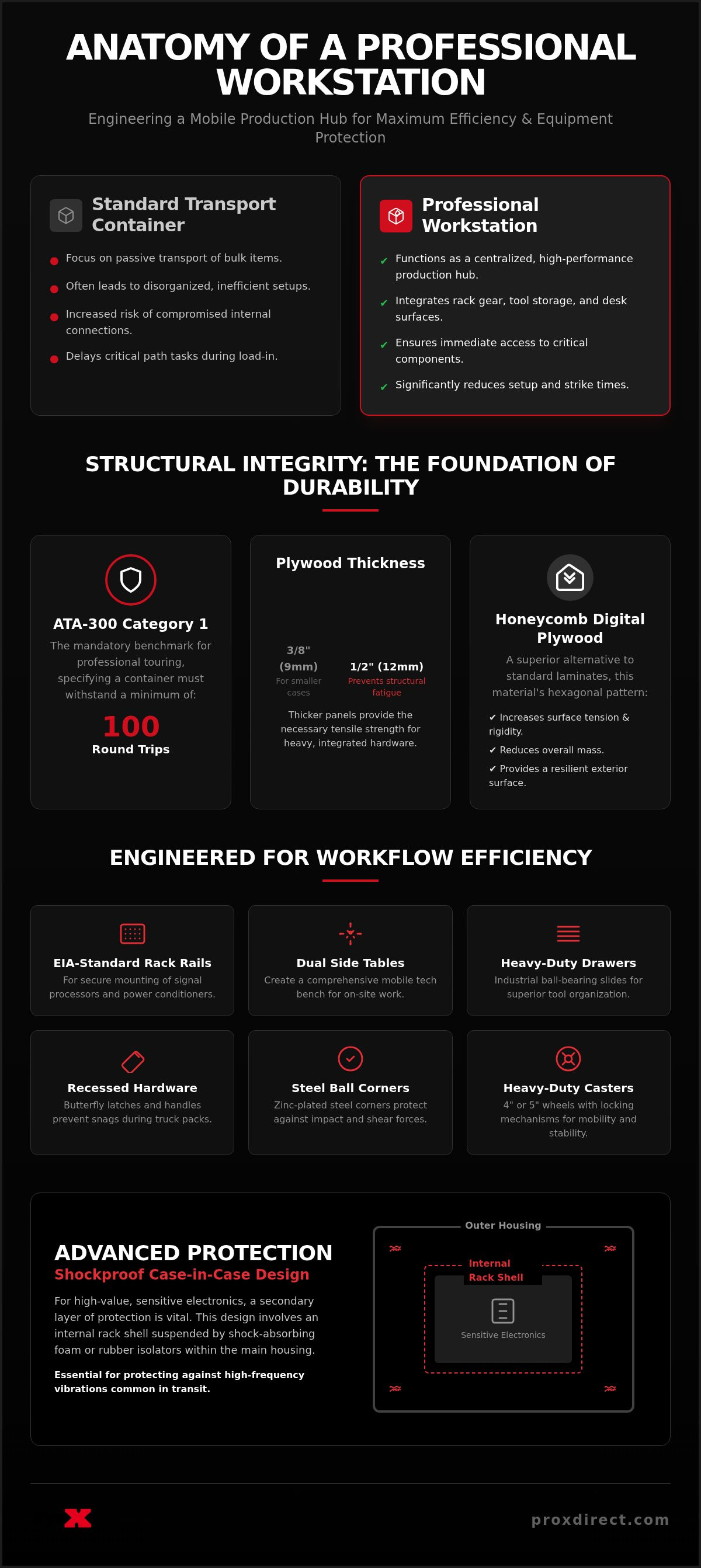
A professional flight case workstation serves as a specialized mobile production hub, engineered to integrate rack-mounted electronics, organized tool storage, and deployable desk surfaces into a single footprint. While standard utility cases focus on the passive transport of bulk items, a workstation is designed for active use upon arrival. It eliminates the logistical friction of searching through loose toolboxes by securing every component within a structured framework. For touring professionals, this centralization is critical; it ensures that specialized tools and sensitive electronics are immediately accessible, reducing the risk of equipment loss or damage during the transition between venues.
The transition from transport mode to operational mode must be seamless to meet tight production schedules. Standardizing the workspace within a mobile housing allows crews to reduce setup and strike times significantly. When every cable, connector, and processor has a dedicated, hard-mounted position, the margin for human error during high-pressure load-ins decreases. Understanding Flight case basics reveals that these units are more than protective shells; they are precision-engineered environments that maintain the integrity of a production's technical core.
The Anatomy of a Production Workstation
The structural framework of these units typically includes EIA-standard rack rails for signal processors and power conditioners, alongside heavy-duty drawers mounted on industrial-grade ball-bearing slides. To facilitate rapid deployment across uneven venue floors, engineers specify 4-inch or 5-inch heavy-duty castors with locking mechanisms. Every external component, from spring-loaded handles to butterfly latches, is recessed into the plywood shell. This design choice prevents snags during tight truck packs and protects the hardware from shear forces. High-quality ProX Cases utilize honeycomb digital plywood, which provides a superior strength-to-weight ratio compared to traditional flat laminates while offering a resilient exterior surface.
Mobile Command Centers for Broadcast and Live Sound
In front-of-house (FOH) and broadcast environments, the flight case workstation functions as a mobile command center. These units often feature lid-mounted monitor brackets and interface units, allowing a technician to begin operations within minutes of removing the case covers. For high-value sensitive electronics, a case-in-case design philosophy is employed. This involves an internal rack shell suspended by shock-absorbing foam or rubber isolators within the main outer housing. This secondary layer of protection is vital for modern digital consoles and server-based broadcast units that can't tolerate the high-frequency vibrations common in maritime or air freight. By standardizing these dimensions, production crews can optimize logistics while ensuring that their technical infrastructure remains consistent across every stop of a tour.
Structural Integrity and ATA-300 Engineering Standards
The structural capability of a flight case workstation is governed by compliance with ATA-300 Engineering Standards. For professional touring, Category 1 is the mandatory benchmark. It specifies that a container must withstand a minimum of 100 round trips. This durability depends heavily on material selection. While 3/8" (9mm) plywood suffices for smaller utility cases, large-format workstations require 1/2" (12mm) plywood to prevent structural fatigue under the weight of integrated drawers and rack-mounted hardware. Thicker panels offer the necessary tensile strength to maintain the case's geometry when fully loaded with heavy tools and electronics.
Modern engineering has introduced honeycomb digital plywood as a superior alternative to standard flat laminates. This material utilizes a hexagonal surface pattern that increases surface tension and rigidity while reducing overall mass. When combined with industrial-grade hardware such as zinc-plated steel ball corners and dual-anchor rivets, the case becomes a resilient exoskeleton. Spring-loaded handles and recessed butterfly latches ensure that the exterior remains flush. This is vital for maintaining the integrity of the unit during high-density loading where external protrusions would otherwise be sheared off.
Shockproof Engineering for Sensitive Electronics
Sensitive signal processors and server units require more than just external protection. High-density foam or internal rubber isolators create a suspended rack environment that decouples the gear from the outer shell. The 12U shockproof workstation has emerged as the industry standard for these applications. It provides sufficient vertical space for complex signal chains while maintaining a manageable center of gravity. Engineering-grade cases undergo rigorous testing to manage both vertical and horizontal G-force impacts. This ensures that internal components don't experience mechanical failure when the case is subjected to the sudden decelerations common in freight handling or rough venue load-ins.
Logistical Efficiency and Truck-Pack Dimensions
Professional logistics depend on standardized footprints. A flight case workstation should be designed with dimensions that align with standard truck-pack widths of 45 or 90 inches. This precision allows for a "tetris-style" loading pattern that eliminates dead space and prevents shifting during transit. Learn more about TruckPaX™ logistical efficiency to understand how these dimensions impact touring costs. Stackability is another critical factor. Integrated wheel cups on the top surface allow multiple units to be securely tiered, maximizing the vertical volume of the touring vehicle. For those building a fleet, choosing standardized workstation housings provides a scalable solution for complex production requirements.
Optimizing Workflow with Integrated Workstation Features
The utility of a flight case workstation is defined by its ability to transform a compact transport footprint into an expansive, ergonomic production environment. Dual side tables, typically engineered into the case lids, provide essential horizontal surfaces for laptops, test equipment, and documentation. This expansion is vital in venues with limited infrastructure. Adhering to principles of Ergonomic workstation design minimizes physical strain during long production shifts; it ensures that the height and layout of the tech bench support sustained focus and safety for the operator.
Thermal management is a critical engineering consideration that differentiates professional workstations from simple storage units. High-density rack configurations generate significant heat that can lead to thermal throttling or component failure. Passive ventilation through perforated panels serves as a baseline, but active fan cooling is necessary for high-draw power amplifiers and server units. These cooling systems maintain consistent airflow across internal heat sinks, which is essential for hardware longevity in non-climate-controlled environments. Cable management is equally important. Integrated rear access panels and internal cable looms prevent disorganized wiring from obstructing airflow or complicating troubleshooting during a performance.
Rack Space Management and Accessibility
Standardizing on 19-inch rack rails ensures universal compatibility with professional audio and video hardware. However, rail-to-rail depth is the primary metric for equipment suitability. Technicians must verify this depth to accommodate deep-chassis amplifiers and server units, such as those sourced from professional IT and networking providers like GenX Systems LLC, without obstructing rear connections. Utilizing both front and rear rack rails allows for complex I/O configurations. This setup enables power distribution and signal patching to remain accessible from the back while primary controls remain forward-facing, maximizing the functional density of the flight case workstation.
Efficiency depends on organized access to small parts, connectors, and specialized tools. Heavy-duty drawers mounted on industrial ball-bearing slides provide smooth operation even when loaded with heavy hardware. Dividing these spaces with adjustable inserts or custom foam cutouts protects high-value microphones and calibrated test gear from impact damage during transit. For broadcast professionals, these configurations are essential for managing the high volume of adapters and specialized cabling required on-site. You can explore professional AV broadcasting case solutions to see how these integrated features support specialized production workflows.
Selecting the Right Workstation for Specific Production Environments
Selecting a professional flight case workstation is a process of aligning mechanical specifications with the distinct operational demands of different production roles. Front-of-House (FOH) engineers typically prioritize rack rail density and ergonomic surface height for signal processors and interface units. In contrast, lighting technicians require significant drawer volume to manage hardware such as clamps, safety cables, and specialized tools. Behavioral researchers also utilize these mobile hubs to protect sensitive tracking systems; for instance, those using Ergoneers solutions require stable, vibration-isolated environments to ensure data integrity during field-based human-machine interaction studies. Broadcast crews focus on vibration isolation and complex signal cable management to protect high-bandwidth data lines from mechanical interference. Mobility requirements also vary by venue type; while 2-inch castors provide a lower center of gravity for smooth ballroom floors, 4-inch heavy-duty castors are the engineering standard for traversing arena ramps and uneven outdoor surfaces.
Standard vs. Custom Workstation Solutions
Off-the-shelf 12U workstations provide a reliable, immediate solution for standard rack-mounted gear and tool storage. These units utilize proven footprints that integrate seamlessly into existing truck-pack logistics. However, unique equipment footprints or specialized broadcast requirements often necessitate bespoke engineering. Custom builds allow for precise internal routing and specialized mounting brackets that standard models cannot accommodate. You can gain a deeper technical perspective by Understanding ZCASE custom build engineering, which focuses on high-precision protection for specialized production gear.
Material Choices: Plywood vs. Composite Panels
Material selection directly impacts both the durability and the logistical cost of a mobile workstation. Standard 1/2-inch plywood with high-pressure laminates offers maximum resistance against physical abrasion and chemical spills, making it the preferred choice for heavy ground touring. For air freight applications where weight is a primary constraint, composite panels can reduce the mass of the shell without compromising structural rigidity. Maintaining these units involves regular inspection of the recessed hardware and lubricating the ball-bearing drawer slides to ensure operational longevity. Browse the full range of ProX technical workstations to find the configuration that matches your touring requirements.
ProX Engineering: Professional-Grade Workstation Solutions
ProX specializes in engineering high-durability solutions such as the 12U shockproof flight case workstation. This specific model serves as the gold standard for mobile tech benches, featuring integrated dual side tables that expand the functional workspace at any venue. By incorporating Santosom engineering, these cases are built to withstand the high-stakes environment of professional production where mechanical failure isn't an option. The construction utilizes 1/2-inch honeycomb digital plywood, a material that features a hexagonal surface pattern to increase surface tension and minimize visible wear. This is paired with heavy-duty recessed hardware, ensuring that the unit remains a reliable backbone for your technical infrastructure throughout its service life.
Why ProX Engineering Sets the Industry Standard
We've been manufacturing professional-grade cases since 1984, developing a deep understanding of the physical demands placed on professional gear. Our engineering process prioritizes functional excellence and structural longevity over aesthetic trends. This experience has led to partnerships with major industry entities, reinforcing our position as an authoritative guide in equipment protection. The result is a product line characterized by touring-grade reliability and precision assembly. You can browse the full catalog of ProX professional cases to find standardized solutions that integrate seamlessly into your logistics chain.
Advanced Deployment with ZCASE Custom Builds
For unique broadcast and live sound requirements, we offer ZCASE custom build cases manufactured in Poland. These solutions include the innovative Flip Ready cases, which are engineered for rapid deployment of complex console setups. This mechanical design allows a technician to flip a console into an operational position quickly, significantly reducing labor requirements during load-in. These bespoke setups provide the same high-level vibration isolation and structural integrity found in our standard workstation lines, ensuring that even the most sensitive digital interfaces remain protected during transit. Equipment failure isn't an option when the show depends on your gear.
Support and Replacement Parts for Long-Term ROI
An investment in a professional flight case workstation is an investment in the long-term protection of your production assets. We support this investment by providing a comprehensive range of ProX Cases replacement parts, including 4-inch heavy-duty castors, spring-loaded recessed handles, and steel butterfly latches. Our extensive dealer network ensures that you can access support and hardware regardless of your tour's location. Maintaining your gear with genuine components extends the life of the case and preserves its resale value. Choosing engineering precision over budget alternatives ensures that your equipment arrives in peak condition, stop after stop. Precision matters on tour.
Engineering for Structural Longevity and Operational Precision
The transition from simple transport to active production requires a shift toward integrated engineering. A professional flight case workstation is no longer just a container; it's a meticulously designed environment that ensures hardware durability through ATA-300 Category 1 compliance. By utilizing heavy-duty honeycomb digital plywood and shock-mount rack systems, you eliminate the mechanical failures that often plague standard utility cases. These units provide a centralized hub that maintains consistency across diverse venue environments stop after stop.
Global touring professionals rely on these specifications to protect high-value assets and streamline logistics. Investing in a technical solution that balances structural integrity with ergonomic utility ensures your crew can focus on performance rather than equipment recovery. Efficiency is the benchmark. You can Explore Professional ProX Workstation Cases to find the exact configuration for your mobile production needs. Trust in proven manufacturing standards to keep your operations efficient and your gear secure on every tour stop.
Frequently Asked Questions
What is the difference between a standard flight case and a workstation?
A standard case is engineered primarily for passive containment and protection during transit. In contrast, a flight case workstation is a specialized environment designed for active production use. It integrates deployable work surfaces, such as lid-mounted side tables, and high-density storage drawers on industrial ball-bearing slides. This configuration transforms the case into a centralized mobile command center, allowing technicians to begin operations immediately upon arrival without unpacking equipment.
How much rack space do I need in a mobile workstation?
Rack space requirements depend on your specific technical role and hardware footprint. Front-of-House engineers often require 8U to 12U of vertical space for signal processors, power conditioners, and interface units. Broadcast technicians managing server-grade hardware may prioritize deeper rack depths over total unit count. Selecting a 12U shockproof model provides an optimal balance between functional capacity and a manageable center of gravity for deployment in various venue environments.
Are shockproof workstation cases necessary for all production gear?
Shockproof engineering is essential for sensitive electronics but unnecessary for inert tools or cables. Digital mixing engines, server units, and power amplifiers contain delicate internal connections that can fail due to high-frequency vibrations during transit. Utilizing a flight case workstation with internal shock-mount rack rails decoupled from the outer shell provides the necessary mechanical isolation. For non-electronic items like clamps or gels, a standard rigid-mount workstation is sufficient.
Can I customize the drawer configuration in a professional workstation?
Professional workstations allow for significant internal organization through adjustable dividers and custom foam inserts. Technicians can configure drawer spaces to secure specific toolsets, connectors, or high-value microphones. For highly specialized equipment footprints that standard models can't accommodate, ZCASE custom builds from Poland offer bespoke engineering. These options allow for precise internal routing and mounting solutions tailored to unique broadcast or live sound requirements, ensuring maximum operational efficiency.
What are the standard dimensions for a truck-ready workstation case?
To optimize logistical efficiency, workstation cases are typically designed to align with standard truck-pack dimensions. These footprints are engineered to fit 90-inch or 45-inch widths, which are the industry standards for professional touring vehicles. Utilizing TruckPaX dimensions ensures a "tetris-style" loading pattern that eliminates dead space and prevents shifting during transport. Standardizing your fleet around these dimensions reduces shipping costs and simplifies the coordination of complex production loads.
How do I maintain the castors and latches on my workstation case?
Maintaining operational reliability requires regular inspection of all mechanical components. You should clean castors to remove debris that can seize bearings and apply a dry-film lubricant to ball-bearing drawer slides. Inspect recessed butterfly latches for alignment and tension, ensuring they engage securely without excessive force. Replacing worn 4-inch castors or damaged handles with genuine ProX Cases replacement parts extends the structural longevity of the unit and preserves your internal production assets.
What materials are best for a lightweight yet rugged workstation?
For heavy ground touring, 1/2-inch plywood with high-pressure laminates remains the engineering standard for structural rigidity. Honeycomb digital plywood provides an improved strength-to-weight ratio while offering superior resistance to physical abrasion. If air freight is the primary transport method, composite panels can reduce overall mass to meet strict weight limitations. However, ground-based workstations benefit from the higher tensile strength of plywood to support the weight of integrated drawers and rack-mounted hardware.
Disclaimer
Any trademarks, trade names or brand names appearing herein that do not belong to ProX are the property of their respective owners and/or companies, and such appearance doesn't and shall not constitute or imply endorsement, sponsorship or recommendation by ProX.


