

A rack case is a critical mechanical component of your signal chain, not just a transport box. You understand that a single thermal failure or a sheared rail can compromise an entire production. High-output power amplifiers and sensitive digital processors require more than just a shell. They need a controlled environment that accounts for heat dissipation and structural load during transit. Selecting the right Amp & Effects Rack Cases requires a meticulous approach to engineering specifications and logistical compatibility.
This guide provides the technical framework necessary to master rack protection. You will learn how to ensure the mechanical integrity and thermal stability of your professional audio gear through precise specification matching. We will analyze rack depth optimization to eliminate logistical inefficiencies; the benefits of Slam Door technology for tight stage footprints; and the application of ATA-300 construction standards. By focusing on industrial durability and functional excellence, you can identify the exact configurations needed to secure heavy power amps and optimize your truck pack density for long-term reliability.
Key Takeaways
- Apply ATA-300 construction standards and 19-inch rack specifications to ensure multi-trip durability for high-value audio equipment.
- Differentiate between standard rail mounting and shock mount engineering to provide the necessary mechanical isolation for sensitive digital signal processors.
- Select the optimal chassis depth, ranging from 7 to 24 inches, to improve truck pack density and eliminate logistical inefficiencies during transport.
- Discover how Slam Door technology and proper thermal clearance in Amp & Effects Rack Cases prevent amplifier thermal shutdown in high-density environments.
- Evaluate the performance of BLAQ Polyurea coatings and integrated caster systems to maintain the structural integrity of your rig during global production logistics.
Understanding Rack Case Standards: U-Spaces and ATA-300 Specifications
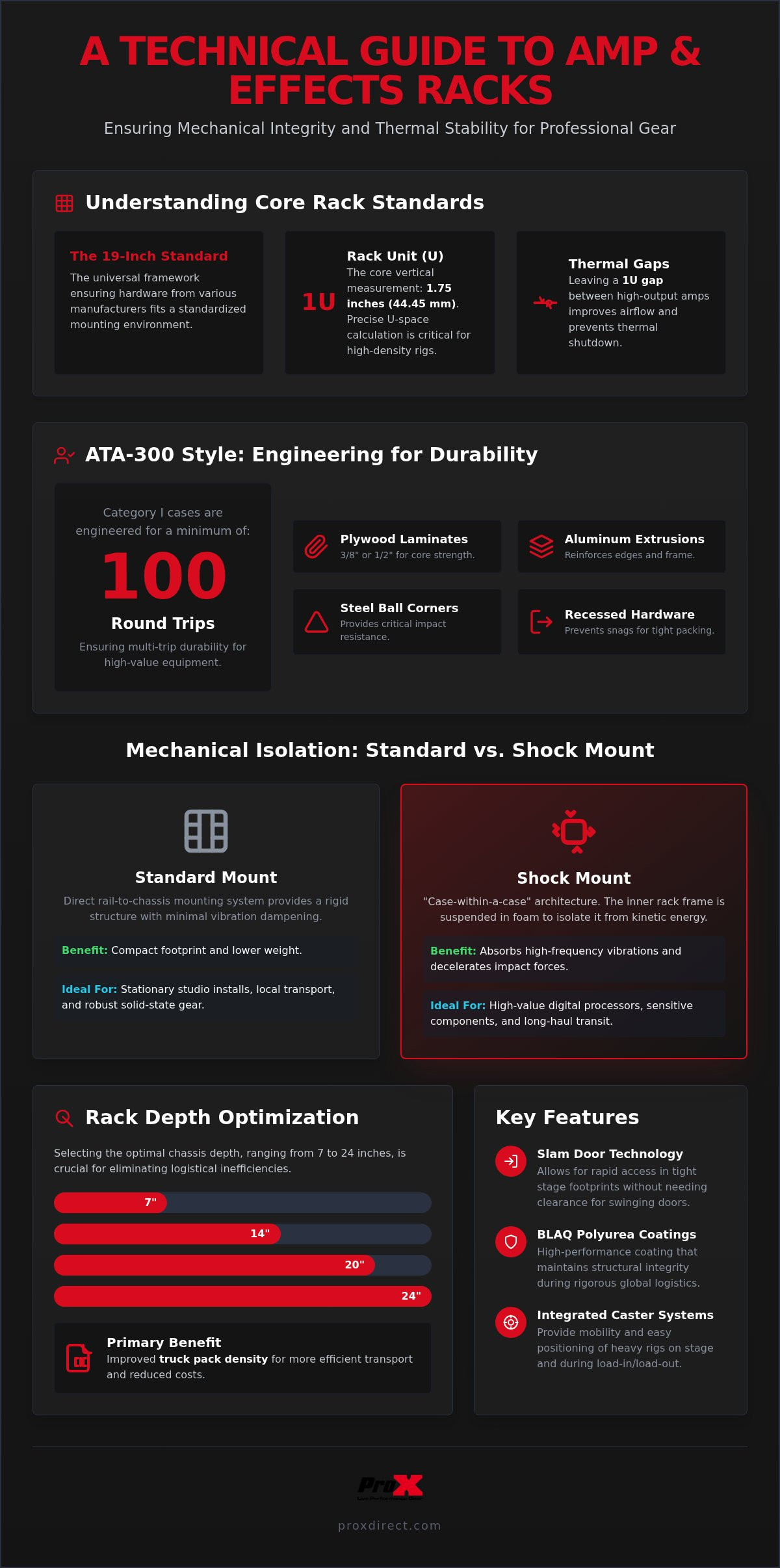
The 19-inch rack standard serves as the universal framework for professional audio integration. This specification ensures that hardware from various manufacturers fits into a standardized mounting environment. At the core of this system is the Rack Unit (U), which measures exactly 1.75 inches (44.45 mm) of vertical height. When selecting Amp & Effects Rack Cases, understanding the cumulative U-space of your gear is the first step in maintaining a compact yet functional rig. High-density setups require precise math to avoid mechanical interference between chassis components.
The Anatomy of Vertical Rack Units
Calculating requirements involves more than just adding up the faceplate dimensions. While a 4U amplifier occupies 7 inches of vertical space, high-performance power amplifiers generate significant thermal energy. Leaving a 1U gap between heavy components facilitates passive airflow. This simple engineering choice can significantly improve system longevity by preventing heat soak in internal capacitors. Mounting rails typically come in two varieties: tapped and square-hole. Tapped rails feature pre-threaded holes, usually 10-32, that allow for direct screw insertion. Square-hole rails require cage nuts. These offer greater flexibility for replacing stripped threads in high-wear environments where gear is frequently reconfigured.
ATA-300 Style Engineering Requirements
For equipment subjected to recurrent transit, "ATA-300 style" refers to design specifications originally established by the Air Transport Association, now Airlines for America. These standards categorize cases based on their ability to withstand multiple shipping cycles. Category I cases are engineered for a minimum of 100 round trips, requiring specific material densities and hardware tolerances. Achieving this durability requires a combination of 3/8-inch or 1/2-inch plywood laminates and industrial-grade aluminum extrusions. Steel ball corners provide critical impact resistance at the most vulnerable points of the chassis.
Recessed hardware is a mandatory requirement for professional logistics. Spring-loaded handles and butterfly latches must sit flush with the case surface. This design prevents mechanical snags during truck loading or automated sorting processes. It also ensures that cases can be packed tightly together without hardware protrusions damaging adjacent units. For a deeper look at high-end manufacturing and precision builds, review the Santosom Cases: Engineering Excellence documentation. These engineering choices provide the structural backbone necessary for the rigors of global production.
Mechanical Isolation: Shock Mount vs. Standard Rack Engineering
Standard Amp & Effects Rack Cases utilize a direct rail-to-chassis mounting system. This engineering approach is highly efficient for stationary studio installations or local transport where the rack is handled by a dedicated crew. The aluminum rails are bolted directly to the plywood shell, providing a rigid structure with minimal vibration dampening. For lightweight signal processors and modern solid-state equipment, this level of structural support is often sufficient. It prioritizes a compact footprint and lower tare weight, which reduces logistical costs during local ground transit.
High-value production gear requires a more sophisticated mechanical strategy. Shock mount engineering employs a "case-within-a-case" architecture. The internal rack frame is suspended within an outer shell, separated by a layer of high-density polyethylene or ester foam. This design is essential for equipment that cannot tolerate the kinetic energy of a drop or the constant vibration of a long-haul truck bed.
The Physics of Shock Mount Protection
Mechanical isolation is the separation of the inner rack from external kinetic energy. During transit, equipment is subjected to varying G-forces from drops, vibrations, and shifts in the transport vehicle. A 2-inch foam buffer acts as a mechanical low-pass filter, absorbing high-frequency vibrations and decelerating the inner rack during impact. This protection is critical for preventing solder joint failure and protecting delicate components like vacuum tubes or mechanical hard drives. While road cases handle transit impacts, stationary audiophile setups can achieve superior isolation with HiFi Rack, which offers specialized resonance damping solutions. While this suspension system adds volume to the chassis, it is a necessary trade-off for protecting mission-critical hardware from structural fatigue.
The decision between these two formats depends on the transit environment and the mechanical sensitivity of the internal components. Standard racks are the logical choice for local applications where the user maintains control over handling. However, international touring and air transport demand the ATA 300 specification for recurrent shipping. Airfreight involves automated sorting systems and high-vibration environments that can easily damage unbuffered gear. Specifying shock protection is mandatory for tube-based amplifiers, as the glass envelopes and internal filaments are prone to mechanical failure under stress.
Balancing protection levels against logistical transport costs is essential for maintaining a profitable production budget. Modern solid-state effects may only require standard protection if they are housed in a secure, climate-controlled environment. For a detailed breakdown of specific model compatibility and rail tolerances, consult the Professional Amplifier Rack Case Guide. If you are building a rig for high-stakes production, exploring specialized rack configurations can ensure your equipment arrives in operational condition.
Rack Depth Optimization: Choosing Between 7, 14, 20, and 24-Inch Chassis
Selecting the correct chassis depth is a logistical decision that impacts both equipment safety and shipping efficiency. Amp & Effects Rack Cases are manufactured in specific depth increments to accommodate different hardware classes while maintaining a manageable footprint. While vertical U-space defines how much gear you can mount, the depth determines the mechanical stability of the entire rig. Using a case that is too deep for your equipment creates unnecessary bulk; using one that is too shallow can lead to connector damage and restricted airflow.
Shallow racks, typically ranging from 7 to 12 inches, are optimized for signal processors, wireless microphone receivers, and networking switchers. These units allow for compact setups in small-scale productions where stage space is limited. Standard racks, measuring 14 to 18 inches, represent the industry sweet spot. Most modern Class-D and Class-H power amplifiers are designed for these dimensions. For high-output touring amplifiers and server-based processing units, deep racks of 20 to 24 inches are required. These deeper units necessitate more robust construction to maintain structural integrity under the increased leverage of heavy internal components.
Calculating rear clearance is a critical step in the selection process. You must account for the physical depth of the hardware plus the space required for connectors and cable strain relief. Professional-grade XLR, Speakon, and PowerCon connectors often require 2.5 to 3 inches of clearance behind the chassis. Forcing cables against the rear lid of a case can lead to intermittent signal failure or permanent port damage on high-value gear.
The Importance of Rear Rack Rails
Heavy amplifiers often exceed 40 pounds, placing significant stress on the front mounting ears. Mounting these units only by the front rails creates cantilever stress that can warp the rack frame or shear off mounting bolts during transit. Rear rack rails allow for 4-point mounting, which distributes the weight evenly across the internal structure. Adjustable rail systems provide the flexibility needed for non-standard equipment dimensions, ensuring a precise fit for every component. Deep Amp & Effects Rack Cases utilize reinforced aluminum extrusions and 1/2-inch plywood to prevent chassis twisting when fully loaded with heavy-duty touring amps.
Logistical Impact of Case Depth
Inconsistent case depths create logistical inefficiencies during truck loading. Standardizing your inventory around specific depth increments allows for a more predictable and stable truck pack. This optimization is central to the design of TruckPaX™ Truck Pack Cases, where dimensions are calculated to maximize interior volume while fitting standard trailer widths. Avoiding dead space within the case minimizes shipping volume, which directly reduces airfreight costs for international productions. By matching the case depth to the equipment requirements, you ensure that every cubic inch of your transport inventory is utilized effectively.
Thermal Management and Operational Access in High-Density Racks
Thermal management is a primary engineering concern for high-density production environments. Enclosed racks act as thermal insulators. When high-output amplifiers operate at high duty cycles, they generate significant heat energy that must be dissipated to prevent thermal shutdown. Amp & Effects Rack Cases provide the structural shell, but the internal configuration determines the cooling efficiency. Failure to account for thermodynamics can lead to catastrophic hardware failure during a performance, especially when using modern Class-D amplifiers that require consistent airflow to maintain stable operating temperatures.
Cable management plays a secondary but critical role in thermal stability. A disorganized mass of XLR and power cables at the rear of a rack creates a physical barrier to exhaust air. Organizing these looms using lacing bars and side-mounted cable channels ensures that the rear of the equipment remains clear. This organization also facilitates rapid troubleshooting during high-stakes production environments where every second of downtime is critical.
Active vs. Passive Cooling Strategies
Passive cooling relies on convection and the strategic placement of vented panels. In racks with low-wattage signal processors, 1U or 2U vented panels provide sufficient clearance for heat to escape. However, high-density amplifier racks often require active cooling solutions. Installing 1U fan units at the top of the rack helps pull hot air out of the enclosure. Airflow must remain unobstructed from front intake to rear exhaust for maximum efficiency. If an amplifier pulls air from the front and exhausts to the rear, the case must have a clear path for that air to exit the back of the rack without recirculating.
Operational Engineering: Slam Doors and Access Panels
Traditional removable lids present logistical challenges in narrow side-stage environments. These lids require storage space and create tripping hazards in dark wings. Slam Door technology addresses this by allowing the doors to retract into the sides of the case. This design is superior for tight spaces, as it maintains a constant footprint regardless of whether the rack is open or closed. It also ensures that the doors are never misplaced or damaged during a busy load-in.
Beyond the front access, rear I/O panels must remain accessible for patching and power distribution. Professional builds often incorporate internal rack lighting and hinged rear panels to speed up the setup process. For complex signal chains and broadcasting requirements, reviewing specialized AV Broadcasting Cases can provide insights into advanced operational access. To ensure your rig remains operational under extreme conditions, integrate high-performance rack accessories into your thermal management plan.
Selecting Professional Rack Solutions for Global Production Logistics
Finalizing a professional rig involves evaluating the external materials that interface with the harsh realities of global logistics. Amp & Effects Rack Cases must withstand more than just vertical loads; they must resist abrasion, impact, and chemical exposure. Traditional ABS laminates provide a standard level of protection, but high-performance environments often require advanced material science. BLAQ Polyurea coatings offer a superior alternative, providing an industrial-grade finish that is nearly impervious to the gouges and scratches common during rapid truck transitions. This coating bonds directly to the plywood, creating a seamless, watertight barrier that maintains structural integrity in high-humidity environments.
Mobility is another critical engineering factor. A fully loaded 12U rack containing heavy-duty amplifiers can easily exceed 200 pounds. Manually lifting such loads is inefficient and increases the risk of equipment damage. Integrating heavy-duty caster boards with 4-inch blue rubber wheels ensures smooth movement across varied surfaces, from concrete loading docks to carpeted backstage areas. These wheels must feature high-load bearings and locking mechanisms to stabilize the rack during operation. Engineering for mobility reduces physical strain on crews and speeds up the load-in process.
Durability Standards: Beyond the Plywood
The longevity of a rack depends on the quality of its mechanical components. Hardware such as butterfly latches and spring-loaded handles should be constructed from zinc-plated steel to prevent oxidation and structural fatigue. Honeycomb digital laminates provide a unique structural advantage, featuring a hexagonal surface pattern that significantly increases scratch resistance compared to smooth finishes. To extend the lifespan of your touring hardware, perform regular maintenance by lubricating latch mechanisms with a dry silicone spray and tightening rail bolts to ensure the internal frame remains square. These small steps prevent mechanical failures during critical production windows.
The Future of Rack Protection: ZCASE and Custom Builds
As signal chains become more complex, off-the-shelf solutions may not accommodate bespoke configurations. The integration of custom foam inserts allows for the secure mounting of non-rackable items alongside standard hardware. For professionals requiring high-precision engineering, ZCASE Custom Build Cases provide a tailored approach to equipment protection. These builds are engineered in Poland and offer specialized signal routing and internal bracing for mission-critical infrastructure.
Contacting an authorized dealer for large-scale production infrastructure quotes ensures that your logistics plan is backed by decades of manufacturing expertise. ProX has been engineering performance gear since 1984, maintaining a commitment to industrial durability that supports the most demanding touring schedules. By choosing Amp & Effects Rack Cases engineered for global logistics, you ensure the mechanical integrity of your signal chain remains intact from the warehouse to the stage.
Securing Your Signal Chain for Global Production
Mastering the technical specifications of your rig ensures that performance failure is never an option. By prioritizing ATA-300 style construction and precise mechanical isolation, you protect the internal integrity of your sensitive processors. Optimizing chassis depth and implementing active thermal management prevents the logistical snags and overheating issues that compromise high-stakes events. These engineering choices provide a reliable backbone for any professional audio environment. Every millimeter of clearance and every pound of weight distribution counts when your gear is in transit across international borders.
ProX has provided industrial durability since 1984. Our manufacturing expertise is trusted by global production companies to deliver functional excellence in every build. Whether you require standard rail configurations or specialized Slam Door technology, our solutions are designed to meet the rigorous demands of recurrent transit. Take the next step in optimizing your mobile infrastructure by choosing Amp & Effects Rack Cases that value technical superiority and long-term reliability. Your equipment is a significant investment; it deserves a shell that matches its professional grade.
Browse the Full Collection of ProX Amp & Effects Rack Cases and secure your professional audio gear today.
Frequently Asked Questions
What is the difference between a shallow effects rack and a standard amp rack?
Shallow racks typically range from 7 to 12 inches in depth, making them suitable for wireless receivers, network switches, and signal processors with short chassis. Standard amp racks extend from 14 to 18 inches to accommodate the physical dimensions of power amplifiers. Choosing the correct depth for your Amp & Effects Rack Cases prevents excessive bulk in your truck pack while ensuring that heavy components have sufficient structural support from both front and rear rails.
Do I really need a shock mount case for my power amplifiers?
Shock mount cases are mandatory for equipment with sensitive mechanical components, such as vacuum tubes or traditional hard drives. While modern solid-state amplifiers are more resilient, the constant vibration of long-haul transit can still fatigue solder joints over time. If your production schedule involves frequent airfreight or automated sorting systems, the foam-buffered "case-within-a-case" design provides the necessary G-force deceleration to prevent catastrophic hardware failure during a tour.
How do I calculate the correct rack depth including my cables?
To calculate the required depth, measure the distance from the front mounting ears to the deepest point of the chassis, then add at least 3 inches of clearance. This additional space is critical for the bend radius of XLR, Speakon, and PowerCon connectors. Without this clearance, cables are forced against the rear lid, which can lead to intermittent signal loss or permanent port damage. Proper depth calculation ensures thermal stability by maintaining unobstructed airflow.
What are the benefits of a Slam Door rack case for touring?
Slam Door technology provides a significant logistical advantage in narrow side-stage environments where traditional removable lids create tripping hazards. These doors retract into the side walls of the chassis, maintaining a consistent footprint whether the rack is open or closed. This design also eliminates the risk of losing or damaging lids during a rapid load-out. It is an ideal solution for high-density setups where operational efficiency and stage safety are primary concerns.
Can I mount 19-inch equipment in a custom ZCASE design?
ZCASE custom builds are fully compatible with the universal 19-inch mounting standard used in professional audio. While the exterior dimensions and internal foam are tailored to your specific logistical needs, the internal rack rails follow the standard U-space increments of 1.75 inches. This allows you to integrate high-value bespoke signal chains into a rugged, custom-engineered shell that provides superior mechanical isolation and thermal management compared to standard off-the-shelf configurations.
How does polyurea coating improve the durability of a rack case?
BLAQ Polyurea coating provides an industrial-grade finish that is significantly more durable than traditional ABS laminates. This coating is chemically bonded to the plywood shell, creating a seamless and watertight barrier that resists deep gouges and impact damage. In the high-stakes environment of global production, this material science ensures that your Amp & Effects Rack Cases maintain their structural integrity and professional appearance despite the rigors of recurrent truck loading and chemical exposure.
What is the maximum weight capacity for a standard 12U rack case?
The weight capacity of a 12U rack depends on the plywood thickness and the use of 4-point mounting. A standard build using 3/8-inch or 1/2-inch plywood can typically support a distributed load of 250 to 400 pounds. To maximize this capacity, you must utilize both front and rear rack rails for heavy power amplifiers. This prevents rail sag and ensures that the kinetic energy of the load is distributed evenly across the aluminum extrusions.
Are ProX rack cases compliant with international shipping standards?
ProX engineering adheres to the ATA-300 style construction standards established for recurrent shipping. These cases are designed to withstand the physical demands of international air and sea freight, categorized for multi-trip reliability. By utilizing recessed hardware, steel ball corners, and industrial-grade plywood, these racks meet the requirements for Category I durability. This ensures that your professional audio infrastructure remains secure and operational regardless of the transport method or the destination.
Disclaimer
Any trademarks, trade names or brand names appearing herein that do not belong to ProX are the property of their respective owners and/or companies, and such appearance doesn't and shall not constitute or imply endorsement, sponsorship or recommendation by ProX.


