
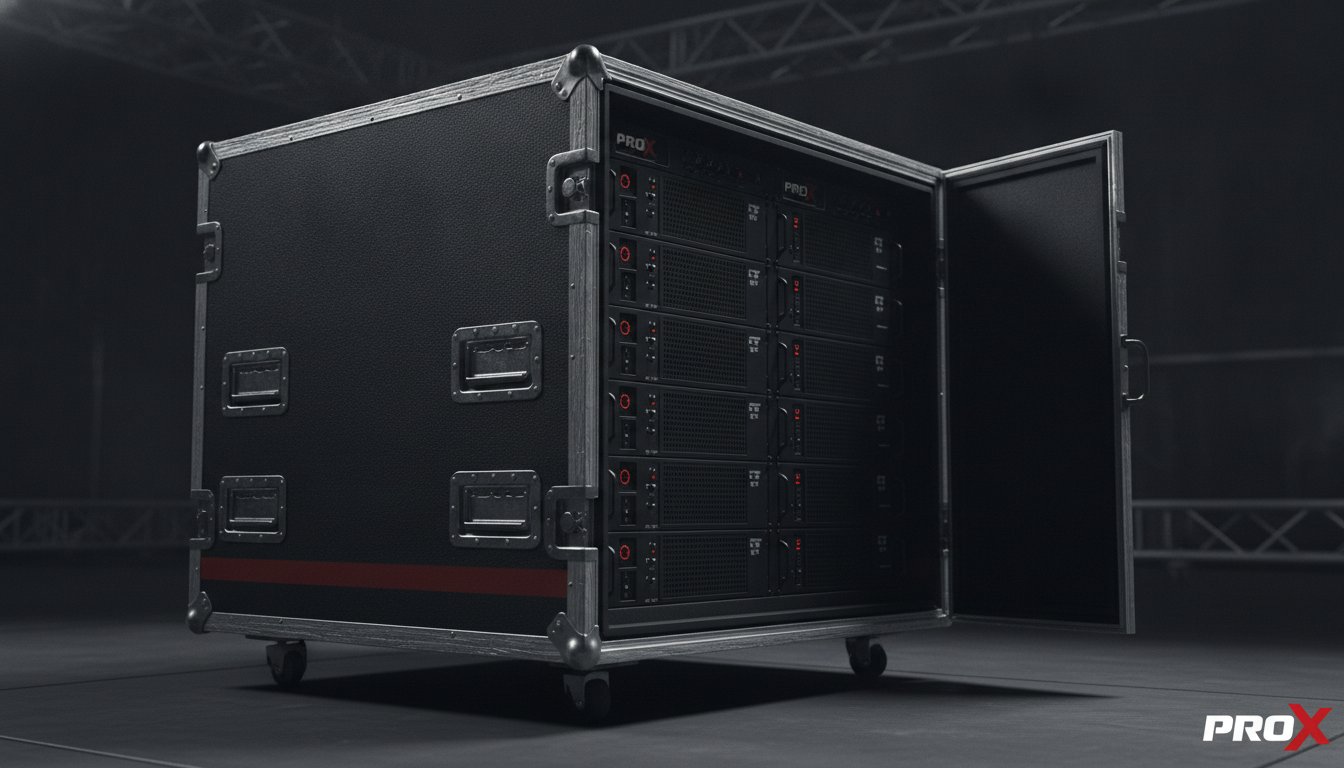
An amplifier rack case is not merely a transport box; it is a precision-engineered component of your signal chain designed to mitigate the physical and thermal stresses of global touring. While a standard enclosure might suffice for local storage, high-stakes production environments demand a more rigorous approach to mechanical protection. A single hardware failure during a performance can lead to catastrophic downtime, making the structural integrity of your rack a primary concern for operational reliability.
You recognize that the rigors of international logistics, including mechanical shock and dense equipment stacking, require hardware that meets the ATA-300 Category I standard. This article explains how to select and configure professional amplifier rack cases to ensure your electronics remain within safe thermal operating limits while surviving at least 100 round trips. We will detail the technical specifications of 3/8" and 1/2" laminated plywood construction; internal rack management for rapid deployment; and advanced shock-mounting techniques that protect sensitive internal components from high-impact environments.
Key Takeaways
- Differentiate between consumer enclosures and professional 19-inch rack standards through plywood density and mechanical reinforcement.
- Analyze how shock-mount systems in an amplifier rack case utilize high-density foam to create a protective "case-within-a-case" environment.
- Implement thermal management solutions, such as vented panels and internal fan units, to ensure maximum thermal efficiency for high-heat electronics.
- Leverage standardized case dimensions and ATA-300 compliance to eliminate logistical delays during international transit.
- Explore the engineering collaboration between ProX, Santosom, and ZCASE to achieve world-class protection standards for professional audio hardware.
Defining the Professional Amplifier Rack Case for Live Production
A professional amplifier rack case functions as a critical protective interface between sensitive high-output electronics and the volatile conditions of live production. Unlike consumer-grade enclosures designed for stationary use, touring-grade racks must withstand repetitive mechanical impact, vibrational stress, and extreme thermal loads. Engineering precision is mandatory in these environments because equipment failure during a performance is not an option. The choice of an enclosure directly impacts the longevity of power amplifiers and signal processors, which represent the core of a production's audio capability.
Understanding Rack Units (U) and Vertical Spacing
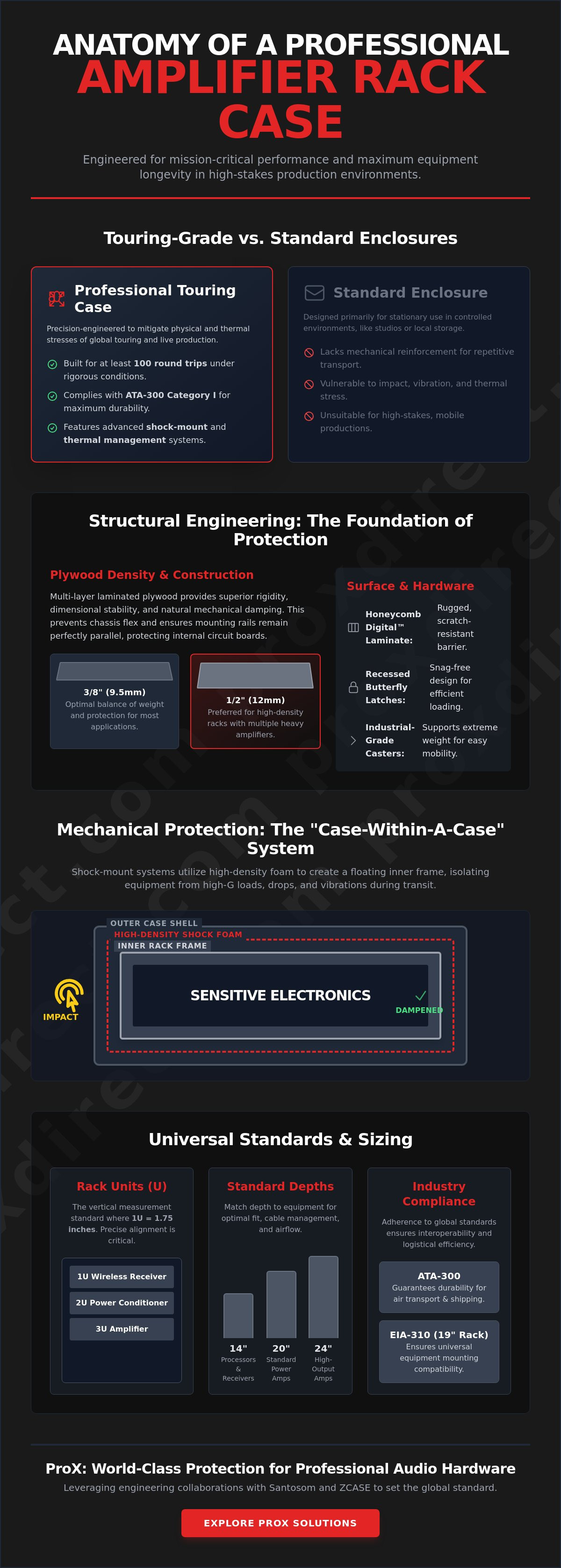
Vertical capacity in the professional audio industry is measured in Rack Units (U), with each unit representing a 1.75-inch (44.45 mm) increment. This measurement dictates the total height of the internal mounting space. Precise rail alignment is essential when mounting heavy 2U and 3U power amplifiers to prevent chassis warping or fastener failure under high-G loads during transport. The 19-inch rack standard serves as the industrial foundation for equipment interoperability. By adhering to this global benchmark, engineers ensure that modular components from disparate manufacturers integrate into a single, cohesive system without physical conflict.
Touring-Grade Hardware vs. Fixed Installation Racks
Touring environments demand materials with high structural density and energy absorption. Plywood, typically utilized in 3/8-inch or 1/2-inch thicknesses, remains the industry standard because it provides superior rigidity over plastic or thin-gauge metal. While fixed installation racks are designed for static placement, an amplifier rack case built for the road incorporates specific hardware to facilitate logistics. This includes recessed butterfly latches that won't snag during loading and industrial-grade casters capable of supporting dense equipment stacks.
Selecting the appropriate depth is a technical requirement based on the amplifier chassis size. Professional cases are generally categorized into three depth standards:
- 14-inch Depth: Engineered for shallow effects processors, wireless receivers, and networking hardware.
- 20-inch Depth: The standard for the majority of professional-grade power amplifiers.
- 24-inch Depth: Necessary for high-output amplifiers with extended rear heat sinks or complex cabling requirements.
Using a case with inadequate depth can lead to cable strain or restricted airflow, while an oversized case wastes valuable truck space. Professional-grade engineering ensures these cases maintain their structural integrity even when housing several hundred pounds of high-performance gear. For those managing extensive inventories, ProX Cases provide the standardized dimensions required for efficient truck packing and rapid deployment.
Structural Engineering: Plywood Density and Mechanical Reinforcement
The structural integrity of an amplifier rack case depends entirely on its material composition and the precision of its assembly. Professional manufacturers prioritize multi-layer plywood because of its natural mechanical damping properties. Unlike plastic enclosures that can crack under extreme temperature changes or solid wood that may warp, laminated plywood maintains its dimensional stability. This is crucial for adhering to the EIA-310 standard, which ensures that mounting rails remain perfectly parallel over years of heavy use. When these rails shift even slightly, it creates mounting stress on the amplifier chassis, potentially damaging internal circuit boards.
For most touring applications, 3/8-inch plywood provides an optimal balance between weight and protection. However, when housing high-density racks with multiple heavy-duty power amps, 1/2-inch plywood is the preferred engineering choice to prevent chassis flex. To enhance surface durability, ProX utilizes a Honeycomb Digital™ laminate. This hexagonal pattern isn't just aesthetic; it creates a rugged barrier that resists scratches and minor impacts, preserving the professional appearance of the gear during rigorous logistics cycles. If you require specialized protection for high-value inventory, exploring the range of ProX Cases can provide the necessary structural benchmarks for your build.
Material Science in High-Performance Cases
Multi-layer plywood excels at absorbing low-frequency vibrations that can loosen internal solder joints in amplifiers. Inside the case, high-density foam padding acts as a secondary shock absorber, isolating the internal rack frame from the outer shell. This "case-within-a-case" geometry is vital for global air-freight, where handling equipment often exceeds standard safety parameters. Engineers must calculate the weight-to-protection ratio carefully. While thicker materials offer more defense, they increase shipping costs. Selecting the right plywood thickness is a strategic logistical decision that affects your bottom line.
Hardware Reliability for Professional Use
The mechanical components of an amplifier rack case must withstand thousands of cycles without failure. Industrial-grade butterfly latches are recessed into the frame to prevent damage during tight truck packs. These latches apply consistent pressure to the gaskets, maintaining a secure seal against dust and moisture. Spring-loaded handles are another essential feature, designed to retract when not in use to maintain a flush profile.
Stackable steel ball corners serve as the primary impact points. These components are engineered to distribute the force of a drop across the aluminum extrusions rather than the plywood panels. Their design also facilitates secure stacking in warehouses and trucks, which is a key requirement for TruckPaX™ Truck Pack Cases. If a component does wear out after years of service, utilizing high-quality ProX Case Accessories for replacements ensures the enclosure maintains its original safety rating.
Shock-Mounting vs. Direct-Mounting: Mechanical Protection Strategies
The mechanical protection of power electronics involves more than just a rigid exterior shell. While previous sections detailed the structural benefits of plywood and reinforcement hardware, the internal mounting strategy determines how much kinetic energy reaches the equipment. A professional amplifier rack case utilizes either a direct-mount or a shock-mount configuration to manage these forces. Direct-mounting involves securing the equipment directly to the rack rails attached to the case walls. This provides excellent stability for local transport but offers minimal protection against high-frequency vibrations and high-G impacts common in air freight or rough logistics. Standard enclosures don't provide the same level of isolation as shock-mount systems, making the latter the industrial choice for high-value inventory.
Shock-Mount Mechanism and Vibration Damping
Shock-mount systems employ a "case-within-a-case" design to isolate hardware from external mechanical stress. In this configuration, an internal steel or aluminum rack frame is suspended within the outer plywood shell using a layer of high-density foam. A shock-mount rack is a secondary suspension system for high-value electronics. This design typically utilizes 2-inch thick foam isolation to absorb energy from drops and constant road vibration. By decoupling the equipment frame from the outer enclosure, the system prevents the transmission of kinetic energy that can lead to fractured internal solder joints or the misalignment of sensitive digital components. It's essential to recognize that this protection is vital for modern digital processors and networked amplifiers containing delicate surface-mount components.
Choosing Between Shock-Mount and Standard Racks
Selecting the correct protection level requires a cost-to-benefit analysis based on touring intensity and equipment sensitivity. Standard racks are suitable for local gigging where handling is controlled and transport distances are short. However, international touring involves complex logistics chains where equipment is subjected to unpredictable handling. While shock-mounting provides superior defense, it increases the overall footprint and mass of the amplifier rack case. This additional weight translates to higher shipping costs and requires more space in truck packs. Engineers must calculate the total load-bearing capacity of the foam system; if the rack is overloaded with heavy amplifiers, the foam can compress permanently, losing its damping properties. For high-density power racks, ensure the suspension system is rated for the specific weight of the amplifiers to maintain the 2-inch isolation gap.
- Digital Signal Processors (DSPs): High sensitivity to vibration; shock-mounting recommended for all touring.
- Class D Power Amplifiers: Moderate sensitivity; shock-mounting preferred for air freight or rough transit.
- Analog Processing Gear: Lower sensitivity; direct-mounting is often sufficient for local use.
Thermal Management and Internal Rack Logistics
Thermal management in an amplifier rack case is as critical as its mechanical shield. While structural engineering protects against physical impact, thermal engineering prevents internal component failure due to heat saturation. High-output power amplifiers generate significant thermal energy during operation. If this heat isn't efficiently dissipated, amplifiers will enter thermal protection mode, resulting in immediate signal loss. Professional rack configurations utilize a combination of active and passive cooling paths to maintain equipment within safe operating temperatures, even in high-ambient environments.
Passive cooling relies on natural convection and the strategic placement of vented rack panels. This method is effective for low-density racks, but high-stakes production environments often require active cooling. Active systems use internal fan units to force air through the rack, creating a predictable front-to-back airflow path. This is a primary differentiator between basic storage and engineering-grade protection. Relying solely on the amplifier's internal fans is often insufficient when multiple units are stacked in a confined enclosure. For complex setups requiring integrated monitoring, AV-Broadcasting Cases offer the necessary space for integrated workstation logistics and thermal control systems.
Optimizing Airflow for High-Output Amplifiers
Calculating the necessary clearance for front-to-back cooling paths is a technical requirement for any 19-inch rack build. Most professional amplifiers draw air from the front and exhaust it through the rear. Blocking these intake or exhaust points leads to rapid heat accumulation. It's a professional best practice to leave 1U of space between high-heat components. This vertical gap acts as a thermal buffer, reducing the radiant heat transfer between stacked amplifiers. Implementing thermal sensors within the rack allows for real-time monitoring of critical audio stacks. These sensors provide the data needed to adjust active cooling speeds before a thermal shutdown occurs.
Logistical Efficiency: Cable Paths and Internal Looms
Rapid deployment and troubleshooting depend on organized internal logistics. Internal cable looms must be secured with industrial-grade strain relief, particularly for heavy 12 gauge speaker wire and shielded XLR cables. This prevents physical stress on the amplifier's rear connectors during transit. Utilizing I/O patch panels is another strategic engineering choice; these panels move the mechanical wear of daily patching from the expensive equipment connectors to a sacrificial, easily replaceable interface. Internal power distribution units (PDUs) should be mounted to ensure clean electrical paths, minimizing electromagnetic interference with signal cables. To optimize your technical infrastructure, view our professional rack accessories to find the components needed for a clean, efficient build.
- Vented Panels: Essential for passive heat dissipation in all rack configurations.
- I/O Patching: Reduces connector wear and speeds up stage-side deployment.
- Strain Relief: Protects internal wiring from vibration-induced failure.
- 1U Air Gaps: Prevents heat stacking between high-wattage power units.
ProX Solutions: Engineering the Future of Professional Racks
ProX has operated as an established manufacturer of industrial-grade protection since 1984. Throughout this period, the focus has remained on engineering precision and functional reliability for high-stakes production environments. While standard sizing meets many requirements, the increasing complexity of modern audio and lighting systems often necessitates a more specialized approach. An amplifier rack case from ProX represents the culmination of decades of material science application and logistical feedback from touring professionals.
The current product ecosystem incorporates advanced manufacturing techniques through strategic collaborations with European partners. This allows for the delivery of hardware that meets the most stringent international standards for mechanical and thermal performance. By maintaining a steady, dependable voice in the industry, ProX continues to serve as a reliable backbone for production companies globally. The priority is always the structural integrity of the build and the long-term safety of the equipment housed within.
Santosom and ZCASE: Elite Protection and Workflows
The integration of European engineering through Santosom Cases introduces a higher level of precision to the North American market. Santosom is recognized for specialized workstation designs that streamline audio and broadcast workflows, moving beyond simple enclosures to create integrated technical environments. These cases are engineered for maximum durability in premium touring scenarios. Similarly, Flip Ready Cases made by ZCASE in Poland offer rapid-deployment solutions that simplify the transition from transport to operation. These specialized designs prioritize the practical realities of professional use, ensuring that equipment remains protected while enhancing on-site efficiency.
Bespoke Engineering for Unique Tour Requirements
Standard configurations don't always align with the unique technical specifications of complex tours. ProX offers custom engineering services to design an amplifier rack case tailored to specific dimensions and thermal requirements. This process involves a meticulous review of the equipment's physical attributes, including depth, weight, and cooling paths. Ensuring compatibility with major hardware brands like QSC, Pioneer DJ, and Roland is a fundamental requirement of the design phase. It's this attention to detail that prevents logistical delays and equipment damage during international transit.
Access to these engineering-grade solutions is facilitated through an extensive dealer network. This network provides professionals with a reliable procurement path for both standard and custom hardware. Whether you require a high-density power rack or a specialized broadcast workstation, the focus remains on the integrity of the build. ProX delivers precision-built solutions that exceed standard industry expectations.
Advancing Technical Infrastructure for Global Production
Securing high-output audio hardware requires a methodical approach to both mechanical and thermal engineering. Prioritizing 3/8-inch or 1/2-inch laminated plywood and implementing shock-mount isolation ensures equipment survives the rigors of international logistics. Effective internal rack management, including 1U thermal gaps and organized I/O patching, protects your investment from heat-related failure and connector wear. Selecting a precision-built amplifier rack case is essential; it's the industrial standard for maintaining operational reliability in high-stakes environments.
ProX has engineered performance gear since 1984, establishing a reputation for technical excellence. This hardware is trusted by major industry brands such as Pioneer DJ and QSC, providing a dependable backbone for professionals worldwide. With a global dealer network ready to offer expert support, you can procure the exact specifications required for your technical riders. Explore the Full Range of ProX Professional Amplifier Rack Cases to find a solution that meets your structural and logistical needs. Build your next system with the confidence that your gear is protected by industry-leading engineering standards.
Frequently Asked Questions
What is the standard width for a professional amplifier rack case?
The standard width for a professional mounting system is 19 inches. This width is defined by the EIA-310 standard and serves as the global benchmark for equipment interoperability. It ensures that modular components from different manufacturers can be secured within the same enclosure without physical conflict.
How do I calculate the number of Rack Units (U) I need for my gear?
One Rack Unit (U) represents 1.75 inches of vertical mounting space. To determine your requirements, sum the heights of all individual components and add extra units for thermal management. Professional engineers often include 1U air gaps between high-output amplifiers to prevent heat stacking within the rack.
What is the difference between a shock-mount rack and a standard rack?
A shock-mount amplifier rack case features an internal frame suspended in high-density foam, while a standard rack secures equipment directly to rails attached to the outer shell. Shock-mounting provides a secondary suspension system that isolates sensitive digital processors from high-G impacts and constant road vibration during transit.
Why is thermal management critical in high-output amplifier racks?
High-output amplifiers generate significant thermal energy that can lead to immediate signal loss if the unit enters thermal protection mode. Thermal management systems, including vented panels and internal fan units, create necessary airflow paths. These paths dissipate heat before it reaches critical levels that could damage internal circuit boards.
How do I determine the correct depth (14", 20", 24") for my amplifier?
Measure the depth of your amplifier chassis and add at least 3 inches for rear cable connectors and airflow clearance. A 14-inch depth is typically sufficient for signal processors; however, most power amplifiers require a 20-inch or 24-inch amplifier rack case to accommodate their physical size and cooling needs.
What materials are best for professional touring cases?
Multi-layer laminated plywood in 3/8-inch or 1/2-inch thicknesses is the professional standard for its mechanical damping properties. This material is reinforced with industrial-grade aluminum extrusions and steel ball corners to distribute impact forces. These components provide the structural rigidity needed to survive the stresses of global logistics.
How does ATA-300 compliance affect the durability of an amplifier rack?
ATA-300 Category I compliance is a performance specification that ensures an enclosure can survive a minimum of 100 round trips via air cargo. Cases meeting this standard utilize specific hardware, such as recessed butterfly latches and reinforced corners. This certification provides a verifiable benchmark for mechanical durability in high-stakes environments.
Can I mount speaker management systems in the same rack as power amplifiers?
Speaker management systems can be mounted in the same rack, but they should be positioned away from the primary heat exhaust of the amplifiers. Utilizing I/O patch panels is a strategic choice for these hybrid racks. These panels organize complex signal routing and reduce mechanical wear on the equipment's primary connectors.
Disclaimer
Any trademarks, trade names or brand names appearing herein that do not belong to ProX are the property of their respective owners and/or companies, and such appearance doesn't and shall not constitute or imply endorsement, sponsorship or recommendation by ProX.


