
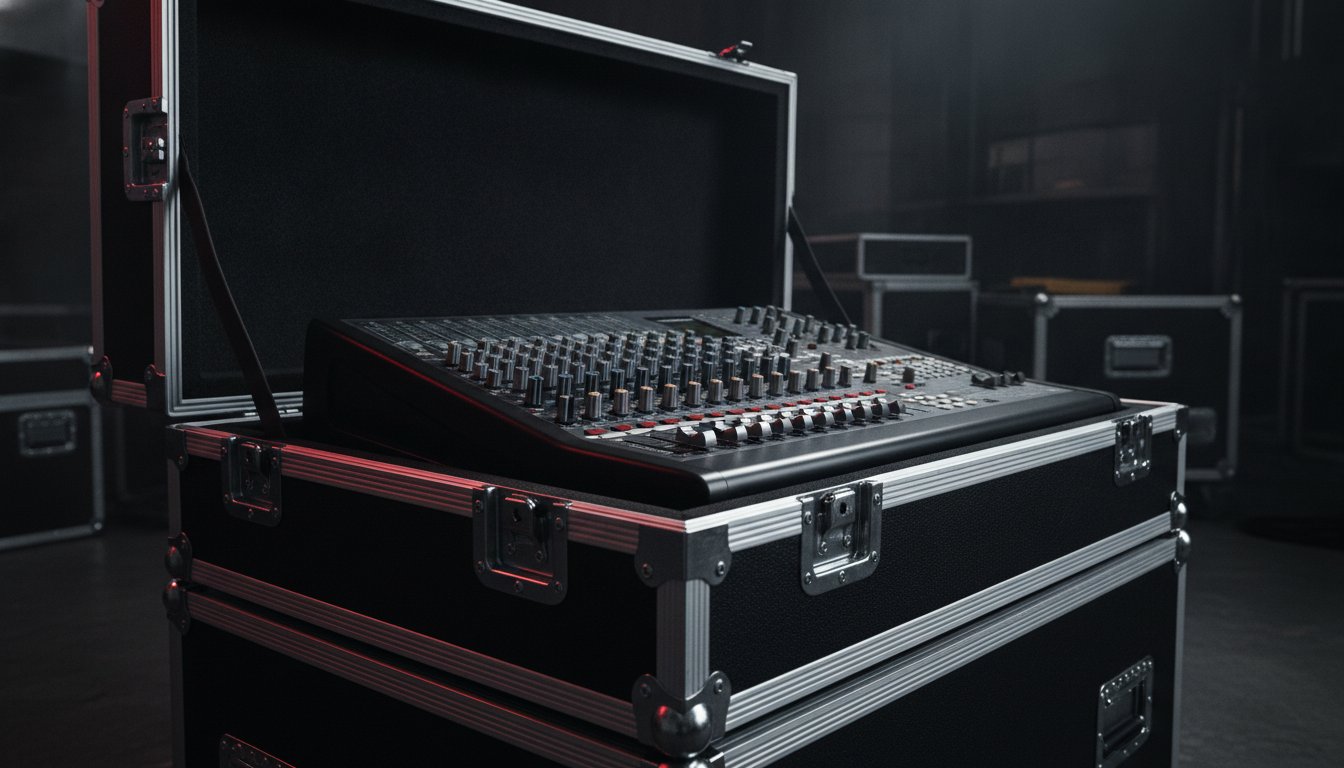
A professional mixer case is not merely a container. It's a mechanical insurance policy engineered to absorb kinetic energy and protect mixer console cases in environments where equipment failure is not an option. You recognize that a single sheared fader or a crushed potentiometer during transit represents more than a repair cost; it signifies a critical failure in the production chain. Protecting these sensitive interfaces requires a shift from viewing transit as a logistical hurdle to treating it as an engineering challenge.
This guide details the rigorous technical standards and material science essential for professional equipment protection within high-stakes touring circuits. You'll learn the specific requirements of ATA 300 Category I compliance, which mandates durability for at least 100 round-trip shipments. We'll also analyze how 3/8-inch laminated plywood and high-density foam work in tandem to provide maximum shock absorption. By understanding these structural specifications and the integration of ergonomic features like gas-spring technology, you can significantly reduce equipment downtime and ensure your console remains operational through the most demanding schedules.
Key Takeaways
- Analyze the specific mechanical properties of EVA, Polyethylene, and Ester foams to determine the optimal shock absorption for sensitive fader banks.
- Evaluate the operational efficiency of integrating processing hardware into specialized mixer console cases to create a unified mobile command center.
- Identify why 3/8-inch to 1/2-inch professional-grade laminates are the required standard for maintaining structural integrity under heavy stacking loads.
- Utilize a technical checklist to verify console dimensions, ensuring clearance for protruding knobs and antennas while confirming caster load ratings for heavy-duty transport.
- Discover how the engineering partnership with Santosom provides Portuguese precision and industrial-grade durability for professional-tier production environments.
Why Professional Mixer Console Cases are Essential for Live Production
Modern digital mixing consoles are high-value precision instruments. Unlike standard rack gear, these consoles feature expansive fader banks and sensitive touchscreens that are exceptionally vulnerable to vertical pressure. During transit, a single stack of heavy equipment placed atop an insufficient lid can compress the internal foam, transferring the load directly onto the faders. This mechanical stress causes bent stems or internal sensor misalignment, leading to signal degradation or total component failure. Professional mixer console cases are engineered to divert these external forces through a rigid exoskeleton, ensuring that the console remains isolated from physical impact.
Quantifying the return on investment for high-performance protection requires looking beyond the initial purchase price. The cost of a single fader bank replacement often exceeds the price of a premium case; when you factor in the labor for specialized technicians and the loss of rental income, the financial risk of using substandard containers becomes clear. The resale value of professional audio equipment is tied directly to its physical condition. A console maintained within a shipping container specifically designed to protect its structural integrity will command a significantly higher market price than one showing signs of impact or environmental wear. These cases also mitigate environmental threats like humidity shifts and particulate ingress, which can corrode internal circuitry over time.
The High Cost of Equipment Failure
Equipment failure at a live event is a catastrophic scenario that professional production companies cannot afford. A console that arrives dead-on-arrival (DOA) due to transport damage results in more than just a repair bill. It leads to potential breach of contract, damaged client reputations, and the immediate need for expensive local rentals. Standard consumer-grade cases often fail under the weight of professional touring loads because they lack the necessary structural reinforcement. Utilizing ProX Cases ensures your gear is housed in an enclosure designed for the rigors of frequent loading and unloading. This level of protection is essential for long-term equipment maintenance and operational reliability.
Logistical Efficiency and Transport
Beyond physical protection, the engineering of a case impacts the overall efficiency of a production. Standardized external dimensions allow for optimized truck pack density, ensuring that equipment fits securely without shifting during transit. This spatial optimization reduces the number of vehicles required and lowers fuel costs. Ergonomic case design, including recessed handles and heavy-duty latches, reduces labor fatigue and speeds up setup times. Stackable hardware is another critical requirement for warehouse storage, allowing for vertical organization without risking the stability of the stack. When mixer console cases are designed with these logistical realities in mind, they become a tool for streamlining the entire production workflow.
The Engineering Behind High-Performance Mixer Protection
High-performance mixer console cases rely on a synergy of material science and mechanical assembly. These enclosures use a rigid exoskeleton to manage physical stress. Every component is selected based on its ability to withstand repetitive kinetic impacts. This engineering approach ensures that the internal electronics remain isolated from external vibration. Professional-grade protection is not a luxury. It's a functional requirement for any high-stakes production environment where equipment reliability is the baseline for success.
Material Science: Plywood and Laminates
The structural foundation of a professional case is its plywood core. 3/8-inch (9mm) plywood is the standard for mid-sized consoles, providing a high strength-to-weight ratio. Large-format consoles require 1/2-inch (12mm) plywood to maintain torsional rigidity under extreme loads. Honeycomb laminates offer a significant mechanical advantage over traditional flat finishes. The hexagonal surface pattern increases scratch resistance and helps hide the inevitable wear of touring. This laminate also provides an additional layer of moisture resistance. ATA 300 Category 1 is a technical requirement for cases designed to withstand a minimum of 100 shipments.
Shock Mounting and Internal Architecture
Internal protection depends on precise foam selection. High-density EVA foam provides a firm grip on the console chassis, preventing lateral movement. Polyethylene and Ester foams offer different levels of compression and rebound to absorb vertical shocks. Calculating foam density is essential to prevent the console from shifting during high-G deceleration. Doghouse compartments are a critical design feature for professional workflows. They provide a recessed space for cable management, protecting delicate multi-pin connectors and power cables from mechanical strain. If a console stays in its base during a show, thermal management is a priority. Internal architecture must facilitate consistent airflow to prevent heat buildup in the processing units and power supplies.
Hardware standards are equally rigorous. Recessed butterfly latches prevent accidental opening and stay protected from shear forces during stacking. Spring-loaded handles ensure a flush profile. This is critical for the safe operation of the equipment when using material handling tools like forklifts or lift gates. Every handle and latch is a point of potential failure. We prioritize heavy-duty steel components with zinc plating to ensure longevity and corrosion resistance. You can explore our full range of engineered protection solutions to find a match for your specific hardware.
Evaluating Case Configurations: From Desktop to Touring Rigs
Selecting the correct configuration for mixer console cases requires a balance between transport protection and operational speed. While the engineering standards discussed previously provide the foundation, the physical layout of the case must accommodate the specific logistics of the venue. Standard flight cases remain the benchmark for dedicated transport. They provide a secure environment for long-term storage and high-frequency shipping. However, modern production environments often demand more integrated solutions that consolidate multiple pieces of hardware into a single mobile unit.
Workflow Optimization with Integrated Cases
Integrated designs like Mixer & Rack Combo Cases are essential for mobile church applications or corporate AV gigs. These configurations allow engineers to house signal processors, power conditioners, and wireless receivers directly beneath the mixing surface. This consolidation minimizes cabling errors and reduces setup time. For live streaming and remote production, AV Broadcasting Cases provide a similar advantage by housing monitors and switchers alongside the audio interface.
For large-format digital consoles, the physical weight of the desk becomes a logistical barrier. Flip Ready designs utilize gas-spring technology to facilitate one-person deployment. This mechanism allows a heavy console to rotate from its vertical transport position to a horizontal operational state with minimal manual lifting. This engineering solution, developed by ZCASE in Poland, slashes labor costs and prevents physical strain on the crew. It transforms a two or three-person lift into a controlled, single-operator task.
Custom vs. Universal Fits
The choice between a universal fit and a custom-engineered interior is a critical decision for equipment longevity. Universal foam inserts often rely on "pick and pluck" cubes or generic friction points. These materials degrade over time, leading to console shifting and potential impact damage. Precision CNC-cut interiors are mandatory for digital consoles. A CNC-milled foam nest ensures that the chassis is supported at specific structural points while maintaining a safe clearance for faders and touchscreens. If an off-the-shelf solution cannot accommodate specialized dimensions or unique outboard gear, ZCASE Custom Build Cases provide the necessary precision. Balancing the overall case weight against the level of protection is a calculated trade-off. While heavier 12mm plywood offers maximum durability, it may exceed airline weight limits for smaller consoles. Selecting the right materials ensures that the case remains a functional asset rather than a logistical liability.

Selecting the Right Protection: A Buyer’s Checklist for Console Cases
Selecting mixer console cases requires a systematic verification of technical specifications. Vague compatibility claims often lead to fitment issues that compromise the safety of the console. You must measure the exact dimensions of the desk, accounting for all protruding faders, knobs, and antennas. A case that's too tight causes mechanical stress on these components, while excessive clearance allows for shifting during transport. Use this checklist to evaluate structural integrity before purchase:
- Verify console dimensions: Include all protruding knobs, antennas, and rear-panel connectors in your measurements.
- Inspect caster ratings: 4-inch heavy-duty wheels with locking brakes are the professional standard for managing the high center of gravity in large consoles.
- Check for reinforced ball corners: These steel components are designed to deflect impact energy away from the plywood core and internal electronics.
- Ensure industrial-grade sealing: Aluminum tongue-and-groove sealing combined with industrial-grade rivets ensures structural rigidity and environmental protection.
- Confirm logistical compatibility: Ensure the case footprint is compatible with existing ProX Truss or staging setups to optimize truck pack density.
Critical Hardware Inspection
Recessed hardware is superior to surface-mounted components because it prevents shear forces from snagging on other equipment during loading. Test the tension of every butterfly latch; they must provide a secure, airtight seal without requiring excessive force. Handle weight-bearing capacity is a critical safety metric for heavy consoles. Stay-hinges are another essential feature. They provide lid stability during operation and prevent the lid from accidentally closing on the engineer's hands or the console interface. These mechanical details distinguish a professional-tier enclosure from a generic storage box.
Maintenance and Longevity
A professional case is a long-term investment that requires periodic maintenance. Identify components that are prone to wear, such as casters and rubber feet, and ensure they are easily replaceable. Clean the honeycomb laminates with a mild, non-abrasive solution to prevent dirt buildup and potential delamination. Utilizing ProX Cases Replacement Parts ensures that localized wear or damage to latches and casters doesn't necessitate the decommissioning of the entire structural enclosure. Maintaining the hardware's mechanical function is the only way to guarantee consistent protection over hundreds of deployments.
Ensure your equipment protection meets these rigorous engineering standards by selecting from our verified inventory of mixer console cases.
ProX Engineering: Meticulous Protection for Industry-Standard Consoles
Since 1984, ProX has established a legacy of engineering performance gear that prioritizes structural integrity over aesthetic trends. We don't view a case as a simple storage box; it's a critical component of the production signal chain. Our manufacturing processes utilize high-precision CNC machining and rigorous load-testing to ensure every enclosure meets the physical demands of high-stakes environments. This commitment to functional excellence is why touring professionals rely on our enclosures to protect high-value assets from brands like Pioneer DJ, QSC, and Roland. When the success of a performance depends on the reliability of the hardware, the engineering of the protective shell becomes paramount.
Our strategic partnerships expand our ability to offer specialized protection for flagship digital desks. The collaboration with Santosom brings professional-grade Portuguese engineering to the US market, combining European design standards with industrial durability. For engineers managing the most complex large-format consoles, ZCASE Custom Builds from Poland provide advanced mechanical solutions. These cases incorporate gas-spring mechanisms and specialized internal architecture designed specifically for the most demanding touring circuits. These partnerships allow us to provide a comprehensive range of solutions that address the unique ergonomic and protective requirements of modern digital interfaces.
The ProX Advantage
The ProX advantage is rooted in a deep understanding of the physical stresses placed on professional gear. Our engineering team focuses on precision tolerances to ensure that mixer console cases provide a secure, movement-free environment for sensitive electronics. This meticulous approach extends to our global dealer network, which provides touring crews with consistent access to our products and support. You can explore our full range of Mixer Console Cases to find engineered solutions for all major industry brands. We maintain a high inventory of replacement parts to ensure that your protection remains functional through years of heavy use.
Building Your Production Rig
Operational efficiency is maximized when your entire equipment inventory follows a unified logistical logic. Integrating your console protection with specialized LED Video Panel Wall Support cases creates a standardized ecosystem for truck packs and warehouse storage. This consistency reduces the margin for error during high-pressure load-ins and load-outs. A unified case ecosystem allows for predictable weight distribution and stacking stability, which are essential for safe transport. If your production requires a unique configuration that standard models don't cover, we encourage you to contact an authorized dealer for custom engineering project quotes. Our team is prepared to develop tailored solutions that meet the specific mechanical and logistical needs of your professional rig.
Securing Your Professional Production Infrastructure
Professional equipment protection is a calculated investment in operational reliability. By prioritizing ATA 300 Category 1 compliant designs, you ensure your console withstands the rigors of at least 100 round-trip shipments. Engineering precision in mixer console cases, from CNC-cut foam interiors to 1/2-inch plywood cores, prevents the mechanical stress that leads to component failure and costly downtime. These technical standards are the baseline for maintaining equipment that stays functional through demanding schedules.
Since 1984, we've focused on delivering performance-gear that touring professionals worldwide trust for high-stakes environments. Maintaining your cases with verified replacement parts and conducting regular hardware inspections will extend the life of your gear and preserve its resale value. Whether you're managing a local corporate event or a global tour, the structural integrity of your enclosure remains the primary defense against the unpredictable demands of transit. You can rely on our established manufacturing standards to keep your production moving forward without interruption.
Browse the Professional Mixer Console Case Collection and secure the long-term reliability of your audio equipment today.
Frequently Asked Questions
What is the difference between an ATA 300 case and a standard road case?
An ATA 300 Category I case is a technical specification requiring the enclosure to withstand a minimum of 100 round-trip shipments. While standard cases may appear similar, they often lack the verified material testing for plywood thickness, hardware shear strength, and impact resistance. ATA-compliant mixer console cases provide a documented baseline for durability in high-frequency logistics environments where equipment failure is not an option.
How do I measure my mixer console for a custom case?
You must measure the absolute maximum dimensions of the console, including all protruding hardware such as fader stems, master knobs, and rear-panel antennas. Use a precision tape measure to record the width, depth, and height at the widest points. These measurements ensure the CNC-cut internal foam provides a secure fit without applying mechanical stress to sensitive control surfaces or interface ports during transit.
Are plastic molded cases as good as plywood flight cases for professional use?
Plywood flight cases are the industry standard for professional touring due to their superior torsional rigidity and kinetic energy absorption. While plastic molded cases offer a lower tare weight, they often lack the structural reinforcement required for heavy stacking in truck packs. Plywood with honeycomb laminates provides a more resilient exoskeleton that protects internal electronics from compression and shear forces during heavy-duty handling.
Can I keep my mixer inside the case during a live performance?
You can safely operate a mixer within its case if the enclosure features a doghouse or sufficient ventilation clearance. Thermal management is critical because modern digital processing units generate significant heat. Ensure that internal airflow is not obstructed by cables or foam and check that the console's cooling fans have at least two inches of clearance from the case walls to prevent overheating.
What type of foam is best for protecting sensitive mixer faders?
High-density EVA foam is the optimal choice for supporting the console's chassis because it prevents lateral shifting. For the lid, a combination of medium-density Polyethylene and softer Ester foam provides a cushioned seal. This specific layering prevents vertical pressure from being transferred directly to fader stems and touchscreens, which are the most vulnerable components of mixer console cases.
Do I need casters on my mixer console case?
Casters are a functional requirement for any console case weighing over 50 lbs to prevent physical strain and facilitate efficient loading. Professional rigs utilize 4-inch heavy-duty wheels with locking brakes to maintain a stable center of gravity. These components allow a single operator to move heavy desks safely across venue floors and up loading ramps without risking impact damage from manual lifting errors.
What is a "doghouse" in a mixer case and do I need one?
A doghouse is a specialized rear compartment designed to house cable looms and protect multi-pin connectors from mechanical strain. It allows for a clean workspace by concealing the cabling while the console remains in the case base. You need a doghouse if your setup involves complex signal routing or if you frequently deploy the console in environments where rapid connectivity and connector protection are essential.
How do I maintain the latches and hinges on my flight case?
Maintain latches and hinges by inspecting rivet integrity and cleaning hardware with a mild, non-abrasive solution to prevent corrosion. Periodically check the tension of butterfly latches to ensure a secure seal is maintained. If components become bent or lose their spring tension, utilize ProX Cases Replacement Parts to restore the structural enclosure to its original engineering specifications and ensure continued equipment protection.
Disclaimer
Any trademarks, trade names or brand names appearing herein that do not belong to ProX are the property of their respective owners and/or companies, and such appearance doesn't and shall not constitute or imply endorsement, sponsorship or recommendation by ProX.


