
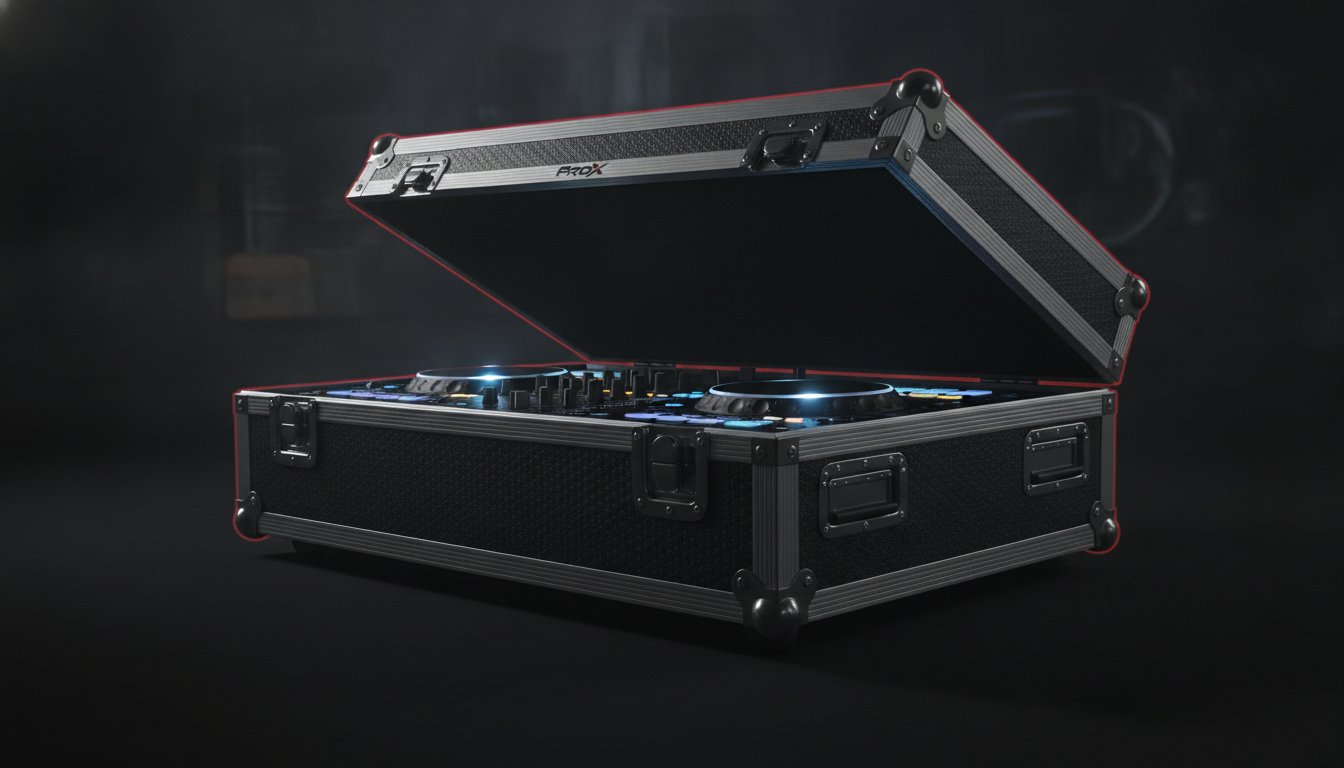
A professional DJ controller case is not a storage accessory. It's a critical logistical asset that determines the survival of your hardware and the efficiency of your tour footprint. When you're managing high-stakes productions, the difference between a standard container and an engineered workstation is measured in equipment lifespan and setup speed. We understand that equipment failure isn't an option. You need gear that withstands the physical demands of professional use while maintaining a standardized footprint for efficient transport.
This guide provides an authoritative, engineering-focused comparison of protection solutions for 2026. You'll gain a technical understanding of how to select cases based on structural integrity and material science. We'll examine the mechanical requirements of the ATA 300 Category I specification and how modular truck-pack dimensions optimize your logistics. This analysis covers everything from 3/8" laminated plywood construction to the integration of specialized hardware, ensuring your setup achieves zero-failure transport and a professional stage presence.
Key Takeaways
- Understand the mechanical requirements of ATA-300 Category 1 certification to ensure equipment survival through 100 or more round trips.
- Learn why 3/8-inch laminated plywood and Honeycomb Digital™ surfaces provide the structural rigidity required for high-frequency touring.
- Discover how to optimize your logistical footprint by selecting a dj controller case that adheres to standardized truck pack dimensions for 90-inch and 96-inch trailers.
- Compare the functional benefits of standard utility builds versus integrated sliding shelf workstations to maximize booth efficiency in cramped environments.
- Evaluate the engineering advantages of model-specific ProX solutions versus custom-built Santosom cases for unique or complex equipment arrays.
The Engineering Standards of a Professional DJ Controller Case
A professional dj controller case serves as the primary defense against mechanical failure in high-stakes production environments. In this industry, aesthetics are secondary to structural survivability. A Road Case must maintain its integrity through extreme logistical cycles without compromise. CNC precision engineering ensures that every component fits with zero-tolerance accuracy, eliminating the internal movement that leads to hardware degradation. When you're managing expensive digital assets, the engineering behind the container is what dictates your operational uptime.
Understanding ATA-300 Compliance in Gear Protection
ATA-300 Category 1 serves as the definitive industrial benchmark for cases engineered to withstand a minimum of 100 round trips. This standard requires rigorous testing, including documented drop tests and sustained vibration resistance metrics. Industrial-grade tour cases protect delicate internal soldering and PCB integrity from the high-frequency vibrations common in truck transport and air freight. Unlike consumer-grade storage solutions, these units are built for repetitive, high-impact environments where equipment failure results in immediate financial loss. Choosing a compliant dj controller case ensures that your hardware remains functional after thousands of miles of transit.
The Anatomy of Shock-Absorbing Interior Foam
Effective protection requires a calculated balance between support and impact displacement. High-density foam provides the necessary structural foundation to hold the controller's weight, while lower-density layers absorb the energy of external shocks. Custom-cut EVA foam inserts are superior to generic pick-and-pluck solutions because they provide continuous contact points across the entire chassis. This precise fit prevents lateral movement during heavy vibration, ensuring that sensitive faders and encoders remain calibrated. The interior lining acts as a mechanical buffer, isolating the hardware from the rigid exterior shell.
Structural integrity depends on the quality of the raw materials and the assembly method. Heavy-duty steel ball corners and aluminum extrusions reinforce the plywood panels, creating a rigid exoskeleton. This design prioritizes functional excellence over emotional appeal, focusing on the physical attributes that prevent chassis warping. In a professional touring environment, the case isn't just a box; it's a piece of precision machinery designed to interface with other logistical assets. Every latch, handle, and rivet is a critical point of failure that must be engineered for long-term expertise and reliability.
Comparing Case Architectures: Standard, Sliding Shelf, and Workstations
Standard utility cases prioritize physical shielding and logistical density. These designs focus on the ATA 300 Specification for container construction, ensuring the hardware survives high-impact transit cycles. While standard cases offer a smaller footprint, they lack the integrated workflow found in more complex architectures. Workstations and sliding shelf designs represent a shift from simple protection to on-site operational efficiency. The choice of architecture depends on the specific demands of your tour, balancing the weight of the unit against the speed of the setup.
The Ergonomics of Integrated Laptop Shelves
Sliding mechanisms must maintain absolute stability under heavy performance vibration. A high-quality dj controller case utilizes reinforced steel rails to prevent shelf sagging or unintended movement during a set. This vertical optimization is critical in cramped DJ booths where horizontal surface area is unavailable. Ergonomically, the shelf height dictates the user's posture. Proper alignment reduces physical fatigue during extended performances. Integrated routing ports allow for permanent cable installation, which creates a clean stage presence and eliminates the risk of accidental disconnection during a show.
Flip Ready™ and ZCASE Workstation Innovations
Efficiency in tour management is measured by the time it takes to move from the truck to a performance-state. ProX Cases featuring Flip Ready™ technology, engineered by ZCASE in Poland, reduce this window to under three minutes. These systems utilize a mechanical hydraulic or manual rotation design that allows a heavy console to be deployed without lifting the hardware out of the base. This architecture integrates power distribution, cooling fans, and cable management into a single logistical unit. It's a specialized solution for professionals who prioritize functional excellence and rapid deployment.
Choosing between these architectures involves a calculated trade-off. Standard cases are lighter and easier to stack in 90-inch truck packs. Workstations are heavier but eliminate the need for external stands and complex cabling on-site. For professionals managing high-frequency tours, the increased weight of a workstation is often offset by the reduction in labor hours during load-in. You can explore the full range of workstation configurations to determine which mechanical layout fits your specific touring requirements. Every dj controller case in this category is designed to serve as a reliable backbone for professional production.
Material Science: Plywood Grades, Laminates, and Hardware
Engineering a tour-grade dj controller case requires a deep understanding of material stress and physical durability. The primary structural component is 3/8-inch (9mm) laminated plywood. This specific thickness is the industry standard because it offers the optimal ratio of structural rigidity to weight. Thinner materials fail to provide the puncture resistance needed in high-density truck packs, while thicker panels add unnecessary weight that complicates logistics. The plywood panels are bonded under high pressure to ensure they meet the rigorous ATA Spec 300 guidelines for reusability and impact protection.
Laminate Technology and Surface Durability
The external protection of a case depends heavily on its laminate layer. The Honeycomb Digital™ surface design isn't just an aesthetic feature; it's a functional innovation. This hexagonal pattern creates a raised texture that minimizes the surface area prone to direct scratching, effectively hiding the wear and tear of a touring schedule. Beyond physical abrasion, these laminates must withstand chemical exposure from cleaning agents or venue spills. High-quality bonding ensures that the laminate doesn't peel or bubble when exposed to rapid thermal changes, which is a common occurrence when moving gear from climate-controlled stages to unheated transport vehicles.
Hardware Specifications for Long-Term Reliability
Hardware is the skeletal system of the container. Professional ProX Cases utilize industrial-grade components designed for maximum deflection. Chrome-plated steel ball corners are a critical engineering feature. Their rounded geometry ensures that if a case is dropped, the force is distributed across the corner rather than being focused on a single point. This prevents the chassis from warping and protects the internal controller from shock.
Mechanical reliability also depends on how these components are attached. Dual-anchor rivets are used to secure handles and latches, providing a far more permanent bond than standard screws or fasteners. Butterfly latches are recessed into the case body to prevent them from shearing off during transit. These latches provide a high-tension closure that maintains the seal even under intense vibration. Spring-loaded handles are another essential feature, designed to sit flush with the case when not in use. This low-profile design is vital for maintaining a standardized footprint, allowing for the tight packing required in professional tour management.

Logistical Efficiency: Truck Pack Standards and Tour Management
Efficient tour management relies on standardized dimensions. A dj controller case that doesn't adhere to industry-standard truck pack dimensions is a logistical liability. Standardizing case footprints for 90, 93, or 100-inch truck widths ensures that every cubic inch of transport space is utilized. This precision reduces transit movement and lowers overall shipping costs. When cases fit together in a predictable grid, production crews can execute load-ins and load-outs with significantly higher speed and accuracy.
Optimizing TruckPaX™ density is about more than just fitting gear into a trailer. It's about maximizing logistical ROI by eliminating "air space." Wasted volume in a truck or sea container represents wasted capital. By utilizing modular case dimensions, such as 22.5-inch or 30-inch widths, production companies can create a unified footprint across their entire inventory. This systematic approach allows a dj controller case to sit flush alongside other tour assets, creating a stable block of equipment that resists shifting during high-speed transit.
Caster Engineering and Stacking Security
Industrial-grade 4-inch casters are the foundation of mobile logistics. These components must be rated for high load capacities while maintaining low roll-resistance on various surfaces. High-frequency touring places immense stress on the swivel and axle of the caster, making regular maintenance and high-quality bearings essential for longevity. Stacking security is managed through the use of integrated caster dishes. These recessed plates in the case lid lock the wheels of the case above it into place. This mechanical connection prevents stack collapse during sudden braking or sharp turns, ensuring the safety of both the equipment and the crew. You can view our TruckPaX™ compatible cases to see how these engineering features integrate into professional workflows.
Standardized Dimensions for Global Logistics
Standardized footprints allow for modular packing in sea containers and trucks, facilitating seamless international transport. This modularity is critical when integrating diverse equipment types into a single shipment. For example, integrating AV-Broadcasting-Cases into a unified truck pack ensures that different departments don't compete for irregular space. Every case becomes a modular block in a larger logistical puzzle. This uniformity simplifies the manifest process and ensures that regardless of the venue or the vehicle, the gear will fit. It's a professional standard that prioritizes the practical realities of global production over haphazard storage methods.
Bespoke vs. Off-the-Shelf: Engineering the Right ProX Solution
The decision between an off-the-shelf dj controller case and a bespoke solution is driven by the complexity of the equipment array. Off-the-shelf models are precision-engineered for specific hardware, ensuring a zero-tolerance fit for high-volume units like the Pioneer DDJ-REV7 or RANE ONE. These cases provide immediate availability and standardized logistical footprints for rapid deployment. Conversely, universal utility solutions offer flexibility for rental houses managing rotating inventories. Professional-grade cases serve as a protective shell that preserves the mechanical integrity of the hardware, which directly impacts the equipment's long-term resale value. Secondary markets prioritize gear that has been housed in tour-grade protection over units transported in soft bags or consumer-grade containers.
The Santosom Custom Engineering Process
Custom-engineered Santosom cases address the needs of specialized tours where standard configurations are insufficient. The process begins with CAD design to map the exact coordinates of multi-component setups. This allows for the integration of controllers, mixers, and lighting interfaces into a single, unified workstation. ZCASE custom builds from Poland exemplify this high-end engineering, utilizing hydraulic systems and specialized foam densities to secure unique equipment configurations. Investing in custom foam inserts provides a high ROI by eliminating the risk of internal component shifting in non-standard hardware. These bespoke builds ensure that every connection point and ventilation port is accessible without compromising the structural integrity of the container.
Selecting the Correct Case for Your Workflow
Choosing the right protection requires an evaluation of your specific operational environment. Mobile DJs often prioritize a balance between physical weight and transportability, favoring cases with integrated wheels and low-profile handles. In contrast, touring production houses focus on standardized external dimensions and maximum structural rigidity for high-density truck packs. Use the following criteria for your selection process:
- Verify the plywood grade and laminate technology for high-frequency touring.
- Assess the need for integrated workstations versus standard storage.
- Confirm compatibility with 90-inch or 96-inch truck widths for logistical efficiency.
- Evaluate the long-term protection of custom-cut EVA foam over generic inserts.
Structural integrity is the primary metric for gear health. While lighter cases may seem convenient for local transport, they often lack the impact deflection required for industrial logistics. Prioritizing a professional-grade dj controller case ensures your hardware remains a functional asset throughout its operational lifecycle. Investing in the correct architecture today prevents the catastrophic costs of equipment failure during a performance tomorrow. Functional excellence and engineering precision are the only reliable defenses in the high-stakes environment of professional production.
Optimizing Your Tour Logistics with Engineered Protection
Selecting the correct dj controller case is a technical decision that dictates the long-term reliability of your equipment and the speed of your production. We've analyzed how ATA-300 compliance, 3/8-inch plywood construction, and standardized truck pack dimensions create a dependable logistical framework. These specifications ensure your hardware survives the rigorous mechanical stresses of global transport while maintaining a professional stage presence. Since 1984, ProX has been engineering high-performance gear that touring professionals trust to protect their Pioneer DJ, QSC, and Roland equipment.
Whether you require a model-specific workstation with Flip Ready technology or a bespoke Santosom solution for a complex array, the priority is functional excellence. Our custom design-and-build services are available to meet unique technical requirements that off-the-shelf solutions can't address. Investing in precision-engineered protection is the most effective way to safeguard your hardware's resale value and operational uptime. We invite you to Browse the complete ProX professional case catalogue to secure your next logistical asset. Build your setup on a foundation of industrial authority and engineering precision that never compromises on quality.
Frequently Asked Questions
What is the difference between a standard flight case and an ATA-300 certified case?
ATA-300 Category 1 is the industrial benchmark for cases engineered to survive a minimum of 100 round trips. While many containers utilize similar aesthetics, true certification requires documented testing for impact deflection and vibration resistance. This ensures the internal electronics of your dj controller case remain intact after repeated logistical cycles through air and ground transport.
Do I need a sliding laptop shelf for my DJ controller case?
Sliding shelves are essential for optimizing vertical space in cramped booths where horizontal surface area is limited. They allow for permanent cable installation and provide a stable platform for laptops or small interfaces. If your priority is a minimal transport footprint and you utilize external stands, a standard utility case may be more efficient for your specific tour logistics.
Are professional DJ cases compatible with standard truck-pack dimensions?
Professional-grade cases are engineered to fit 90-inch and 96-inch truck widths. Standardized dimensions, such as 22.5-inch or 30-inch modules, allow for a zero-gap truck pack. This maximizes logistical ROI and prevents equipment from shifting during transit, which is a primary cause of chassis warping and hardware failure.
What is the benefit of the Honeycomb Digital™ laminate on ProX cases?
The Honeycomb Digital™ laminate features a hexagonal pattern that creates a raised texture on the case surface. This design minimizes the surface area in direct contact with other objects, effectively hiding scratches and abrasions. It maintains the professional appearance of the equipment even after years of high-frequency touring and heavy handling.
Can I get a custom-built case for a modified DJ controller setup?
Bespoke engineering is available for unique or modified equipment arrays through Santosom and ZCASE. These builds utilize CAD design to create precise foam inserts and internal routing for multi-component setups. This is the optimal solution for professionals using non-standard hardware combinations that require integrated power and cooling.
How do recessed handles and butterfly latches improve case durability?
Recessing hardware components protects them from being sheared off during the loading and unloading process. Butterfly latches provide a high-tension mechanical bond that won't vibrate loose under intense transit conditions. Spring-loaded handles sit flush with the case body, allowing for tighter packing in sea containers or trailers without snagging.
What maintenance is required for tour-grade case casters and hardware?
Maintenance involves checking swivel bearings for debris and ensuring axle bolts are tightened to specification. High-frequency tours place significant stress on 4-inch casters, so regular lubrication and hardware inspection are necessary to maintain low roll-resistance. Latch tension and rivet integrity should also be verified to ensure the structural shell remains secure.
Is a hard-shell case necessary if I only do local mobile DJ gigs?
Hard-shell protection is vital even for local transport to prevent fader and encoder damage during vehicle loading. Soft cases don't offer the puncture resistance or stacking security required when gear is transported alongside speakers or lighting stands. Using a professional dj controller case ensures your hardware remains a functional asset throughout its operational lifecycle.
Disclaimer
Any trademarks, trade names or brand names appearing herein that do not belong to ProX are the property of their respective owners and/or companies, and such appearance doesn't and shall not constitute or imply endorsement, sponsorship or recommendation by ProX.


