

A professional transport solution is not a luxury; it's a critical component of the signal chain that ensures operational continuity. Selecting the right all-in-one DJ controller case requires a shift from aesthetic preferences toward a rigorous analysis of structural engineering and material science. You understand that a single mechanical failure or a shifted internal component during transit can jeopardize an entire production. High-stakes environments leave no room for equipment shifting or impact damage caused by inferior housing.
This guide provides the technical specifications and ATA 300 engineering standards required to secure high-value hardware in rigorous touring environments. You'll learn how to evaluate shell integrity and internal foam densities to maximize gear longevity and total ROI. We'll examine high-density CNC-cut foam tolerances, Honeycomb Digital surface protection, and the logistical advantages of standardized dimensions for professional truck packs. By prioritizing functional excellence over simple storage, you ensure your workstation remains a reliable backbone for every performance.
Key Takeaways
- Learn why 3/8-inch (9mm) plywood and Honeycomb Digital™ surfaces are the engineering standards for structural integrity in professional touring.
- Understand the importance of ATA 300-style construction in mitigating mechanical failure during repeated logistical cycles.
- Discover how a precision-engineered all-in-one DJ controller case improves operational speed through integrated workstation features.
- Evaluate the role of CNC-cut high-density foam in preventing internal component shifting and long-term hardware fatigue.
- Optimize logistical efficiency by selecting cases with standardized dimensions for truck packs and international transit compliance.
The Engineering Necessity for All-In-One DJ Controller Protection
All-in-one controllers represent a significant shift in production efficiency, but they introduce a critical single point of failure. Unlike modular setups where a malfunctioning media player can be isolated and replaced, a damaged all-in-one unit compromises the entire performance. This centralized architecture makes the selection of an all-in-one DJ controller case a foundational requirement for any professional tour. Standard soft bags and consumer-grade sleeves provide negligible protection against vertical compression or lateral impact. When equipment is stacked in a trailer or handled by local stagehands, the shell must withstand several hundred pounds of pressure without transferring that force to the internal hardware.
Transitioning from basic storage to industrial-grade logistics requires an understanding of how a Road case functions as a protective exoskeleton. High-value gear requires a rigid barrier that prevents the chassis from flexing. If the controller's frame bends even slightly, internal circuit boards can crack or desolder. This level of protection is only achievable through standardized professional cases built to endure the physical stresses of global transit.
Mechanical Risks of All-In-One Hardware
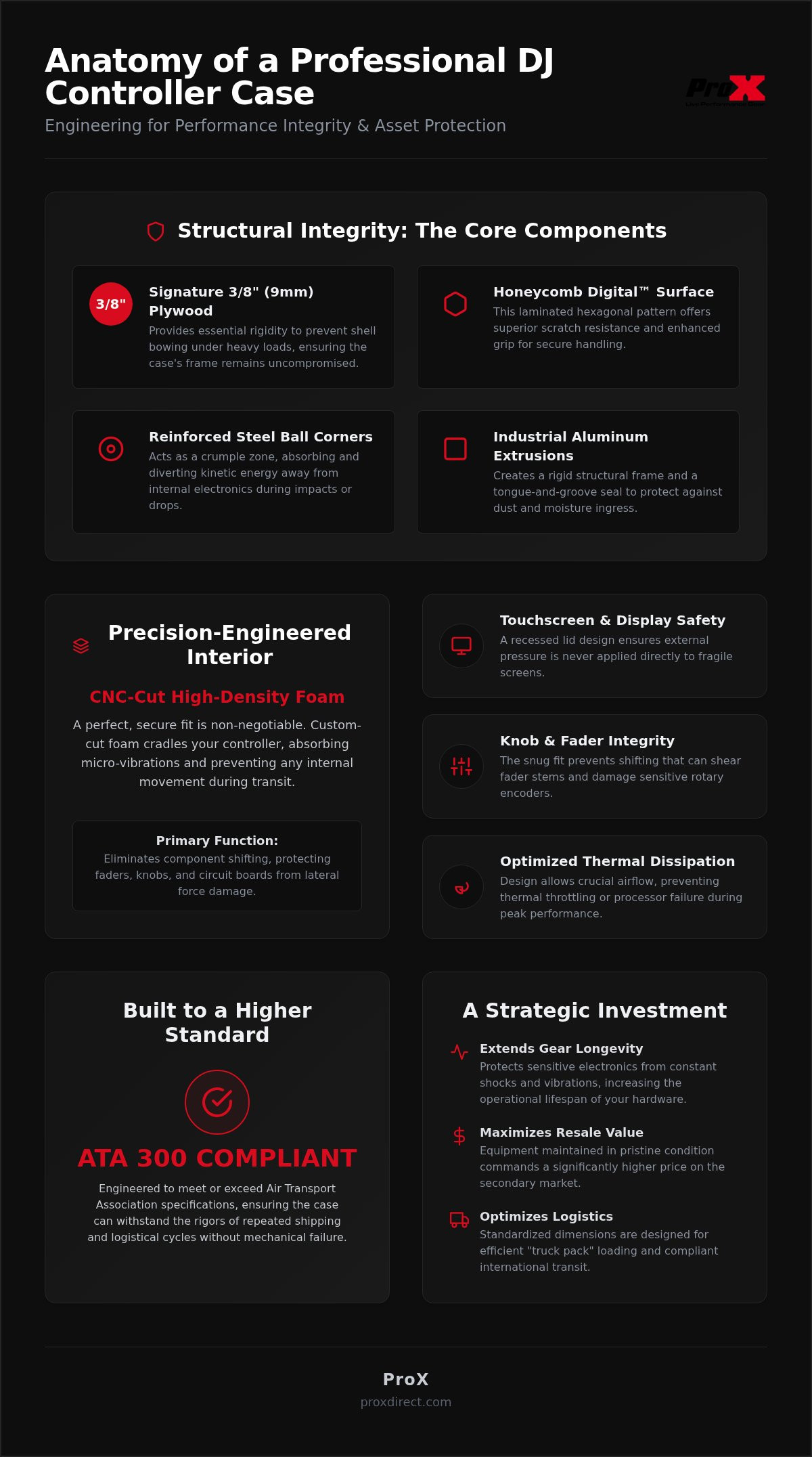
Modern flagship controllers often feature large, integrated touchscreens that are highly susceptible to pressure-induced cracking. Without a recessed lid and precision-cut foam, any weight placed on the case exterior can press directly against the glass. Knob and fader shear are also common results of poor internal fit. If the unit shifts even a few millimeters during transit, the lateral force can snap fader stems or damage rotary encoders. Effective case engineering also accounts for thermal dissipation. All-in-one units generate considerable heat during extended sets. A well-designed case ensures that the unit remains elevated and ventilated, preventing thermal throttling or processor failure during peak performance.
The ROI of Industrial-Grade Housing
Investing in high-quality housing is a strategy for long-term asset management. Gear longevity is directly tied to the stability of its environment. By eliminating micro-vibrations and impact shocks, you extend the mechanical life of every button and fader. Maintaining your hardware in a dedicated all-in-one DJ controller case also pays dividends during equipment upgrades. Controllers maintained in pristine condition command significantly higher resale values on the secondary market. For touring production companies, utilizing standardized protection can even assist in managing insurance liabilities. Demonstrating a commitment to professional-grade hardware protection reduces the likelihood of claims and ensures that the backbone of your production remains operational night after night.
Structural Integrity: The Anatomy of a Professional Case
The structural integrity of an all-in-one DJ controller case depends on the synergy between material choice and mechanical assembly. While consumer cases often utilize thinner materials to reduce shipping costs, professional-grade housing relies on 3/8-inch (9mm) plywood. This thickness provides the necessary rigidity to prevent the shell from bowing under the weight of stacked equipment in a trailer. The exterior is typically finished with Honeycomb Digital™ surfaces. This hexagonal pattern isn't just aesthetic; it provides superior scratch resistance and enhances grip during manual handling in humid or low-light environments.
Impact absorption is managed by a framework of aluminum extrusions and reinforced steel ball corners. These components act as a crumple zone, diverting kinetic energy away from the sensitive internal electronics during a drop or collision. The aluminum extrusions utilize a tongue-and-groove fit to create a dust-resistant seal when the lid is closed. By utilizing heavy-duty hardware, manufacturers ensure the case maintains its geometric alignment even after years of loading cycles. You can explore the full range of these industrial-grade enclosures to see these engineering standards in practice.
Plywood and Lamination Standards
Professional construction utilizes cross-grain lamination to maximize structural stability. This process involves bonding multiple layers of wood with alternating grain directions, which prevents warping when exposed to varying humidity levels. In coastal venues or high-temperature outdoor stages, this stability is vital for maintaining the case's seal. Standardized plywood also ensures that surface textures remain consistent, providing a predictable friction coefficient that prevents the case from sliding across stage decks or truck floors during transit. The bond between the laminate and the plywood must be industrial-strength to prevent delamination under extreme thermal stress.
Industrial Hardware Specifications
Hardware selection focuses on mechanical reliability and corrosion resistance. Zinc-plated steel is the preferred material for butterfly latches and spring-action handles, as it resists oxidation in high-moisture environments. Recessed hardware is another critical engineering choice. By mounting latches and handles within the plane of the case wall, the design facilitates high-density truck packs. This flush profile prevents hardware from snagging on adjacent cases or straps during loading. Industrial-grade rubber feet complete the assembly, providing essential vibration isolation from sub-bass frequencies. These feet are bolted through the plywood to ensure they remain attached under lateral shear forces during positioning.
Maximizing Workflow with Integrated Workstation Features
A professional all-in-one DJ controller case functions as more than a protective shell; it's a mobile command center designed to minimize setup and strike times. In professional production, every minute spent on cable management and peripheral positioning is a minute lost to sound checks and technical rehearsals. The integrated workstation concept prioritizes functional excellence by allowing the hardware to remain patched and ready for operation immediately after removing the lid. This approach transforms the case into a stable performance platform that maintains its mechanical integrity under the high-vibration conditions of a live stage. For those who want to perfect their performance in a similarly high-end setting, you can check out Book a DJ Studio for a fully equipped, professional space.
Cable management is a primary engineering focus in these designs. High-quality cases include dedicated rear access ports and internal routing channels. These features allow for permanent power and data connections, reducing the wear on the controller's physical ports caused by repeated insertion and removal cycles. By utilizing internal space for cable looms, the workstation maintains a clean, professional aesthetic while preventing accidental disconnections during a performance.
The sliding laptop platform is a critical component for modern digital workflows. Engineering these shelves requires a focus on smooth travel and absolute stability. Industrial-grade drawer slides ensure the platform moves without resistance, while locking pins or friction stops prevent unwanted movement during intense use. These platforms are rated for specific weight capacities to support professional laptops, external drives, and MIDI controllers without bowing. To ensure the safety of the hardware, the surface often utilizes high-density foam or hook-and-loop fasteners to secure the laptop in place. This design allows the screen to be positioned at an ergonomic height, reducing neck strain for the operator during extended sets.
Rack Integration and Power Management
Advanced case designs often incorporate 1U or 2U rack spaces beneath the main controller compartment. This space is essential for housing wireless microphone receivers, power conditioners, or drive recorders. Integrating these peripherals into an all-in-one DJ controller case creates a "one-plug" setup. You can connect a single power inlet to the case to energize the controller and all rack-mounted gear simultaneously. Thermal management is vital here. Engineers include ventilated panels or specific spacing to ensure that heat generated by power supplies doesn't affect the primary hardware. This consolidation of equipment into a single professional case simplifies logistics and ensures that all necessary tools are present at every venue.
Logistical Considerations: Dimensions, Weight, and Truck Pack Efficiency
Logistical efficiency determines the profitability and safety of a touring production. When selecting an all-in-one DJ controller case, engineering must extend beyond the internal protection of the hardware to the external footprint of the enclosure. Global logistical compatibility requires cases to adhere to standardized dimensions that maximize density in shipping containers and standard trailers. This standardization prevents shifting during transit and reduces the risk of equipment damage caused by improper stacking. A case that doesn't conform to these footprints creates "dead space," which increases shipping costs and compromises the stability of the entire load.
Caster engineering is another vital logistical factor. For indoor corporate environments, industrial rubber feet provide sufficient vibration isolation. However, for large-scale touring, 4-inch industrial wheels with locking brakes are the professional standard. These casters are bolted to a reinforced plywood caster plate to distribute weight and prevent hardware shear during high-impact loading on ramps. You can optimize your logistics by exploring the technical specifications of our professional case inventory.
Truck Pack Standardization
Modular loading is a cornerstone of professional touring. ProX engineers cases to align with the dimensions of standard 90-inch or 96-inch wide trailers. This ensures that an all-in-one DJ controller case fits seamlessly alongside other production assets without creating gaps. By optimizing dimensional weight, production companies can significantly reduce shipping costs. For comprehensive logistical planning, you can review the technical specifications of TruckPaX™ Truck Pack Cases to understand how these modular systems facilitate high-density loading and secure transit.
Weight Management and Ergonomics
The tradeoff between material thickness and portability is a constant engineering challenge. While 9mm plywood provides superior protection, it increases the total load. Strategic handle placement is essential for managing this weight safely. Professional cases feature recessed spring-action handles positioned to facilitate two-person lifts, adhering to standard occupational safety practices. For mobile professionals utilizing air travel, weight limits are a primary concern. Standard airline checked baggage typically has a 50 lb weight limit and a 62 linear inch size limit. Exceeding these can result in fees ranging from $100 to $200 per segment. Engineering a case that stays within these parameters while utilizing industrial-grade materials requires precise CAD modeling and material optimization.
Selecting Your Case: Compatibility and Custom Engineering
Selecting the correct all-in-one DJ controller case requires a precise understanding of the physical dimensions and connector placements of your hardware. While universal cases offer a baseline of protection, professional touring demands precision fits that account for micro-tolerances in chassis design. A mismatch between the internal foam and the controller frame can lead to localized pressure points, which can damage internal circuit boards or compromise the exterior finish. Professional equipment procurement often involves collaboration with an authorized dealer network. This ensures that the selected housing meets the specific technical requirements of the production fleet and aligns with existing logistical workflows.
Long-term fleet management also necessitates a strategy for maintenance and component replacement. Industrial-grade cases are engineered for durability, but the mechanical nature of latches, handles, and wheels means that parts may eventually require replacement after years of rigorous cycles. Maintaining a stock of ProX Cases Replacement Parts ensures that the structural integrity of the housing remains intact throughout its operational life. This proactive maintenance approach maximizes the ROI on the initial investment by extending the service life of the protective shell well beyond the lifespan of the controller itself.
Brand-Specific Precision Fits
Engineering for flagship models from AlphaTheta and Denon DJ involves detailed CAD analysis to ensure that every port, fader, and touchscreen is protected. You can consult the Professional DJ Equipment Case Purchase Guide for specific compatibility data regarding current 2026 flagship models. Custom-fit foam inserts are vastly superior to universal solutions because they provide multi-axis support. This prevents the unit from shifting during vertical or lateral impacts, which is critical for protecting the high-resolution touchscreens and sensitive jog wheels found on modern all-in-one units. The foam density is calculated to absorb kinetic energy without transferring it to the controller's chassis.
Bespoke Solutions and Custom Builds
For unique production configurations that involve non-standard peripherals or integrated control systems, bespoke engineering is the only viable path. In these scenarios, utilizing ZCASE Custom Build Cases provides access to specialized manufacturing in Poland. These solutions are engineered to house complex workstations that include multiple screens, secondary controllers, or custom power distribution units. ProX engineering support assists in the design phase, ensuring that the final build meets all logistical and structural standards required for global touring environments. This level of customization allows production teams to create a highly specialized all-in-one DJ controller case that serves as a unique backbone for their specific performance requirements.
Engineering for Long-Term Operational Continuity
Protecting high-value hardware requires a transition from basic storage to industrial-grade logistics. You've seen how 3/8-inch plywood, Honeycomb Digital surfaces, and ATA 300-style construction form a necessary exoskeleton for modern controllers. These engineering standards prevent mechanical fatigue and ensure that integrated touchscreens remain functional throughout rigorous touring cycles. By focusing on structural integrity and internal tolerances, you eliminate the single point of failure inherent in complex all-in-one units.
Logistical efficiency is equally critical for professional production. Standardizing your all-in-one DJ controller case dimensions for truck packs reduces dead space and lowers shipping overhead. Since 1984, we've manufactured performance gear trusted by major brands like Pioneer DJ and QSC. This long-term expertise is supported by a global network of authorized dealers who understand the physical demands of professional gear. You can Browse the complete catalog of ProX DJ Controller Cases to find the exact configuration for your flagship hardware. Prioritize the integrity of your build to ensure every performance remains technically flawless.
Frequently Asked Questions
What is the difference between ATA 300-style cases and standard flight cases?
ATA Specification 300 defines specific durability categories for air transport. Category I cases must withstand 100 round trips, while Category II covers at least 10 trips. Generic flight cases often lack these verified engineering benchmarks. A professional-grade case utilizing these standards ensures structural integrity during repeated logistical cycles. This distinction is critical for production crews managing high-value assets across international borders where handling conditions are often unpredictable.
How do I ensure my all-in-one controller fits perfectly in a universal case?
Achieving a precise fit in a universal all-in-one DJ controller case requires the use of high-density, adjustable foam blocks. You must measure the controller's chassis dimensions, including protruding knobs and fader stems. Secure the equipment using hook-and-loop fasteners on the foam to prevent internal shifting. This multi-axis support is vital for protecting integrated touchscreens from pressure-induced cracking during vertical or lateral impact events in a truck pack.
Are sliding laptop shelves stable enough for scratching and heavy performance?
Sliding laptop platforms are engineered for stability during intense performance if they utilize industrial-grade steel slides. These platforms feature locking pins or friction stops to prevent movement during high-vibration scratching or heavy drumming. You should verify the weight capacity rating to ensure the shelf supports professional laptops and MIDI accessories. A reinforced plywood base prevents the platform from bowing, maintaining a level surface for ergonomic operation throughout the show.
Can I add wheels to a case that did not come with them?
Adding wheels requires a secondary 18mm or 3/4-inch caster plate to distribute the load across the plywood base. Bolting 4-inch industrial wheels directly to the 9mm case wall can result in material shear when the case is pushed over thresholds or ramps. You must use zinc-plated carriage bolts that pass through both the shell and the caster plate. This modification is essential for solo operators managing heavy workstations in large-scale venues.
What is the benefit of the Honeycomb Digital surface over smooth lamination?
The Honeycomb Digital surface utilizes a hexagonal pattern that provides a higher friction coefficient than smooth lamination. This design enhances grip during manual handling and prevents cases from sliding across stage decks. Additionally, the textured surface hides micro-abrasions and scratches that typically occur during frequent loading cycles. This maintains the professional aesthetic of your equipment fleet while providing a durable barrier against environmental factors like moisture and heat.
How do I maintain the latches and handles on my DJ road case?
Maintenance involves regular inspection of zinc-plated steel hardware for signs of mechanical wear or oxidation. You should apply a dry silicone lubricant to the butterfly latches to ensure smooth operation. Check the integrity of all rivets and bolts, especially those securing the spring-action handles. Cleaning the hardware with a non-corrosive solution is necessary in coastal environments to prevent salt-induced pitting. This proactive care extends the service life of the protective housing.
Is it possible to rack-mount wireless units inside my controller case?
Advanced case designs often incorporate 1U or 2U internal rack spaces specifically for wireless microphone receivers or power conditioners. Integrating these peripherals into your all-in-one DJ controller case simplifies the signal chain and enables a "one-plug" setup. You must ensure that the rack compartment includes ventilated panels to manage heat dissipation. This configuration protects sensitive RF equipment within the same rugged exoskeleton used for the primary controller, optimizing logistical efficiency.
Disclaimer
Any trademarks, trade names or brand names appearing herein that do not belong to ProX are the property of their respective owners and/or companies, and such appearance doesn't and shall not constitute or imply endorsement, sponsorship or recommendation by ProX.


