

A standard foam insert is not a suspension system, and treating it as such is a frequent cause of catastrophic gear failure. Many professionals assume that any soft material provides adequate cushioning, yet improper density often leads to bottoming out or internal shifting during high-G transit events. You understand that when sensitive electronics or delicate optics are on the line, the margin for error is zero. Protecting high-value assets requires a shift from basic padding to intentional mechanical engineering.
By reading this guide, you'll discover the technical specifications and engineering principles behind high-performance custom flight case foam designed for professional production equipment. We'll break down the material science of closed-cell polyethylene versus open-cell polyurethane to help you choose the right density for your specific payload. You'll also learn the critical difference between impact absorption and vibration damping, ensuring your gear survives the rigors of global logistics. This overview covers everything from CNC precision tolerances to professional branding integration, providing the technical data you need to secure your inventory for the long term.
Key Takeaways
- Define foam as a mechanical suspension system designed to mitigate G-force impacts rather than simple padding.
- Differentiate between material compositions and densities to match specific equipment load requirements and prevent compression sets.
- Learn how 3D CAD design and CNC cutting produce custom flight case foam with precision tolerances for high-value production gear.
- Optimize internal case layouts by calculating the center of gravity and organizing accessories to prevent secondary damage during transit.
- Implement a systematic maintenance schedule to inspect for material degradation and clean closed-cell surfaces for long-term performance.
Understanding the Engineering Principles of Custom Flight Case Foam
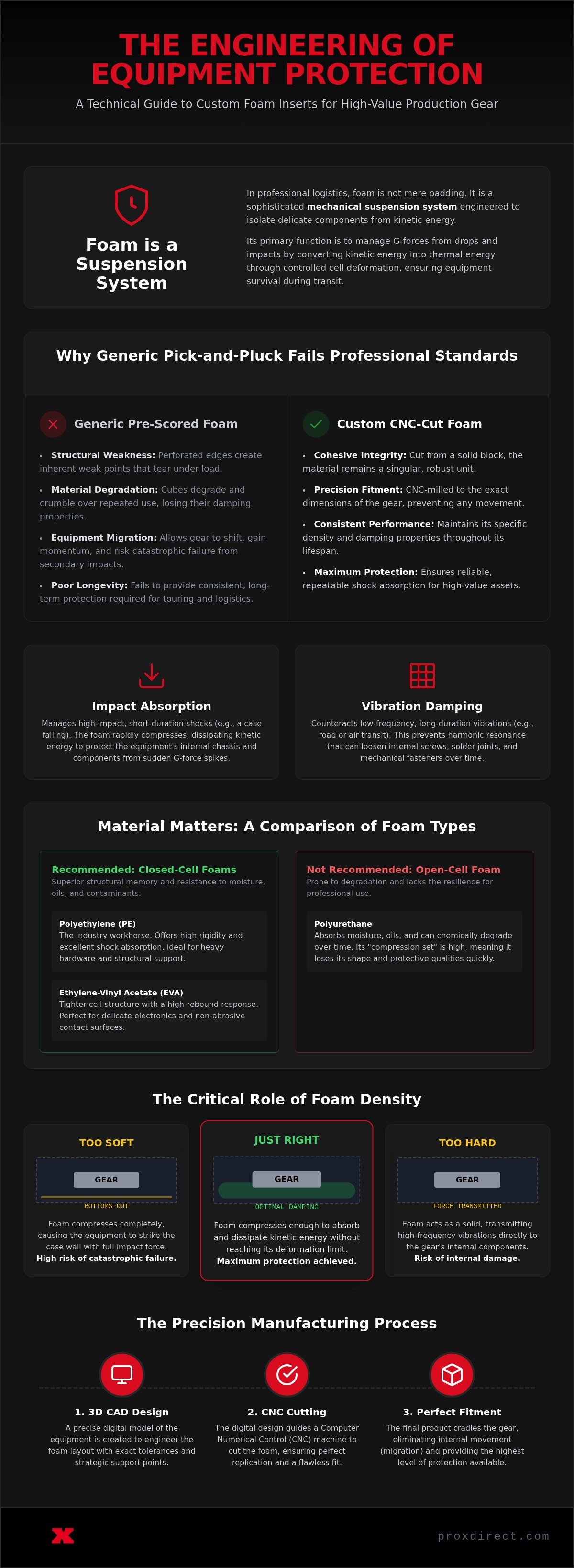
In professional logistics, custom flight case foam acts as a sophisticated mechanical suspension system rather than simple padding. Its primary function is to isolate delicate circuitry and mechanical components from the kinetic energy generated during transit. When a case is dropped or subjected to rapid deceleration, the foam must manage the resulting G-forces by converting kinetic energy into thermal energy through cell deformation. This process requires a deep understanding of the engineering principles of foam, specifically how cell structure influences load-bearing capacity and energy dissipation.
Distinguishing between surface protection and structural shock absorption is critical for equipment longevity. Surface protection prevents abrasions and cosmetic wear. In contrast, structural shock absorption protects the internal chassis of your gear. If the foam is too soft, the equipment bottoms out against the case wall. If it's too hard, the impact force is transmitted directly to the equipment. Precision fitment ensures no migration occurs. Even a few millimeters of "play" allows gear to gain momentum during a jolt, significantly increasing the risk of a catastrophic failure.
The Physics of Impact and Vibration Damping
Foam absorbs energy through compression, where the cell walls buckle and dissipate the force. High-impact shocks, such as a case falling off a loading dock, require different material responses than low-frequency vibrations found in a moving truck. Vibration damping prevents the harmonic resonance that can loosen internal screws or solder joints over thousands of miles. Deceleration distance is the total thickness of the foam available to slow down the equipment before it reaches a full stop.
Why Generic Pick-and-Pluck Fails Professional Standards
Pre-scored foam cubes offer convenience but lack structural integrity. The perforated edges create inherent weak points that tear under the weight of heavy amplifiers or lighting fixtures. Over repeated touring cycles, these cubes degrade and allow the equipment to shift. In contrast, solid blocks used in ProX Cases are CNC-cut to the exact dimensions of the gear. This ensures the material remains a singular, cohesive unit that maintains its damping properties throughout the lifespan of the equipment.
Evaluating Foam Densities and Material Composition
Selecting the appropriate material for custom flight case foam requires an analysis of both the payload mass and the required deceleration rate. Professional manufacturers primarily utilize closed-cell foams, such as Polyethylene (PE) and Ethylene-Vinyl Acetate (EVA), due to their superior structural memory and resistance to moisture. Unlike open-cell polyurethane, which can absorb oils and degrade over time, closed-cell materials provide a stable chemical profile. This prevents off-gassing and protects sensitive finishes from environmental contaminants during long-term storage.
The relationship between equipment weight and foam density is a critical engineering calculation. Foam that is too soft will bottom out during a high-impact event, causing the equipment to strike the case wall with nearly 100% of the force. Conversely, foam that is too hard acts like a solid transmitter. It passes high-frequency vibrations directly into the gear's internal components, potentially loosening solder joints or mechanical fasteners. Achieving the correct balance ensures the foam compresses just enough to absorb kinetic energy without reaching its limit of deformation.
Polyethylene (PE) vs. Ethylene-Vinyl Acetate (EVA)
Polyethylene is the industrial workhorse of the touring industry. It offers high rigidity and excellent shock absorption for heavy hardware. For more delicate electronics or items requiring a smoother aesthetic finish, EVA foam provides a high-rebound response and a tighter cell structure. In complex builds, engineers often use a hybrid approach. This involves layering high-density PE for the base support and softer EVA for the contact surfaces. This methodology ensures maximum structural integrity while maintaining a non-abrasive interface for the equipment.
Selecting the Correct Density (lb/ft³) for Your Gear
Foam performance is measured in pounds per cubic foot (lb/ft³). Lighter gear typically requires lower-density foam to allow for compression, while heavier payloads require higher densities to prevent sagging. Surface area also dictates pressure distribution; a thin, heavy item exerts more PSI than a wide, heavy one. For example, Stage Truss and Base Plate Cases require high-density PE to withstand the extreme static loads and sharp edges of metal components. When designing a bespoke solution, utilizing CNC foam cutting allows for precise material removal, ensuring the density remains consistent across the entire insert. For your next project, consider how a professionally engineered ProX case can optimize your equipment's safety profile.
The Precision Manufacturing Process: CAD Design to CNC Cutting
The transition from material selection to a finished custom flight case foam insert involves a rigorous engineering workflow. It begins with the acquisition of precise equipment dimensions, either through 3D scanning or official manufacturer technical drawings. These data points are imported into CAD (Computer-Aided Design) software to create a digital twin of the payload. Unlike manual cutting methods, digital prototyping allows engineers to simulate the interaction between the equipment and the foam before any material is sacrificed. This stage is critical for identifying potential interference points or insufficient wall thicknesses that could compromise the case's structural integrity.
CNC (Computer Numerical Control) routing is the industry standard for deep inserts. While laser cutting is effective for thin gaskets, it often results in tapered edges and heat-affected zones in thicker foam blocks. CNC routing maintains vertical sidewall integrity and allows for varied depth pockets within a single foam sheet. This precision is vital for layering, where multiple levels of storage are nested to maximize case volume. By utilizing multi-axis routing, engineers create complex, stepped interiors that accommodate protruding knobs, faders, and connectors without requiring excessive external case dimensions. For those who want to learn more about CNC Cut to Size and how precision routing technology is applied across various industrial materials, professional CNC services offer the high-tolerance solutions required for such complex designs.
Engineers must account for "squeeze" or interference fit during the design phase. A pocket that's exactly the size of the equipment may be too tight for easy removal or too loose to prevent migration. CAD designs include specific tolerances for compression, alongside functional features like finger-pulls and dedicated cavities for cable management. Advanced projects also integrate custom branding through precision engraving or contrasting foam layering for a professional aesthetic. These details ensure that the interior is as functional as it is protective.
ZCASE and Santosom: Bespoke Engineering Standards
For high-value production gear, ZCASE Custom Build Cases represent the pinnacle of bespoke engineering. These projects leverage global partnerships with Santosom and ZCASE in Poland to deliver consistent quality across international borders. While many requirements are met by the ProX-Cases category, bespoke builds provide the granular control needed for unique console configurations or sensitive broadcasting arrays. This collaborative process ensures the final product meets the exact mechanical demands of the professional user while maintaining the highest standards of durability.
Strategic Foam Layouts for High-Value Production Equipment
Designing a custom flight case foam layout requires more than spatial efficiency; it requires a precise calculation of the center of gravity. If the mass is distributed unevenly, the case becomes unstable during transit or while being moved on casters. Engineers strategically place the heaviest components at the base of the case to lower the center of gravity and prevent tipping. Beyond the primary payload, accessory organization is a critical safety factor. Heavy power cables, mounting brackets, or ballasts must be isolated in dedicated, reinforced cavities. This isolation prevents accessories from migrating during transit and striking delicate components like glass lenses or PCB arrays.
Thermal management is another engineering priority for gear that remains in the case during operation. Ventilation cavities are carved into the foam to facilitate heat dissipation from cooling fans. Without these engineered air gaps, internal temperatures can quickly exceed manufacturer-specified safety limits. From a logistical perspective, standardized internal layouts provide significant benefits for large production crews. When every case in a fleet follows an identical internal schematic, inventory management becomes instantaneous. Technicians can verify that all components are present at a glance, which streamlines the load-out process and reduces the risk of lost gear.
Optimizing AV and Broadcasting Configurations
AV Broadcasting Cases require specialized foam geometries to protect sensitive control surfaces. Digital consoles often feature motorized faders and large touchscreens that can't tolerate vertical pressure. Engineers utilize "floating" foam designs that secure the chassis while maintaining a clearance gap over the interactive surfaces. Additionally, trap-door foam designs allow for rear-panel cable access. This enables technicians to patch gear without removing it from the foam suspension, which doesn't compromise the protection during the event.
Lighting Rig and Moving-Head Protection
This degree of specialized protection is a core requirement for the sophisticated equipment provided by United Broadcast & Media Solutions (UBMS), where maintaining the integrity of professional video and cinema cameras is essential for high-stakes production workflows.
Heavy lighting fixtures require specialized foam cradles that support both the yoke and the head independently. This dual-point support prevents the tilt-lock mechanism from bearing the full weight of the fixture during a high-impact event. Securing lenses and internal reflectors requires high-rebound contact points that dampen high-frequency vibrations. For large-scale deployments, such as those utilizing LED Video Panel Wall Support, consistent layouts ensure that panels aren't subjected to uneven stress during stacking. To optimize your workflow and protect your assets, browse our selection of ProX Cases for a professional-grade storage solution.
Maintaining and Upgrading Your Custom Foam Inserts
Professional grade custom flight case foam is engineered for longevity, but it remains a consumable component within your logistics ecosystem. Environmental factors, repeated compression cycles, and accidental contamination can eventually degrade the material's damping properties. A systematic maintenance schedule ensures that your gear continues to receive the calculated protection defined during the initial design phase. For closed-cell materials like PE and EVA, cleaning is straightforward. Use compressed air to remove abrasive dust from the cavities; for stubborn debris, a damp cloth with mild detergent is sufficient. Avoid solvent-based cleaners, as these can alter the chemical structure of the foam and lead to premature hardening or shrinkage.
It's often more cost-effective to replace a foam insert than to decommission an entire case. If the outer plywood shell and extrusion profiles remain structurally sound, a new precision-cut insert can extend the life of your fleet by several years. During your hardware inspections, verify the integrity of latches, handles, and casters. If mechanical components show wear, utilizing ProX Cases Replacement Parts allows you to maintain the external shell while upgrading the internal suspension system. This modular approach to case maintenance reduces long-term capital expenditure while ensuring equipment safety remains uncompromised.
Identifying Signs of Foam Fatigue
The most critical sign of failure is "bottoming out," which occurs when the material reaches its compression set limit. When the foam fails to return to its original height after the equipment is removed, its ability to absorb kinetic energy is significantly diminished. While closed-cell foams are resistant to the crumbling common in open-cell polyurethane, they can still develop surface abrasions that allow equipment to shift. We recommend a full inspection of high-frequency touring gear every six months. If you notice the gear "sinking" deeper into the pocket than it did when new, the foam has lost its rebound and requires immediate replacement.
Custom Retrofitting for Existing Cases
Upgrading legacy cases with modern engineering is a viable path for many production houses. The process involves taking accurate internal measurements of your existing shell and providing the technical specifications of your new equipment. This allows for a seamless transition to ZCASE engineering standards without the cost of new external hardware. By retrofitting with high-density PE or EVA, you can bring older inventory up to current professional standards. To begin the design process for a bespoke interior, consult with a ProX engineer for your next custom project. Our team provides the technical oversight needed to ensure your retrofitted inserts provide a perfect, high-tolerance fit.
Securing Your Production Inventory for Global Transit
Professional grade protection is built on the intersection of material science and mechanical engineering. By understanding the specific density requirements of your payload and utilizing precision custom flight case foam, you eliminate the variables that lead to equipment failure. We've explored how CAD modeling and CNC routing create a suspension system that manages G-force impacts and vibration damping with industrial accuracy. Strategic layouts that account for the center of gravity and thermal management further ensure that your gear remains operational regardless of the logistical challenges ahead.
ProX has been engineering performance gear since 1984, providing the precision CNC manufacturing trusted by global touring professionals. Whether you require a bespoke interior for a digital console or a standardized fleet of storage solutions, our technical team delivers the structural integrity your inventory demands. Don't leave your high-value assets to chance with generic padding when engineered protection is available. Your equipment's longevity depends on a foundation of functional excellence and meticulous build quality.
Explore ProX Custom Engineering and Santosom Case Solutions to optimize your touring infrastructure today. We look forward to helping you secure your most critical gear for the long haul.
Frequently Asked Questions
What is the best foam density for heavy audio amplifiers?
High-density polyethylene (PE) is the standard for heavy audio amplifiers, typically requiring a density of 2.0 lb/ft³ or higher. This density provides the necessary structural support to prevent the chassis from bottoming out during high-impact events. Using foam that is too soft allows the amplifier to strike the case walls, while the correct PE density ensures the kinetic energy is absorbed through controlled cell deformation without compromising the material's rebound properties.
Can I get custom foam for a case I already own?
Yes, you can retrofit an existing case with a new custom insert. The process requires precise internal dimensions of the case shell and the technical specifications of your equipment. Engineers use this data to create a CAD model that ensures a high-tolerance fit within your current hardware. This is a cost-effective way to upgrade legacy inventory to professional engineering standards without the capital expenditure of purchasing entirely new external cases.
What is the difference between PE and EVA foam in flight cases?
Polyethylene (PE) is a rigid, durable material designed for heavy hardware and structural support. Ethylene-Vinyl Acetate (EVA) foam offers a higher rebound rate and a smoother surface finish, making it ideal for protecting delicate electronics or interactive control surfaces. While PE handles the primary load-bearing duties, EVA is often used as a contact layer in custom flight case foam designs to provide non-abrasive protection for sensitive gear and high-value components.
How do I measure my equipment for a custom foam insert?
Measuring equipment for a custom insert requires capturing the maximum length, width, and depth using digital calipers. You must account for all protrusions, including knobs, faders, and rear-panel connectors. For complex geometries, providing the manufacturer's technical drawings or utilizing 3D scanning ensures the CAD model is accurate. This precision prevents equipment migration and ensures that the foam suspension system functions as intended during global logistics and heavy handling.
Is closed-cell foam better than open-cell for touring?
Closed-cell foam is significantly better for touring applications than open-cell alternatives. Materials like PE and EVA don't absorb moisture, oils, or environmental contaminants, which prevents material degradation and off-gassing. Open-cell foam often crumbles over time, creating abrasive dust that can damage internal circuitry. Closed-cell foam maintains its structural memory through thousands of miles, providing consistent damping and protection for high-value production equipment in diverse climates.
How long does the custom foam engineering process take?
The timeline for the custom engineering process depends on the complexity of the equipment and the required design tolerances. It begins with the digital prototyping phase in CAD, followed by material selection and CNC routing. Each project undergoes a rigorous verification process to ensure the final insert meets the structural requirements of the payload. While timelines vary, the focus remains on delivering a precision-engineered solution that withstands the physical demands of professional use.
Can custom foam include compartments for cables and accessories?
Yes, custom flight case foam designs frequently include dedicated cavities for cables, mounting brackets, and power supplies. Integrating these accessories into the primary insert prevents them from shifting during transit and causing secondary impact damage to the equipment. Engineers strategically place these compartments to maintain the case's center of gravity, ensuring the entire unit remains stable and balanced when being moved by production crews in high-stakes environments.
Does custom foam protect against moisture and humidity?
Closed-cell foam provides a high degree of protection against moisture and humidity because its cell structure is sealed. This prevents the material from acting like a sponge, which is a common failure point for cheaper, open-cell padding. By resisting water absorption, the foam maintains its weight and damping characteristics in diverse climates. This moisture resistance is vital for protecting sensitive electronics from corrosion and environmental wear during long-term storage or sea freight.
Disclaimer
Any trademarks, trade names or brand names appearing herein that do not belong to ProX are the property of their respective owners and/or companies, and such appearance doesn't and shall not constitute or imply endorsement, sponsorship or recommendation by ProX.


