

A single millimeter of calibration drift can turn a high-stakes production schedule into an expensive troubleshooting session. For event professionals, the transit phase is often the most volatile part of the project. You've likely dealt with the frustration of unboxing a printer only to find internal mechanical damage or inconsistent output caused by persistent road vibration. These technical failures don't just delay setups; they threaten the reliability of your service and your bottom line.
Professional Printer Cases are more than simple transport containers. They function as precision-engineered environmental stabilizers designed to maintain hardware integrity under harsh logistical conditions. By utilizing engineering-grade materials and CNC-precision manufacturing, these cases mitigate the risks of mechanical shock and environmental hazards. You'll discover how specialized construction and standardized dimensions ensure zero-damage transit while improving truck-packing efficiency. This article details the structural specifications and technical advantages of investing in professional-grade protection for your sensitive production hardware. We will examine how industrial-strength builds allow you to focus on performance rather than equipment failure.
Key Takeaways
- Identify how mechanical isolation and ATA-300 standards protect sensitive internal components from calibration drift during heavy transit.
- Review the structural specifications of professional Printer Cases, focusing on the utility of laminated plywood and reinforced recessed hardware.
- Assess the logistical advantages of trolley-style designs and lift-off lids for rapid deployment in high-pressure production environments.
- Learn how standardized exterior dimensions and the TruckPaX™ system facilitate efficient truck packing and minimize equipment handling risks.
- Gain insights into the engineering precision provided by the Santosom partnership for specialized production hardware protection.
Understanding the Technical Requirements of Professional Printer Cases
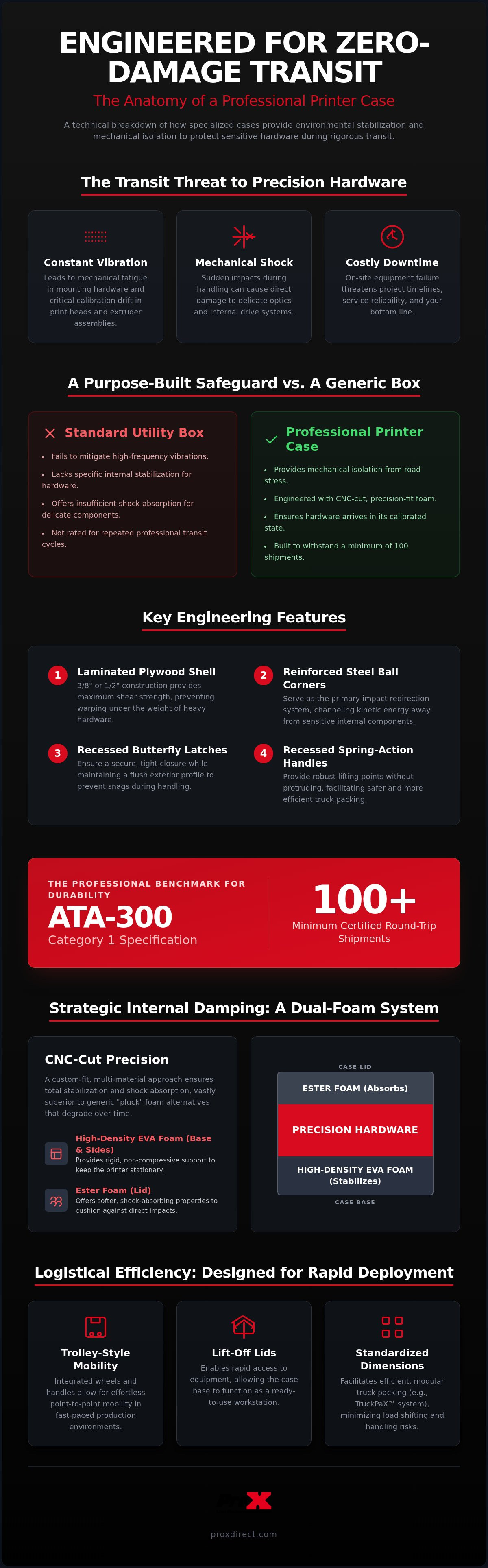
A professional-grade printer case is a specialized protective housing engineered to meet the rigorous ATA-300 Category 1 specification. Unlike general utility boxes, these enclosures provide mechanical isolation to protect sensitive internal components from the kinetic energy generated during professional transit. Production-grade printers contain intricate drive systems, delicate optics, and smart sensors—like those developed by Contrinex for complex automation—that require significantly higher shock absorption than standard rack-mounted audio gear. A generic box simply doesn't offer the precision-cut internal stabilization needed to secure a printer's specific center of gravity.
Professional Printer Cases prioritize structural integrity to ensure hardware arrives in its calibrated state. While a utility box might prevent scratches, it fails to mitigate the transfer of high-frequency vibrations that lead to component fatigue. Engineering these cases involves a deep understanding of material science and mechanical assembly to create a reliable backbone for event logistics. This specialized approach distinguishes professional enclosures from budget alternatives that lack the reinforcement necessary for long-term touring.
The Impact of Vibration on Precision Printing Hardware
Continuous micro-vibrations during long-haul transport present a major risk to dye-sublimation print heads. These vibrations can cause mechanical fatigue in mounting hardware, leading to significant calibration drift before the equipment is even powered on. In the context of 3D printers, vibration often results in the displacement of the build plate or the misalignment of the extruder assembly. Mechanical isolation is the primary goal of professional case engineering, serving to decouple the hardware from external logistical stressors. Without this isolation, the cumulative effect of road vibration leads to inconsistent output quality or total component failure at the event site.
ATA-300 Standards and Touring Durability
The Air Transport Association (ATA) 300 Category 1 specification is the technical benchmark for professional touring durability. This standard requires that the enclosure withstand a minimum of 100 round-trip shipments without compromising the safety of the contents. Achieving this level of resilience necessitates the use of high-impact materials, such as heavy-duty laminated plywood and reinforced steel hardware. For a deeper technical analysis of these requirements, consult The Ultimate Guide to Flight Cases. These standards ensure that the case maintains its structural geometry even after repeated mechanical shocks. Engineering for ATA compliance involves precise CNC manufacturing and the integration of recessed butterfly latches to prevent accidental opening during heavy handling.
Key Engineering Features of High-Performance Cases
Industrial-grade Printer Cases rely on a foundation of 3/8" or 1/2" laminated plywood to ensure maximum shear strength. This material choice prevents the enclosure from warping under the substantial weight of production-grade hardware. Complementing this shell, recessed butterfly latches and spring-action handles are integrated into the design to maintain a flush exterior profile. These hardware specifications are vital for preventing snags during tight truck packs. Reinforced steel ball corners serve as the primary impact redirection system, channeling kinetic energy away from the sensitive internal electronics. This level of advanced packaging engineering is what separates professional protection from consumer-grade storage solutions.
Internal protection requires a strategic choice between foam types. High-density EVA foam is typically utilized for the base and sides to provide rigid support that won't compress over time. In contrast, Ester foam may be used in the lid for its softer, shock-absorbing properties. This dual-material approach ensures the printer remains stationary while the case absorbs external vibrations. Choosing the correct lining is essential for maintaining the mechanical alignment of the device during long-distance transit.
Foam Density and CNC-Cut Precision
Custom-fit CNC-cut foam is vastly superior to generic "pluck" foam alternatives. While pluck foam offers a quick solution, it lacks the longevity and structural consistency required for heavy printers. CNC precision allows for exact cutouts that match the printer’s unique geometry, providing balanced support across the entire chassis. This precision is also crucial for thermal management. If equipment is packed while still warm from operation, the foam must maintain its integrity without off-gassing or deforming. You can view our specialized professional case offerings to see how these precision-cut interiors are implemented across different hardware models.
External Shell Technology
The Honeycomb Digital™ surface design provides an added layer of protection against the physical rigors of the road. This specialized hexagonal pattern creates a scratch-resistant barrier that maintains the case's professional appearance even after years of use. Industrial-grade laminates are chosen over standard painted finishes because they don't chip or peel when exposed to moisture or temperature fluctuations. This shell technology ensures that the case remains structurally rigid, protecting your investment from the varied environmental hazards encountered in professional production environments.
Selecting the Right Case for Production and Photo Booth Printers
Selecting Printer Cases involves more than matching physical dimensions. It's a decision that impacts your entire operational workflow. For professionals, the lift-off lid design is often a primary requirement. This configuration allows the printer to remain securely seated in the case base during operation, providing a stable platform while protecting the chassis from accidental bumps in high-traffic environments. You can Browse ProX Case Categories to evaluate different lid styles and hardware configurations tailored for specific production needs.
Trolley-style cases are a logistical necessity when dealing with heavy industrial units or multi-printer setups. Integrating a telescoping handle and high-quality wheels ensures that a single technician can navigate venue ramps and elevators without additional assistance. While universal fits offer flexibility for rental houses with rotating inventory, model-specific engineered enclosures provide the tightest tolerances. These precise fits eliminate the internal movement that often leads to hardware fatigue over long touring cycles. It's vital to choose a design that balances this protection with the practical realities of your specific event type.
Cases for Photo Booth Printers (DNP, HiTi, Mitsubishi)
Photo booth operators require enclosures that accommodate more than just the printer itself. Professional cases for brands like DNP, HiTi, and Mitsubishi must provide dedicated space for cable management and media handling. Front-loading access panels are a critical feature, allowing for rapid mid-event media changes without removing the printer from its protective housing. Proper weight distribution is also essential in compact setups to prevent tipping when the printer is loaded with heavy paper rolls. These cases are engineered to maintain a small footprint while ensuring the hardware remains cool and accessible during continuous operation.
Industrial and 3D Printer Enclosures
For businesses navigating complex logistical requirements, such as those in the cannabis industry, maintaining the integrity of both physical hardware and operational data is vital; to discover how an integrated ERP can streamline your workflow, visit PROTEUS420.
Managing the larger footprints and weight of 3D printing hardware requires a different engineering approach. These units often have sensitive gantry systems and heated beds that must be locked down or isolated during transit. Standardized cases often fall short for these specialized tools, making ZCASE Custom Build Cases a preferred option for high-value engineering equipment. Custom enclosures can be designed with reinforced internal bracing and specialized foam densities to support the unique center of gravity found in industrial 3D printers. This bespoke protection ensures that even the most complex mechanical systems arrive at the job site ready for immediate calibration and use.
Logistical Efficiency: Standardized Dimensions and Truck Packing
Standardized exterior dimensions are a prerequisite for professional touring logistics. When Printer Cases are designed with modular footprints, they integrate seamlessly into the TruckPaX™ Truck Pack system. This system relies on cases having widths that are mathematical fractions of a standard trailer's interior width, typically 90 or 96 inches. This integration allows production teams to maximize trailer volume by eliminating irregular gaps that compromise load stability. Uniformity in dimensions reduces logistical failure points by ensuring that every unit occupies a predictable cubic area within the truck.
Caster selection is another technical variable that dictates logistical efficiency. High-performance cases offer two primary wheel configurations: 4-inch industrial-grade casters or recessed wheels. Industrial casters, often featuring non-marring rubber and heavy-duty bearings, provide superior mobility over uneven venue floors and are essential for heavy production printers. Recessed wheels offer a lower center of gravity and are often preferred for smaller photo booth printer enclosures where maximizing internal space is the priority. Selecting the right wheel grade ensures the case remains a reliable asset across hundreds of load-ins.
Optimizing the Load-Out
Stacking integrity is a critical factor in high-density truck packing. Utilizing integrated wheel cups on the top of the case allows for secure multi-case layers, preventing lateral movement during transit. This mechanical lock is vital for protecting the internal printer calibration discussed in previous sections. Standardizing case heights is equally important; it creates level floors within the truck, allowing for additional equipment to be stacked on top without risking structural collapse. This methodical approach reduces labor costs by simplifying the loading process and minimizing the time required to secure the load. CNC precision manufacturing ensures that every case in a production run maintains these exact tolerances.
Handling and Ergonomics
Strategic placement of recessed handles is necessary for safe two-person lifts and efficient maneuvering. While some smaller printers might appear manageable for a single technician, the combined weight of the hardware and the protective enclosure often necessitates a coordinated lift to prevent injury or equipment drops. Ergonomic handle design ensures that technicians can maintain a firm grip even in high-pressure event environments. Professional-grade hardware includes spring-action handles that stay flush to the case when not in use, preventing damage during tight packs. For those looking to upgrade their logistical setup, you can view our professional printer case specifications to find the right ergonomic fit for your inventory.
The ProX Advantage: Engineering Reliability for the Industry
ProX has manufactured performance-grade protection since 1984. This decades-long tenure provides a deep understanding of the physical stressors inherent in professional production and heavy touring. When investing in Printer Cases, you aren't just purchasing a container; you're securing a piece of equipment designed by industrial veterans who understand the high-stakes environment of live events. This experience translates into CNC-precision manufacturing and material selection that exceeds standard requirements for durability. Our engineering team focuses on functional excellence, ensuring that every latch and corner is positioned for maximum structural rigidity and ease of use in the field.
Santosom Cases and Global Standards
The partnership between ProX and Santosom represents a convergence of American logistical expertise and professional-grade European engineering. Santosom cases are built to exacting global standards, ensuring that hardware remains protected across international borders and varied climate zones. Production companies prioritize these engineered solutions because they offer a level of reliability that budget alternatives cannot match. This synergy is evident across our entire catalog, including specialized AV Broadcasting Cases, where mechanical precision and thermal management are non-negotiable. By utilizing CNC-precision cuts and high-impact laminates, these cases provide a standardized housing that fits perfectly into global touring workflows.
For non-standard hardware or unique 3D printing tools, ProX offers custom engineering services. These bespoke solutions allow for the integration of specific foam densities and reinforced internal bracing tailored to specialized footprints. This flexibility ensures that even the most unconventional production hardware receives the same level of industrial protection as high-volume printer models. Whether you're moving standard dye-sublimation units or complex industrial printers, the focus remains on maintaining the mechanical integrity of the device.
Long-Term Maintenance and Support
A professional case is a long-term asset. Maintaining structural integrity over years of rigorous touring requires more than just initial build quality; it requires access to high-quality replacement parts. ProX maintains a comprehensive inventory of ProX Cases Replacement Parts, including recessed butterfly latches, spring-action handles, and reinforced ball corners. This commitment to maintenance allows event professionals to repair rather than replace gear, significantly extending the lifecycle of their transport systems. Accessing the ProX dealer network ensures rapid ordering and technical support when components need servicing after heavy use.
You can view the full range of ProX Printer Cases to identify the specific engineering solutions that fit your current production inventory and long-term logistical goals. Each case is designed to act as a reliable backbone for your equipment, ensuring that your focus remains on the production rather than the logistics of hardware failure. By choosing engineered protection, you're investing in the longevity of your hardware and the efficiency of your entire event operation.
Securing Your Production Workflow with Engineered Protection
The mechanical integrity of your printing hardware depends on structural isolation and precise engineering. Industrial-grade Printer Cases prevent calibration drift by utilizing high-density foam and ATA-300 compliant shells. These systems facilitate logistical efficiency through standardized TruckPaX™ dimensions. Equipment failure isn't an option in professional production. This uniformity reduces the risk of transit damage while maximizing trailer volume. ProX has been engineering performance gear since 1984, establishing a reputation for reliability that's trusted by touring professionals worldwide. Through our Santosom European engineering partnership, we provide the technical superiority required for high-stakes environments. Maintaining your investment is simplified by access to standardized replacement parts and a robust dealer network. Choosing a professional-grade enclosure is a commitment to operational excellence and hardware longevity. Ensure your equipment arrives at every venue in its calibrated state, allowing you to focus on delivering high-quality results for your clients.
Find an Authorized ProX Dealer for Your Printer Case Needs
Frequently Asked Questions
Why is a specialized printer case necessary instead of a standard utility case?
Specialized cases provide mechanical isolation. Standard utility boxes lack the specific foam density to prevent calibration drift. Printer-specific enclosures use precise internal bracing to secure the chassis and protect delicate print heads from high-frequency vibrations. This targeted protection ensures hardware arrives prepared for immediate operation without the mechanical alignment issues common in generic storage solutions. By decoupling the hardware from external kinetic energy, these cases maintain the precision required for production environments.
Do ProX printer cases meet ATA-300 Category 1 standards for international shipping?
Yes, ProX engineering focuses on meeting or exceeding ATA-300 Category 1 specifications. This standard ensures the enclosure can withstand at least 100 round-trip air shipments. We achieve this through the use of 3/8" or 1/2" laminated plywood, reinforced steel ball corners, and recessed hardware. These materials provide the impact resistance required for international touring and rigorous logistical handling in professional production environments where equipment failure isn't an option.
What is the advantage of CNC-cut foam for dye-sublimation printers?
CNC-cut foam provides a precision fit that generic pluck foam cannot replicate. For dye-sublimation units, this ensures that the heavy printer base is fully supported while delicate media trays and external panels remain isolated from impact. The high-density EVA foam used in these Printer Cases maintains its structural geometry over time. This prevents the hardware from shifting, which is the primary cause of internal mechanical fatigue and calibration drift during long-distance transit.
Can I get a custom-built case for a large-format 3D printer?
Custom engineering services are available for non-standard hardware, including large-format 3D printers. Through our ZCASE partnership, we develop bespoke protection that accounts for the unique center of gravity and sensitive gantry systems of industrial 3D units. These cases often include specialized internal bracing and reinforced floor plates to manage the significant weight and footprint of professional engineering tools. This ensures zero-damage transit across varied logistical routes regardless of the equipment's complexity.
How do printer cases with wheels handle rough terrain at event sites?
Cases equipped with 4-inch industrial casters are designed to navigate venue ramps, gravel, and uneven loading docks. These wheels feature heavy-duty bearings and non-marring rubber to absorb shock before it reaches the case shell. For smaller photo booth enclosures, recessed wheels provide a lower center of gravity, which improves stability on inclined surfaces. This hardware selection ensures that a single technician can safely transport heavy hardware without compromising equipment safety or personal ergonomics.
Are these cases compatible with standard truck pack dimensions?
ProX designs many of its Printer Cases to integrate with the TruckPaX™ system. This means exterior dimensions are calculated as mathematical fractions of standard trailer widths. By utilizing these modular footprints, production teams can eliminate irregular gaps in the load. This standardization improves stacking integrity and maximizes trailer volume. It makes the load-out process more efficient and reduces the likelihood of equipment shifting, which is a common cause of logistical failure.
What maintenance is required to ensure the longevity of a touring case?
Maintaining a touring case involves regular inspections of the hardware and shell. Technicians should verify that recessed butterfly latches remain properly aligned and that spring-action handles operate smoothly. If hardware is damaged during heavy handling, ProX provides a comprehensive inventory of replacement parts, including corners and casters. Keeping the exterior Honeycomb Digital™ surface clean and checking internal foam for compression ensures the enclosure continues to provide engineering-grade protection for years of professional use.
Is there a warranty or support system for ProX engineering products?
ProX stands behind its manufacturing with a dedicated support system and a global dealer network. Since 1984, we've provided event professionals with reliable hardware that's backed by a commitment to functional excellence. If you require technical assistance or need to order specific replacement components, our authorized dealers offer expert guidance. This support infrastructure ensures that your investment remains a dependable backbone for your production inventory throughout its entire operational lifecycle, protecting your high-value technology.
Disclaimer
Any trademarks, trade names or brand names appearing herein that do not belong to ProX are the property of their respective owners and/or companies, and such appearance doesn't and shall not constitute or imply endorsement, sponsorship or recommendation by ProX.


