

The perceived efficiency of an integrated rack system often becomes a liability when faced with the physical realities of high-stakes production. While housing your console and outboard gear in a single chassis seems logical, the resultant weight and lack of mechanical isolation can compromise both your hardware and your crew's efficiency. Choosing between a mixer console case vs combo case requires a precise understanding of your logistical footprint and the specific protection needs of modern digital desks.
Professional engineers recognize that equipment failure isn't an option when the professional audio market is projected to reach $13.26 billion by late 2026. This article provides a technical engineering comparison between dedicated console protection and integrated rack systems to help you optimize your rig for the rigorous demands of the coming years. We will examine how Santosom and ZCASE engineering solutions address weight distribution, cable management, and ATA-300 style durability to ensure your signal chain remains secure from load-in to strike. By the end of this analysis, you'll have the data required to maximize truck pack efficiency and reduce strike times without sacrificing the integrity of your sensitive electronics.
Key Takeaways
- Identify the structural distinctions between dedicated low-profile enclosures and vertical integrated rack systems designed for outboard hardware.
- Understand how material science, including honeycomb laminates and high-density EVA foam, provides critical mechanical isolation for sensitive digital electronics.
- Evaluate the logistical trade-offs in the mixer console case vs combo case debate, focusing on truck pack density and individual component weight.
- Optimize operational efficiency by analyzing how integrated systems can reduce signal chain complexity and accelerate setup and strike times.
- Apply a professional selection framework to align your protection strategy with touring intensity and the specific mechanical requirements of your console.
Defining Professional Audio Transport Architectures
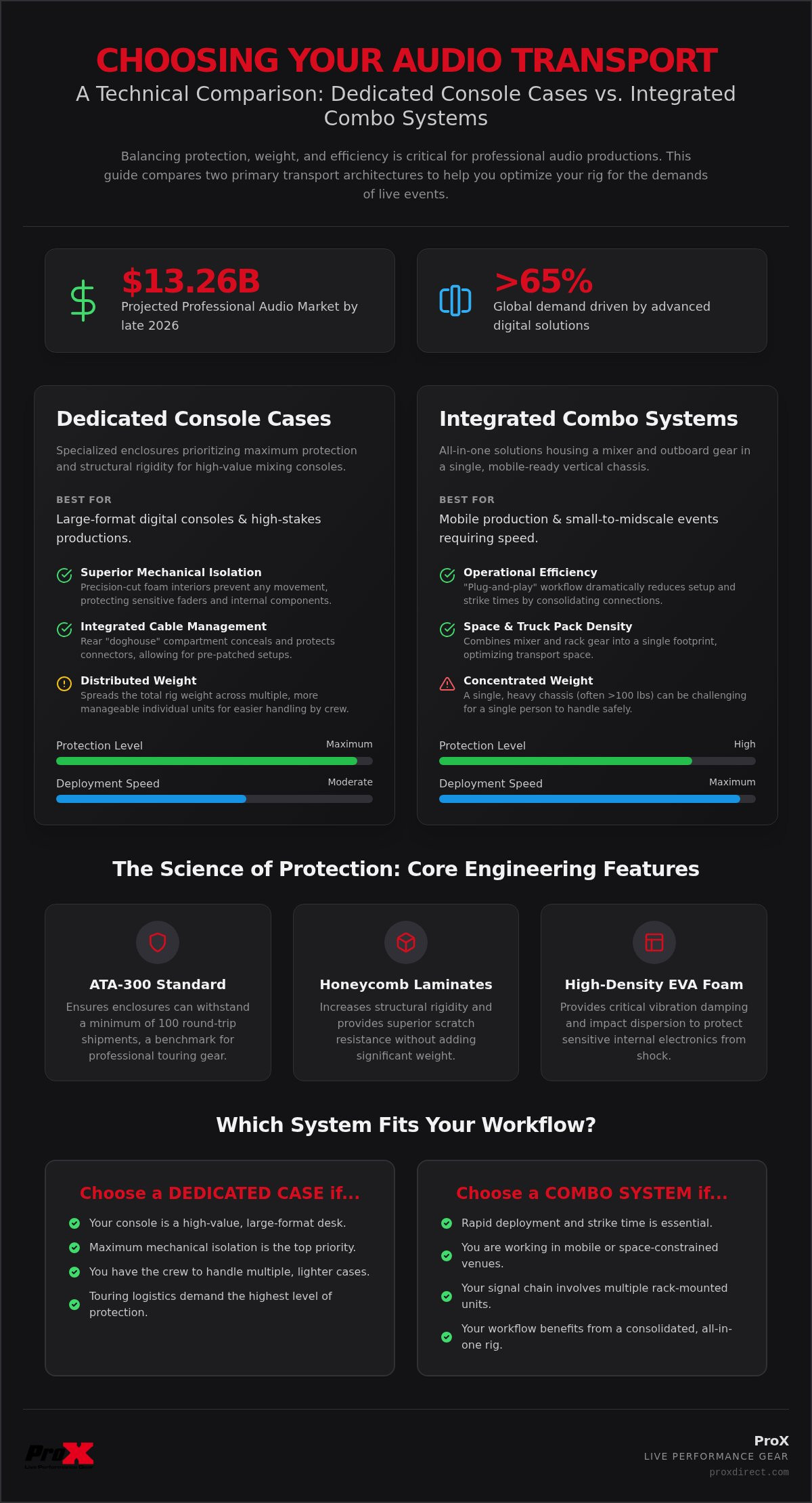
The architecture of professional audio transport has evolved alongside the digitization of the signal chain. In 2026, where over 65% of the global demand for professional audio is driven by advanced digital solutions, the physical enclosure acts as the primary defense against mechanical failure. Every shipping container designed to protect sensitive equipment must adhere to rigorous standards like ATA-300 to survive the logistical demands of modern touring. When evaluating a mixer console case vs combo case, the decision depends on the scale of the deployment and the specific mechanical isolation required for the hardware.
Dedicated Mixer Console Cases for Large-Format Desks
Large-format digital consoles, such as the Midas M32 or Allen & Heath dLive, require specialized enclosures that prioritize structural rigidity. These cases provide a low-profile environment where the primary focus is mechanical isolation. Precision-engineered foam interiors are cut to the exact dimensions of the desk to prevent lateral movement during transport. A critical feature of these designs is the integrated doghouse. This rear compartment protects sensitive connectors and facilitates clean cable management, allowing the desk to remain patched into a stage box while the lid is secured. It's a configuration built for high-value assets where the console is the center of the operation.
Integrated Mixer and Rack Combo Solutions
Integrated solutions offer a vertical housing strategy for mobile rigs. These units feature a slanted top section for the mixer and a standard 19-inch vertical rack space below, adhering to EIA-310-E mounting requirements. This architecture is ideal for signal chains that require local preamps, wireless microphone receivers, or power conditioners. By consolidating the mixer and outboard gear into a single footprint, crews achieve a "plug-and-play" workflow. This integration is particularly effective for mobile production and small-to-midscale live sound applications where rapid deployment is essential. It doesn't just save space; it simplifies the entire interconnect process.
The primary engineering goal for any professional case architecture is balancing protection with operational speed. While combo cases reduce the number of individual units to move, they increase the weight of a single chassis, often exceeding 100lbs when fully loaded. Conversely, dedicated cases distribute the load across multiple smaller footprints. This distinction defines how a rig interacts with the truck pack and how efficiently it can be struck at the end of a performance. You aren't just buying a box. You're engineering a logistical workflow that protects your investment.
The Engineering Behind Dedicated Mixer Console Cases
The structural integrity of a dedicated console enclosure relies on a combination of material science and mechanical assembly standards. Most professional specifications utilize 3/8 inch or 1/2 inch plywood reinforced with honeycomb laminates. These laminates feature a hexagonal surface pattern that provides superior scratch resistance and increases the structural rigidity of the panel without adding excessive weight. For international logistics, adhering to ATA-300 Category I standards is essential. This rating ensures the enclosure can withstand a minimum of 100 round trips, a requirement that differentiates professional-grade solutions in the mixer console case vs combo case debate.
Precision-Fit Foam and Impact Dispersion
Protecting the internal PCBs and motorized faders of a digital desk requires more than generic padding. High-density EVA (Ethylene-Vinyl Acetate) foam is utilized for its superior vibration damping properties. Unlike open-cell foam, EVA doesn't compress permanently over time, maintaining its protective profile throughout the equipment's lifecycle. These custom-cut interiors are engineered to isolate fragile components and minimize movement during high-G deceleration events. High-density foam prevents mechanical fatigue in digital consoles by absorbing kinetic energy before it reaches the sensitive solder joints of the internal circuitry. This impact dispersion across the outer shell ensures that the chassis remains isolated from the physical shocks of the road.
Low-Profile Designs and Doghouse Integration
The "doghouse" is a specialized rear compartment that serves as a protective shroud for the mixer's primary I/O panel. By housing the connectors and cable looms within this wooden or plastic structure, engineers can protect sensitive XLR and network ports from accidental impact during operation. Dedicated cases often feature a low-profile base design. This allows the console to remain seated in the bottom tray of the case during the performance, maintaining a clean aesthetic at the Front of House (FOH) position. It also minimizes the vertical height of the desk, ensuring the engineer's line of sight to the stage remains unobstructed.
Recessed butterfly latches and spring-loaded handles are standard hardware requirements for any professional case configuration. These components are mounted in deep-dish housings to prevent them from being sheared off during truck loading. While a combo case might offer vertical storage, the dedicated console case provides a tailored environment that prioritizes the specific mechanical vulnerabilities of large-format digital desks. This engineering focus ensures that high-value assets remain operational even under the most demanding touring schedules.
Strategic Advantages of Mixer and Rack Combo Cases
Consolidating a complete processing chain into a single chassis represents a specific logistical strategy for mobile production. For crews managing rapid deployments, the primary objective is reducing the number of external interconnects. By utilizing a common housing, the signal paths between the console and peripheral hardware remain patched during transport. This architecture relies on the 19-inch rack standard, which ensures mechanical compatibility for mixers, wireless receivers, and outboard processors alike. In the mixer console case vs combo case debate, the combo system wins on integration and operational speed.
Vertical Signal Chain Consolidation
Most professional combo designs provide between 10U and 12U of vertical rack space beneath the mixer section. This volume is sufficient to house a comprehensive signal chain, including power conditioners, network switches, and localized preamps. Internal cabling strategies are vital for maintaining signal integrity. High-quality builds allow for the physical separation of AC power lines from low-level audio and data cables to minimize electromagnetic interference. Pre-wired systems deliver consistent performance across different venues because the core signal chain remains undisturbed between shows. It's a methodology that significantly slashes setup times for small-to-midscale live sound applications.
Slant-Top Ergonomics and Rack Accessibility
The slanted top section of these cases is engineered for ergonomic utility. By angling the mixer's control surface, the case provides an optimal viewing angle for the operator, which is essential for maintaining visibility during long events. Many Mixer & Rack Combo Cases also include rear access doors. These panels allow for rapid troubleshooting and cable patching without necessitating the removal of the hardware. This accessibility is a distinct advantage in cramped performance areas where floor space is at a premium.
Vertical stacking optimizes the footprint of the Front of House (FOH) or monitor position. In environments like corporate ballrooms or small clubs, floor space is often restricted. By housing the entire processing chain in one vertical unit, production teams maintain a clean, organized workspace. While the total mass of a loaded combo case requires careful handling, the operational efficiency gained through integration makes it an ideal solution for mobile workstations. Choosing a mixer console case vs combo case ultimately depends on whether your priority is the protection of a single large asset or the consolidation of a multi-component system.
Comparative Analysis: Portability, Ergonomics, and Thermal Management
Assessing a mixer console case vs combo case involves a logistical audit of your transportation assets. The primary challenge of integrated systems is the concentration of mass. A 12U combo case loaded with a digital mixer, power amplifiers, and wireless racks frequently exceeds 100 lbs. This weight concentration necessitates two-person lifts or the use of loading ramps to prevent crew injury and equipment damage. Conversely, dedicated console cases distribute the weight across multiple smaller footprints. This modularity allows for single-person handling and greater flexibility when loading transport vehicles where ramp access is unavailable.
Truck Pack Efficiency and Logistical Density
Standardizing case dimensions is critical for maximizing space in professional logistics. Utilizing TruckPaX™ Truck Pack Cases ensures that your gear adheres to industry-standard dimensions for 90-inch trailers. This standardization allows for high-density stacking and prevents equipment shifting during transit. Heavy-duty 4-inch casters with locking brakes are mandatory for high-mass units to facilitate rapid load-ins on uneven surfaces. While a single combo case might seem efficient, two separate cases often provide better truck pack density in tight van packs. The ability to stack smaller, standardized units leads to a significant improvement in space utilization compared to oversized, irregular combo units.
Heat Dissipation in Enclosed Rack Environments
Thermal management is a critical engineering requirement in high-density rack environments. Modern digital mixers and outboard processors generate significant heat during sustained operation. In a vertical combo architecture, thermal energy from lower-mounted power supplies and amplifiers rises directly into the mixer's chassis. This creates a high risk of thermal throttling, screen flickering, or intermittent component failure during long outdoor events in 2026. Integrating vented panels and active rack fans ensures consistent airflow across internal heatsinks and sensitive fader motors. Active cooling is essential in 12U+ combo architectures to maintain the operational temperature of sensitive digital electronics and prevent costly downtime.
Choosing the right enclosure requires balancing these physical demands against your specific touring requirements. Select the optimal protection for your signal chain to ensure your gear remains operational in any environment.
Strategic Selection Framework for Professional Production
Selecting the correct transport architecture is a critical engineering decision that impacts both the longevity of your hardware and the efficiency of your crew. The decision between a mixer console case vs combo case is a calculation of logistical risk versus operational reward. Weight dictates logistics. High-value digital consoles representing a significant capital investment require the mechanical isolation found in premium enclosures. For these sensitive assets, investing in Santosom Cases provides the necessary structural rigidity and vibration damping required for national and international touring cycles.
Professional Selection Criteria for Touring Engineers
Large-format digital desks almost always require dedicated Mixer Console Cases. This is due to the physical footprint of the desk and the necessity of distributing mass across multiple units for safe handling. When a signal chain requires a bespoke configuration for unique outboard hardware, ZCASE Custom Build Cases offer engineered solutions for high-value production gear. Engineers must identify the "point of no return" regarding weight. If a loaded combo unit exceeds the safe lifting capacity of your available manpower or the physical limits of standard ramps, it becomes a logistical liability. Audit your crew size before committing to high-mass integrated systems.
ProX Engineering Solutions for Professional Audio
Long-term reliability is maintained through proper maintenance and accessibility to high-quality hardware components. ProX ensures the continued utility of your enclosures by providing a comprehensive inventory of ProX Cases Replacement Parts. This includes heavy-duty casters, recessed latches, and spring-loaded handles. Utilizing the ProX online catalog allows engineers to cross-reference manufacturer-specific dimensions, ensuring a precision fit that eliminates internal equipment movement during transit. This systematic approach to selection ensures your rig remains adaptable for future equipment upgrades.
To finalize your protection strategy, consider the following decision matrix:
- Inventory Value: High-value digital faders and touchscreens require the superior damping of dedicated enclosures.
- Touring Intensity: Multi-month national tours demand the structural integrity of ATA-300 style engineering.
- Logistical Footprint: Combo cases offer rapid setup for mobile production but require ramp-equipped vehicles.
- Future-Proofing: Ensure your case selection can accommodate modular rack upgrades as your signal chain evolves.
Professional production environments don't allow for equipment failure. By aligning your transport architecture with your logistical realities, you secure your signal chain and optimize your professional audio rig for the demands of 2026.
Engineering Your Logistical Advantage
The decision between a mixer console case vs combo case defines your operational workflow and the long term health of your equipment. Dedicated console enclosures provide the precision engineered foam and mechanical isolation required to protect sensitive digital faders from vibration. Integrated combo systems offer the vertical consolidation necessary for rapid deployment in high pressure mobile environments. Both architectures serve specific logistical needs depending on your crew size and truck pack requirements.
ProX has been manufacturing performance gear since 1984. We utilize rugged ATA-300 style construction to ensure your high value assets survive the physical demands of professional touring. Our engineering team prioritizes functional excellence and structural integrity to provide the reliable backbone your production requires. Whether you need the bespoke protection of a ZCASE custom build or the efficiency of a standardized rack system, our solutions are trusted by touring professionals worldwide.
Browse the full range of ProX Professional Cases to find the exact transport architecture for your 2026 tour requirements. Secure your signal chain today with the confidence of industry standard protection.
Frequently Asked Questions
What is the main difference between a mixer console case and a combo case?
A mixer console case is a low-profile enclosure dedicated to a single desk, whereas a combo case features a slanted top for a mixer and a vertical 19-inch rack below. The choice in the mixer console case vs combo case debate depends on whether you need to house outboard gear in the same chassis. Dedicated cases offer superior isolation for large desks, while combos consolidate the entire signal chain into one footprint.
Are combo cases too heavy for a single person to transport?
Fully loaded combo cases often exceed 100 lbs, making them unsafe for single-person transport. Professional logistics standards dictate that any equipment of this mass should be moved using two-person lifts or loading ramps. Integrated racks concentrate weight into a single chassis, which can be a liability without proper manpower. Modular setups using separate cases distribute the weight, allowing for easier handling by individual crew members during rapid load-ins.
Can I use a universal mixer case for a digital console with a doghouse?
Universal cases are generally incompatible with consoles requiring a doghouse because they lack the specific rear clearance for the compartment. A doghouse is a specialized rear shroud that protects sensitive I/O ports and cable looms. For high-value digital desks, a precision-fit enclosure is necessary to ensure the doghouse aligns with the case's internal structure. Using a generic fit risks mechanical interference and provides inadequate support for the console's rear chassis.
Do combo cases provide enough airflow for high-powered amplifiers?
Combo cases require active cooling strategies to prevent thermal energy from lower rack units rising into the mixer section. High-powered amplifiers generate significant heat that can lead to thermal throttling in digital electronics. To maintain consistent performance, you should integrate vented panels and 1U or 2U rack fans. These components facilitate airflow and ensure that the internal temperature remains within manufacturer-specified operating ranges during long outdoor events or high-intensity touring cycles.
How does truck pack efficiency differ between dedicated and combo cases?
Truck pack efficiency in the mixer console case vs combo case comparison depends on the standardization of dimensions. Dedicated cases often follow TruckPaX™ standards, allowing for high-density stacking in 90-inch trailers. Combo cases consolidate gear into one unit but can create irregular gaps in a tight pack if their dimensions don't match standard logistical footprints. Modular cases are often easier to stack symmetrically, maximizing the total cubic volume of the transport vehicle.
What materials are best for professional-grade audio cases in 2026?
The industry standard for 2026 remains 3/8 inch or 1/2 inch plywood reinforced with honeycomb laminates. These materials offer high structural rigidity and scratch resistance. For internal protection, high-density EVA foam is the preferred choice for its vibration damping and longevity. Hardware should include recessed butterfly latches and spring-loaded handles mounted in deep-dish housings to prevent mechanical failure during the high-G events common in international shipping and air transport logistics.
Should I choose a case with a fixed or removable lid for mixing?
Removable lids are superior for professional mixing because they allow the console to sit in a low-profile tray. This configuration maintains a clean aesthetic at the Front of House position and ensures the engineer's line of sight remains unobstructed. Fixed lids or hinged designs often create physical barriers that interfere with cable routing or ergonomic movement. A lift-off lid design provides 360-degree access to the console and simplifies the integration of external monitors.
How do I ensure my mixer console case meets ATA-300 standards?
To meet ATA-300 Category I standards, a case must be engineered to withstand a minimum of 100 round trips. This requires specific construction techniques, such as the use of heavy-duty aluminum extrusions, steel ball corners, and recessed hardware. You should verify that the manufacturer utilizes these specifications and has performed impact testing. Authentic ATA-style engineering ensures that the enclosure provides the necessary mechanical protection for sensitive electronics during rigorous air transport and logistical handling.
Disclaimer
Any trademarks, trade names or brand names appearing herein that do not belong to ProX are the property of their respective owners and/or companies, and such appearance doesn't and shall not constitute or imply endorsement, sponsorship or recommendation by ProX.


