

The global market for cold spark technology is projected to reach $1.6 billion by 2026, marking a significant shift toward sophisticated atmospheric effects in professional production. This growth brings a critical challenge: protecting sensitive internal heating elements and high-precision electronics during rigorous transport. You understand that a single equipment failure at showtime isn't just a technical glitch; it's a threat to your professional reputation and the safety of the event. A specialized cold spark machine case is no longer a luxury but a baseline requirement for maintaining operational integrity.
We'll show you how precision-engineered cases utilize high-density EVA foam to isolate vibration and prevent internal damage. You'll discover how standardized external dimensions optimize truck-pack efficiency and why specific interior designs are necessary to contain powder residue. This guide provides a technical overview of the structural standards required for 2026. We'll cover everything from material specifications to the logistical advantages of stackable, industrial-grade housing for your atmospheric fleet. By prioritizing engineering precision, you ensure your gear remains functional across every tour leg.
Key Takeaways
- Understand why high-density EVA foam and reinforced steel hardware are essential for isolating sensitive heating elements from transit-induced vibration.
- Identify the optimal cold spark machine case configuration for your production scale, comparing single-unit mobile setups with standardized dual-unit housings.
- Discover how standardized exterior dimensions and stackable designs improve truck pack logistics and streamline load-in for high-volume event schedules.
- Learn how precision-cut interiors and integrated accessory compartments prevent powder residue contamination and protect delicate electronic components.
- Gain a technical framework for selecting protective housing based on specific machine wattage and the rigorous physical demands of professional touring.
Why Atmospheric Effects Demand Specialized Protective Cases
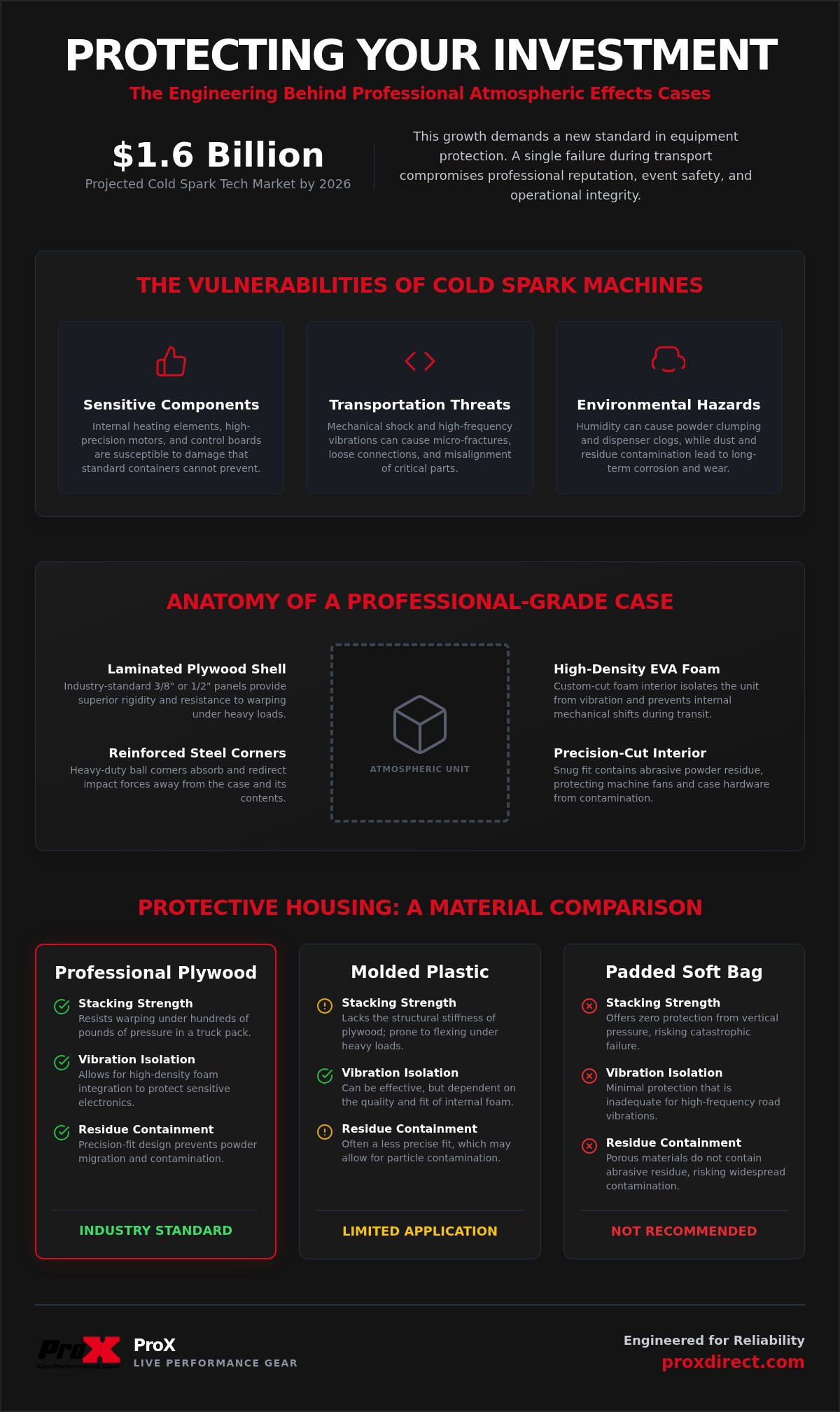
Cold spark machines represent a significant investment in atmospheric effects technology. Unlike standard LED fixtures, these units utilize internal heating elements and high-speed precision motors to create vertical spark displays. These components are sensitive to mechanical shock. A standard utility box might provide a basic shell, but it lacks the internal engineering required to mitigate the high-frequency vibrations encountered during long-haul transit. Without a dedicated cold spark machine case, your equipment is vulnerable to micro-fractures in the heating core and misalignment of the powder dispenser. Equipment failure at showtime isn't an option.
The Vulnerability of Cold Spark Electronics
Professional cold spark units rely on a complex assembly of thermal sensors and electronic control boards. Continuous vibration during transport often leads to loose internal connections or failed solder joints on the PCB. Humidity and dust also pose a threat; the metallic powder used in these machines can become clumpy if exposed to moisture, leading to dispenser clogs. A rigid exterior serves as the primary barrier against impact, while high-density foam provides the necessary vibration isolation. This dual-layer protection prevents the internal mechanical shifts that cause equipment failures during load-in.
Why Soft Bags Fail the Professional Test
Some mobile operators opt for padded nylon bags, but these fail the rigorous demands of professional touring. Soft cases offer no protection against the vertical stacking pressure found in a standard truck pack. In a high-volume environment, gear is often subjected to hundreds of pounds of weight from equipment stacked above it. Without the structural integrity of a hard-shell case, the machine's external housing can warp, leading to motor binding or catastrophic failure. Professional cases act as an essential insurance policy, ensuring that the physical attributes of the machine remain intact regardless of the logistical environment.
Residue management is another critical factor. The metallic granules used in cold spark machines are inherently abrasive. If a case doesn't feature precision-cut foam that seals the unit, powder residue can migrate into the case hardware or the machine's cooling fans. This contamination leads to long-term corrosion and mechanical wear. Engineering-grade cases are designed with specific tolerances to contain these materials, extending the operational life of both the machine and the protective housing itself. Precision matters. Protecting the internal heating core is just as important as protecting the outer shell.
Key Engineering Specifications for Cold Spark Equipment Housing
The structural integrity of a cold spark machine case depends on the integration of high-grade materials and industrial hardware. Professional-grade housing must withstand the physical stresses of stacking and the mechanical vibrations of transport. Unlike consumer-level containers, engineering-grade cases prioritize impact redirection and surface durability to ensure that the internal atmospheric electronics remain calibrated and operational upon arrival at the venue.
Material Science: Plywood vs. Plastic
Laminated plywood remains the industry standard for professional touring due to its superior weight-to-strength ratio and rigidity. Most professional configurations utilize 3/8-inch or 1/2-inch plywood panels. This thickness provides the necessary resistance to warping under heavy loads. A honeycomb-patterned digital laminate is often applied to the exterior surface to enhance scratch resistance and maintain a professional aesthetic over years of use. While plastic molded cases exist, they often lack the structural stiffness required to protect the delicate heating cores found in cold spark machines. Adhering to the handling protocols suggested by the NFPA 1126 Standard requires equipment to be secured in a manner that prevents mechanical damage, making heavy-duty plywood the logical choice for safety and compliance.
Hardware Standards for 2026 Production
The hardware components of a case are just as vital as the panels themselves. Every cold spark machine case should feature reinforced steel ball corners. These components are designed to redirect the energy of an impact away from the case joints, preserving the overall structural box. Recessed hardware is another mandatory specification for modern production. By utilizing recessed spring-loaded handles and industrial-grade butterfly latches, the case maintains a flush exterior profile. This design is essential for tight truck packs where every inch of space is calculated. Flush-mounted hardware prevents snagging and allows for seamless stacking with other standardized equipment.
Mobility is managed through heavy-duty casters, typically four inches in diameter, equipped with locking brakes. These casters must support the combined weight of multiple spark units and their associated consumables. Locking mechanisms are critical for stage safety, preventing the gear from shifting on uneven surfaces or during high-vibration performances. Professional production companies often explore our full range of professional cases to standardize their atmospheric fleet. This standardization ensures that regardless of the machine's wattage or specific dimensions, the logistical footprint remains consistent across the entire inventory.
Comparing Multi-Unit Configurations for Production Efficiency
Selecting the correct cold spark machine case configuration is a logistical decision that directly impacts asset management and transit efficiency. Independent operators often prefer single-unit cases for maximum placement flexibility in small venues. However, for most professional applications, dual-unit cases provide a balanced footprint. These configurations are particularly effective for wedding DJs and small stage setups where a pair of machines is the standard requirement. By housing two units in a single enclosure, you halve the number of items handled during load-in and load-out, reducing the labor hours required for setup.
Logistical Impact of Case Size
Large-scale event production requires a more aggressive approach to inventory management. Quad-unit, or 4-pack, configurations are engineered to consolidate high-volume atmospheric fleets into manageable blocks. This consolidation significantly reduces the number of individual line items on a shipping manifest, which minimizes the risk of equipment loss at the venue. Beyond manifest tracking, these cases are designed around standardized dimensions to maximize truck pack density. For instance, TruckPaX™ Truck Pack Cases: Engineering Logistical Efficiency focuses on ensuring that equipment footprints align with standard trailer widths. This alignment eliminates "dead air" in the truck, preventing gear from shifting and sustaining damage during long-distance transit.
Custom vs. Standard Configurations
While standardized cases serve most market-leading machines, non-standard atmospheric arrays require a more tailored approach. High-wattage units or specialized moving-head spark machines often possess dimensions that don't fit traditional dual-unit shells. In these scenarios, production companies opt for custom-built solutions. ZCASE engineering, for example, allows for the creation of multi-unit housings with specialized internal dividers. These dividers don't just separate the machines; they create specific zones for mixed equipment storage, such as dedicated compartments for wireless controllers and DMX cabling. This ensures that all components required for a specific effect are kept together in a single, organized cold spark machine case.
Standardized internal dividers also allow for the secure storage of consumables alongside the hardware. This ensures that the powder packets required for the show are always co-located with the machines, preventing delays caused by misplaced supplies. For those managing more diverse inventories, including cameras or signal distribution gear, Custom AV and Broadcasting solutions offer similar engineering benefits. Whether you choose a standard 2-pack or a custom quad-unit configuration, the priority remains the same: optimizing the physical footprint to ensure every cubic foot of transport space is utilized effectively. Efficient load-outs depend on this level of structural organization.
Maximizing Tour Longevity: Hardware and Interior Management
Long-term equipment reliability depends on the internal environment of your cold spark machine case. While the exterior plywood and steel hardware redirect physical impacts, the interior architecture manages the subtle forces that degrade electronic components over time. Precision-engineered cases utilize high-density EVA foam, which provides superior vibration isolation compared to generic cushioning. This foam is specifically routed to match the dimensions of the machine, eliminating lateral movement during transport. When machines are secured within these exact tolerances, the risk of internal mechanical shifts is virtually eliminated.
Internal Architecture and Vibration Dampening
Professional production companies distinguish between open-cell and closed-cell foam for gear protection. Open-cell foam is prone to trapping moisture and metallic powder residue, which can lead to internal corrosion of the machine's heating core. Engineering-grade cases prioritize closed-cell foam because it remains non-absorbent and provides a firmer support structure for heavy atmospheric units. For a deeper technical analysis of these materials, consult The Ultimate Guide to Flight Cases: Engineering Protection. Custom dividers within this architecture further isolate the machine from accessory compartments, ensuring that heavy power cables and DMX leads don't impact the delicate nozzle or housing during high-impact transit.
Maintenance for Professional Reliability
Maintenance protocols are essential for tour longevity. Cold spark powder consists of metallic granules that are highly abrasive. If allowed to accumulate in the case interior, this residue acts like sandpaper against the machine’s finish and can eventually migrate into cooling intakes. Regular vacuuming of the foam inserts is mandatory after every load-out to prevent this buildup. Residue management isn't just about aesthetics; it's about preventing mechanical friction that wears down the protective housing and the equipment itself.
Hardware integrity must be verified before every tour leg. This includes testing the spring tension of recessed handles and the engagement of butterfly latches. If a latch fails to draw the lid tight, the seal is compromised, allowing moisture and dust to enter. Caster maintenance is equally critical. Wheels must be inspected for flat spots or gritty swivel bearings that impede smooth movement across diverse venue surfaces. Worn casters are a significant safety hazard on sloped loading docks and can lead to transport accidents. To maintain the structural integrity of your fleet, you should regularly inspect and update your hardware by browsing our ProX Cases Replacement Parts to ensure your gear remains in peak operational condition.
Professional Case Solutions for Cold Spark Machines
The ProX engineering philosophy centers on functional excellence and structural redundancy. Since 1984, the focus has remained on providing a reliable backbone for the production industry through meticulous material selection and assembly. Selecting the appropriate cold spark machine case requires a technical analysis of both machine wattage and physical dimensions. Higher wattage units typically feature larger internal heating cores and heat sinks, necessitating cases with greater internal volume and specific foam tolerances to ensure proper vibration isolation. Precision matters. Matching the case to the specific machine ensures that the protective housing performs as an integrated system rather than a generic container.
The ProX Advantage in Atmospheric Protection
Industrial-grade materials are the standard across the entire atmospheric protection line. Utilizing 3/8-inch or 1/2-inch honeycomb digital plywood and reinforced steel ball corners ensures that each enclosure can withstand the high-stakes environment of professional touring. These cases are engineered for compatibility with major cold spark machine brands, providing a standardized solution for diverse inventories. Reliability isn't just a goal; it's a requirement. ProX hardware, from recessed butterfly latches to heavy-duty casters, is tested to survive thousands of open-close and transport cycles. This technical superiority ensures that sensitive atmospheric electronics remain shielded from the physical demands of the road, maintaining the integrity of the build throughout the tour.
Ordering and Customization Through the Dealer Network
Securing your production equipment is streamlined through an established global dealer network. Local dealers provide immediate access to standard protective solutions, allowing for rapid deployment of new atmospheric fleets. For unique gear or non-standard configurations, the process for initiating a custom engineering project is methodical and highly structured. ZCASE custom builds, manufactured in Poland, offer bespoke interiors and specialized layouts for complex arrays. This allows production managers to specify exact divider placements and accessory compartment dimensions for mixed-gear storage. It doesn't matter if your setup is standard or highly specialized; the engineering standards remain consistent.
To begin optimizing your logistics and protecting your investment, you should evaluate your current fleet requirements against our engineering standards. Whether you need a standard dual-unit housing or a bespoke quad-pack configuration, the priority is zero equipment failure at showtime. You can browse our professional case category to identify the specific model that aligns with your machine specifications and transport needs. Consistency in your case inventory leads to more efficient truck packs, simplified manifests, and lower long-term maintenance costs. Protecting your gear is the first step in ensuring a flawless performance.
Securing Your Atmospheric Inventory for the Future
Professional production demands a commitment to equipment longevity and logistical precision. Selecting an engineering-grade cold spark machine case ensures that sensitive internal components remain operational despite the rigors of high-volume touring. You've seen how high-density EVA foam and reinforced steel hardware provide the necessary vibration isolation to protect delicate heating elements. Precision matters. Utilizing cases with standardized dimensions allows your team to maximize truck pack density and streamline load-in workflows across any venue.
With over 40 years of engineering expertise, ProX remains a trusted partner for major touring professionals. Our focus on functional excellence guarantees that your atmospheric fleet is protected by the most durable materials available. Prioritizing structural integrity today prevents catastrophic failures at showtime tomorrow. Take the next step in professionalizing your inventory management by browsing our latest hardware configurations designed for 2026 standards.
View All Professional Cold Spark Machine Cases
Securing your gear with precision-engineered solutions is the most effective way to guarantee consistent performance for every audience.
Frequently Asked Questions
How many cold spark machines can fit in one case?
Standard configurations typically accommodate one, two, or four units depending on the specific model selected. Single-unit cases offer maximum placement flexibility for mobile operators, while dual-unit and quad-unit housings are engineered to consolidate inventory for large-scale productions. Choosing a multi-unit cold spark machine case reduces the total number of items on a shipping manifest, which streamlines inventory tracking and load-in efficiency for professional touring crews.
Are these cases stackable for truck transport?
Yes, these cases feature standardized exterior dimensions and recessed hardware to facilitate secure stacking during truck transport. The inclusion of caster cups on the top lids allows the wheels of a stacked case to lock into place, preventing lateral movement during transit. This design philosophy maximizes truck pack density and ensures that equipment remains stable even when subjected to the high-vibration environment of long-haul logistics.
Do the cases include storage for cold spark powder?
Most dual-unit and quad-unit configurations feature integrated accessory compartments specifically designed for consumables and cabling. These internal dividers allow you to store powder packets alongside the machines, ensuring that all necessary components for the effect are co-located. Keeping consumables in a dedicated section within the cold spark machine case prevents them from interfering with the machine's cooling intakes or nozzle assembly during transport.
What is the difference between a standard case and a custom-engineered case?
Standard cases are designed to fit the most common machine dimensions using pre-configured foam inserts and hardware layouts. Custom-engineered solutions, such as those provided by ZCASE or Santosom, are tailored to unique equipment dimensions or specific logistical requirements. Custom builds allow for specialized internal architecture, including mixed-gear storage zones and unique divider placements that aren't available in off-the-shelf models, providing a bespoke protection strategy for specialized atmospheric fleets.
How do I clean the interior of the case if powder spills?
The most effective method for removing spilled metallic powder is using a high-suction industrial vacuum with a brush attachment. Because the powder is abrasive, you should avoid wiping it with a cloth, as this can grind the granules into the foam or the machine’s finish. Regular vacuuming of the closed-cell foam interiors prevents residue migration into the case hardware or the machine's internal electronics, maintaining the long-term health of your equipment.
Will these cases protect my machines in extreme weather conditions?
While these cases provide a rigid barrier against dust and moisture, they are primarily designed for physical protection and vibration isolation during transit. For environments requiring absolute waterproof integrity, specialized options like UltronX™ Watertight Cases utilize gasket seals to prevent water ingress. Standard plywood cases offer significant protection against humidity and light splashes, but they shouldn't be submerged or left exposed to heavy rain for extended durations without additional cover.
Are the casters on these cases replaceable?
Yes, the casters are designed as modular components that can be easily replaced if they become worn or damaged. Professional cases utilize heavy-duty four-inch casters secured with standard bolt patterns, allowing for quick field repairs. Maintaining smooth-rolling casters is essential for safe movement across diverse venue surfaces and loading docks. You can source exact replacement parts through the established dealer network to ensure continued mobility for your gear.
Can I use these cases for other types of atmospheric effects like fog machines?
You can use these cases for other atmospheric effects provided the internal dimensions and foam tolerances align with the equipment's specifications. However, cold spark machines have unique requirements for residue management and vibration dampening that may differ from fog or haze machines. It's best to verify that the internal architecture provides adequate support and ventilation for the specific unit to prevent mechanical stress or overheating during storage.
Disclaimer
Any trademarks, trade names or brand names appearing herein that do not belong to ProX are the property of their respective owners and/or companies, and such appearance doesn't and shall not constitute or imply endorsement, sponsorship or recommendation by ProX.


