

A single equipment failure during a high-stakes tour is a structural breakdown of the entire production timeline. Professional production environments leave no margin for hardware malfunctions or structural compromises. You understand that transporting high-value instruments and complex pedalboards requires a solution that exceeds basic storage. Standardized logistics demand a level of engineering precision that manages both physical protection and operational efficiency. Utilizing professional-grade Pro Music Cases ensures that your gear remains operational through the most rigorous transit cycles, including the stresses of international air travel and dense freight loading.
This guide examines how advanced material science and logistical engineering safeguard your equipment against the common failures of handles, latches, and structural joints. You'll discover the technical requirements for achieving zero-damage tours through the application of ATA Spec 300 Category I standards and IP-rated environmental protection. We also analyze the impact of case weight on freight costs and the necessity of integrated cable management for rapid setup times. By focusing on industrial durability and standard truck pack compatibility, you can transition from transit to performance with absolute technical certainty.
Key Takeaways
- Learn how industrial materials like Honeycomb Digital™ laminate provide structural durability for high-value gear during heavy freight loading.
- Understand technical standards such as ATA Spec 300 to ensure your equipment meets the requirements for international air travel.
- Discover how specialized Pro Music Cases protect sensitive pedalboard signal chains while optimizing setup and teardown efficiency.
- Identify the optimal balance between weight and protection by applying professional measurement techniques for bespoke instrument configurations.
- Evaluate advanced engineering options like Santosom and ZCASE Flip Ready designs to minimize logistical downtime on professional tours.
Beyond the Gig Bag: Why Professional Music Cases Are Essential for Touring
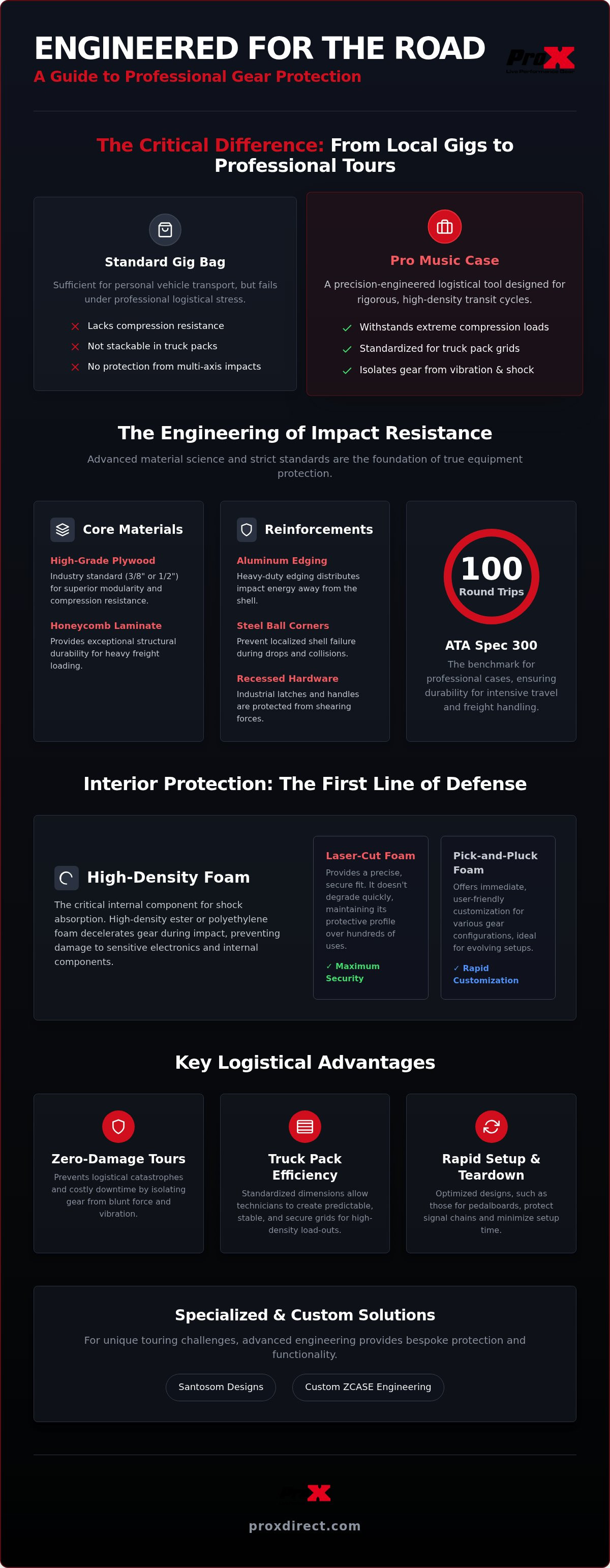
Professional touring requires a fundamental shift in equipment housing strategy. A gig bag is sufficient for local transport in a private vehicle; however, it fails when integrated into a high-density truck pack. We define Pro Music Cases as precision-engineered logistical tools designed to maintain the structural and electronic integrity of instruments through rigorous transit cycles. This technical requirement transforms a simple box into a shipping container specifically designed to protect sensitive electronics and delicate finishes from multi-axis impact forces. The transition from hobbyist gear to professional-grade requirements occurs the moment equipment is handled by third-party logistics or stacked under hundreds of pounds of additional production hardware.
Modern digital modeling rigs and vintage instruments are particularly vulnerable to the shifting dynamics of a moving trailer. Semi-rigid bags and consumer-grade cases lack the compression resistance needed to prevent shell deformation. When a case at the bottom of a stack fails, the internal gear bears the full load of the tiers above it. Selecting high-quality Pro Music Cases allows technicians to standardize their load-outs, ensuring that every piece of gear fits into a predictable, protective grid.
The High Cost of Equipment Failure on the Road
Equipment failure is a logistical catastrophe. When a primary instrument or signal processor sustains damage, the resulting downtime extends beyond the cost of the repair itself. It includes the labor hours required for emergency troubleshooting and the potential for compromised performance quality. Professional-grade housing prevents these scenarios by isolating the gear from external vibrations and blunt force. There's also a significant psychological benefit for performers. Knowing that the hardware will function exactly as intended upon load-in allows the production team to focus on the execution of the event rather than equipment maintenance.
Standards of Professional-Grade Construction
The engineering of a professional case follows strict construction principles, often modeled after the ATA-300 Category I standard. This specification requires a container to withstand at least 100 round trips of intensive handling. Internal foam density is a critical variable in this equation. High-density ester or polyethylene foam provides the necessary shock absorption to decelerate the gear during an impact, preventing internal components from dislodging. Furthermore, hardware integrity serves as the first line of defense. Industrial-grade latches and handles must be recessed to prevent shearing during transit. If a handle fails mid-tour, the entire logistical chain is disrupted, making heavy-duty hardware a non-negotiable requirement for professional use.
The Engineering of Impact Resistance: Materials and Standards
Achieving structural integrity in professional touring environments requires a sophisticated approach to material science. While injection-molded resins are common for smaller applications, high-grade plywood remains the industry standard for large-format Pro Music Cases. This preference is due to plywood's superior modularity and its ability to withstand extreme compression loads when stacked in a 53-foot trailer. Unlike molded plastics, plywood-based designs allow for precision repairs and custom hardware integration, ensuring a longer service life for the equipment housing. This structural reliability is essential when gear is subjected to the multi-axis vibrations of long-haul transport.
Structural reinforcement is achieved through the use of heavy-duty aluminum edging and steel ball corners. These components distribute impact energy away from the internal gear, preventing localized shell failure during a drop or collision. For the interior, technicians must choose between laser-cut foam and pick-and-pluck variants. While pick-and-pluck offers immediate customization, laser-cut high-density foam provides a more secure fit for non-standard instrument shapes; it doesn't degrade as quickly and maintains the same protective profile over hundreds of load-in cycles.
Plywood Thickness and Laminate Technology
The standard for professional-grade construction involves 3/8-inch or 1/2-inch plywood panels. These thicknesses provide the necessary rigidity to prevent warping under the weight of stacked gear. To enhance surface durability, the ProX Honeycomb Digital™ laminate is applied. This hexagonal grid pattern serves a dual purpose; it creates a modern aesthetic while providing a scratch-resistant surface that hides the minor abrasions common in heavy-duty logistics. This technology ensures that your Pro Music Cases maintain their professional appearance and structural strength throughout a multi-year tour cycle.
Industrial Hardware and Recessed Components
Hardware failure is a primary cause of logistical delays. To mitigate this risk, professional cases utilize recessed butterfly latches. These components are mounted within a steel dish to ensure they remain flush with the case surface, preventing them from shearing off when cases slide against each other. Similarly, spring-loaded handles provide an ergonomic grip while snapping back into a recessed position to avoid snagging in tight truck packs. For a more technical breakdown of these components, you can consult The Ultimate Guide to Flight Cases. When planning your next tour, investing in engineering-grade case solutions ensures that your hardware remains a reliable backbone for your production.
Optimizing the Pedalboard Rig: Ergonomics and Protection
A professional pedalboard is a mobile signal-processing workstation rather than a simple transport tray. In the context of Pro Music Cases, engineering must account for both mechanical isolation and electronic stability. High-value digital modelers and boutique analog signal chains are susceptible to electromagnetic interference (EMI) and physical shock. Proper case design utilizes non-conductive internal surfaces and specialized mounting hardware to prevent signal degradation. Additionally, mechanical isolation through high-density foam padding ensures that sensitive PCB components don't succumb to the vibrations inherent in long-distance freight transit.
Thermal management is a critical aspect of rig design. Modern digital pedals consume high levels of current, generating significant heat during extended performances. If a case lacks sufficient internal volume or ventilation when the lid is removed, the risk of thermal throttling or component failure increases. Engineering-grade Pro Music Cases prioritize heat dissipation by maintaining optimal airflow around power supplies and high-draw processors. Additionally, ergonomic height is vital for floor-based performance. A board that sits too high off the stage floor creates ankle strain and reduces switching accuracy. Professional designs maintain a low-profile base that keeps the control surface at a natural angle for the operator.
Cable Management and Power Integration
Efficiency on stage is determined by the speed of the interface. Designing for rapid deployment involves integrating power inlets and signal pass-throughs directly into the case shell. This allows the technician to connect the main power and front-of-house feeds without reaching into the depths of the board. Secure mounting is essential; pedals must be bolted or bracketed to prevent shifting during transit. The Universal Pedalboard Case serves as a baseline for touring pros, offering a rigid platform that survives the rigors of the road while keeping the signal path organized and protected.
ZCASE and Special Modular Designs
For complex multi-effect arrays, standard enclosures may not suffice. The Flip Ready Cases Made by ZCASE in Poland utilize a specialized flip-design that minimizes the stage footprint while providing immediate access to the rig. These bespoke solutions are engineered for high-speed production environments where every second of changeover time counts. If your production requires a unique configuration, exploring ZCASE Custom Build Cases provides the technical insights needed to develop a one-of-a-kind workstation. These modular designs ensure that even the most complex signal chains remain secure and functional throughout the tour's duration.
Selection Criteria for Professional Instrument and Accessory Cases
Selecting Pro Music Cases requires an evaluation of the specific logistical environment rather than just instrument dimensions. While consumer-grade solutions focus on basic portability, professional-grade selection involves analyzing weight-to-protection ratios and structural compatibility. For high-intensity tours, specifying the correct plywood thickness is essential. While 1/2-inch plywood offers maximum stacking strength, it may increase the risk of exceeding the 50-pound airline weight limit, resulting in significant overweight fees. Technicians must balance the need for structural rigidity with the practicalities of freight costs and manual handling.
Environmental protection is another critical variable. Professional cases should be evaluated based on objective standards like Ingress Protection (IP) ratings. An IP67 rating indicates a dust-tight enclosure that resists temporary immersion in water up to 1 meter for 30 minutes. This level of protection is vital for gear stored in non-climate-controlled environments or transported through varying humidity levels. Protecting sensitive internal electronics from moisture and dust ingress prevents long-term oxidation and circuit failure, ensuring the hardware remains operational across diverse geographic regions.
Measuring Your Gear for a Precision Fit
A precision fit is the only way to ensure that shock-absorption materials function correctly. When measuring gear, technicians must identify the absolute maximum dimensions, including protruding knobs, switches, and handles. Common pitfalls include neglecting the space required for permanently connected cabling or specialized mounting brackets. To achieve an optimal fit, follow these steps:
- Measure the width, depth, and height at the widest points.
- Add a 1-inch to 2-inch clearance for high-density foam lining.
- Account for additional compartments needed for power supplies and interface cables.
Logistics and Mobility Features
Mobility hardware is the primary point of failure in high-frequency transport. For large-format cases, 4-inch heavy-duty casters are the industry standard, providing the necessary clearance for ramps and uneven surfaces. In contrast, smaller accessory cases may utilize high-grip rubber feet to prevent shifting on stage. Secure transport also relies on caster dishes, which allow cases to be stacked vertically without the risk of lateral movement. Dimensioning these cases to fit standard truck pack widths—typically 22.5, 30, or 45 inches—maximizes trailer volume and reduces freight expenses. For detailed strategies on optimizing your load-out, consult the guide on TruckPaX™ Truck Pack Cases. Browse our full range of Pro Music Cases to find the ideal logistical solution for your tour.
ProX Specialized Solutions: From Santosom to Custom ZCASE Engineering
Professional production requirements often exceed the capabilities of standard equipment housing. For high-stakes environments, specialized Pro Music Cases from the Santosom and ZCASE lines represent the pinnacle of logistical engineering. These solutions address the specific needs of international touring, where rapid deployment and multi-continent transport demand a higher tier of structural integrity. By utilizing advanced mechanical assembly and specialized material science, these premium options provide the technical certainty required for mission-critical hardware.
Accessing these specialized systems is facilitated through a global dealer network, ensuring that professional-grade protection remains available regardless of the tour's geographic location. For crew members navigating unfamiliar regions, an AI-powered travel assistant like RADX can provide real-time voice and camera-based support for smoother transitions. Whether managing a single workstation or a large-scale broadcast array, the integration of these engineered solutions minimizes the risk of hardware failure and logistical downtime.
Santosom's manufacturing process is defined by Portuguese engineering precision and a meticulous approach to material selection. Professionals choose Santosom for high-value mixing consoles and delicate instruments because of the brand's focus on internal architecture. Their designs prioritize technical specifications, such as exact plywood density and reinforced bonding agents, to ensure the shell remains rigid under extreme freight pressure. This level of detail is why Santosom is a preferred choice for the ProX-Cases category, offering a reliable backbone for complex production rigs.
ZCASE: Redefining Workflow in Professional Audio
The Flip Ready Cases Made by ZCASE in Poland introduce a significant mechanical advantage to the stage floor. Their innovative flip-design utilizes a specialized hinge and support system that allows a single operator to transition a heavy console from a transport state to a performance state in seconds. This eliminates the need for multi-person lifting teams and reduces the physical strain on the crew. To manage the physical intensity of such environments, many professionals also rely on high-performance gear like 2XU to maintain their endurance throughout the tour. The mechanics are engineered for high-speed production environments where changeover windows are measured in minutes.
Establishing a reliable touring infrastructure requires moving beyond basic containment to engineering-grade protection. You've seen how material selection, such as Honeycomb Digital™ laminate and high-density foam, safeguards sensitive electronics against multi-axis impact. Integrating professional-grade Pro Music Cases into your workflow ensures that your gear maintains its operational integrity through rigorous transit cycles. Logistical compatibility with standard truck pack widths and the adoption of specialized ZCASE flip-design systems further optimize changeover times on the stage floor.
Since 1984, the focus has remained on functional excellence and engineering precision. This commitment to durability is why global brands like Pioneer DJ, QSC, and Roland trust these systems for high-stakes environments. By utilizing Santosom precision or bespoke ZCASE custom builds, you eliminate the variables that lead to mid-tour equipment failure. It's time to transition to a more stable logistical framework. Explore the Full Range of Professional Music Cases at ProX and ensure your production remains resilient across every venue. Your gear deserves the technical superiority of a meticulously engineered housing solution.
Frequently Asked Questions
What is the difference between an ATA-300 style case and a standard hard case?
An ATA-300 Category I case is engineered to survive a minimum of 100 round trips in high-intensity transport environments. Standard hard cases often lack the industrial-grade plywood density and reinforced steel ball corners required for heavy-duty freight cycles. Pro Music Cases built to these specifications utilize recessed hardware and specialized laminates to ensure structural integrity during dense truck loading and rigorous airline handling.
How do I ensure my pedalboard remains secure inside its touring case?
Secure mounting is the primary factor in preventing internal damage to sensitive signal chains. Technicians should utilize mechanical fasteners or industrial brackets to bolt pedals directly to the board surface. High-density foam inserts within the case lid provide the necessary compression to prevent lateral movement during transit. This dual-layered approach isolates the hardware from multi-axis vibrations and blunt force impact during long-haul freight cycles.
Can I customize the interior foam of a ProX music case?
Professional users can choose between high-density laser-cut foam and customizable pick-and-pluck variants for their interior layouts. Laser-cut foam provides a precision fit for non-standard equipment shapes, maintaining its protective profile over hundreds of load-in cycles. We also offer custom engineering services for bespoke projects. This allows for the design of complex interior architectures tailored to specific instrument dimensions and specialized accessory requirements.
Why is plywood preferred over plastic for professional touring cases?
Plywood provides superior modularity and structural rigidity compared to injection-molded resins. Standard 3/8-inch or 1/2-inch plywood panels offer the compression resistance needed to prevent shell deformation under the weight of stacked gear in a 53-foot trailer. While plastic options may be lighter, plywood-based Pro Music Cases remain the industry standard because they allow for the integration of heavy-duty recessed hardware and precision internal bracing.
How do I calculate the weight of my fully loaded music case for air travel?
Accurate weight calculation requires summing the empty case weight with the total mass of the enclosed gear, including power supplies and interface cables. Most U.S. airlines enforce a 50-pound limit for standard checked baggage. If a fully loaded case exceeds this, it may incur additional fees. Based on 2026 airline standards, these fees typically range from $100 for 50-70 lbs to $200 for heavier items.
What maintenance is required for professional-grade case hardware?
Regular inspection of recessed butterfly latches and spring-loaded handles ensures mechanical reliability throughout the tour. Technicians should check for loose rivets and apply dry lubricant to moving parts to prevent oxidation in high-humidity environments. Cleaning the Honeycomb Digital™ laminate surface with a non-abrasive solution maintains the professional appearance. Replacing damaged casters or handles promptly prevents the failure of the entire logistical chain during critical production windows.
What are the benefits of the ZCASE flip-design for professional musicians?
The Flip Ready Cases Made by ZCASE in Poland optimize stage workflow by enabling rapid deployment of heavy consoles. This specialized mechanical system allows a single operator to transition equipment from a transport state to a performance state without multi-person lifting teams. It reduces the physical footprint on stage and minimizes changeover times. This level of automation is essential for high-speed production environments where efficiency is a strict technical requirement.
How do I choose between a universal fit and a custom-engineered case?
Universal fit cases are ideal for standard-sized gear and offer immediate availability through a global dealer network. However, custom-engineered solutions are necessary for high-value instruments or complex multi-effect arrays with non-standard dimensions. If your rig requires integrated power inlets or specialized cable management, a bespoke design from ZCASE or Santosom provides the precision fit required for maximum shock absorption and long-term hardware durability.
Disclaimer
Any trademarks, trade names or brand names appearing herein that do not belong to ProX are the property of their respective owners and/or companies, and such appearance doesn't and shall not constitute or imply endorsement, sponsorship or recommendation by ProX.


