

A case label is operational data, not decoration. During a busy load-in, crews need to identify cases quickly, confirm contents and ownership, and route each one to the right truck, room, or work area. The best practices for labeling road cases start with a consistent information system, then match the label material and placement to the handling the case will face.
When markings differ from crew to crew or become hard to read, inventory checks slow down and routing mistakes become more likely. A reliable system doesn’t need a complicated code. It needs readable, relevant information presented consistently across cases and locations. This guide covers what to include, how to structure labels for your workflow, and how to choose between fixed and changeable options. It also explains how to assess label materials and placement for production use, so crews can identify case contents and ownership through storage, preparation, and handoffs.
Key Takeaways
- Use the best practices for labeling road cases to establish a repeatable system with clear fields and one format crews can follow.
- Make the main identifier easy to locate, then keep supporting details brief and consistently arranged for quick scanning.
- Choose between adhesive labels, reusable write-on surfaces, and protected document inserts based on how often information changes and how the case is handled.
- Separate permanent equipment identification from temporary event or routing details, so updates don’t obscure the case’s core identity.
- Assign responsibility for creating identifiers and updating changing information, then review the process as equipment and workflows change.
Best Practices for Labeling Road Cases Start with Clear Identification
A road-case label gives crews concise, visible information to identify a case and handle it correctly. It should be readable at a glance, match the case’s contents and assignment, and make sense to the next person who moves or checks it. The case protects the equipment; the label helps people place that equipment in the production workflow. For background on typical construction and uses, see What is a Road Case?
Consistent identification helps at every handoff. In storage, it helps staff find the right case. During loading, it lets the crew compare cases against a load plan. At a venue and on return, a shared naming system helps teams verify destinations and inventory without relying on memory. The best practices for labeling road cases begin with deciding which information is essential, then applying those fields consistently.
What information belongs on a road-case label?
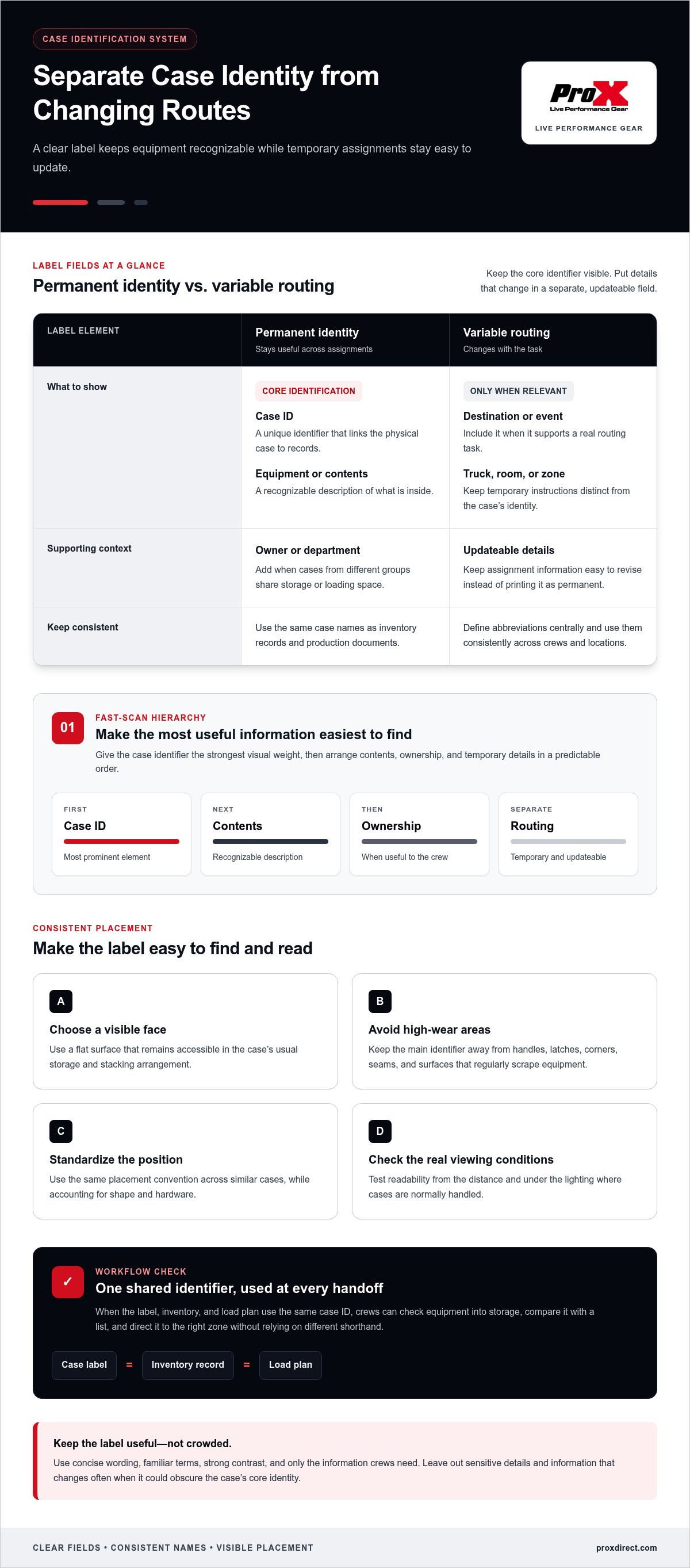
Start with a unique case identifier and a recognizable description of the equipment or contents. Add the owner, department, or production team when cases from multiple groups share a storage or loading area. Include a destination only when it supports a real routing task. Use the same names as your inventory records and production documents. For example, don’t call a case “audio rack” on its label, “rack 3” on the load plan, and “sound case” in inventory.
Make the primary identifier visually distinct from secondary details. A crew member should be able to find the case ID first, then scan the contents or ownership as needed. Leave out sensitive information and details that change often, such as personal contact information or a temporary assignment printed as if it were permanent. Put short-term information in a separate, updateable field.
- Core identification: Case ID and equipment or contents.
- Supporting context: Owner or department, when needed.
- Variable routing: Destination or event information, only when relevant.
How do labels support production workflows?
A shared naming convention links the physical case to the records crews already use. When the case ID on the label matches the inventory and load plan, staff can check equipment into storage, compare it with a list, and direct it to the right zone. At handoff, both teams can refer to the same identifier rather than interpret different shorthand. Define abbreviations centrally and use them consistently across crews and locations.
Keep identity separate from instructions. The case ID and contents description should remain useful across events; a truck position, room, or temporary destination may change with each assignment. Keep those operational details visibly distinct and easy to update rather than letting them replace or obscure the permanent identifier. This approach works across professional case categories, where equipment and production workflows vary. Clear fields give crews a reliable reference without turning the label into a crowded checklist.
Design Road-Case Labels for Readability, Placement, and Fast Scanning
A label only helps when a crew member can find and read it during the task at hand. Build a clear visual hierarchy: make the case identifier the most prominent element, then arrange contents, ownership, and temporary routing details in a predictable order. Use concise wording and strong contrast between text and background. Avoid squeezing in extra fields. Small, crowded text is harder to scan in a busy loading area.
Use the same format across the inventory. If the identifier appears in the same position and style on each case, crew members can find it without checking every surface. Consider viewing distance and lighting where the cases are normally handled. A label that reads well up close may be difficult to see when a case is stacked or moving through a crowded work area.
Where should labels go on a road case?
Choose a flat, visible face that remains accessible in the case’s usual storage and stacking arrangement. Keep the primary identifier away from handles, latches, corners, seams, and surfaces that regularly scrape against other equipment. These areas can interrupt text or expose label edges to abrasion. Use the same placement convention across similar cases, while accounting for their shape and hardware.
If a case can be viewed from more than one practical angle, crews can establish a consistent secondary label position. The goal isn’t to cover every face, but to make the identifier easy to find when cases are stored in their normal orientation. Test the placement on the actual case type before applying labels across a group. Case designs and usable surfaces vary, so reviewing ProX case categories can help teams consider case format alongside their labeling workflow.
How can crews make case labels easy to read?
Keep the information order predictable: identifier first, contents next, then any supporting or temporary details. Use familiar terms, legible type, and a high-contrast color combination. Limit abbreviations to ones the full crew understands. Before adopting a layout, check that text is readable from the distance at which cases are commonly identified, not only when someone stands beside them.
- Emphasize the identifier: Give it the clearest position and strongest visual weight.
- Separate information: Use spacing or distinct fields to distinguish contents from destination details.
- Keep wording concise: Remove redundant descriptions and unfamiliar shorthand.
- Use codes as support: QR codes or barcodes can connect a case to digital inventory, but retain readable text so identification doesn’t depend on scanning equipment.
Test the layout in ordinary working conditions, including stacked storage and typical lighting. Ask crew members in different roles to locate the identifier and explain the fields. If they focus on the wrong detail or disagree about what a label means, revise the hierarchy or wording before using the format across the inventory.
Compare Road-Case Labeling Methods by Durability and Change Frequency
Match the label format to how stable the information is and how the case moves through the production workflow. A permanent case identifier has a different job from a destination that changes between events. Using separate methods for these information types can reduce unnecessary label replacement while keeping current instructions visible. No single format suits every case, crew, or handling pattern.
Use this comparison to assess trade-offs rather than assume one method will work across an entire inventory. Performance depends on the label, surface, placement, and handling conditions. Don’t treat any format as inherently permanent or maintenance-free.
| Method | Useful for | Change and upkeep considerations |
|---|---|---|
| Adhesive label | Stable identifiers and information that should stay with the case. | Replacement may be needed when details change or a label becomes difficult to read. Select a location and label suited to the case surface and handling. |
| Reusable write-on surface | Temporary destinations, event details, or assignments that change between deployments. | Updates are convenient, but crews need a consistent process for revising information and removing outdated entries. |
| Protected document insert | Details that need to be replaced as a group, such as a current contents or routing sheet. | Updates involve preparing and inserting a revised document. Keep the insert visible and ensure obsolete information is removed. |
When are fixed labels or reusable labels more practical?
Keep stable information, such as a permanent case identifier, in a fixed format so it stays associated with the equipment. Use a reusable surface or replaceable insert for fields that change by event, venue, or deployment. This separates lasting identity from temporary operations. Reusable formats reduce the need to replace a full label for every assignment, but someone still needs to revise the details and clear old instructions. If updates are missed, crews may encounter conflicting information.
Before choosing a format, consider how often the field changes, who owns updates, and whether the crew can read it during ordinary handling. The best practices for labeling road cases treat convenience and maintenance as linked decisions: a format is useful only when its information stays current.
When should a barcode or QR code supplement a label?
A barcode or QR code can supplement the printed identifier when a crew already uses a compatible scanning and inventory process. The code can point to a record within that process, but it doesn’t automatically provide tracking or inventory control. Keep the case identifier readable without a scanner, so staff can still identify it if a device is unavailable, a code is damaged, or scanning isn’t part of the handoff.
Apply the same checks to every method: consider whether the information changes, whether the label remains visible in the case’s normal position, and how much effort updates require. A practical system may use fixed identification alongside replaceable event details instead of forcing every field into one format.
Apply a Repeatable Road-Case Labeling Process Across the Crew
A labeling system stays useful when every crew member follows the same rules. Define the format, assign ownership, and add label checks to existing inventory or preparation routines. Match the case type to the equipment and production context, too. The case’s shape, hardware, and storage position can affect where a label will remain visible.
How do you establish a consistent case-labeling system?
Start with the production records crews already use, then choose a naming convention that matches them. Assign one person or role to create identifiers and maintain the approved template. Before wider adoption, test the format on representative case types and ask crew members to find and interpret the information in normal working conditions.
- Define the fields. Decide which details are permanent identifiers and which are event-specific. Focus on information crews actually use.
- Set the naming convention. Align case names and abbreviations with existing inventory records, load plans, and production documents. Document meanings so different teams interpret them consistently.
- Create one approved template. Establish the order and visual hierarchy of fields. Identify who can assign a new case identifier, so duplicate or inconsistent IDs don’t enter the inventory.
- Pilot the layout. Apply the format to representative cases with different shapes, hardware, and surfaces. Check whether labels are visible in typical storage positions and readable during routine handling.
- Gather crew feedback. Ask staff in relevant roles to find the identifier and explain the secondary information. Revise unclear fields or placement before expanding the system.
- Apply and record changes. Use the approved format across the intended cases, and update the inventory record when a case, identifier, or assignment changes.
How should teams maintain labels over time?
Assign responsibility for changes, not just initial setup. The person or role authorized to update event details should remove outdated information during handoff or return. If a case changes contents or ownership, update its record and label together. This keeps the physical marking and inventory in sync.
Add a quick label review to an existing inventory check or production preparation routine. Replace markings that are unreadable or contradictory instead of adding another layer of text. The best practices for labeling road cases depend on consistent maintenance as much as initial design. Each review should confirm that the identifier matches the case and temporary routing details are current.
Build the system around the equipment it serves. ProX professional case options span a range of case types that crews can consider alongside their identification and handling workflow.
Match Road-Case Labeling Practices to the Case and Production Workflow
A label should reflect the case’s job, not just the equipment inside it. Contents, stacking orientation, storage location, and frequency of reassignment all affect which information needs to stay visible and which details need to change. A case that travels with the same equipment may need a stable identifier, while a case assigned to different rooms or destinations may need a separate, replaceable routing field.
Keep permanent equipment identification distinct from temporary event information. This makes it easier to update an assignment without obscuring the case’s identity or leaving outdated directions in circulation. The best practices for labeling road cases account for both the physical case and how crews use it.
How do equipment and case use affect labeling decisions?
Consider how each case is handled, stored, and grouped with related equipment. Cases that travel or sit together should use consistent equipment names, so crews can interpret the group as one coordinated set. For audio-visual and broadcast equipment, place identifiers where they remain legible in the planned handling workflow, including when cases are stacked or accessed in storage. AV broadcasting cases serve varied production needs, so label placement and field choices should suit the specific case and workflow rather than assume every case has the same layout.
ProX has engineered performance gear since 1984, with cases for professional audio, lighting, DJ, and production equipment. Case selection and identification work together: the case supports the equipment and its production context, while the label gives crews a consistent reference as it moves through storage, preparation, and use.
What should crews review before adopting a labeling method?
Test the format with the people who will read and update it. Review a representative case in its usual storage position and during ordinary handling. Check whether the identifier is legible, the information is accurate, and crew members understand the terms and abbreviations. Then consider how often assignments change and whether the selected format makes updates practical without creating competing versions.
- Legibility: Can crew members read the identifier in the case’s normal position?
- Placement: Does the label remain visible and avoid common contact or abrasion areas?
- Accuracy: Do the case marking and production records use matching names?
- Team understanding: Do different roles interpret the fields consistently?
- Change frequency: Can temporary routing details be updated without changing stable identification?
Use feedback to refine one shared template, then keep updates within that convention. Avoid parallel formats that make similar cases look as if they follow different rules.
Match the case to the equipment protection needs and workflow. ProX case options include cases for professional production equipment.
Put Your Case Identification System to Work
Choose a representative group of cases and apply your labeling standard to their real assignments. Use the cases through storage, preparation, and handoffs, then note where information is hard to find or becomes outdated. Feedback from crews using the labels can guide controlled revisions before the format is adopted more widely.
A well-matched case and a clear identification workflow support the same goal: keeping production equipment organized and easier to manage. The best practices for labeling road cases work when the system fits both the equipment and the demands placed on it. ProX has engineered performance gear since 1984 and serves customers worldwide through a dealer network.
For cases suited to professional production equipment, explore ProX case options. Use the product range to find a case type that fits your equipment and labeling workflow.
Frequently Asked Questions
What information should be on a road-case label?
Include a unique case identifier and a short description of the equipment or contents. Add an owner, department, or destination only if it helps the crew make a decision. For example, “MIX-04” can identify a mixer case, while a contents field can distinguish it from similar cases in the same inventory. The best practices for labeling road cases keep each field useful and avoid personal or sensitive details.
Where is the best place to put labels on road cases?
Place the primary label on a broad, flat area crew members can see in the case’s usual stored position. Before settling on a location, check whether a neighboring case or stack will hide it. Inspect the spot after routine handling to see whether contact with other cases or equipment makes the label hard to read. Consistent placement across similar case types helps staff know where to look.
Are QR codes or barcodes useful for labeling road cases?
They can be useful when the crew already uses a scanning process linked to its inventory records. For example, scanning a code during a storage check can help staff open the matching record, provided the inventory system supports that workflow. A code alone doesn’t tell someone what it means without access to the record, so retain a visible text identifier. Keep a manual lookup process available for handoffs when scanning isn’t practical.
How can crews keep road-case labels readable over time?
Build a visual label check into routine case preparation and return. Look for lifted edges, scuffed text, fading, or information that no longer matches the case, then replace or update the marking before the next assignment. Handle changes to the label and inventory record together. This prevents a readable but outdated label from sending a crew to the wrong equipment or creating uncertainty during a contents check.
Should road-case labels show contents or only an inventory number?
Use both when they serve different tasks: the inventory number points to the case record, while a concise contents description helps crews recognize the equipment without looking it up. For a specialized case, a short equipment name may be enough; for similar cases, a model or department detail can distinguish them. Avoid listing every accessory if that level of detail belongs in the inventory record instead.
Can reusable labels work for touring and event production?
Yes, reusable surfaces can suit information that changes between events, such as a venue, room, or temporary routing assignment. They work best when one role is responsible for making updates and clearing old details before the next deployment. Keep permanent identification separate, so removing an event note doesn’t erase the case’s identity. If the crew can’t maintain the reusable information consistently, a replaceable insert may be easier to manage.
Disclaimer
Any trademarks, trade names or brand names appearing herein that do not belong to ProX are the property of their respective owners and/or companies, and such appearance doesn't and shall not constitute or imply endorsement, sponsorship or recommendation by ProX.


