

A single sheared latch or a compromised caster wheel can jeopardize a six-figure equipment inventory during a cross-continental tour. In the professional production industry, the physical demands placed on gear are relentless, and the margin for mechanical error is zero. You know that the integrity of your transport system depends entirely on the quality of its flight case accessories and structural hardware. When standard components fail to meet the rigors of heavy-duty logistics, the equipment inside pays the price through impact damage or environmental exposure.
This guide demonstrates how to optimize your touring setup with high-performance components designed for industrial-grade protection and maximum logistical efficiency. By prioritizing engineering precision over generic alternatives, you'll extend the lifespan of your production gear and significantly reduce maintenance downtime. We'll examine the technical specifications of replacement parts, the benefits of standardized dimensions found in TruckPaX™ solutions, and how ZCASE custom internal engineering ensures your hardware remains secure through every load-in. From material science to truck pack density, this is your roadmap to professional-grade equipment management.
Key Takeaways
- Identify the technical requirements for flight case accessories that align with ATA 300-style protection standards for high-frequency touring.
- Evaluate the mechanical advantages of recessed butterfly latches and spring-loaded handles in maintaining structural integrity during heavy transit.
- Optimize internal equipment management using precision rack rails and dedicated cable storage solutions to prevent internal shifting and hardware fatigue.
- Improve logistical throughput by selecting high-performance casters and standardized wheel plates compatible with TruckPaX™ shipping dimensions.
- Implement a rigorous maintenance schedule using authentic ProX replacement parts to ensure full component compatibility and extend gear lifespan.
Essential Flight Case Accessories: Beyond Basic Hardware
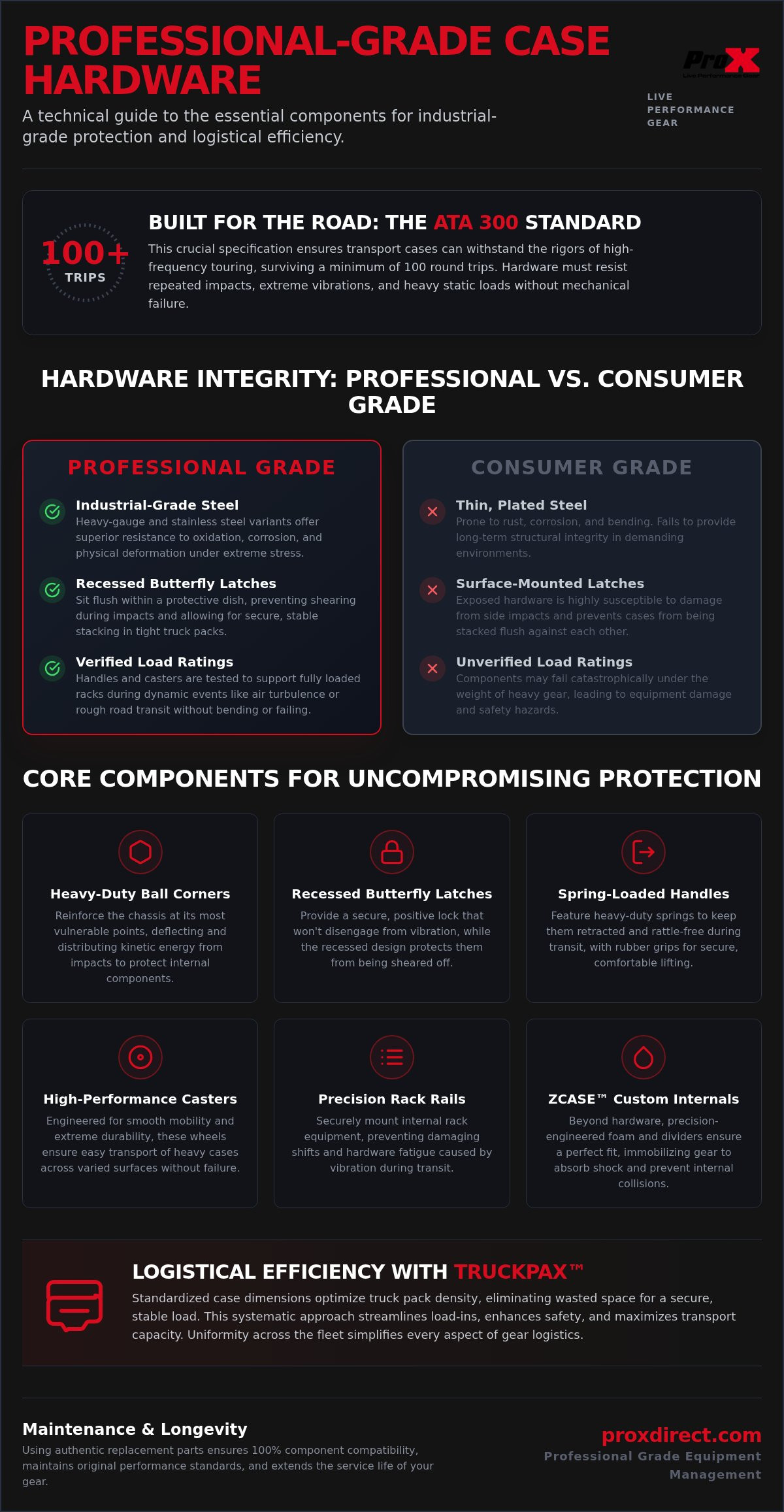
Professional-grade flight case accessories are not merely decorative additions; they're precision-engineered components that define the structural limits of a transport system. The foundational principles of Flight case construction and history reveal that the ATA 300 specification was established to ensure equipment could survive at least 100 round trips. Achieving this standard requires hardware that can withstand repeated impact, extreme vibration, and heavy static loads without mechanical failure. This engineering-first approach distinguishes industrial-grade systems from consumer alternatives.
Utilizing standardized hardware across a fleet is critical for logistical consistency. When your ProX Cases share uniform latches, handles, and casters, maintenance becomes a predictable process rather than a series of custom repairs. This uniformity facilitates faster load-ins and ensures that replacement parts are always compatible, regardless of which case requires service on the road. It's a method that prioritizes functional excellence and long-term reliability over temporary fixes.
The Difference Between Consumer and Professional Grade
Material science dictates the performance gap between consumer-grade and industrial-grade hardware. While budget options often rely on thin zinc-plated steel, professional flight case accessories utilize heavy-gauge industrial steel or stainless steel. These materials offer superior resistance to oxidation and corrosion, which is vital when gear is stored in humid trailers or exposed to coastal environments. Industrial steel maintains its structural integrity even after years of exposure to the physical demands of professional production.
Load ratings are equally decisive in high-stress environments. Industrial-grade handles must support the weight of fully loaded racks without bending or shearing under tension. Professional hardware is tested for structural integrity under the dynamic forces of air turbulence or rough truck transit. By selecting components with verified load ratings, you ensure that the hardware isn't the weak link in your protection strategy.
Strategic Importance of Accessory Selection
Strategic hardware choices directly impact the total cost of ownership for production companies. Investing in high-grade accessories reduces the frequency of equipment damage and extends the service life of the case itself. Proactive upgrades to existing containers or ensuring full compatibility with ZCASE Custom Build Cases minimizes the risk of catastrophic failure during high-stakes events. It's an investment in hardware that pays for itself through reduced downtime and fewer equipment replacements.
Reliability remains the primary objective for the modern technician. By selecting accessories that match the engineering precision of the internal gear, crews spend less time troubleshooting hardware issues and more time focused on production execution. Standardized compatibility ensures that your logistics chain remains unbroken, even during the most demanding global tours. This meticulous attention to component detail is what separates a professional build from a standard transport box.
Structural Hardware: Engineering Precision in Latches and Handles
Structural integrity begins at the chassis level. High-impact collisions during transit often target the corners and edges of a container. Ball corners and heavy-duty braces serve as the primary defense, distributing kinetic energy away from the internal components. These flight case accessories are essential for maintaining the alignment of the lid and base, ensuring a consistent seal over years of operation. The use of heavy-gauge industrial steel in these corners provides a rigid frame that resists deformation even when cases are stacked five-high in a trailer.
Latch Mechanisms and Security Standards
The choice between recessed and surface-mounted latches determines both the longevity of the hardware and the ease of stacking. Surface-mounted hardware is susceptible to shearing during side-impact events or when cases rub together in a tight truck pack. Recessed butterfly latches sit flush within a deep-dish housing, protecting the mechanical assembly from external force. These latches utilize a precision tension-release system that provides a secure mechanical lock, preventing accidental opening under heavy vibration. For high-value equipment, padlockable options offer a necessary layer of security without compromising the latch's mechanical performance. Professionals who prioritize the security of their gear may also find specialized resources like Lockpick Pros useful for understanding and maintaining high-quality locking mechanisms.
Manual handling represents a consistent risk for production crews during load-in and load-out. Spring-loaded handles with recessed rubber grips are engineered to minimize hand strain and prevent crush injuries. By utilizing a heavy-duty spring-return mechanism, the handle stays flat against the case when not in use. This flush profile is a critical factor for touring efficiency and logistics, as it prevents handles from snagging on adjacent gear during rapid movement.
Strategic placement is vital for long-term durability. Large speaker cases or heavy-duty power distribution racks require multiple lift points to balance the load across the chassis. Proper handle positioning prevents uneven weight distribution that can lead to hardware fatigue or localized failure of the plywood panels. For technicians tasked with fleet maintenance, sourcing authentic ProX Cases Replacement Parts ensures that every handle and latch meets the original engineering specifications for load-bearing capacity. Selecting the correct flight case accessories for these high-stress points ensures the fasteners grip the strongest part of the assembly, maintaining the structural rigidity required for the most demanding production environments.
Internal Management: Optimizing Rack Mounts and Cable Storage
Internal engineering is the difference between a simple container and a functional workstation. While external hardware provides the primary defense, internal flight case accessories ensure that delicate circuitry and heavy power units remain stationary under load. For professionals utilizing AV Broadcasting Cases, internal organization is a matter of operational speed. A well-designed interior allows for immediate deployment of monitors, switchers, and control surfaces without the need for extensive on-site cabling. This workflow-centric approach reduces the risk of equipment damage due to poor internal management.
Rack Hardware and Thermal Management
Standard 19-inch rack rails must be manufactured with absolute precision to prevent cross-threading and ensure alignment across multi-unit stacks. High-density amp and effects racks require heavy-duty steel rails that won't flex under the weight of massive transformers. Utilizing cage nut systems allows for easier maintenance and hardware replacement compared to tapped rails. However, physical mounting is only half the challenge; thermal management is critical in enclosed environments. Enclosed racks must integrate ventilation panels or active cooling fans to prevent heat soak, which can lead to premature component failure. For sensitive digital consoles, shock-mount accessories provide an additional layer of isolation, using internal rubber dampers to absorb high-frequency vibrations that rack rails alone cannot mitigate.
Advanced Internal Organization
Effective cable management transforms a chaotic interior into a reliable system. Organizing high-density XLR looms and 12-gauge speaker wire requires dedicated internal mounting brackets and hook-and-loop cable ties. These flight case accessories prevent cable fatigue and ensure that connectors aren't subjected to lateral tension during transit. For smaller components like adapters, fuses, and specialized tools, integrated drawer systems and utility bins provide secure storage that remains accessible during high-pressure load-ins.
When standard internal layouts are insufficient, ZCASE Custom Build Cases offer bespoke internal engineering tailored to specific hardware footprints. This includes custom CNC-cut foam inserts and adjustable internal dividers that prevent movement of non-rackable gear. By using high-density polyethylene foam and reinforced dividers, technicians can create a tiered storage environment that maximizes every cubic inch of the case. This methodical approach to internal management ensures that every component, from the smallest connector to the largest power distribution unit, is secured according to industrial standards.
Logistical Enhancements: Mobility Solutions for Touring Efficiency
Mobility is the operational backbone of any touring production. The ability to move high-density gear from a loading dock to a stage depends entirely on the engineering of the mobility system. Professional flight case accessories like high-performance casters and wheel plates are designed to manage extreme static and dynamic loads. While a standard wheel might support a case on a flat surface; industrial-grade mobility solutions must maintain integrity under the lateral forces of rapid truck loading and the vertical impact of uneven ramps.
Caster Selection for Professional Environments
Material selection for wheels is a technical decision based on the touring environment. Polyurethane (PU) wheels are the industry standard for high-load applications on smooth arena floors. They offer low rolling resistance and high weight capacity. Conversely; rubber wheels provide superior shock absorption for rough outdoor festival terrain, though they typically have lower load ratings. Beyond material, the mechanical configuration is vital. A mix of swivel casters for navigating tight backstage corridors and fixed casters for straight-line stability ensures a balanced handling experience. Integrated braking mechanisms are a non-negotiable safety requirement for sloped loading docks, preventing uncontrolled case movement in high-traffic areas.
Optimizing Truck Pack Logistics
Efficient transport relies on maximizing the cubic volume of 53-foot trailers. This is achieved through the use of TruckPaX™ Truck Pack Cases, which utilize standardized wheel plates and case dimensions. When every case in a fleet shares a uniform footprint, technicians can achieve a level truck pack that eliminates wasted space. Stacking dishes are essential flight case accessories in this context. They provide a secure nesting point for the casters of the case above. This mechanical interlock prevents case migration during transit, which is a leading cause of internal gear damage and hardware failure.
Maintaining these systems is critical for touring longevity. Bearings must be regularly inspected for debris, and wheel surfaces should be checked for flat spots that occur during prolonged storage under heavy loads. Replacing worn components with authentic parts ensures the mobility system remains a reliable asset rather than a logistical liability. To upgrade your fleet's mobility and ensure consistent performance, explore our range of industrial-grade casters and wheel plates designed for the physical demands of professional production.
Maintenance and Longevity: Utilizing ProX Replacement Parts
Rigorous maintenance schedules are the primary defense against equipment failure in the professional production industry. Proactive management of flight case accessories ensures that small mechanical issues don't escalate into catastrophic structural collapses during transit. Regular hardware inspections allow technicians to maintain a fleet that operates with the same precision as the day it left the assembly line. This commitment to upkeep is vital for protecting the long-term value of high-performance gear and preventing expensive downtime during a tour. For those who apply this level of meticulous preparation to their professional advancement, Reasoning Tests Online provides specialized support for mastering competitive career assessments.
Detecting structural stress requires a methodical approach. Inspect ball corners for flattening or shearing, which indicates high-velocity impact during loading. Plywood laminates must be checked for localized cracking or delamination near stress points. Test the tension of recessed butterfly latches to ensure they provide a consistent compression seal. Handles must be evaluated for their spring-back functionality; a handle that fails to retract against the case becomes a snagging liability in high-density truck packs. If a component fails to meet its original mechanical specifications, a full replacement is required to preserve the integrity of the build.
Sourcing and Installing Replacement Parts
Precision repairs require authentic ProX Cases Replacement Parts sourced through authorized channels. Generic hardware frequently lacks the material gauge and corrosion resistance necessary for industrial environments. Sourcing authentic components guarantees that the replacement part matches the original footprint, preventing the need for additional drilling that weakens the plywood structure.
Professional installation relies on proper tooling and technique to maintain the original build quality. Follow these steps for hardware replacement:
- Remove damaged hardware by drilling out the original rivets with a high-speed bit sized to the fastener diameter.
- Position the replacement part and verify alignment with the existing lid and base seals.
- Secure the hardware using an industrial rivet gun and heavy-duty steel rivets.
- Always use backing washers on the internal plywood surface to prevent the fastener from pulling through the wood under tension.
A final inspection protocol must verify that the enclosure retains its ATA 300-style protection standards. This process ensures that every latch, handle, and corner brace functions as a unified system, prepared for the physical rigors of global logistics. By maintaining flight case accessories to factory specifications, production companies ensure their gear remains protected through hundreds of load-ins and load-outs.
Securing Your Inventory with Engineering Precision
Professional production demands hardware that remains reliable under extreme logistical stress. This guide has detailed how structural components like recessed butterfly latches and spring-loaded handles provide the foundational protection required for global transit. By integrating precision-engineered flight case accessories, you ensure your equipment remains secure from the loading dock to the stage. Standardizing your fleet with TruckPaX™ dimensions and maintaining it with authentic replacement parts minimizes the risk of catastrophic failure while optimizing truck pack density.
Since 1984, ProX has engineered performance gear using industrial-grade materials for high-stakes production environments where equipment failure is not an option. Our global dealer network ensures rapid access to essential components, allowing you to maintain your inventory without operational delays. Invest in the structural integrity of your transport system to ensure long-term reliability. Browse the Full Catalog of ProX Case Accessories to find the professional-grade solutions your gear deserves. Your equipment is an investment; protect it with the engineering excellence it requires.
Frequently Asked Questions
What are the most essential accessories for a professional flight case?
Essential accessories include recessed butterfly latches, spring-loaded handles, and heavy-duty ball corners. These components ensure structural integrity and meet the rigorous physical demands of touring. High-density foam inserts and precision rack rails are also vital for internal gear protection. By selecting industrial-grade flight case accessories, production crews minimize the risk of mechanical failure during transit and maintain consistent performance across their equipment inventory.
How do I choose the right caster size for my equipment case?
Caster selection depends on the total weight of the case and the terrain it'll encounter. For heavy-duty production gear, four-inch casters are the industry standard for balancing load capacity with mobility. Larger wheels handle uneven surfaces like festival grounds more effectively. You must calculate the combined weight of the case and equipment to ensure each caster's load rating isn't exceeded. Polyurethane wheels are preferred for smooth arena floors due to their low rolling resistance.
What is the difference between recessed and surface-mounted hardware?
Recessed hardware is mounted within a deep-dish housing, ensuring the latch or handle sits flush with the case surface. This design protects the component from shearing forces and impact damage during tight truck packs. Surface-mounted hardware is bolted directly to the exterior, making it susceptible to snagging or breaking when cases rub together. For professional touring, recessed components are required to maintain structural rigidity and facilitate efficient, high-density stacking in transport vehicles.
How can I improve the cable management inside my rack case?
Improving internal organization requires dedicated cable management flight case accessories such as hook-and-loop ties and internal mounting brackets. These tools prevent cable fatigue and ensure that high-density XLR or speaker looms remain secure during movement. Utilizing internal dividers and drawer systems for small adapters further streamlines the workflow. Professional rack cases often integrate these solutions to reduce setup times and prevent equipment damage caused by loose cables shifting during transit.
Why should I use standardized wheel plates for touring?
Standardized wheel plates are critical for achieving level stacking in transport trailers. When every case in a fleet uses uniform plate dimensions, such as those found on TruckPaX™ cases, the caster heights remain consistent. This uniformity allows for high-density truck packs where cases can be stacked securely without tilting. Standardized plates also ensure that stacking dishes align perfectly, creating a mechanical interlock that prevents case migration and equipment damage during long-haul transit.
What maintenance does flight case hardware require?
Regular maintenance involves inspecting latches for tension, testing handle spring-back functionality, and checking casters for debris. Bearings should be lubricated periodically to ensure smooth rotation. It's also important to verify that rivets and fasteners remain tight against the plywood panels. If hardware shows signs of fatigue or corrosion, it should be replaced immediately using authentic ProX replacement parts. Proactive upkeep extends the service life of the enclosure and maintains its protection standards.
Can I upgrade a standard case with ZCASE custom accessories?
Yes, standard enclosures can be upgraded with ZCASE custom build accessories to enhance protection for high-value gear. These upgrades often include bespoke internal engineering such as CNC-cut foam inserts or shock-mount rack systems. Integrating these precision-engineered components allows technicians to tailor a standard case to specific hardware footprints. This approach provides a higher level of isolation from vibration and impact, ensuring that delicate electronics remain functional throughout demanding production schedules.
Are ProX replacement parts compatible with other case brands?
ProX replacement parts are designed to meet industry-standard dimensions, making them compatible with many professional-grade cases that follow ATA 300 guidelines. However, you should always verify the hole patterns and material thickness before installation. Using authentic ProX components ensures that the hardware meets the original engineering specifications for load-bearing capacity and durability. This compatibility allows production companies to maintain a diverse fleet with a single, reliable source for high-quality structural hardware and accessories.
Disclaimer
Any trademarks, trade names or brand names appearing herein that do not belong to ProX are the property of their respective owners and/or companies, and such appearance doesn't and shall not constitute or imply endorsement, sponsorship or recommendation by ProX.


