

What if a case described as waterproof still leaves your event electronics exposed? Rain is only one concern outdoors. Splashes, dust, standing water, cable entry points, and repeated handling all affect the protection your equipment needs. Choosing a waterproof case for outdoor event electronics starts with the conditions at the actual site, not the label alone.
It’s reasonable to expect a protective case to shield valuable gear without making setup, connections, or operation impractical. But “waterproof,” “watertight,” and “weather-resistant” don’t describe identical protection limits, and enclosure design must also suit the equipment and its access requirements.
This guide explains how to assess site exposure, compare case construction and sealing, and account for fit, access, and cables. You’ll learn how to evaluate protection claims against real operating conditions and identify a relevant option, including ProX UltronX™ Watertight Cases or a custom-built case for unusual equipment dimensions or protection requirements.
Key Takeaways
- Map rain, splashes, standing water, dust, and handling at the event site before selecting a waterproof case for outdoor event electronics.
- Compare enclosure design and documented protection limits; a rating applies to specified conditions, not every setup or modification.
- Measure equipment with connectors, accessories, cable paths, and operating access in mind to avoid a poor fit.
- Use equipment type, exposure, access needs, and transport frequency to compare case options systematically.
- Consider ProX UltronX™ Watertight Cases or a custom-built case when equipment dimensions or protection requirements call for a tailored fit.
Waterproof Cases for Outdoor Event Electronics: Match Protection to Exposure
A case for outdoor event equipment should be selected for the water and environmental conditions it is documented to handle, not treated as an unlimited protection promise. A short period under light rain presents a different exposure from repeated splashes, water collecting around the enclosure, or contact with dusty ground. Transport adds another variable: the case may face handling before and after the equipment is deployed, while the operating setup may leave cables or access points exposed.
For a waterproof case for outdoor event electronics, assess where the enclosure will sit, how long it will be exposed, and whether it will be moved or handled during the event. A case used under a covered stage may face occasional spray; equipment placed near a wet walkway may encounter splashes and standing water. Those conditions call for different documented limits.
What does waterproof mean for event equipment?
“Waterproof” needs context. The term alone doesn’t specify the test conditions, exposure duration, or intended use, so it shouldn’t be taken as proof that an enclosure can withstand every form of water contact. “Watertight” describes an enclosure intended to restrict water ingress, while “weather-resistant” can indicate protection against some environmental exposure without defining a specific water limit. These claims aren’t interchangeable.
Use the manufacturer-stated rating and conditions where provided, and compare them with the actual site exposure. The Water Resistant mark offers background on standardized water-resistance terminology for devices; it doesn’t replace documentation for a case or establish its limits. If a rating describes a particular test, treat that as the boundary of the claim, not a guarantee for other conditions, cable arrangements, or modifications.
Which outdoor event conditions create the main risks?
Build an exposure picture for both transit and operation. During storage and transport, a closed case may encounter rain, dust, ground contact, and repeated handling. At the event, the equipment may be operating with its lid open, controls accessible, and cables connected. Protection of the closed enclosure doesn’t automatically describe the working configuration.
- Rain: Consider whether the case is exposed directly, sheltered, or positioned where water can run across it.
- Splashes and standing water: Note nearby foot traffic, wet surfaces, and low placement where water may collect.
- Dust and ground contact: Account for outdoor surfaces, airborne debris, and how the case is set down.
- Handling: Include movement, opening, closing, and setup activity that may affect how the enclosure is used.
Cables and access openings matter. A connected cable can change how an opening is exposed, while an open lid or altered setup may fall outside the stated protection conditions. Keep the operating arrangement in view when defining the case requirement. ProX’s professional equipment cases cover event equipment categories, with selection guided by the application and documented exposure limits.
How Watertight Case Design Protects Outdoor Event Electronics
Water protection depends on how the enclosure works as a system. The body must resist the stated exposure, the lid interface must meet the body consistently, closures must hold the lid in position, and ports or other openings must not create an unaccounted path for water. A strong shell alone can’t establish the protection of the complete case.
The complete enclosure system determines protection; one robust component cannot compensate for a gap at an interface or an exposed opening. This is why a waterproof case for outdoor event electronics must be assessed in the configuration and conditions covered by its documentation. A rating or claim doesn’t automatically apply after drilling, adding accessories, changing the closure arrangement, or operating with the lid open.
Seals, closures, and enclosure interfaces
At the lid interface, a continuous contact surface can help limit ingress when the case is closed as intended. Closures keep the lid seated against that interface, but their presence alone doesn’t prove a particular water-protection level. Check the manufacturer’s stated use and inspect the contact area and closure points before deployment.
Debris on a sealing surface can interrupt contact. Wear or deformation may also prevent consistent closure, while a latch that isn’t fully engaged can leave part of the interface uncompressed. Treat modifications and added accessories separately from the intact enclosure: a new opening or attachment may change the conditions under which the original protection claim applies. Ready.gov’s Basic Disaster Supplies Kit guidance recommends a waterproof, portable container for important documents and other supplies, illustrating the practical value of enclosure protection without defining an electronics case rating.
Access, connectors, and operation outdoors
Plan how the equipment will be used, not just how it will be stored. An operator may need to view a display, adjust controls, or connect power and signal cables during a performance. If that requires an open lid, the enclosure is no longer in the same closed configuration that a protection claim may describe. Keep the case’s documented operating conditions distinct from its closed storage or transit use.
Cable entries deserve particular attention. Routing a cable through a lid gap, port, or modified opening can affect the barrier against water. Don’t assume an enclosure’s stated protection carries over to a connected setup unless the documentation covers that arrangement. Before deployment, identify which controls and connectors must remain accessible, how cables will exit, and whether the case can remain closed during operation.
Match the case to the real configuration: intact and closed for storage, or configured for the documented operating conditions during use. ProX’s professional equipment cases provide a starting point for comparing case categories against equipment and application needs.
Compare Waterproof Case Options for Different Event Electronics
The right enclosure depends on the equipment’s physical layout and working pattern, not just its category. A mixer with top-mounted controls has different access needs from a lighting unit with rear connectors or a broadcast system with multiple cable runs. Compare dimensions, connection points, operating access, site exposure, and how often the case will be handled before choosing a design.
A watertight case and a general equipment case serve different priorities. A watertight design is relevant when water exposure is a defined concern, but its documented limits must match the intended use. A general case may suit equipment whose main needs are organized storage, equipment fit, and handling protection, without a stated requirement for water protection. Don’t infer water performance from a case’s appearance or general purpose.
| Equipment example | Fit and access considerations | Selection focus |
|---|---|---|
| Audio mixer or control surface | Measure the chassis, protruding controls, connector positions, and space needed for connected cables. | Determine whether operators need access while the equipment remains in the case. |
| Lighting equipment | Account for handles, connector orientation, accessories, and the way the unit is placed for use. | Compare the expected exposure with the case’s documented use and limits. |
| Broadcast or event control electronics | Include displays, controls, cable paths, and any components packed alongside the primary unit. | Balance access and configuration needs against the desired enclosure protection. |
Choose protection for audio, lighting, and control equipment
For audio and control gear, connector placement can determine whether cables can remain attached without obstructing closure or access. Lighting equipment may require room for related components, while broadcast systems often involve several connections and operator interfaces. ProX case categories include options for professional event equipment; AV broadcasting cases are a relevant category to compare for broadcast applications.
When a standard case or custom build may fit better
A standard case can be a practical match when the equipment dimensions and access pattern align with its intended use. Unusual dimensions or specific protection requirements may call for custom case engineering. Custom fit addresses enclosure design around the equipment; it does not, by itself, establish a water rating or certification. Evaluate those claims separately against product documentation.
Use this comparison to narrow the options for a waterproof case for outdoor event electronics. Measure the complete operating setup, including connectors and accessories, then compare the required access and exposure with the case’s stated use. The best fit is the one that accommodates the equipment and working configuration while staying within its documented protection limits.
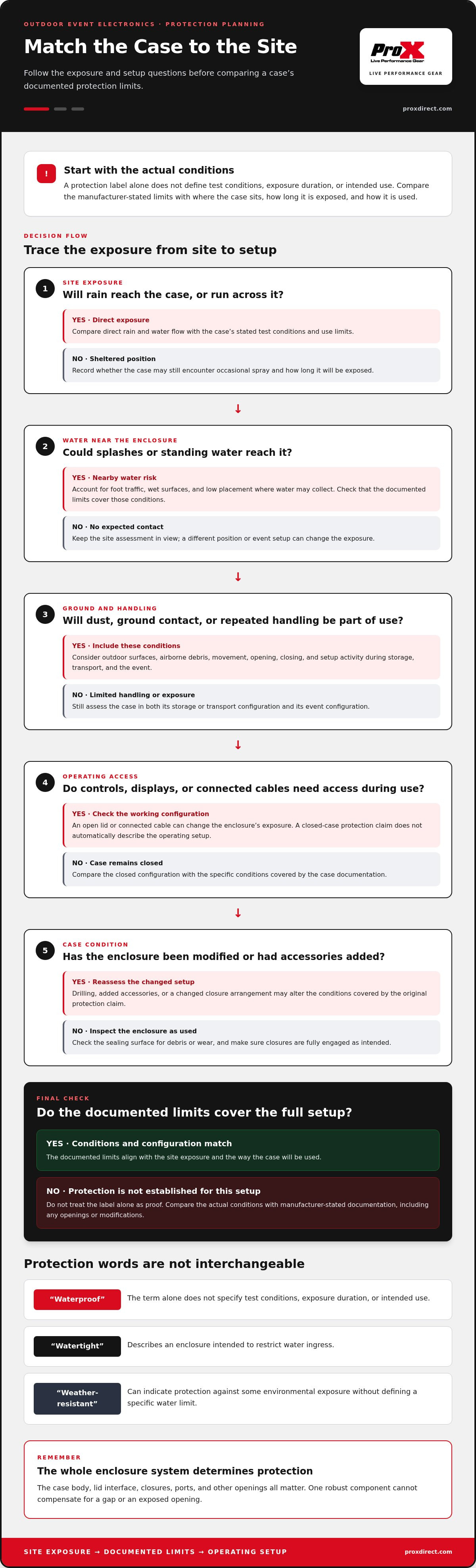
Use This Checklist to Select a Waterproof Case for an Outdoor Event
Make the selection against a written equipment and site profile, not a general impression of how protective a case looks. Separate verified product specifications from your own selection criteria: the manufacturer’s documentation establishes stated limits, while your measurements and event plan establish the conditions the case must suit. A waterproof case for outdoor event electronics is appropriate only when its documented use aligns with the intended configuration and exposure.
Measure equipment and define the working configuration
Record the complete setup that must fit, including protruding controls, connectors, removable components, required accessories, and cable paths. Note how much handling space operators need to connect, adjust, or remove equipment. External case dimensions alone don’t establish internal fit, and equipment measurements alone don’t account for access or connected cables.
- Inventory the equipment. List each device, accessory, and component that must travel or operate in the enclosure.
- Map site exposure. Record expected rain, splashes, dust, ground contact, placement, and the duration of outdoor deployment.
- Define access. Specify which controls, displays, and connectors must remain accessible, and whether the enclosure will be closed during operation.
- Compare dimensions. Measure the equipment and working configuration, including connectors, cable paths, accessories, and space needed for handling.
- Review documentation. Match the manufacturer-stated protection conditions and limitations to the event plan. Keep documented specifications separate from assumptions about performance.
Review protection claims against the event plan
Exposure duration, placement, and handling shape the selection. Direct rain on a stationary case, brief splashes near a stage, and repeated movement across dusty ground are distinct conditions. Record each one, then compare the complete exposure profile with the product’s stated use. Don’t extend a documented rating or claim to a modified enclosure or operating setup unless the documentation covers it.
| Criterion | Question to answer | Evidence to record |
|---|---|---|
| Equipment fit | Do the device, controls, connectors, and accessories fit in the intended arrangement? | Measurements and configuration notes |
| Access and cables | Will the case remain closed, and how will operators connect or reach equipment? | Operating setup and cable-routing plan |
| Exposure | What water, dust, placement, duration, and handling conditions are expected? | Site and deployment notes |
| Protection claim | Which conditions does the documentation specify, and what limitations apply? | Manufacturer documentation and stated limits |
This comparison keeps the decision auditable: site exposure defines the required protection, equipment dimensions and access define fit, and product documentation defines the limits of the claim. If the equipment dimensions or protection requirements call for a tailored enclosure, custom case engineering may be relevant. Browse ProX case options to compare categories with your equipment and event requirements.
Explore ProX Watertight Cases for Outdoor Event Electronics
ProX offers UltronX™ Watertight Cases as a case category for professionals evaluating watertight equipment enclosures. The right choice still depends on the equipment, its operating arrangement, and the exposure expected at the event. Category naming alone doesn’t establish a specific water rating, construction detail, dimension, or suitable exposure condition. Base those decisions on current product documentation and the requirements of your setup.
Use the site and equipment profile from your selection process to focus the comparison. A mixer, lighting unit, or broadcast component may have distinct dimensions and access needs, while event conditions determine which protection limits matter. The aim is to identify a case whose documented use and fit align with the application, rather than assume any enclosure suits every outdoor deployment.
Where UltronX™ Watertight Cases fit the decision
UltronX™ Watertight Cases are the directly relevant ProX category for readers comparing watertight equipment-case options. Review the current product-page information for any stated dimensions, materials, ratings, and conditions, then compare those details with the equipment and deployment plan. Don’t infer performance in an unlisted environment or extend a stated limit beyond its documented conditions.
Choose a ProX case path for your equipment
For standard equipment requirements, compare relevant case categories by equipment type and application. If dimensions are unusual or the project has specified protection requirements that call for a tailored enclosure, custom case engineering can address those project needs. Fit and protection claims are separate considerations: a custom dimension does not by itself establish a water rating or certification.
Before selecting, bring the key requirements together:
- Equipment: Record the device, accessories, connectors, and dimensions that affect fit.
- Operation: Define which controls and connections must remain accessible and how the equipment will be used.
- Exposure: Match site conditions and deployment practices to the documented limits of the case.
This distinction matters for any waterproof case for outdoor event electronics. “Watertight” in a category name is a useful starting point for comparison, not a substitute for product specifications. Check the relevant documentation against the complete equipment configuration and event requirements; where a standard case doesn’t suit unusual dimensions or specified protection needs, a custom-built path may be appropriate.
Explore ProX case options to compare equipment categories and identify a case path that fits your application and documented protection requirements.
Turn Your Site Requirements Into a Case Decision
Before the next outdoor deployment, turn your site observations into a practical case specification. Record the equipment configuration, access needs, likely exposure, and handling conditions, then use those requirements to guide the final comparison. This gives your team a consistent basis for evaluating a waterproof case for outdoor event electronics and helps keep selection decisions tied to actual operating conditions.
ProX has engineered performance gear since 1984, with case options for professional event equipment. If your application calls for a watertight case or a tailored fit, compare the relevant options against your equipment and documented requirements rather than relying on a general label. A well-matched case supports a more deliberate deployment plan.
Explore ProX case options and identify a case path that fits your equipment and event conditions. Your next selection can start with clear requirements and a sound technical basis.
Frequently Asked Questions
Can I leave electronics powered inside a sealed case?
Only if the equipment and case documentation support powered operation in that configuration. A waterproof case for outdoor event electronics can limit water entry, but that doesn’t establish how heat builds up around powered gear. For example, a processor running through a long event may have different operating needs from equipment stored while switched off. Check the device’s required operating conditions and the case’s instructions before closing the enclosure during use.
Can a watertight case prevent condensation?
No. Watertight construction doesn’t by itself control moisture or temperature inside the enclosure. If equipment moves from a cold vehicle into a warm, humid venue, moisture can form as temperatures change. Keep gear dry before storage, avoid sealing damp equipment inside, and follow the handling instructions for both the case and devices. Don’t add desiccants or other moisture-control materials unless the relevant manufacturers’ guidance supports their use.
Can I route cables through a waterproof case while it is closed?
Only when the case documentation supports the specific cable arrangement. A cable trapped across the lid interface can prevent full closure, while routing through a modified opening can change the enclosure configuration. For a stage-side setup, map each power and signal cable before deployment and keep the closure area clear. If the intended routing isn’t covered by the case instructions, don’t assume the closed case retains its stated protection.
Can one outdoor event case fit different electronics?
Possibly, if every device and intended arrangement fits without obstructing controls or connections. For example, swapping a compact controller for a larger unit may change connector clearance and accessory space, even if both devices appear similar in footprint. Evaluate each configuration separately, including removable components and cables that remain attached. Keep a record of approved arrangements so a last-minute equipment change doesn’t create an unassessed fit or access problem.
Are watertight cases intended for permanent outdoor installation?
Not automatically. A case used temporarily at an event may not be intended for continuous exposure or fixed installation. Permanent placement can involve mounting, prolonged sunlight, temperature changes, and cable entry conditions that differ from temporary deployment. For example, a case sheltered during a performance may face direct exposure after the event layout changes. Use the manufacturer’s stated conditions and the electronics’ operating requirements to assess the intended application.
What should I do if a case gets wet during an event?
Follow the case and equipment manufacturers’ instructions before opening the enclosure or powering the contents. If practical, move it away from ongoing exposure and note how it was positioned and handled. After opening it as directed, inspect the equipment and interior for moisture rather than relying on the case label. If moisture is present, follow the device maker’s inspection and drying guidance before returning the electronics to operation.
Disclaimer
Any trademarks, trade names or brand names appearing herein that do not belong to ProX are the property of their respective owners and/or companies, and such appearance doesn't and shall not constitute or imply endorsement, sponsorship or recommendation by ProX.


