

The integrity of a mobile production depends entirely on the structural reliability of its housing. For the professional touring engineer, DJ Workstation Cases are not merely storage units; they are precision-engineered mobile command centers designed to mitigate the risks of mechanical failure and logistical friction. You understand that every minute spent troubleshooting a disorganized cable loom or repairing a damaged fader is a direct threat to the execution of a high-stakes event. Equipment must remain secure during high-vibration transport while remaining accessible for immediate technical operation upon arrival at the venue.
This guide provides a technical overview of how to select a workstation that balances industrial durability with ergonomic workflow. You'll learn to evaluate specifications for material science, internal component protection, and rapid deployment technologies like the ZCASE Flip Ready system. We'll also examine how standardized dimensions, such as those found in the TruckPaX™ series, optimize truck pack efficiency and streamline the transition from transit to performance. By prioritizing engineering precision over basic transport, you can ensure your setup remains a reliable backbone for any professional production environment.
Key Takeaways
- Identify the technical distinctions between standard transport and professional DJ Workstation Cases to build a more reliable mobile production environment.
- Prioritize structural specifications like 3/8-inch plywood and honeycomb digital laminates to protect high-value hardware from mechanical stress.
- Enhance logistical precision by selecting cases with standardized footprints, such as the TruckPaX™ series, for optimized truck loading.
- Streamline onsite workflows through ergonomic cable management and rapid-deployment technologies like ZCASE Flip Ready systems.
- Ensure hardware compatibility by measuring internal dimensions against industry-standard controllers from Pioneer DJ and Roland.
Defining the Professional DJ Workstation Case
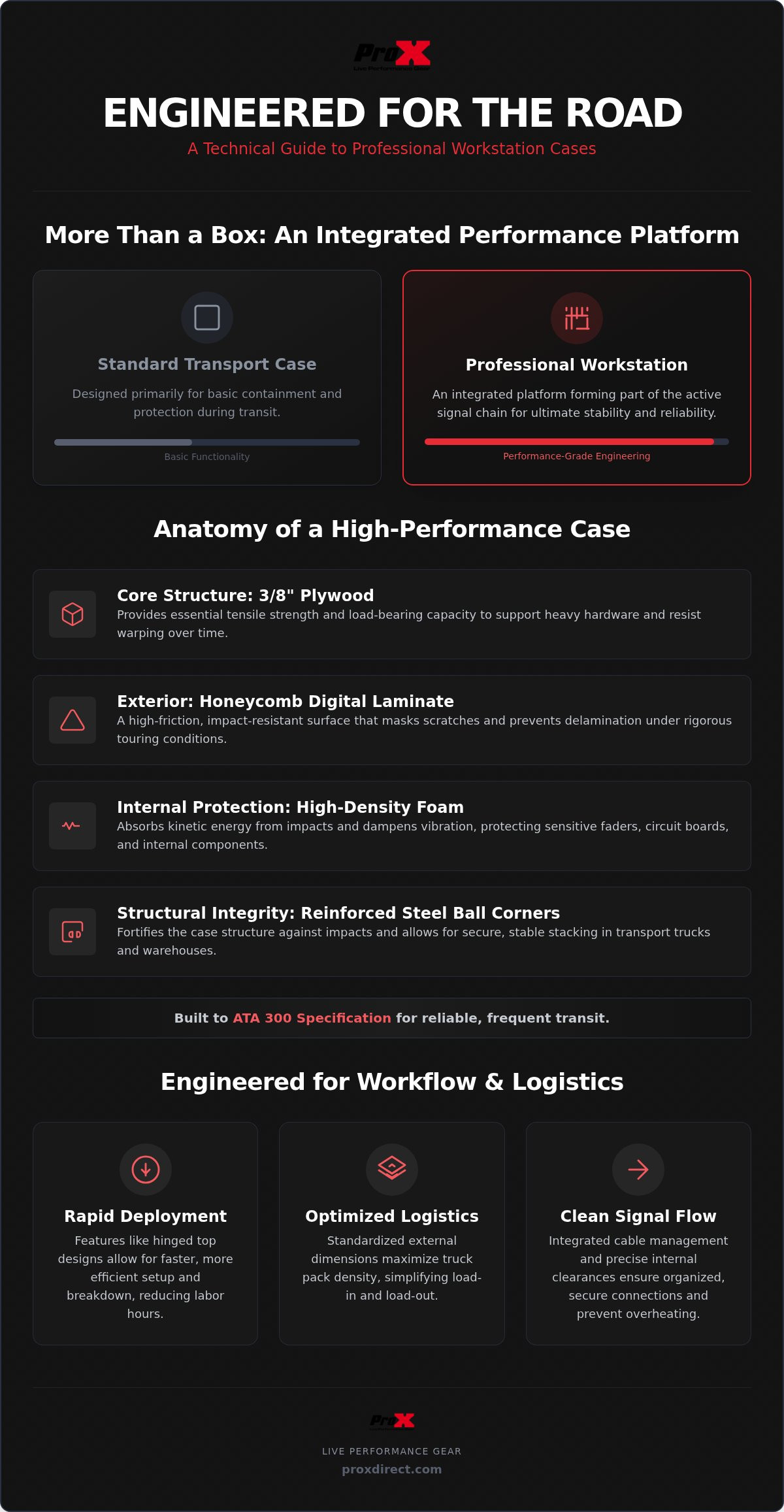
A professional workstation case functions as an integrated performance platform rather than a simple transport container. While a standard Road Case (Flight Case) provides basic protection during transit, DJ Workstation Cases are engineered to remain part of the active signal chain. This distinction is critical for touring professionals who require a consistent technical environment across different venues. The engineering focus shifts from mere containment to functional excellence, prioritizing the mechanical stability of the hardware during high-intensity use. By integrating the equipment into a fixed, pre-configured architecture, production crews can eliminate the variables that typically lead to technical failure or signal degradation.
Engineering for the touring circuit requires significantly higher structural tolerances than consumer-grade alternatives. Professional gear must withstand the cumulative stress of frequent loading, high-vibration environments, and varying climate conditions. Industrial-grade workstations utilize reinforced hardware and specialized laminates to maintain their structural integrity over years of service. This precision-built approach reduces setup friction. It allows technicians to focus on performance rather than troubleshooting hardware connections or structural instability caused by inferior housing.
The Anatomy of a High-Performance Workspace
The internal architecture of a workstation must support the substantial weight of modern digital controllers and mixer consoles without flexing or shifting. High-performance ProX Cases utilize 3/8-inch or 1/2-inch plywood cores to provide the necessary load-bearing capacity. Beyond physical strength, thermal management is a primary engineering concern. Professional designs incorporate specific internal clearance zones to facilitate airflow, preventing the heat buildup that can lead to processor throttling or hardware crashes during extended sets. Integrated cable paths and dedicated mounting points for power distribution units ensure that all connectivity remains secure and organized. This eliminates the interference risks associated with cluttered wiring looms.
Logistical Advantages for Touring Professionals
Logistical efficiency is a direct byproduct of standardized engineering. Workstations designed with uniform external footprints, such as the TruckPaX series, allow for maximum truck pack density. This consistency simplifies the load-out process. It ensures that equipment fits predictably into standard transport dimensions, reducing the time lost to inefficient trailer packing. Features like the ZCASE Flip Ready technology allow for rapid deployment, significantly reducing the labor hours required for stage setup and breakdown. Investing in industrial-grade protection provides a measurable return on investment. It extends the lifespan of high-value electronics and minimizes the costly downtime associated with equipment damage. When the integrity of the build is prioritized, the result is a reliable backbone for any professional production.
Structural Engineering and Material Specifications
The physical integrity of DJ Workstation Cases depends on the mechanical properties of their raw materials. Professional grade builds utilize a 3/8-inch or 1/2-inch plywood core. This core provides the essential tensile strength required to support heavy hardware while resisting warping over time. To protect these surfaces, manufacturers apply honeycomb digital laminates. This hexagonal grid pattern creates a high-friction, impact-resistant exterior that masks scratches and prevents surface delamination. These material choices align with the rigorous requirements of ATA Spec 300, which defines the standard for equipment packaging intended for frequent transit.
Internal protection is equally critical. High-density foam inserts serve as the primary vibration dampening system. Unlike standard packing foam, this industrial-grade material absorbs kinetic energy during rough handling. It prevents internal component displacement, ensuring that sensitive faders and circuit boards remain operational even after high-vibration truck transport. Reinforced steel ball corners further fortify the structure by absorbing corner impacts and allowing for secure stacking in a warehouse or trailer.
Hardware and Assembly Standards
The reliability of a workstation is often determined by its secondary hardware. Recessed butterfly latches and spring-action handles are standard for touring applications. These components sit flush with the case surface, which prevents shearing during the loading process. Structural alignment is maintained through an aluminum tongue-and-groove valance. This feature ensures a precise seal every time the case is closed, distributing weight evenly across the frame. This focus on high-precision sealing is also a hallmark of premium luggage brands like ALEON, which utilize similar aerospace-grade aluminum construction for demanding travel. For mobility, heavy-duty casters with reinforced wheel wells are utilized. These components are designed to withstand the vertical load of a fully populated workstation without failing under stress.
Engineers must balance extreme ruggedness with the logistical constraints of modern travel. While 1/2-inch plywood offers maximum protection, it adds significant weight that can impact shipping costs and manual handling. Selecting the right material thickness depends on the intended use case and the fragility of the internal hardware. These cases must also perform in high-humidity and extreme temperature environments. Resistance to moisture and thermal expansion is essential for maintaining the fit of the lids and the security of the internal mounts. If you require specific material data for your next build, you can review the technical specifications in the ProX Cases catalog.
Ergonomics and Integrated Workflow Features
The functional utility of DJ Workstation Cases extends beyond industrial protection to encompass the ergonomic requirements of the live performer. A workstation is a technical interface where equipment positioning directly impacts performance execution. Engineering these units requires a deep understanding of human factors, specifically the optimal height and reach for the operator. If the profile of the case is too deep or the hardware sits too low, it leads to physical fatigue and reduced precision during high-intensity sets. Professional designs prioritize a low-profile chassis that allows for natural wrist positioning while maintaining easy access to all rear-panel I/O ports.
Integrated cable management is a critical component of a professional workflow. These systems are engineered to isolate signal paths from power distribution lines, which minimizes the risk of electromagnetic interference. By providing dedicated routing channels and internal mounting points for power strips, a workstation eliminates the clutter that often leads to accidental disconnections. This organization also facilitates better equipment accessibility. When cables are managed within the internal architecture, technicians can quickly swap components or troubleshoot connections without navigating a tangled loom of wiring.
Sliding Platforms and Adjustable Shelving
Modern performance setups often require the integration of laptops, hard drives, and auxiliary controllers. High-performance workstations utilize sliding platforms engineered with industrial-grade rail systems. These mechanisms must provide smooth lateral movement while maintaining absolute rigidity when locked into position. Ensuring stability under heavy vibration is a primary engineering challenge. Platforms are designed with safety locks and adjustable tension settings to prevent unwanted movement during a performance. This mechanical stability is essential for protecting the integrity of the laptop's internal components and ensuring the reliability of touch-sensitive interfaces.
Ventilation and Thermal Management
Thermal management is often overlooked in standard transport containers, but it's a mandatory feature for an active workstation. High-output digital controllers and mixer consoles generate significant heat during extended operation. Professional DJ Workstation Cases incorporate passive cooling strategies to facilitate heat dissipation. This is achieved through the strategic positioning of vents and the maintenance of internal clearance zones. These vents are engineered to allow for maximum airflow while preventing the ingress of dust and debris. By maintaining a stable operating temperature, the workstation protects sensitive processors from thermal throttling, ensuring that the hardware performs at its peak specification throughout the event.
Selecting the Right Case for High-Value Controllers
Selecting DJ Workstation Cases for high-value controllers requires a meticulous evaluation of mechanical tolerances. Industry-standard hardware from Pioneer DJ and Roland features sensitive faders, encoders, and touch-sensitive platters that are vulnerable to vibration and lateral shift. A precise fit is the primary defense against mechanical fatigue during transit. When evaluating a case, you'll need to distinguish between internal dimensions, which dictate the equipment cavity, and the external footprint, which determines logistical compatibility with existing truck packs. If the internal cavity is even slightly oversized, the hardware can shift, leading to damaged ports or bent fader stems.
For rigs requiring auxiliary processing, workstation-rack combos provide integrated space for power conditioners, wireless receivers, or effects processors. These hybrid designs centralize the technical infrastructure, which reduces the number of external connections required onsite. You'll also need to choose between fixed-cable and removable-lid configurations based on your operational environment. Fixed-cable designs often facilitate faster deployment by keeping the rear I/O pre-patched, while removable lids provide greater flexibility for cooling and manual cable routing in tight booth spaces. For those who value specialized technical infrastructure in other high-stakes fields, such as the trading platforms provided by TradingPRO, the importance of a reliable and high-performance setup is universally understood.
Universal vs. Gear-Specific Engineering
Gear-specific cases are engineered to the exact CAD specifications of a particular controller model. This engineering approach ensures zero-movement fitment, providing the highest level of protection for sensitive knobs and faders. In contrast, universal workstation designs utilize high-density modular foam inserts. This allows for a customizable internal cavity, making it a viable solution for production houses that rotate different hardware models. Regardless of the choice, the internal architecture must prevent any shifting that could lead to chassis stress. High-density foam serves as the primary energy absorber, protecting the controller's internal circuit boards from high-frequency vibrations.
Custom Case Engineering Services
Unique production rigs or non-standard AV broadcasting equipment often require bespoke housing solutions. The process of designing a custom build involves selecting specialized materials and configuring internal layouts to meet specific logistical standards. You can Explore ProX Custom Case Engineering to see how industrial-grade specifications are applied to unique hardware configurations. These services ensure that even the most complex setups benefit from the same structural integrity found in standard catalog offerings. Professionals seeking a reliable backbone for their gear can browse the full range of professional cases to find the exact match for their specific hardware requirements.
The ProX Advantage: Engineering for Global Production Standards
ProX has established itself as a reliable backbone for the production industry, manufacturing performance gear since 1984. This longevity is rooted in an engineering philosophy that prioritizes technical superiority and logistical efficiency. For touring professionals, DJ Workstation Cases are more than protective shells; they are precision instruments that must integrate seamlessly into global logistics chains. The TruckPaX™ series, for instance, is engineered with standardized dimensions that optimize truck pack density. By utilizing a uniform footprint, production crews can maximize trailer volume and ensure a predictable load-out, reducing the variables that lead to logistical delays and increasing overall transport efficiency.
The ProX advantage is further reinforced by a global dealer network that ensures professional support and availability across multiple territories. This infrastructure is vital for high-stakes environments where equipment failure is not an option. By maintaining partnerships with industry leaders like Pioneer DJ and Roland, the brand ensures that every case is built to current hardware specifications. This commitment to detail allows engineers to deploy complex rigs with the confidence that their technical environment is standardized and secure, regardless of the venue's location.
Touring-Grade Solutions: Santosom and ZCASE
Professional touring requires specialized hardware that can withstand the rigors of international transit. Santosom cases represent the pinnacle of European engineering, offering bespoke protection for high-value consoles. Complementing this is the ZCASE Flip Ready technology, which has become an industry standard for rapid deployment. This mechanical system allows a single technician to transition a console from transport to performance position in seconds, significantly slashing setup times for touring crews. Those requiring specialized configurations can Browse ZCASE Custom Solutions to evaluate how these technologies integrate with bespoke production rigs.
Maintaining Your Workstation for Long-Term Reliability
The longevity of industrial-grade equipment depends on a rigorous maintenance schedule. Professional operators should conduct routine inspections of all recessed butterfly latches, spring-action hinges, and caster assemblies. Maintaining the structural integrity of these mechanical components prevents minor wear from escalating into a catastrophic failure during transit. The honeycomb digital laminate exterior should be cleaned regularly to prevent debris buildup that could interfere with the fit of the aluminum valance. For those needing to restore a unit to its original specification, sourcing Essential Replacement Parts for Case Maintenance ensures that the workstation continues to meet professional-grade standards for years of service.
Advancing Your Mobile Production Infrastructure
It's clear that the transition from simple transport to an integrated performance environment is the hallmark of professional production. Selecting DJ Workstation Cases built with ATA-300 style compliance ensures that your high-value controllers and processing gear remain protected against the cumulative mechanical stresses of global touring. By prioritizing ergonomic cable management and standardized dimensions like those found in the TruckPaX series, you'll directly reduce onsite friction and maximize truck pack density for more efficient logistics.
ProX has served as the industry's reliable backbone since 1984, offering both catalog standards and specialized custom design-and-build services for bespoke technical needs. Reliability is not optional. These engineering standards are trusted by touring professionals worldwide to maintain a consistent, high-performance workspace in high-stakes environments. This commitment to structural integrity allows you to focus on technical execution rather than equipment vulnerability. To secure your mobile infrastructure with industrial-grade housing, Find a Dealer to Purchase ProX Workstation Cases today. Investing in functional excellence ensures the long-term reliability of your mobile command center for every future performance.
Frequently Asked Questions
What is the difference between a standard case and a workstation?
A workstation is an integrated performance platform designed to remain part of the active signal chain during operation. Unlike a standard transport container, these units feature ergonomic heights, internal cable management, and integrated laptop platforms. Professional DJ Workstation Cases prioritize functional access to I/O ports and thermal management, whereas standard cases focus primarily on equipment containment and physical protection during the transit phase.
How do I ensure my DJ workstation case fits in a standard truck pack?
To ensure logistical compatibility, you should select cases engineered with standardized external footprints. ProX offers the TruckPaX series, which utilizes dimensions specifically calculated to optimize truck pack density in standard trailers. By aligning the external dimensions of your workstation with these industry standards, you maximize trailer volume and ensure a predictable, secure load-out. This consistency reduces the risk of equipment shifting and damage during high-vibration transport.
Are these cases suitable for air travel and international touring?
Yes, professional workstations are built to meet or exceed ATA-300 style specifications for international touring. Series such as Santosom and ZCASE utilize reinforced hardware and high-density materials to withstand the mechanical stresses of air travel. These cases are designed for frequent loading and unloading in diverse climate conditions. The structural integrity of the build ensures that sensitive electronics remain secure during high-impact handling by ground crews at global transit hubs.
What materials are used in professional workstation construction?
Professional construction utilizes a 3/8-inch or 1/2-inch plywood core for maximum tensile strength. This is paired with an aluminum tongue-and-groove valance to ensure precise structural alignment and a secure seal. Exterior surfaces are finished with honeycomb digital laminates for impact resistance. Internal protection is provided by high-density foam inserts, which serve as the primary vibration dampening system for the housed hardware. Industrial-grade steel ball corners provide additional reinforcement against corner impacts.
Can I customize the internal layout of my workstation case?
You can customize the internal layout through dedicated custom case engineering services or by utilizing modular foam systems. ProX provides bespoke design-and-build projects tailored to specific equipment dimensions and unique production requirements. This engineering process allows for the integration of non-standard AV broadcasting gear or complex multi-controller rigs. For standard models, modular foam inserts allow for minor adjustments to the internal cavity, ensuring a zero-movement fitment for your specific hardware configuration.
How do I maintain the hardware on my case for long-term use?
Long-term reliability requires routine inspections of all mechanical components, including recessed butterfly latches and spring-action handles. You should regularly verify the integrity of the aluminum valance and ensure that heavy-duty casters remain free of debris. Cleaning the honeycomb exterior surface with non-corrosive agents prevents the buildup of contaminants that could impact the fit of the lids. If hardware becomes compromised, utilizing professional replacement parts ensures the workstation maintains its original technical specifications.
What is the benefit of the honeycomb laminate surface?
The honeycomb digital laminate surface provides a high-friction, impact-resistant exterior that masks surface scratches and prevents delamination. This hexagonal grid pattern is engineered to withstand the abrasive environments of loading docks and warehouses. Beyond aesthetics, the texture improves handling by providing a superior grip surface for production crews. This material choice is a critical component of professional DJ Workstation Cases, as it extends the service life of the housing while maintaining a professional appearance.
Does ProX offer cases for specific brands like Pioneer DJ or Roland?
ProX manufactures gear-specific cases engineered to the exact technical specifications of hardware from Pioneer DJ, QSC, and Roland. These partnerships ensure that the internal cavities, port access points, and thermal management zones are optimized for specific controller models. By using CAD-driven designs, the manufacturer provides a zero-movement fitment that protects sensitive faders and touch-sensitive platters. This precision-built approach eliminates the risks associated with using generic, oversized housing for high-value digital electronics.
Disclaimer
Any trademarks, trade names or brand names appearing herein that do not belong to ProX are the property of their respective owners and/or companies, and such appearance doesn't and shall not constitute or imply endorsement, sponsorship or recommendation by ProX.


