

If your QSC speaker system is the backbone of your production, treating its transport as an afterthought is a calculated risk that eventually leads to mechanical failure. Professional operators understand that the transition between venues is often more taxing on internal components than the performance itself. You've likely experienced the logistical headache of trying to secure a KS212C subwoofer or the frustration of a disorganized load-in. Finding a high-quality QSC speaker case isn't just about a snug fit; it's about maintaining technical precision in a high-stakes environment where equipment failure isn't an option.
We agree that your investment deserves a protective solution as meticulously engineered as the audio technology inside. This guide provides the technical data you need to select and maintain engineered protection that ensures long-term performance and logistical efficiency. You'll learn about the structural requirements of ATA 300 Category I standards, including 3/8 inch laminated plywood and high-density shock-absorbing foam. We also examine how standardized truck pack dimensions and heavy-duty caster systems can streamline your entire logistical workflow.
Key Takeaways
- Understand why high-output drivers and internal electronics require rigid enclosures to maintain acoustic integrity during rigorous transit cycles.
- Identify the structural advantages of ATA-style builds, featuring 3/8-inch laminated plywood and Honeycomb Digital™ surfaces for maximum impact resistance.
- Evaluate whether a single or dual QSC speaker case configuration best serves your specific operational needs and storage constraints.
- Learn how TruckPaX™ dimensions and standardized stacking systems optimize trailer space and reduce equipment shifting during long-haul transport.
- Explore engineered solutions from Santosom and custom ZCASE builds for high-value production environments and global touring requirements.
Why Professional QSC Speaker Systems Require Engineered Protection
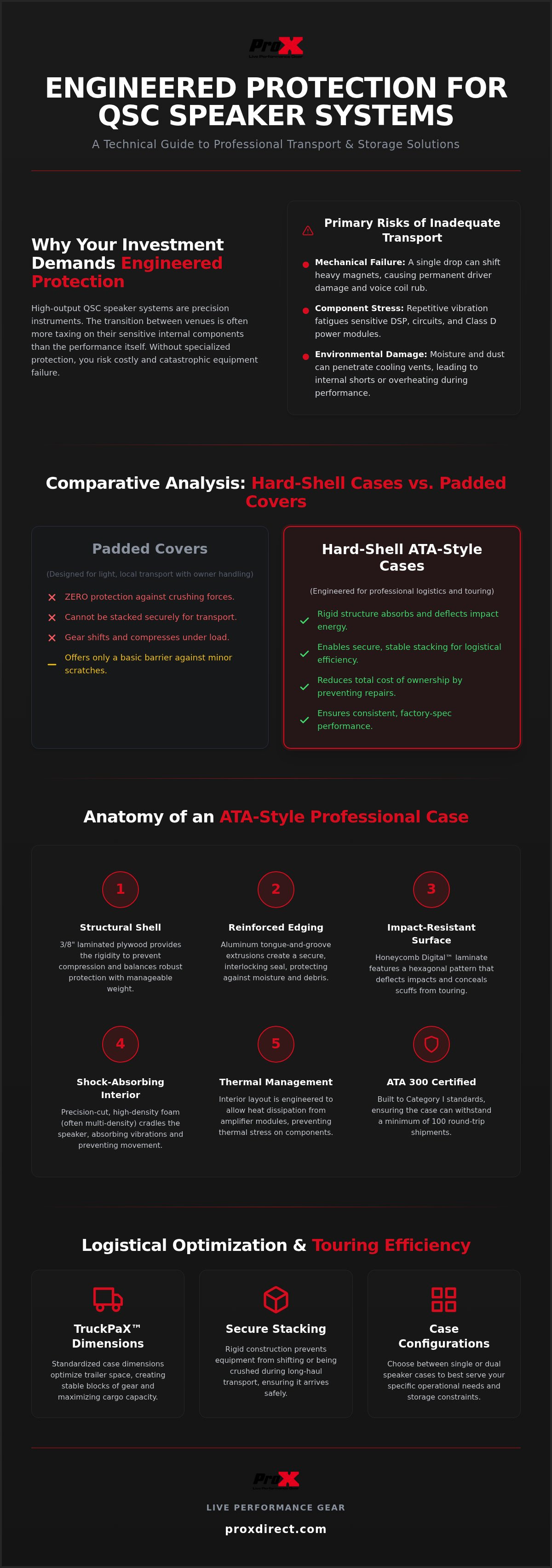
QSC systems represent a substantial capital investment for any production firm or independent engineer. Maintaining the acoustic integrity of these high-output cabinets requires an engineered environment that goes beyond simple storage. A professional QSC speaker case isolates sensitive components from the extreme physical shocks inherent in the touring cycle. While the exterior cabinets are rugged, the internal architecture is surprisingly delicate. High-frequency compression drivers and Class D power modules don't tolerate repetitive vibration or high-impact events. A single drop can shift a heavy magnet, resulting in voice coil rub and permanent driver failure.
The Risks of Inadequate Speaker Transport
Structural fatigue is a primary risk during movement between venues. Heavy-duty grilles can deform if weight is applied incorrectly, potentially contacting the driver surround and distorting the frequency response. Integrated DSP and amplification circuits are sensitive to the mechanical stresses of long-haul logistics. Without an ATA-style flight case, environmental factors also become a threat. Moisture and dust often penetrate the cooling vents of an amplifier module during storage or transit. This leads to internal shorts or overheating during a critical performance when the gear is pushed to its limits.
Hard Cases vs. Padded Covers: A Comparative Analysis
Padded covers are designed for light-duty, local transport where the owner maintains total control over the handling. They provide a basic barrier against minor scratches but offer zero protection against crushing forces or vertical stacking. Hard-shell cases utilizing 3/8-inch plywood and high-pressure laminate provide a rigid skeletal structure that absorbs energy before it reaches the speaker. This design enables logistical efficiency through secure stacking. Professional crews rely on these dimensions to create stable blocks of gear in a truck, which is impossible with soft-sided bags that shift and compress under load.
The long-term return on investment for a dedicated QSC speaker case is undeniable. It significantly reduces the total cost of ownership by eliminating the high costs of driver replacement and amplifier repair. Beyond hardware costs, you avoid the professional embarrassment of equipment failure on site. High-quality protection ensures your system performs to its original factory specifications every time it's deployed, regardless of how many miles it has traveled.
Anatomy of an ATA-Style Case for QSC Speakers
A professional QSC speaker case is an exercise in mechanical engineering, designed to survive the repetitive stresses of global logistics. The foundation consists of 3/8-inch plywood laminated with a high-pressure surface. This specific thickness provides the necessary structural rigidity to prevent cabinet compression when multiple units are stacked in a trailer. This material choice isn't arbitrary; it's the established standard for professional production because it balances physical protection with manageable weight.
Structural Integrity and Material Science
The assembly is reinforced with aluminum tongue-and-groove extrusions that create a secure, interlocking seal. This prevents the ingress of moisture and debris while ensuring the lid remains aligned under heavy pressure. Adherence to ATA Specification 300 Category I standards means these cases are built to withstand a minimum of 100 round-trip shipments. Honeycomb Digital™ laminate serves as both a structural reinforcement and an aesthetic advantage, featuring a hexagonal pattern that deflects impacts and conceals the inevitable scuffs of the production environment.
Interior Cushioning and Shock Absorption
Inside the case, the protection strategy shifts to energy management. Precision-cut high-density foam is shaped to the exact footprint of specific QSC models, such as the KW or K series. We utilize a combination of foam densities to maximize shock absorption. Closed-cell foam provides a firm base that prevents the speaker from shifting, while softer open-cell layers absorb high-frequency vibrations during transit. It's also vital to consider thermal management for speakers stored immediately after a performance. The interior layout is engineered to allow for heat dissipation from the rear amplifier modules, preventing thermal stress on the internal capacitors and circuitry.
The mechanical reliability of the case depends on its hardware. Recessed butterfly twist-latches are essential for a snag-free exterior, protecting the locking mechanism from being sheared off during tight truck packs. Steel ball corners are utilized to distribute the force of corner impacts away from the plywood panels. For mobility, we integrate heavy-duty 4-inch casters with industrial bearings. These casters are designed to handle the significant weight of dual-speaker configurations while providing the smooth movement required for efficient stage setup.
For those seeking the highest level of equipment security, our catalog of QSC speaker case options provides the structural integrity required for professional use.
Evaluating Case Configurations: Single vs. Dual QSC Speaker Cases
Selecting the correct configuration for a QSC speaker case involves balancing labor efficiency against physical space constraints. Dual speaker cases are the industry standard for high-volume production environments where speed is critical. By housing two cabinets in a single enclosure, crews reduce the number of individual items to track, secure, and move. This consolidation improves Logistical Optimization during complex event schedules. However, single speaker cases remain essential for smaller deployments or when navigating venues with limited elevator capacity or narrow access points.
Dual configurations offer a lower cost-per-unit for protection. While a dual case has a higher initial price point than a single unit, it's typically more economical than purchasing two separate single cases. The trade-off is total weight. A dual case loaded with two KW series cabinets requires mechanical assistance, such as ramps or lift gates, and it's best handled by a two-person team. In contrast, single cases allow for more granular truck packing in smaller vehicles where every inch of vertical and horizontal space must be utilized. Don't underestimate the physical toll of moving single cases manually if your venue lacks loading docks.
Efficiency in Mobile Production
The operational speed gained from dual cases significantly impacts labor costs. During teardown, a crew can secure a full PA system in half the trips required for single enclosures. These cases also serve secondary functions on-site. The rigid, flat top of a dual speaker case provides a stable surface for staging accessories or acting as a temporary workstation during system tuning. To find the right fit for your inventory, Explore our full range of ProX Cases designed for professional audio standards.
Protecting Large Format QSC Subwoofers
Large format enclosures like the QSC KS212C require specialized engineering due to their weight and acoustic port design. A subwoofer-specific QSC speaker case must account for the cardioid porting of the KS212C to ensure no structural stress is placed on the grille or port assembly during transit. High-grade 4-inch casters with reinforced mounting plates are mandatory for these builds. The interior foam must be rigid enough to prevent the heavy enclosure from bottoming out during a high-velocity impact, maintaining the critical air gap between the cabinet and the outer plywood shell. This gap is essential for absorbing energy that would otherwise transfer directly to the transducer assembly.
Logistical Optimization: Truck Pack and Touring Efficiency
Professional touring requires more than just protection; it requires logistical precision. A QSC speaker case engineered with truck pack dimensions allows for a standardized footprint that maximizes trailer volume. In a high-stakes production environment, "dead air" in a truck is a financial liability. By utilizing standardized case sizes, you ensure that equipment fits together like a puzzle, preventing the lateral shifting that leads to sheared latches or punctured plywood panels. This efficiency allows crews to move more gear in fewer vehicles, directly impacting the bottom line of a tour or event.
Load stability is achieved through interlocking designs. Stacking cups, or caster dishes, are integrated into the top of the case lid to accept the wheels of the unit above it. This vertical locking mechanism is essential when navigating rough roads or steep ramps, where unanchored gear becomes a projectile. These cases are designed to integrate seamlessly into a broader production ecosystem. Whether you're packing QSC tops alongside Stage Truss or power amplifier racks, the uniform external dimensions facilitate a more stable and predictable load. This modularity allows production managers to calculate exact truck space requirements before the first case is even wheeled onto the ramp.
Maximizing Trailer and Van Space
Calculating the footprint of your QSC rig is the first step in logistical planning. Most professional trailers are 90 to 96 inches wide, so cases are often designed in 22.5-inch or 45-inch increments. Using these specific dimensions eliminates gaps that would otherwise require additional strapping or dunnage. To streamline your inventory management and ensure a tighter load, Optimize your load with TruckPaX™ Truck Pack Cases, which are purpose-built for these logistical standards.
Maintenance for Long-Term Touring Reliability
Touring reliability is a product of routine maintenance. Inspect recessed butterfly latches for alignment and ensure spring-loaded handles retract fully to prevent snags during tight packs. The Honeycomb Digital™ exterior should be wiped down periodically with a mild detergent to maintain its high-friction surface and professional aesthetic. Casters require periodic lubrication and inspection for flat spots or debris in the bearings caused by dragging over uneven surfaces. It is essential to replace internal foam once it shows signs of compression or degradation to maintain a snug, protective fit for the speaker cabinet. Consistent maintenance ensures that your protection system doesn't become a point of failure during a critical tour leg.
Browse our complete collection of hard-shell cases for QSC systems to upgrade your touring logistics and protect your investment.
ProX Solutions: Santosom and Custom Engineering for QSC
ProX provides a multi-tiered approach to equipment security that addresses the diverse needs of the audio industry. We recognize that while a standard QSC speaker case meets the requirements for regional production, global tours demand a higher level of mechanical integrity. Our catalog spans from industrial-grade standard builds to premium European partnerships. This ensures that every QSC system, from a compact K8.2 to a heavy-duty KS series subwoofer, has a protective environment tailored to its specific logistical demands. We've been manufacturing professional enclosures since 1984, establishing a foundation of engineering precision that industry veterans trust.
Santosom: The Professional Standard
Santosom cases represent the pinnacle of engineered protection for international touring and high-stakes events. These enclosures are preferred by global crews who face the most rigorous transport cycles across multiple continents. The engineering precision in a Santosom QSC-specific design accounts for every millimeter of the cabinet's geometry, ensuring a zero-tolerance fit that prevents internal movement during high-vibration air or sea freight. To understand the material science and design philosophy behind these premium builds, Read our guide on Santosom Engineering Excellence.
Bespoke Protection with ZCASE
High-value production gear often requires more than a standard enclosure. When you're deploying unique QSC arrays or non-standard configurations, bespoke engineering becomes a necessity rather than an option. Our partnership with ZCASE in Poland allows us to offer custom solutions for unique production needs. These are meticulously planned enclosures designed for specific high-stakes workflows, ensuring that even the most complex systems remain secure. You can explore the possibilities of ZCASE Custom Build Cases to see how bespoke protection manages high-value production gear.
An engineered case is a long-term asset, not a consumable. We support the longevity of your investment by offering a comprehensive range of ProX Cases Replacement Parts. Maintaining the structural integrity of your QSC speaker case through routine hardware updates ensures it remains a reliable backbone for your business inventory. By prioritizing functional excellence and structural capabilities, ProX provides the technical superiority required for professionals who cannot afford equipment failure. This commitment to durability and compatibility makes us the definitive partner for protecting your professional audio systems.
Securing Technical Integrity for Professional Logistics
Protecting a high-performance audio system requires more than basic coverage. It demands an enclosure built to industrial standards. You've seen how ATA-style construction and high-density foam manage the physical stresses of repetitive touring cycles. By utilizing standardized truck pack dimensions, you optimize trailer space and reduce the risk of equipment shifting during transit. Investing in a dedicated QSC speaker case ensures your cabinets maintain their acoustic integrity and physical aesthetics over hundreds of deployments.
Since 1984, ProX has engineered precision solutions trusted by touring professionals worldwide. Whether you utilize the K, KW, or KS series, our cases provide the structural reliability your production requires. From the premium engineering of Santosom to bespoke ZCASE builds, we offer the technical backbone for your equipment inventory. Browse Engineered QSC Speaker Cases at ProX to secure your investment today. Your gear is a critical asset; treat it with the engineering precision it deserves.
Frequently Asked Questions
Do I really need a hard case for my QSC speakers if I only do local gigs?
Hard-shell protection is essential even for local transit due to the high frequency of loading and unloading. Local gigs often involve packing speakers into personal vehicles alongside sharp-edged hardware or heavy stands. A dedicated QSC speaker case provides a rigid barrier that prevents cabinet compression and protects internal Class D electronics from the shocks of uneven pavement. While padded bags resist dust, they cannot mitigate the mechanical stress of a single vertical drop.
Will a dual QSC speaker case fit in a standard SUV or van?
Standard dual speaker cases are engineered for logistical efficiency in professional trailers, typically following 22.5-inch or 45-inch increments. Most modern cargo vans accommodate these dimensions easily. However, SUV owners must verify the interior clearance between wheel wells and the total height of the vehicle's rear opening. A dual case loaded with two cabinets is significantly heavier than a single unit; ensure your vehicle has the payload capacity and a flat loading surface.
What is the difference between ATA-300 and standard utility cases?
ATA Specification 300 Category I is a rigorous engineering standard requiring a case to survive a minimum of 100 round-trip shipments. Standard utility cases often use thinner panels and lighter hardware that fails under the repetitive stress of professional touring. An ATA-style QSC speaker case utilizes 3/8-inch laminated plywood, recessed butterfly latches, and steel ball corners. These components are specifically designed to absorb and deflect high-velocity impacts that would shatter a lightweight utility enclosure.
Can I use a universal speaker case instead of a QSC-specific one?
Precision-cut foam is the primary advantage of a model-specific enclosure. While universal cases utilize generic foam blocks, they often leave air gaps that allow the speaker to shift during transit. This movement transfers kinetic energy directly to the cabinet and internal components. A QSC-specific case ensures that high-density foam supports the speaker at its strongest points, such as the corners and base, while protecting delicate areas like the front grille and rear control panel.
How much weight does a professional flight case add to a QSC K12.2?
A professional single-speaker enclosure typically adds between 25 and 35 pounds to the total load. This weight reflects the use of industrial materials like 3/8-inch plywood, aluminum extrusions, and heavy-duty steel hardware. While this increases the physical effort required for transport, the added mass is a direct result of the structural integrity needed for stacking. Most professional users find the trade-off acceptable given the significant reduction in equipment repair costs over the system's lifespan in a QSC speaker case.
Are ProX cases compatible with other speaker brands if I upgrade my rig?
ProX designs many cases with modularity in mind, but precision-fit foam is usually model-specific. If you upgrade to a speaker with similar external dimensions, you might only need to modify or replace the internal foam inserts. Our cases utilize standardized hardware and construction techniques, making them a versatile long-term investment. However, always verify the exact cabinet dimensions of your new gear to ensure that the structural support points align correctly with the existing interior layout.
How do I clean the interior foam of my speaker case?
Maintain the interior by using a high-suction vacuum to remove dust and debris from the foam pores. For light staining, use a damp cloth with a mild, non-abrasive detergent. It's critical to avoid harsh chemical solvents that can degrade the adhesive bonds or the cellular structure of the high-density foam. Ensure the interior is completely dry before resealing the case to prevent moisture buildup, which can damage the speaker's internal electronics and lead to mold growth.
What should I do if a caster or latch breaks during a tour?
Mechanical components like casters and latches are subject to extreme wear during professional use. ProX maintains an extensive inventory of ProX Cases Replacement Parts to address these issues on-site. Most casters and recessed butterfly latches use standardized mounting patterns, allowing for quick field repairs with basic hand tools. Carrying a small kit of spare hardware is a standard practice for touring crews to ensure that a single component failure doesn't compromise the safety of the entire load. Just as understanding the nuances of vehicle security—like knowing what to call your car key when requesting a duplicate from Soxxi Master—is vital for fleet management, carrying spare hardware for your cases is essential for touring success.
Disclaimer
Any trademarks, trade names or brand names appearing herein that do not belong to ProX are the property of their respective owners and/or companies, and such appearance doesn't and shall not constitute or imply endorsement, sponsorship or recommendation by ProX.


