

What if a case that looks like a close fit is wrong for your crew? A custom flight case for moving head lights must account for more than a fixture’s headline width, height, and depth. Its full shape, protrusions, and the way technicians load, secure, and remove it all affect the internal layout.
Start with two practical questions: does a listed lighting-case configuration match the complete fixture and your workflow, or does the project call for custom engineering? Either route can work. The right choice depends on accurate measurements and real handling requirements, not the product name alone.
This guide explains how to record a fixture’s full dimensions, assess access and internal fit, and prepare a useful case specification. It also covers how crew routines affect layout, so you can compare a listed option with a bespoke design. ProX has engineered performance gear since 1984 and offers lighting cases and custom case engineering tailored to equipment dimensions and protection requirements.
Key Takeaways
- Choose a listed case when its documented fit matches your fixture and handling needs; consider custom engineering when it doesn’t.
- A custom flight case for moving head lights should reflect the fixture’s full geometry, including projections and its transport position.
- Plan internal separation and access around how your crew handles the fixture, rather than assuming one layout suits every setup.
- Build a practical specification by recording fixture identification, quantity, transport position, attached components, and intended use.
- Define custom case requirements around your equipment dimensions and the protection needs of your production workflow.
When Does a Custom Flight Case for Moving Head Lights Make Sense?
A close fit and a workable handling sequence matter more than a generic capacity label. A listed configuration may suit a fixture when its documented compatibility covers the complete unit, its capacity matches the number of lights you need to carry, and the crew can load and remove each one as intended. Consider a custom flight case for moving head lights when one of those conditions is not met, such as when the fixture’s shape, transport position, or access needs fall outside the listed configuration.
Separate protection requirements from convenience preferences. In the case brief, identify which components need support or clearance, then explain how the crew handles the fixture. Easier access may improve the load-in sequence, but it is not the same as a protection requirement. ProX’s professional case range includes lighting cases, and custom engineering can tailor a layout to specific equipment dimensions and protection requirements.
What makes a moving-head fixture difficult to fit?
A moving head is not a simple rectangular load. Its head, yoke, base, connectors, handles, and other projections can create different clearance needs across the fixture. Movable components also need to be considered in the position used for transport. Measuring only the main housing can leave a protrusion outside the intended internal envelope or put pressure on a vulnerable part.
The goal is a supported fit, not maximum compression. Identify which surfaces and components can bear contact and which need clearance. The intended transport position affects where support and separation may be needed, so include it in the case brief. For general context on case purpose and construction, see Road case (flight case) definition and standards.
When is a listed case configuration enough?
Start with documented compatibility, not a product title or capacity label. Compare the listed case’s stated fit with the fixture’s complete transport envelope, including projections and attached components. Then check whether the configuration accommodates the required number of units and lets the crew follow its usual loading and removal sequence. A listed option is practical when fit, quantity, and handling all align.
Custom case engineering can address a nonstandard fit when documented compatibility does not cover the complete fixture, or when the required access and handling sequence calls for a different layout. It can also suit a project where the transport position or attached components change the space the case needs to provide. Describe the mismatch clearly: which part conflicts, what position the fixture occupies, or which step in loading needs a different arrangement. This gives the case brief a functional basis instead of treating customization as a preference alone.
How Fixture Geometry Shapes a Custom Moving-Head Case
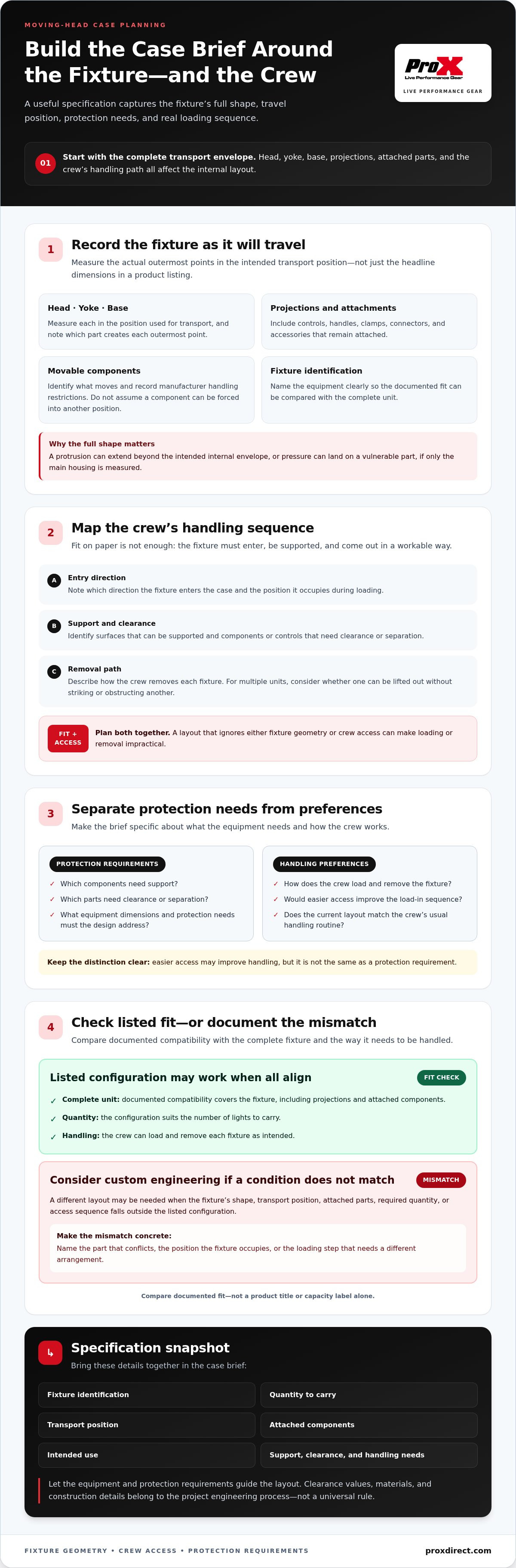
A moving-head case’s internal layout starts with the fixture’s actual geometry, not just length, width, and height copied from a product listing. The head, yoke, base, attached controls, and chosen transport position all affect the usable internal envelope. Access points matter too. A layout that fits on paper can still frustrate the crew if the fixture must be loaded from an awkward direction or lifted past another component.
Record the fixture as it will travel, including every component that remains attached. For each measurement, note what creates the outermost point and whether that part is fixed or movable. This gives the design brief a clearer picture than overall dimensions alone.
- Measure the head, yoke, and base in the intended transport position.
- Include projecting controls, handles, clamps, connectors, and attached accessories.
- Identify movable components and any manufacturer handling restrictions.
- Note the direction the fixture enters and the sequence used to remove it.
These details distinguish the space the fixture occupies from the space the crew needs to handle it. Leave material choices, clearance values, and construction specifications to the project engineering process. They depend on the equipment and protection requirements, not a universal rule.
Which measurements define usable internal space?
Measure the outermost points in the transport position, including projections that are easy to miss when the head or yoke is repositioned. Record dimensions for attached parts separately where useful, and identify movable elements rather than assuming they can be forced into a convenient position. Follow the fixture manufacturer’s handling restrictions when documenting its orientation and contact points.
How should compartments support real crew handling?
Map the loading sequence from approach to removal. Identify which surfaces can be supported and which controls or components need separation from adjacent equipment. Internal separation is a design decision, not a standard feature. Compartment placement should follow fixture shape, quantity, and access requirements. A guide to flight case construction and features provides broader context, while the specific construction should follow the project requirements.
Case layout must account for fixture geometry and crew access together, because ignoring either can make loading or removal impractical. For example, if a fixture enters base-first, compartment placement and clearances should support that sequence rather than assume the crew can rotate it inside the case. For multiple fixtures, consider how one unit can be lifted out without striking or obstructing another.
Use these handling observations alongside the equipment dimensions and protection requirements in the design brief. ProX’s lighting case options provide a starting point for comparing listed configurations with a custom layout when fixture geometry or crew access calls for a different arrangement.
Custom Case or Listed Moving-Head Case: How to Compare the Options
The decision is not simply between standard and custom. Compare how each route meets the fixture’s documented fit, required quantity, access needs, crew handling sequence, and expected configuration flexibility. A listed case is practical when its stated compatibility matches the actual equipment and its layout supports the way the crew works. A custom build is worth considering when one or more requirements falls outside the listed options.
Use the criteria below to make the comparison specific to your equipment and workflow:
| Criterion | Listed configuration | Custom build |
|---|---|---|
| Documented fit | Choose when stated compatibility matches the complete fixture and its transport position. | Consider when dimensions or projections differ from the documented fit. |
| Fixture quantity | Works when the listed capacity matches the number of units to be carried. | Can be designed around a different quantity or equipment arrangement. |
| Access | Assess whether the case opening and layout suit the crew’s loading and removal sequence. | Consider when access needs call for a different internal arrangement. |
| Handling | Compare the listed layout with the crew’s normal handling process. | Useful when that process requires a different loading direction or sequence. |
| Configuration flexibility | Best when the listed arrangement meets current equipment needs. | Relevant when the project has specific layout requirements beyond that arrangement. |
When should buyers choose a listed configuration?
Start with documented fit and capacity. Confirm that the stated configuration applies to the complete fixture, not just a similar model or its main housing. Then consider the physical routine: where the case is opened, how the fixture enters, and whether the crew can remove it without rearranging other equipment. ProX lighting case options are a useful starting point when listed compatibility and layout align with the brief.
When does a custom build provide a better fit?
Consider custom case engineering when the fixture has unusual dimensions or projections, or when the required equipment arrangement and access differ from listed options. Describe the mismatch in practical terms. For example, the listed layout may not suit the required unit quantity or the crew’s loading sequence. A tailored layout can address those specified needs, while a listed case may be simpler when its documented fit already works. Neither route is inherently safer, stronger, or more economical. The comparison depends on the project requirements.
For a custom flight case for moving head lights, base the decision on the equipment and workflow brief. Choose a listed configuration when fit, quantity, and handling align. Specify custom engineering when they do not, and define the required dimensions and protection needs clearly.
What to Include in a Custom Flight Case Specification
A useful project brief turns equipment details and crew requirements into information that can guide a case layout. Keep it specific and consistent: identify the fixtures, record their dimensions in the intended transport position, describe what travels with them, and explain how the crew handles the equipment. For a custom flight case for moving head lights, a clear brief connects the physical fit to the way the case will be used.
Build the specification in sequence:
- Identify each fixture. Record the manufacturer and model as project details, plus the number of units to be carried. This distinguishes the exact equipment being measured, but does not establish compatibility by itself.
- Measure the complete fixture. Record length, width, and height in the intended transport position. Include the head, yoke, base, controls, handles, clamps, connectors, and other attached or projecting parts.
- Document movable components. Note which parts change position and any manufacturer handling restrictions. Photograph the fixture from useful angles, including views that show projections and areas that may need clearance.
- List the contents. Name each fixture and accessory intended to share the case. State quantities clearly and distinguish attached components from loose items.
- Describe access and handling. Explain the loading direction, how each item enters and leaves, and the sequence the crew follows. Include access constraints that affect the workflow.
- State the use context. Describe storage and transport conditions or other practical constraints relevant to the project. Specify the requirement rather than prescribing a material or construction method.
Document the fixture and its complete dimensions
Measure the unit as it will be positioned in the case, not in an assumed compact arrangement. A projection such as a handle or attached clamp can define the outer envelope, while a movable head or yoke may change the measured profile. Label photographs with the model and transport position so they can be read alongside the measurements. Refer to the ProX Cases range when comparing listed case configurations with a custom project.
Describe contents, access, and handling
Give the brief to someone unfamiliar with the crew’s routine and check whether they can picture the load sequence. Clarify which accessories travel with each fixture, how units are removed, and whether equipment shares the case. These details define the requirements without assuming a particular internal material, clearance, or construction specification. Project engineering determines those choices from the stated equipment dimensions and protection requirements.
Specification summary: “We need a case for [fixture model and quantity], measured in [transport position], with [attached components and accessories]. The crew loads from [direction], removes equipment by [sequence], and uses the case for [storage or transport context]. The key requirements are [fit, access, handling, and protection needs].”
Use this summary to describe the project consistently as you develop the brief. Start your custom case project with the fixture details, photographs, and handling requirements gathered here.
Move from Case Requirements to a Custom-Build Project
The decision comes down to documented fit and project requirements. Choose a listed case when its stated compatibility, capacity, and access suit the fixture and crew workflow. Specify custom work when dimensions, equipment arrangement, or handling needs differ from the available configuration. Neither route is automatically better. The brief should show which requirements are essential and where the mismatch lies.
Turn the specification into a clear project brief
Consolidate the information into one version the production team can use consistently. Identify the fixture and quantity, include complete measurements in the transport position, and state what equipment or accessories will share the case. Describe loading direction, removal sequence, storage context, and any constraints that affect use. This gives custom case engineering a functional basis rather than leaving the layout to assumptions.
Separate required fit and handling needs from preferences. A required clearance for an attached component, for example, is different from a preference for a particular loading direction. Mark each item accordingly and explain the reason for any non-negotiable requirement. This keeps the project focused on equipment dimensions and protection requirements while preserving flexibility on details that are not essential.
For general background on professional flight case engineering, a construction guide can help clarify the range of design considerations. It does not replace the project brief. Construction choices should follow the specific equipment and intended use. ProX’s engineering experience provides context for this work, and each custom project is tailored to its stated requirements.
Explore case options for the project
Review the available lighting case configurations when documented fit and layout align with the brief. If the fixture’s dimensions, projections, intended contents, or crew access needs differ, custom engineering can address those project-specific requirements. Keep the comparison practical: identify what fits, what does not, and which preferences can remain flexible.
Before moving forward, make sure the brief represents the equipment as it will actually travel. A model name without attached components, a quantity without a loading plan, or measurements without a stated position can leave important design questions unanswered. A concise, consolidated specification helps move the project from requirements to a layout discussion with fewer assumptions.
Once you’ve identified whether a listed configuration meets the brief or custom dimensions are needed, explore case solutions for the project.
Put Your Case Plan into Practice
Use the case brief as a practical reference for production planning, not just as a one-time design document. Keep fixture details, handling priorities, and essential requirements together so the team can refer to the same information when evaluating a listed option or planning a custom flight case for moving head lights. If equipment or crew routines change, revisit the brief before adjusting the case layout. This keeps future decisions connected to actual use rather than assumptions.
Next, identify which requirements must be met and which preferences can remain flexible. This distinction gives the project a clear direction while leaving room for engineering decisions about the final layout. It also keeps discussions focused on fit, access, and protection needs for your production setup.
Explore ProX case solutions and take the next step with a clear project brief. Explore case solutions. A well-defined plan gives your team a solid starting point.
Frequently Asked Questions
Can one custom case hold more than one moving-head light?
It can be designed for multiple fixtures, but the appropriate capacity depends on each unit’s dimensions, the overall layout, and how the crew handles the equipment. Include the exact number of lights in the specification, even if their models appear similar. For example, explain whether technicians need to remove one fixture without shifting another. That detail informs the layout, while capacity and configuration should follow the defined project requirements.
Should moving-head lights be measured with the head in a particular position?
Measure the fixture in the position intended for transport, following the equipment manufacturer’s handling guidance rather than assuming one position suits every light. Record that position alongside the measurements and identify any movable components separately. If the head or yoke can occupy more than one position, note which position is planned for the case. This keeps measurements and photographs consistent and reduces ambiguity in the project information.
Can accessories travel in the same case as a moving-head fixture?
Accessories can be included in the project requirements, but their placement depends on the complete layout. List each item, such as a clamp or cable, and state whether it must travel with the fixture or can be carried separately. Note its dimensions and any contact points that matter. This lets the case brief account for additional contents without assuming that every configuration includes accessory storage or a particular compartment design.
What should I photograph when planning a custom case for a moving-head light?
Photograph the complete fixture in its intended transport position, then add clear views of attached components, protrusions, and movable parts. Include angles that show how the equipment is approached for loading and where hands or other fixtures could affect removal. Use the images to clarify measurements, not replace them. A photo can show the shape of a projection, but dimensions and handling notes are still needed to define the project accurately.
Does a custom case need to match the fixture's original packaging dimensions?
No. Specify the fixture’s actual dimensions and intended handling rather than treating its original packaging as the required case layout. Packaging may serve a different purpose, so document the light in its intended transport position and include all attached parts. If you use packaging measurements as a reference, label them clearly. The brief should describe the equipment and its use, not assume a particular design’s fit or protective performance.
Can a custom case be designed for different moving-head models?
A multi-model layout may be considered, but do not assume different fixtures will share a compatible fit. Each model can have distinct dimensions, projections, and handling needs. Identify every intended fixture by manufacturer and model, and provide measurements for each one. If the case is meant to accommodate different units at different times, explain that use clearly. This makes model flexibility a project requirement to assess, not an automatic compatibility promise.
What details help distinguish a custom case project from a standard case purchase?
Compare the listed configuration’s documented fit with the actual equipment, then consider quantity, access, and crew handling. A listed option may suit the job when those details align. A custom flight case for moving head lights is worth specifying when the project has dimensions, contents, or workflow requirements that differ from the listed arrangement. The distinction is about meeting defined needs, not assuming custom work is always necessary, superior, or less expensive.
Disclaimer
Any trademarks, trade names or brand names appearing herein that do not belong to ProX are the property of their respective owners and/or companies, and such appearance doesn't and shall not constitute or imply endorsement, sponsorship or recommendation by ProX.


