

A professional rack case is not merely a shipping container; it's a precision-engineered thermal and structural environment designed to sustain the operational integrity of high-value electronics. You know that in the high-stakes world of professional production, equipment failure is a risk that cannot be tolerated. Whether it's internal component damage from sustained vibration or overheating within an enclosed space, the physical demands of touring test even the most robust gear. This article explores the technical standards and engineering precision required to manufacture Amp & Effects Rack Cases that meet the rigorous demands of global logistics and heavy-duty use. You'll discover how EIA-310-E standards and ATA-300 Category I construction provide the necessary framework for zero equipment downtime. We'll examine critical factors such as thermal management for high-output amplifiers, the integration of Honeycomb Digital™ scratch-resistant surfaces, and the importance of adhering to standard truck-pack dimensions for efficient strike times. From protecting sensitive digital signal processors to ensuring structural stability for 400-pound loads, we provide a methodical look at the hardware that supports the industry's most demanding productions.
Key Takeaways
- Identify the mechanical standards of the touring cycle, focusing on how recessed hardware and high rivet density preserve structural integrity during repeated loading.
- Learn to mitigate the "Oven Effect" within Amp & Effects Rack Cases by implementing thermal management strategies that prevent heat-related component failure.
- Differentiate between rackable depth and total exterior depth to ensure equipment compatibility and seamless integration with standard truck-pack dimensions.
- Apply EIA-310-E and ATA-300 Category I specifications to select enclosures that provide verified durability for sensitive digital signal processors.
- Explore custom engineering solutions from Santosom and ZCASE to address bespoke production needs and complex technical configurations.
Engineering for the Rigors of Professional Production
A professional rack case functions as a mechanical shield, isolating sensitive electronics from the destructive forces of the touring cycle. This cycle is a repetitive sequence of high-impact loading, chassis-stressing transport, and constant high-frequency vibration. In these environments, standard plastic racks often fail because they lack the rigidity to support heavy power supplies or the impact resistance to survive forklift mishandling. For the professional technician, structural integrity is the only metric that matters. Every component within Amp & Effects Rack Cases must adhere to the 19-inch rack standard to ensure precise mounting and long-term reliability.
The engineering behind these enclosures prioritizes functional excellence over aesthetics. When a rack is loaded into a truck, it's subjected to multi-axis stressors. A failure in the outer shell can lead to a catastrophic collapse of the internal frame, resulting in crushed chassis and severed signal paths. By treating the enclosure as a structural extension of the gear itself, manufacturers ensure that the hardware remains operational from the first load-in to the final strike. Reliability isn't a luxury; it's a baseline requirement for professional production environments.
The Mechanics of Impact Protection
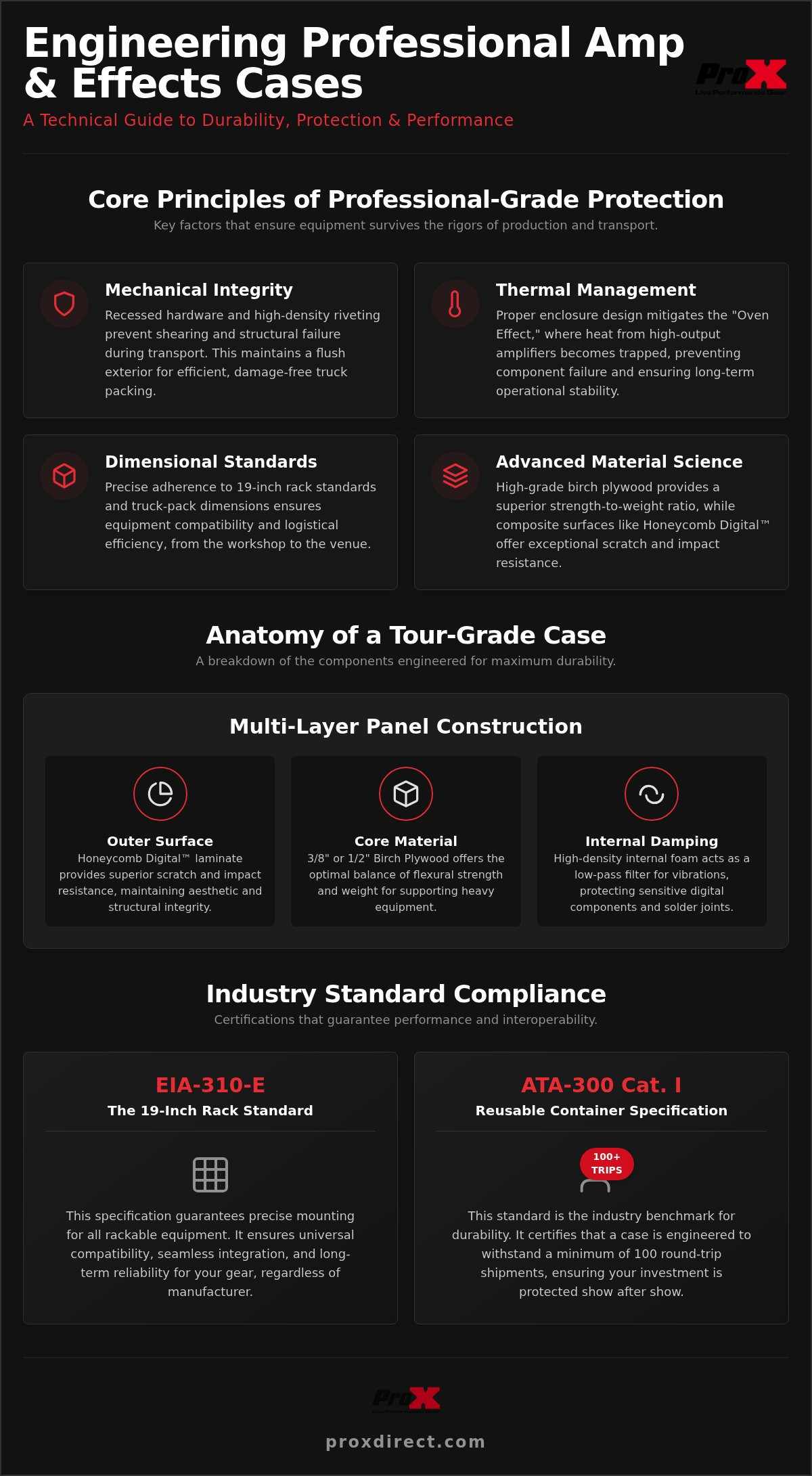
Protection begins with kinetic energy management. When a case experiences an impact, the force must be distributed through the outer shell and absorbed before reaching the internal rack rails. High-density internal foam plays a critical role here. It doesn't just cushion; it acts as a low-pass filter for vibrations that could otherwise dislodge internal cards or solder joints in digital signal processors. ATA-300 Category I is the industry specification for reusable shipping containers designed to survive a minimum of 100 trips. This standard ensures that the materials and assembly methods can withstand the rigors of global production schedules without compromising the safety of the contents.
Material Science: Plywood vs. Composites
The foundation of Amp & Effects Rack Cases remains high-grade birch plywood, typically in 3/8-inch or 1/2-inch thicknesses. Birch offers an optimal strength-to-weight ratio, providing the flexural strength needed to support heavy amplifiers without the brittleness found in many molded plastics. To enhance this durability, modern professional cases utilize the Honeycomb Digital™ surface design. This hexagonal-patterned finish provides superior scratch and impact resistance, maintaining the case's structural and aesthetic integrity over years of service. For international logistics, where every pound impacts shipping costs, selecting the right plywood thickness ensures the gear remains protected without exceeding weight limits for standard air or sea freight. Unlike standard storage boxes, these engineered plywood builds maintain their shape under the weight of stacked equipment, preventing the warping that often plagues lighter materials.
Structural Integrity: Hardware and Assembly Standards
Structural integrity in Amp & Effects Rack Cases depends on the mechanical synergy between the enclosure and its hardware. Recessed components are a logistical necessity. Protruding handles or latches frequently snag on adjacent equipment during tight truck packs, causing structural torque or hardware shearing. By recessing these elements into the plywood, the exterior remains flush, which facilitates efficient loading and prevents damage during transit.
Rivet density serves as the primary indicator of seam longevity. Industrial-grade assembly requires rivets placed at precise intervals along all aluminum extrusions. This prevents the extrusions from separating from the plywood when the case is subjected to shear forces. Heavy-duty steel ball corners are engineered to absorb and dissipate the energy of a corner-first impact, shielding the internal contents from the bulk of the kinetic force. For racks housing heavy power amplifiers, 4-inch industrial-grade casters with reinforced mounting plates are essential. They maintain maneuverability and prevent caster-plate failure under heavy loads.
Rack Rail Precision and Alignment
Mounting precision is critical for maintaining the 19-inch rack standard. Square-hole rails are the preferred choice for professional production because they utilize replaceable cage nuts. If a thread is stripped, you simply replace the nut, whereas a tapped-hole rail requires a complete rail replacement. For deep power amplifiers, front and rear rail alignment is mandatory. Securing the gear at four points prevents chassis sagging and reduces the mechanical stress on the front rack ears. Sensitive digital signal processors often benefit from shock-mounted rack frames. These internal cages are isolated from the outer shell by high-density rubber dampers, filtering out the high-frequency vibrations that can cause digital component failure.
Reinforcement and Industrial Latches
The perimeter of the case is reinforced with heavy-duty aluminum extrusions. A tongue-and-groove sealing system ensures that the lids align perfectly every time, providing a dust-resistant barrier. Recessed butterfly latches offer a significant mechanical advantage, using a high-tension draw action to lock the lids of Amp & Effects Rack Cases securely. These latches resist opening under heavy vibration, a common failure point in lower-grade enclosures. You can Explore our full range of ProX Cases to find the specific hardware configuration that matches your rig’s weight and depth requirements. Selecting the right hardware ensures your professional case remains a reliable asset for years of touring.
Thermal Management and Signal Integrity
Heat is the primary catalyst for electronic component failure within enclosed production environments. High-output touring amplifiers generate substantial thermal energy. When multiple units are stacked in Amp & Effects Rack Cases, the cumulative BTU output can quickly exceed safe operational thresholds. This phenomenon, known as the "Oven Effect," occurs when trapped heat saturates the internal air, leading to thermal throttling or catastrophic hardware shutdown. Professional-grade rack design prioritizes thermal dissipation through the strategic integration of vented panels and active cooling systems, ensuring that sensitive digital signal processors remain within their specified temperature ranges during extended use.
Beyond cooling, the internal architecture of a rack must facilitate clean signal flow and efficient cable management. A cluttered interior restricts airflow and increases the risk of electromagnetic interference. By utilizing integrated cable management systems, technicians can maintain a structured environment that supports both signal integrity and thermal efficiency. This methodical approach to internal organization ensures that the rig remains reliable under the most demanding production schedules. It allows for faster strike times and reduces the likelihood of intermittent signal loss caused by cable tension.
Airflow Dynamics in Enclosed Cases
Effective thermal management relies on maintaining consistent airflow patterns. Modern high-power amplifiers typically utilize front-to-back cooling cycles, drawing cool air through the front face and exhausting heat out the rear. To support this, Amp & Effects Rack Cases must be configured with adequate spacing. Utilizing blank vented panels between high-draw units facilitates the "chimney effect," allowing rising heat to escape rather than pooling around sensitive components. For dense configurations, active cooling units can be installed to force air through the rack, preventing the formation of stagnant heat pockets that could compromise gear longevity. Proper spacing usually involves leaving 1U of open space for every 2U of high-wattage amplification.
Cable Management and Rear Access
Signal integrity is directly linked to how cables are managed within the enclosure. Removable rear doors are a standard requirement for professional racks, providing immediate access to the I/O panels of amplifiers and processors for quick signal patching and troubleshooting. Integrated cable pass-throughs and lacing bars are utilized to prevent mechanical strain on XLR and power connectors, which are common failure points during the vibration-heavy touring cycle. A critical factor in rack maintenance is the implementation of a service loop; this is a calculated length of extra cable coiled within the rack that allows equipment to be partially pulled from the rails for inspection without disconnecting the signal path. This attention to detail reduces setup times and ensures the long-term reliability of the internal wiring loom.
Specifying Your Rig: Depth, Units, and Logistics
Precision in specification ensures that Amp & Effects Rack Cases function as intended within a larger production ecosystem. A primary technical distinction often overlooked is the difference between rackable depth and total exterior depth. Rackable depth refers to the usable space between the front and rear mounting rails, or from the front rail to the inside of the rear lid. Total exterior depth includes the chassis, lids, and recessed hardware. When specifying a rig, you must account for the chassis depth of the amplifier plus the additional clearance required for XLR connectors, power cables, and the mandatory service loops discussed previously. Failing to calculate for connector depth often results in the inability to close the rear lid without damaging the signal cables.
Weight distribution is another critical engineering factor. Top-heavy effects racks are prone to tipping during transit or when being maneuvered on stage. To ensure stability, high-mass equipment like power amplifiers should be mounted at the lowest possible point in the rack. This lowers the center of gravity and reduces the mechanical stress on the casters and the enclosure's base plate. For international logistics, standardizing case dimensions is a requirement rather than a preference. Consistent sizing allows for predictable stacking and interlocking, which is essential for maintaining the structural integrity of a load during sea or air freight cycles.
Calculating Necessary Rack Units (U)
Determining the correct height of your enclosure requires a detailed audit of your gear's vertical requirements. A standard rack unit (U) is 1.75 inches. Beyond the physical height of the equipment, you must include expansion space for future hardware and 1U thermal gaps to facilitate airflow. For heavy rigs, a single 12U case is often more efficient than two 6U cases; it provides better structural stability and simplifies the internal wiring loom. For more detailed technical data, consult our Professional Amplifier Rack Case Guide. This methodical approach to planning prevents the need for frequent case replacements as your rig evolves.
Truck Pack Efficiency and External Dimensions
Standardizing the external dimensions of Amp & Effects Rack Cases is essential for global logistical cycles. Professional production trucks are loaded based on "quarter-pack" and "half-pack" concepts, where case dimensions are mathematical sub-multiples of standard truck widths. Using non-standard sizes creates dead space, which increases shipping costs and allows gear to shift during transport. Implementing TruckPaX™ Truck Pack Cases ensures that your entire inventory fits into a stable, interlocking grid. This logistical precision reduces strike times and protects your investment from the impacts of shifting loads. You can view our full inventory of standardized rack solutions to optimize your touring logistics.
Professional Solutions for Amp & Effects Protection
ProX has been engineering performance gear since 1984. This extensive history provides a deep understanding of the physical demands placed on professional equipment in high-stakes environments. Selecting the right Amp & Effects Rack Cases involves more than just picking a size; it requires a commitment to engineering standards that proactively prevent equipment failure. For the most demanding production environments, ProX offers a tiered approach to protection, ranging from standardized industrial builds to bespoke custom solutions designed for specific logistical challenges.
The logical conclusion of gear protection is the integration of high-grade materials with precise mechanical assembly. When you choose an enclosure engineered for the touring cycle, you're investing in the longevity of your signal processors and power amplifiers. This final section examines the elite-tier solutions available for professionals who require the highest level of structural reliability and custom integration.
Santosom and ZCASE: The Pinnacle of Protection
For elite-level touring requirements, Santosom Cases represent the benchmark for precision manufacturing. These enclosures utilize high-grade materials and specialized assembly techniques to ensure structural longevity across global logistics cycles. When standard configurations cannot meet the complexity of a specific rig, ZCASE custom engineering provides a tailored solution. ZCASE builds, manufactured in Poland, specialize in integrating workstations and complex rack systems into a single, cohesive unit. These solutions solve problems related to signal path complexity and thermal management by designing the enclosure around the specific hardware footprint. This level of customization ensures that even the most sensitive digital signal processors remain protected during high-impact transport and rapid setup sequences.
Maintenance and Long-Term Value
A professional rack is a long-term asset. Maintaining its protective capabilities requires a methodical inspection schedule. Technicians should regularly verify the mechanical operation of recessed butterfly latches to ensure high-tension closure. It's also vital to check caster swivel and brake functionality for the safe maneuverability of heavy amplifier racks. Inspecting the integrity of internal foam densities is necessary to prevent equipment shifting, while checking the alignment of aluminum extrusions ensures the tongue-and-groove seals remain dust-resistant.
Choosing professional-grade Amp & Effects Rack Cases provides a significantly higher ROI than purchasing multiple low-cost replacements. Cheap enclosures often suffer from hardware shearing or plywood delamination after only a few transit cycles. By utilizing ProX Cases Replacement Parts, technicians can extend the service life of their inventory indefinitely. This approach ensures that gear remains operational, strike times stay efficient, and equipment downtime is eliminated. ProX engineering remains the standard for professionals who value functional excellence and structural reliability. You should Consult with a ProX dealer to engineer your next rack system and secure your production assets for the long term.
Optimizing Your Touring Infrastructure
Achieving zero equipment downtime requires a shift from viewing enclosures as mere transport boxes to treating them as precision-engineered environments. By integrating ATA-300 construction standards with active thermal management, you ensure that high-value amplifiers and processors remain operational under extreme conditions. ProX has specialized in these rigorous engineering requirements since 1984, providing a reliable backbone for the production industry. Our offerings include the rugged Honeycomb Digital™ exterior finish and precision-manufactured Santosom and ZCASE options for bespoke needs. Selecting the right Amp & Effects Rack Cases is a critical decision that impacts your logistical efficiency and gear longevity. This methodical approach to protection reduces strike times and secures your high-value assets for years of service. You can Browse Professional Amp & Effects Rack Cases to find the exact configuration for your next tour. Your rig's long-term reliability begins with a foundation of industrial-grade engineering and meticulous assembly.
Frequently Asked Questions
What is the difference between an ATA-style case and a standard rack?
ATA-300 Category I specifications define a reusable container designed for a minimum of 100 trips. Unlike standard storage racks, ATA-style construction requires specific hardware, plywood thickness, and impact-resistant finishes like Honeycomb Digital™. These cases are engineered to withstand the mechanical stressors of global logistics cycles. Standard racks often use lighter materials that fail under the vibration and impact loads found in professional production environments.
How much rack depth do I need for a professional power amplifier?
Standard power amplifiers typically require 14 to 18 inches of depth. However, high-output touring units often necessitate 18 to 24 inches to accommodate larger power supplies and cooling fans. When specifying Amp & Effects Rack Cases, you must include the operational depth of cables and connectors. A chassis measuring 18 inches often requires a 21-inch deep rack to avoid cable strain against the rear lid.
Can I mount effects units and amplifiers in the same rack case?
Yes, combining these units is a common practice for integrated rigs. To maintain structural stability, you should mount heavy amplifiers at the bottom to lower the center of gravity. Effects units and digital signal processors are placed higher for ergonomic access. Proper thermal management is essential here; ensure that high-wattage amplifiers don't radiate excessive heat into sensitive digital effects by utilizing blank vented panels and 1U thermal gaps.
What are the benefits of shock-mounted rack frames for digital processors?
Shock-mounted systems feature an internal frame isolated from the outer shell by high-density rubber dampers. This engineering protects sensitive digital signal processors from high-frequency vibrations that can cause component failure or solder joint fractures. During transit, the dampers filter out mechanical shocks that would otherwise pass directly to the gear's chassis. This isolation is critical for maintaining zero equipment downtime during rigorous international touring schedules.
How do I ensure proper airflow in a fully loaded amp rack?
Maintaining airflow requires a methodical approach to thermal management. You should utilize vented panels to facilitate the "chimney effect" for rising heat. Modern high-power amplifiers use front-to-back cooling, so the rack must remain unobstructed at both ends. For dense configurations, active cooling units can be integrated to force air through the enclosure. Leave at least 1U of open space for every 2U of high-draw equipment to prevent heat saturation.
What plywood thickness is recommended for heavy-duty touring racks?
Heavy-duty touring racks require 3/8-inch or 1/2-inch birch plywood. Birch offers the necessary strength-to-weight ratio to support distributed loads of 250 to 400 pounds. Thinner materials or molded plastics often warp or crack under the weight of stacked amplifiers. ProX utilizes these specific plywood standards to ensure the enclosure maintains its structural integrity across repeated loading cycles and high-impact transport scenarios.
How do external dimensions affect truck pack efficiency for production crews?
External dimensions are engineered around "quarter-pack" and "half-pack" concepts. These sizes are sub-multiples of standard production truck widths, allowing cases to interlock in a stable grid. Standardizing the dimensions of your Amp & Effects Rack Cases eliminates dead space and prevents gear from shifting during transit. This logistical precision reduces strike times for crews and lowers shipping costs by optimizing the volume used within a trailer or sea container.
Are replacement parts available for ProX rack cases?
Yes, ProX maintains a comprehensive inventory of ProX Cases Replacement Parts to ensure long-term case maintenance. Components such as recessed butterfly latches, heavy-duty casters, and aluminum extrusions can be replaced if they sustain damage during service. This availability increases the ROI of your investment by allowing for field repairs rather than requiring complete case replacements. Maintaining hardware integrity is essential for preserving the protective capabilities of your touring inventory.
Disclaimer
Any trademarks, trade names or brand names appearing herein that do not belong to ProX are the property of their respective owners and/or companies, and such appearance doesn't and shall not constitute or imply endorsement, sponsorship or recommendation by ProX.


