

A single bent pin on a high-density digital snake input can silence a professional production before the first sound check. In the high-stakes environment of global touring, the stage box represents the critical nervous system of the audio architecture, yet it's often the most exposed to mechanical failure. Selecting a professional stage box case isn't merely about storage; it's an engineering decision to protect the structural and signal integrity of your most sensitive hardware.
We understand that equipment failure isn't an option when schedules are tight and budgets are fixed. This guide provides the technical framework to select and implement cases that ensure zero hardware failures and optimized setup times. You'll discover how to evaluate internal padding for connector protection, manage cable clutter during high-pressure changeovers, and utilize standardized dimensions for efficient truck pack logistics. We'll examine the specific requirements for Santosom and custom ZCASE solutions that bridge the gap between industrial-grade protection and immediate functional access.
Key Takeaways
- Understand the critical engineering requirements for protecting high-density XLR and EtherCON connectors from mechanical failure during transport.
- Evaluate material specifications, including 7mm to 12mm plywood thickness, to ensure your stage box case meets ATA-300 standards for international touring.
- Identify when to utilize standard 19-inch rack-mount configurations versus custom-engineered foam inserts for non-standard digital interfaces.
- Optimize operational efficiency by calculating necessary rear-rack clearance for heavy-duty snake cables and implementing passive or active thermal management.
- Leverage a manufacturing legacy dating back to 1984 to ensure long-term equipment reliability and access professional support through an established dealer network.
What is a Stage Box Case and Why is it Essential?
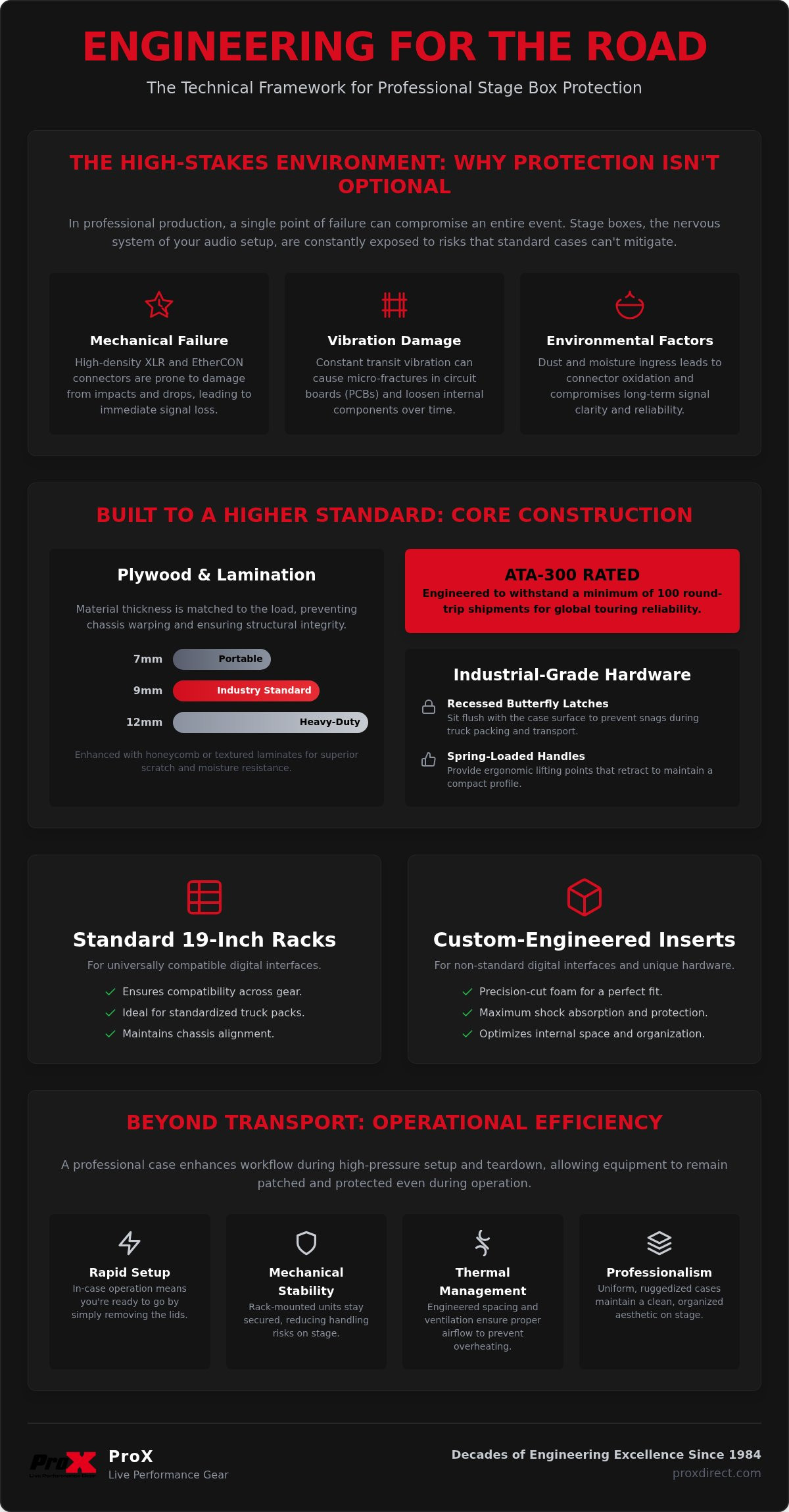
A stage box case is a specialized enclosure engineered to protect digital audio interfaces and analog snakes from the physical rigors of the production environment. Unlike standard utility trunks, these cases provide the structural rigidity and internal shock absorption required to maintain the integrity of sensitive circuit boards. Professional production relies on high-density XLR and EtherCON connectivity, where even a minor mechanical misalignment can result in total signal loss. Investing in a dedicated stage box case ensures that these critical I/O points remain protected against the impact and vibration inherent in global logistics.
Standard utility boxes don't provide the necessary internal clearances or mounting precision required for high-value digital snake systems. When gear is loose or improperly cushioned, the risk of connector failure increases exponentially. ProX has been manufacturing performance gear since 1984, emphasizing that a case isn't just a container but a critical component of the signal chain. High-quality construction prevents the chassis from warping, which is essential for maintaining the alignment of rack-mounted components over years of heavy use.
The Vulnerability of Digital Stage Boxes
Digital interfaces are susceptible to internal damage that isn't always visible from the exterior. Constant vibration during transit can lead to micro-fractures in printed circuit boards (PCBs) or loosen internal ribbon cables. Additionally, environmental factors like dust and moisture contribute to connector oxidation, which compromises signal clarity over time. The financial impact of equipment downtime during a professional tour often exceeds the initial cost of the hardware itself due to labor overhead and potential venue penalties.
Beyond Transport: Functional Stage Use
The utility of a stage box case extends into the active performance environment. These cases are designed to facilitate rapid setup and teardown by allowing the equipment to remain patched during transit. Many models, such as those found in the Santosom line, support in-case operation. This means technicians only need to remove the front and rear lids to access the interface. This approach provides several operational advantages:
- Mechanical Stability: Rack-mounted units stay secured, reducing the risk of accidental drops during handling.
- Thermal Management: Engineered spacing and ventilation allow for proper airflow around the chassis.
- Visual Professionalism: Uniform, ruggedized cases maintain a clean aesthetic for corporate events where visible gear must look organized.
By integrating the equipment directly into the transport solution, production teams reduce the variables that lead to human error during high-pressure changeovers. This methodology ensures that the system is operational the moment the lids are removed, maintaining the high standards required for professional live sound reinforcement.
Technical Specifications: Engineering for the Rigors of the Road
Engineering a professional stage box case requires a precise balance of material density and mechanical reinforcement. ATA-300 Category 1 standards serve as the benchmark for international touring, necessitating construction that withstands a minimum of 100 round-trip shipments. This level of durability is achieved through the integration of high-grade plywood and precision-machined hardware that maintains structural alignment even under extreme shear forces. For technicians, these specifications represent the difference between a functional system and a catastrophic failure during a high-stakes production.
Plywood and Lamination Standards
The choice between 7mm, 9mm, and 12mm plywood depends on the weight and dimensions of the audio interface. While 7mm offers weight savings for portable setups, 9mm serves as the industry standard for most digital snakes. Heavy-duty applications require 12mm plywood to prevent bowing under load. We utilize honeycomb and textured laminates bonded with industrial adhesives to provide superior scratch resistance and prevent delamination in high-humidity environments. This ensures the case remains a cohesive structural unit throughout its service life.
Industrial Hardware Components
Hardware selection is critical for logistical efficiency. Recessed butterfly latches sit flush with the case surface, preventing snags during truck loading and unloading. Spring-loaded handles provide ergonomic lifting points without protruding into the truck pack. Internal protection relies on specific foam densities: polyethylene for load-bearing support and polyurethane for delicate shock absorption. For standardized engineering that meets these specifications, our Santosom cases provide the reliability required for professional use.
Aluminum extrusions and steel ball corners form the external skeleton of the enclosure. The extrusions distribute mechanical stress across the panel surfaces, while the ball corners deflect direct impacts that would otherwise crush plywood edges. This architecture ensures that internal rack rails remain perfectly vertical, preventing the twisting forces that damage internal circuit boards. Every component of a stage box case is selected to maximize the structural load-bearing capacity for stacked equipment during transport. By prioritizing these engineering standards, production teams can ensure their hardware survives the physical demands of global logistics without compromising signal integrity.
Standard 19-Inch Racks vs. Custom-Engineered Cases
Selecting the appropriate architecture for a stage box case depends on the hardware's physical geometry and the complexity of the touring environment. Professional production environments typically utilize one of two paths: standardized 19-inch rack-mount systems or custom-engineered bespoke enclosures. Each approach offers distinct advantages for signal integrity and logistical consistency. The decision rests on whether the equipment conforms to standard mounting specifications or requires a more tailored protective environment.
The Versatility of 19-Inch Rack Systems
Standardized Rack Units (RU) provide a predictable foundation for modular gear. Using a 19-inch stage box case allows for the integration of auxiliary equipment, such as power conditioners and network bridges, within a single enclosure. This modularity is essential for maintaining truck pack efficiency. Standardized dimensions ensure that cases stack securely without shifting during transit, optimizing space in a tightly packed trailer. For interfaces that include factory rack ears, these systems offer a cost-effective and highly flexible solution that adapts to changing rig configurations.
Bespoke Protection with ZCASE and Santosom
Custom engineering becomes necessary when hardware lacks standard mounting points or features vulnerable connector layouts. Specialized ZCASE custom builds and Santosom cases are engineered to accommodate the specific physical attributes of high-end digital snakes. These bespoke solutions use precision-machined foam inserts to provide uniform support across the entire chassis. This level of specificity prevents the mechanical stress that occurs when heavy hardware is supported only by its front panel.
Integrating shock-mount systems is a primary benefit of custom builds. These systems use internal rubber isolators to decouple the equipment from the outer shell, absorbing high-frequency vibrations that can damage internal electronics. While standard racks rely on the rigidity of the rails, custom solutions prioritize shock attenuation. Designing a bespoke case involves a detailed analysis of the hardware's airflow requirements and cable exit points. This ensures that the stage box remains operational within the case while maintaining maximum structural protection.
The cost-benefit analysis for custom engineering is clear when protecting high-value digital assets. A bespoke build eliminates the risk of equipment shifting within a generic enclosure. It also streamlines teardown times by providing dedicated cavities for permanently attached snakes and power looms. For professionals managing unique or non-rackable hardware, custom engineering represents the highest standard of physical security and operational reliability.
Optimizing Integration: Airflow and Cable Management
Effective integration within a stage box case requires more than just physical mounting. It demands a calculated approach to internal spatial geometry. While many technicians focus on the front panel interface, the rear of the enclosure is where signal integrity and thermal stability are often compromised. A professional setup must account for the physical depth of heavy-duty XLR connectors and the minimum bend radius of digital snake trunks. Ignoring these dimensions leads to mechanical strain on the interface ports, eventually causing intermittent signal loss or port failure.
Calculating rear-rack clearance is a prerequisite for any touring rig. High-density snakes often require 4 to 6 inches of additional depth beyond the chassis of the audio interface to accommodate cable looms and strain relief. If the case is too shallow, the rear lid will compress the connectors, forcing them into the PCB at an angle. This physical stress is a primary cause of hardware failure in the field. Utilizing a stage box case with sufficient depth ensures that permanently patched looms remain secure and stress-free during both operation and transport.
Heat Dissipation in Digital Systems
Modern digital stage boxes are essentially high-performance computers equipped with sophisticated DSP chips and internal power supplies. Unlike traditional analog snakes, these units generate significant thermal energy. In an enclosed environment, heat buildup can lead to processor throttling or hardware shutdown. Passive thermal management involves the strategic placement of ventilation slots to allow for natural convection. However, high-density setups or environments with high ambient temperatures may require active cooling solutions. When cases are stacked in a truck or on stage, ensuring that side or rear vents remain unobstructed is critical for maintaining a safe operating temperature.
Cable Management and Strain Relief
Internal organization is the foundation of rapid deployment. Designing the internal space to house permanent cable looms reduces the time spent patching during changeovers. Integrating rack shelves and D-ring organizers allows technicians to secure cables away from the airflow paths of the equipment. For complex multi-channel systems, internal labeling is mandatory. Clear, durable identification of every input and output on the rear of the unit prevents patching errors under low-light conditions. For those designing mobile production environments, our AV Broadcasting Cases offer additional inspiration for integrating complex cable architectures into ruggedized workstations.
Cable pass-throughs are another essential feature for "closed-lid" operation. These allow the main snake and power cables to exit the case while the lids are secured, providing an extra layer of protection against environmental debris and accidental disconnection. By prioritizing these logistical details, you ensure your equipment remains cool and your signal chain remains organized. Explore our full range of racks and case accessories to find the specialized components needed to optimize your cable management strategy.
The ProX Standard: Decades of Engineering Excellence
ProX has maintained a position as an industry leader in performance gear engineering since 1984. Our approach to manufacturing a stage box case focuses on the practical realities of the professional production environment. This legacy is built on a foundation of engineering precision and a deep understanding of the physical stresses placed on high-value audio equipment during global transport. By prioritizing functional excellence over temporary trends, we provide a reliable backbone for the industry that ensures equipment longevity and signal integrity.
Standardization across our product lines allows for predictable logistical planning. When every case in a rig follows established dimensional standards, production crews calculate load-in requirements with mathematical certainty. We also emphasize the availability of genuine ProX replacement parts. Maintaining a stage box case over years of heavy touring requires access to the same high-specification latches, corners, and casters used in the original build. This commitment to long-term maintenance ensures that your protection remains consistent throughout the equipment's service life.
Global Logistics and TruckPaX™ Compatibility
Modern touring requires maximum efficiency in the truck pack. ProX cases are engineered to interlock and stack with precision, minimizing wasted space and preventing shifting loads. Our TruckPaX™ Truck Pack Cases represent a significant advancement in logistical engineering, offering standardized dimensions that simplify tour planning for production crews. This systematic approach to case sizing allows for a uniform footprint across diverse equipment types, from digital snakes to lighting consoles.
Custom Engineering and ZCASE Innovation
For specialized requirements that exceed standard rack configurations, we offer advanced protection through ZCASE Custom Build Cases. This line represents an engineering collaboration between ProX and international manufacturing partners in Poland, focusing on bespoke solutions for high-value digital assets. These cases utilize unique internal architectures to provide maximum shock absorption and accessibility. To initiate a custom design project, authorized users can submit technical specifications and hardware dimensions directly through the ProX dealer portal for an engineering review. Our global dealer network stands ready to provide professional support and facilitate orders, ensuring that every production team has access to the highest standard of protective engineering.
Securing Your Signal Chain for the Long Haul
Protecting a digital interface requires an engineering approach that accounts for both physical impact and internal thermal stability. A professional stage box case must provide more than just a plywood shell; it needs to integrate precise airflow paths and sufficient rear clearance to prevent mechanical stress on high-density connectors. By adhering to industrial standards like ATA-300 and utilizing technical specifications like 9mm or 12mm plywood, production teams ensure their hardware survives the logistical demands of international touring.
ProX has been engineering performance gear since 1984, establishing a legacy of reliability that touring professionals worldwide trust. Whether you require a standardized 19-inch rack solution or a bespoke ZCASE custom build for high-value electronics, our equipment is designed for functional excellence and logistical density. Maintaining your rig with genuine replacement parts ensures your protection remains consistent over years of service. Take the next step in optimizing your production workflow and safeguarding your signal integrity today.
Browse Professional Stage Box Cases at ProX and secure your equipment with the industry's most dependable protective solutions.
Frequently Asked Questions
What is the difference between a standard rack case and a stage box case?
A stage box case is specifically engineered for high-density I/O interfaces. While standard racks focus on mounting depth, a dedicated stage box enclosure prioritizes rear clearance for heavy-duty snake cables and connectors. It often includes specialized ventilation for digital processing units and may feature custom foam inserts for non-standard chassis shapes. This ensures mechanical stability for the signal chain during both operation and logistics.
Does my digital stage box require a shock-mount case?
High-value digital interfaces benefit significantly from shock-mount systems. These enclosures use internal rubber isolators to decouple the hardware from the outer shell, attenuating the high-frequency vibrations that damage sensitive circuit boards. If your equipment travels frequently through rigorous logistical channels, a shock-mount architecture is a necessary investment to prevent micro-fractures in PCBs and internal ribbon cable failure.
How do I calculate the required rack depth for my stage box and cables?
To calculate the required depth, measure the chassis depth and add a minimum of 4 to 6 inches for rear connector clearance. This additional space prevents the rear lid from compressing XLR or EtherCON connectors, which can cause port damage. Always account for the bend radius of your snake cables. ProX provides varied depth options across the Santosom and standard rack lines to accommodate these technical requirements.
Are these cases compliant with international airline transport standards?
Professional cases engineered by ProX meet ATA-300 Category 1 specifications. This standard requires the enclosure to withstand a minimum of 100 round-trip shipments via commercial air or sea freight. Construction features like recessed butterfly latches, steel ball corners, and 9mm to 12mm plywood panels ensure the case remains structurally sound under the extreme stresses of international shipping and heavy-duty touring.
Can I operate my stage box without removing it from the case?
Yes, many professional stage box cases are designed for in-case operation. By removing the front and rear lids, you gain full access to the interface while the hardware remains secured to the rack rails. This setup facilitates faster changeovers and protects the chassis from accidental drops. Ensure the enclosure has adequate ventilation slots to prevent thermal buildup during extended use on stage.
What materials are best for protecting audio gear in high-humidity environments?
High-density plywood bonded with industrial adhesives provides the best structural foundation for humid environments. We utilize honeycomb or textured laminates that resist moisture penetration and prevent delamination. For extreme conditions, UltronX™ watertight cases offer a sealed environment that protects sensitive electronics from corrosion and oxidation. Maintaining the integrity of the external lamination is critical for long-term equipment reliability.
How do I maintain the butterfly latches and casters on my tour cases?
Routine maintenance involves inspecting hardware for mechanical alignment and lubricating moving parts. Use a dry silicone-based lubricant on butterfly latches to ensure smooth operation without attracting dust. Casters should be checked for debris in the bearings and flat spots on the wheels. Replacing worn hardware immediately prevents logistical delays. ProX has been engineering performance gear since 1984, emphasizing that well-maintained hardware extends the case's service life.
Where can I find replacement parts for a ProX case?
Genuine ProX Cases Replacement Parts are available through our global dealer network. Accessing the dealer portal allows you to identify specific components, such as recessed handles, ball corners, and specialized latches, that match your original engineering specifications. Using identical replacement parts ensures that the structural integrity and ATA-300 compliance of your stage box case are maintained throughout its operational life.
Disclaimer
Any trademarks, trade names or brand names appearing herein that do not belong to ProX are the property of their respective owners and/or companies, and such appearance doesn't and shall not constitute or imply endorsement, sponsorship or recommendation by ProX.


