

A stage cable trunk is a precision logistical tool, not merely a storage box; its true value is measured in truck-pack density and the extension of cable service life. In an industry where North America accounts for 38.1% of the global event logistics market, the difference between profit and loss often sits on four heavy-duty casters. You understand that every minute lost to a jammed latch or a tangled loom during a high-pressure load-out is a direct hit to your operational bottom line. Improper storage doesn't just cause clutter. It leads to copper fatigue and insulation failure that can compromise a production at the worst possible moment.
This guide will help you master the science of cable management and logistical density through the lens of professional engineering. We'll examine how standardized exterior dimensions maximize space in 90-inch and 96-inch trailers, ensuring your inventory remains stable during transit. You'll also learn about the structural requirements for hardware and plywood thickness that withstand the rigors of frequent transport. We'll preview the 2026 NEC standards for cable support and how specialized trunk designs help maintain compliance and hardware integrity over hundreds of tour dates.
Key Takeaways
- Understand the engineering specifications that define a professional stage cable trunk, focusing on high-density transport and long-term cable life extension.
- Learn how to maximize truck-pack efficiency by utilizing standardized case dimensions tailored for 90-inch and 96-inch trailer interiors.
- Discover how internal organization tools like dividers and removable trays prevent cable degradation and streamline load-out procedures for mixed inventories.
- Evaluate the critical role of material science, including impact-resistant plywood and industrial-grade hardware, in maintaining structural integrity during high-frequency touring.
What Defines a Professional Stage Cable Trunk?
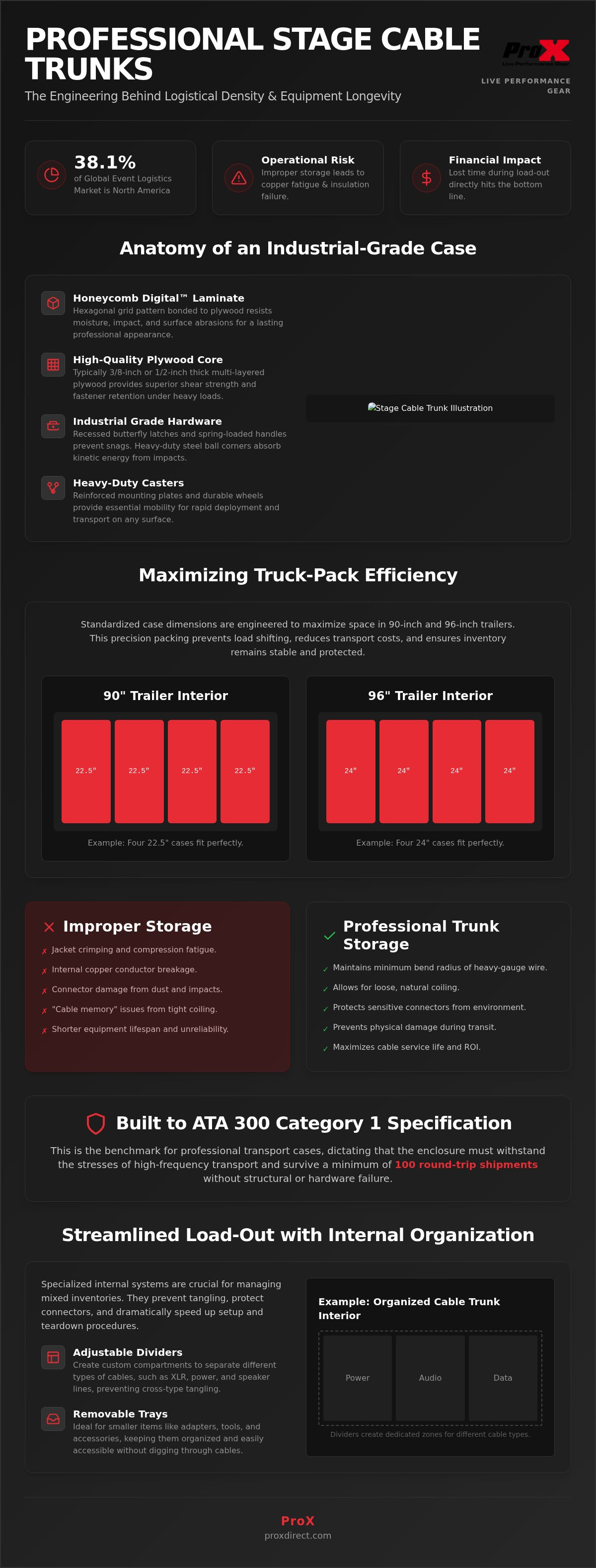
A professional stage cable trunk serves as a specialized, mobile enclosure engineered for the high-density transport of XLR, power, and speaker cables. It represents a critical transition from basic storage bins to industrial-grade protection systems. These units are built for the high-stakes environment of professional production where equipment failure isn't an option. Adhering to the Road Case standards, specifically the ATA 300 Category 1 specification, ensures the enclosure survives a minimum of 100 round-trip shipments. This engineering precision protects high-value assets like 12-gauge speaker wire and expensive multi-core snakes from the physical demands of the road.
The Anatomy of an Industrial-Grade Case
Structural integrity depends on material science. ProX Utility Cases utilize high-quality plywood, typically 3/8-inch or 1/2-inch thick. This material is bonded with a high-pressure laminate to resist moisture and impact. The exterior features the Honeycomb Digital™ protective finish. This hexagonal grid pattern prevents surface abrasions and maintains a professional appearance over years of use. Industrial hardware is a requirement, not an upgrade. Recessed butterfly latches and spring-loaded handles prevent snags during truck loading. Heavy-duty casters with reinforced mounting plates provide the necessary mobility for rapid stage deployment.
Why Proper Storage Extends Cable Lifespan
Improper storage is the primary cause of cable degradation. When cables are compressed or coiled too tightly, they suffer from jacket crimping and internal copper fatigue. A dedicated stage cable trunk provides the internal volume and structure to maintain the minimum bend radius of heavy-gauge wire. This protection shields sensitive connectors from dust, moisture, and mechanical impacts common during transit. A professional trunk prevents cable memory issues by allowing for loose, natural coiling that preserves the physical integrity of the internal conductors. This methodical approach to storage ensures that your inventory remains reliable for every performance.
Engineering Standards and Material Science in Cable Protection
Engineering a professional stage cable trunk requires adherence to rigorous mechanical standards. The ATA 300 Category 1 specification remains the benchmark for performance gear. It dictates that a case must withstand the stresses of high-frequency transport without structural failure or hardware compromise. This level of protection is essential for maintaining compliance with safety protocols established by organizations like the Event Safety Alliance. When cases are handled by third-party logistics providers, the structural integrity of the enclosure is your primary defense against equipment loss and operational downtime.
Material selection is the foundation of this durability. While generic utility boxes often use low-density plywood or thin plastic, professional trunks utilize multi-layered, impact-resistant plywood. This material offers superior shear strength and fastener retention, ensuring that handles and latches don't pull out under load. For specialized applications, the internal lining plays a vital role. Hard rubber linings are preferred for heavy power cables because they resist compression and chemical degradation from cable jackets. Conversely, high-density foam provides better shock absorption for delicate multi-core connectors and fiber optic looms.
Santosom Cases: The Precision Engineering Advantage
Santosom engineering represents the peak of European manufacturing standards. These cases are designed with a focus on structural longevity and technical precision. They utilize high-strength aluminum extrusions that interlock at every seam, creating a rigid skeleton. Heavy-duty steel ball corners reinforce these joints, absorbing the kinetic energy of accidental drops or collisions. This construction method ensures that the frame remains square even under heavy loads. If your production requires unique dimensions or integrated power distribution, Santosom offers custom engineering services to create bespoke cable management solutions. You can view the full range of Santosom Cases to find a configuration that fits your specific technical requirements.
Impact Resistance and Load Ratings
Calculating load ratings is critical for safe truck packing and warehouse storage. A standard stage cable trunk must support significant vertical pressure when cases are stacked three or four high in a trailer. Caster placement is engineered to distribute this weight evenly across the base, preventing the floor from bowing or the casters from collapsing. Proper offset and tracking ensure stability on steep loading ramps and uneven truck docks. For a deeper dive into the technical specifications of professional enclosures, read The Ultimate Guide to Flight Cases. This resource details the testing procedures used to verify impact resistance and hardware endurance under extreme conditions.
Optimizing Logistics with TruckPaX™ Dimensions
Logistical density is the primary metric for evaluating the efficiency of a touring production. In an industry where transport costs are a significant portion of tour overhead, every cubic foot of unused air in a trailer represents lost revenue. Standardizing the stage cable trunk to match 90-inch and 96-inch truck interior dimensions is a strategic necessity. This precision engineering ensures that equipment is packed securely end-to-end, preventing the shifting that leads to hardware failure. By eliminating air space, production managers can consolidate inventory into fewer vehicles, directly impacting the financial viability of long-term tours.
The transition from random case sizing to a standardized system reduces the time required for load-outs. Professional crews don't have to solve a geometric puzzle every night; they follow a repeatable, engineered pack plan. This consistency is essential for maintaining strict schedules between cities. When cases are designed to interlock and fit the specific constraints of North American trailers, the risk of transit damage drops significantly. This structural reliability is the backbone of modern event logistics, allowing for higher equipment density without compromising the safety of the crew or the integrity of the gear.
Calculating Your Truck Pack Density
Professional logistics rely on mathematical modularity. Utilizing standardized widths of 22.5 inches and 45 inches allows for 1/4 and 1/2 pack configurations across the trailer width. This modularity ensures a level load and provides a stable surface for secondary stacking. Adhering to safety and dimension protocols like those found in the ANSI/ESTA entertainment technology standards ensures that cases remain stable even under the vibration of high-speed transit. For a detailed breakdown of these dimensions, examine the engineering behind TruckPaX™ Truck Pack Cases. This system allows for precise volume calculations, ensuring you never pay for empty space on the road.
Mobility and Maneuverability
A dense truck pack is only effective if the gear can be safely deployed upon arrival. Each stage cable trunk features deep caster dishes recessed into the lid. These dishes allow the wheels of the case above to lock into place, creating a vertical column that resists lateral shifting. Mobility is facilitated by 4-inch heavy-duty wheels engineered to navigate arena floors, gravel lots, and steep loading ramps. These casters must possess high weight ratings to support the hundreds of pounds of copper cabling stored inside. Safe handling practices dictate that casters are positioned to provide a low center of gravity, which is vital when navigating tail lifts and uneven loading docks during a high-pressure load-in.
Internal Organization: Trays, Dividers, and Cable Management
Internal organization transforms a storage box into a high-performance inventory system. In professional production, "the nest" is a common failure point where tangled cables lead to copper fatigue and significant time loss during load-in. A well-engineered stage cable trunk utilizes a system of internal partitions to maintain order across diverse inventories. Separating XLR lines from heavy-duty power cables isn't just about aesthetics. It prevents the mechanical weight of power looms from crushing delicate data conductors and reduces the risk of jacket abrasion. Maintaining visibility within the trunk is critical for inventory management. When every cable has a designated slot, missing items are immediately apparent during the post-show pack-out. This visual accountability prevents the gradual loss of expensive inventory over a long tour.
The Utility of Removable Dividers
Adjustable divider systems allow technicians to reconfigure the internal layout based on specific tour requirements. These dividers slide into precision-milled slots, providing a rigid barrier that stays in place during high-vibration transit. Segregating high-voltage feeders from shielded data cables is a standard practice to maintain signal integrity and ensure a clean stage setup. A 45-inch trunk typically utilizes a three-segment longitudinal divider system to balance structural support with high-volume cable capacity. This segmentation ensures that long-run multicore snakes remain coiled in their designated zones, preventing the crossover that causes tangling. Using an over-under coiling technique within these segments allows cables to lay flat, which maximizes the vertical space of the trunk while preventing jacket twisting.
Trays and Accessory Management
Upper-level removable trays provide a secure environment for small-format accessories and delicate connectors. Instead of burying adapters, gender changers, or cable testers at the bottom of a heavy trunk, these trays keep mission-critical tools visible and accessible. Standardizing your labeling system on the case exterior and internal trays speeds up the troubleshooting process during a high-pressure show. Quick-access storage for PVC tape, labeling kits, and circuit testers ensures that your crew has the necessary supplies within reach at all times. This methodical approach to organization reduces the need for DIY solutions that often fail under the rigors of the road. It ensures that every component is protected from the mechanical impacts that occur during truck loading and unloading.
To maintain your inventory's performance and replace worn components, browse our selection of ProX Cases Replacement Parts to ensure your gear remains in peak condition for every performance.
Selecting the Right ProX Stage Cable Trunk
Selecting the correct stage cable trunk starts with a technical assessment of your inventory's volume, weight, and deployment frequency. High-capacity tours require a standardized ecosystem to maintain logistical efficiency across multiple venues. Beyond logistics, professional productions often rely on high-quality visual branding from Zodiac Event Displays to ensure their presence is as impactful as their technical execution. For mixed inventories involving both standard power cables and delicate data lines, the choice between a standard utility trunk and the TruckPaX™ series depends on your truck packing strategy. Standard utility trunks provide versatile storage for local productions, while the TruckPaX™ series is engineered specifically for high-density touring where trailer space is calculated to the inch. It's essential to match the case's load rating to the specific density of the copper cabling it will house to prevent structural failure during transit.
Maintenance and Longevity
Engineering precision must be matched by consistent maintenance to ensure equipment longevity. Casters are the most vulnerable component of any mobile enclosure. Regular cleaning and lubrication of the ball bearings prevent seizing and ensure smooth mobility across arena floors. Technicians should conduct post-tour inspections of the plywood panels and aluminum extrusions to identify structural fatigue or stress fractures. If hardware components like latches or handles show signs of wear, utilizing ProX Cases Replacement Parts allows you to restore the case to its original engineering specifications without replacing the entire unit. This proactive approach prevents the catastrophic hardware failure that can stall a load-out.
Custom vs. Standard Solutions
While standardized trunks meet the needs of most productions, high-value arrays and complex power distribution systems may require bespoke engineering. ZCASE custom builds offer specialized internal structures and integrated connectivity for unique technical requirements. Transitioning from a fragmented collection of generic storage bins to a unified ProX ecosystem improves both warehouse organization and on-site efficiency. This standardization ensures that every stage cable trunk in your fleet shares the same footprint and hardware standards, simplifying maintenance and training for your crew. You can browse the full range of ProX Professional Cases to determine which configuration best supports your current and future logistical needs.
Sourcing professional gear requires a reliable supply chain. ProX maintains an extensive global dealer network, ensuring that replacement parts and additional inventory are available regardless of your tour's location. This network provides technical support and expertise for complex logistical challenges. By partnering with established manufacturers, you gain access to decades of engineering experience dating back to 1984. This reliability is the backbone of the industry, providing a steady foundation for productions that cannot afford equipment failure. Investing in the right enclosure today ensures your cables remain protected through hundreds of tour dates and thousands of miles.
Mastering Touring Logistics Through Engineering Precision
Professional touring requires a commitment to structural integrity and logistical density. By adopting a standardized stage cable trunk system, you eliminate the inefficiencies of irregular truck packs and reduce the risk of copper fatigue within your inventory. The integration of industrial-grade hardware and impact-resistant materials ensures that your equipment survives the physical demands of high-frequency transport. It's a strategic move that protects your bottom line by minimizing hardware failure on the road.
ProX has been engineering performance gear since 1984, providing the technical backbone for industry leaders like Pioneer DJ and QSC. Our global dealer network ensures that professional support is accessible regardless of your tour's destination. You don't have to compromise on reliability when the stakes are high. Transitioning to a unified case ecosystem allows your crew to focus on technical execution rather than troubleshooting damaged gear or solving geometric puzzles at the loading dock.
Explore ProX Professional Cable Trunks and Utility Cases to optimize your next production. Securing your inventory with precision-engineered enclosures is a vital step toward operational excellence.
Frequently Asked Questions
What is the standard size of a stage cable trunk for truck packing?
Standardized dimensions for a professional stage cable trunk are engineered around 22.5-inch and 45-inch widths. These specific measurements allow for 1/4 and 1/2 pack configurations within standard 90-inch and 96-inch wide trailers. This modularity ensures that the cases fit securely side-by-side, eliminating lateral movement and maximizing trailer volume. Adhering to these dimensions is a fundamental practice in modern event logistics to ensure predictable and repeatable truck packing results.
Are ProX stage cable trunks ATA 300 compliant?
ProX professional cases are engineered to meet or exceed the ATA 300 Category 1 standard. This specification requires the enclosure to survive at least 100 round-trip shipments without structural failure. We utilize high-density plywood, industrial-grade aluminum extrusions, and reinforced steel ball corners to maintain this level of protection. Every component, from the recessed butterfly latches to the spring-loaded handles, is selected for its ability to withstand the rigors of high-frequency touring environments.
Can I stack different sizes of TruckPaX™ cases?
You can stack different TruckPaX™ models because they share a standardized footprint and modular engineering. The 22.5-inch and 45-inch widths are designed to interlock through recessed caster dishes located on the case lids. This system allows a 45-inch trunk to support two 22.5-inch cases side-by-side on top of it. This vertical modularity is essential for maintaining a level and stable load within a trailer, preventing shifting during transit.
How many XLR cables can fit in a standard 45-inch trunk?
Capacity varies based on cable gauge and coiling technique, but a 45-inch stage cable trunk typically houses between 100 and 150 standard 25-foot XLR cables. Utilizing internal dividers allows you to segment these by length or function, which prevents tangling and maximizes the usable internal volume. For heavier 12-gauge power cables or multi-core snakes, the capacity will be lower to ensure you don't exceed the safe weight rating of the industrial casters.
What caster size is best for professional touring trunks?
Professional touring standards dictate the use of 4-inch heavy-duty casters. This size provides the necessary clearance to navigate arena floors, loading ramps, and uneven dock plates without bottoming out. These wheels must feature high weight ratings and integrated locking mechanisms to secure the case during transit. Smaller casters often fail under the weight of high-density copper cabling and don't provide the shock absorption required for long-term hardware integrity and structural durability.
How do I install or adjust dividers in my cable trunk?
ProX trunks utilize a precision-milled slot system for divider installation. You can adjust the internal layout by sliding the high-density plywood dividers into these pre-cut channels. This allows for custom segmentation based on your current inventory needs, such as separating data looms from high-voltage power feeders. It's important to ensure the dividers are fully seated in the slots to provide maximum structural support and prevent lateral movement of the cables during transport.
What is the difference between a utility trunk and a cable trunk?
A standard utility trunk is a general-purpose enclosure, while a stage cable trunk is specialized for wire management. Professional cable trunks feature internal divider systems and removable trays specifically designed to prevent cable memory issues and tangling. They often include hard rubber linings to resist chemical degradation from cable jackets. While both use similar structural materials, the cable-specific model is engineered to optimize the organization and lifespan of high-value copper and fiber optic assets.
Do these trunks come with a warranty for touring use?
ProX provides a limited lifetime warranty that covers manufacturing defects in materials and workmanship. This coverage is essential for gear used in high-stakes touring environments where equipment reliability is non-negotiable. While the warranty doesn't cover normal wear and tear from road use, we maintain a full inventory of replacement parts, including casters, latches, and handles. This ensures that you can maintain your trunks to original engineering standards throughout their entire operational lifespan.
Disclaimer
Any trademarks, trade names or brand names appearing herein that do not belong to ProX are the property of their respective owners and/or companies, and such appearance doesn't and shall not constitute or imply endorsement, sponsorship or recommendation by ProX.


