

A single mechanical failure in a base-level component can jeopardize the strict timeline of a high-stakes production. For logistics managers and stage crews, the reliability of a professional caster board is the difference between a seamless load-in and a catastrophic equipment delay. When moving high-value electronics or heavy lighting rigs, the structural integrity of the transport platform is a non-negotiable requirement for operational success.
You've likely seen how inferior hardware leads to wheel failure, physical strain, and avoidable damage to expensive inventory. This guide details how professional-grade caster boards optimize touring logistics, ensure equipment safety, and streamline the movement of gear across diverse venue environments. We'll analyze the engineering specifications required for 2026, focusing on material durability, standardized dimensions for truck packing, and the mechanical advantages of heavy-duty polyurethane casters within the ProX ecosystem. By prioritizing technical precision and compatibility with Santosom and TruckPaX systems, you can secure long-term hardware durability and maintain the integrity of your professional gear during every transit cycle.
Key Takeaways
- Understand how a professional caster board functions as the structural foundation for the "case-on-wheels" logistics model used in high-stakes production.
- Identify critical engineering specifications, including the use of 18mm birch plywood and the distinction between static and dynamic load ratings for heavy equipment.
- Learn to optimize load-in efficiency by utilizing standardized dimensions that integrate seamlessly with TruckPaX™ and Santosom case ecosystems.
- Improve transport safety by mastering center-of-gravity principles and utilizing caster cups for secure stacking during transit.
- Evaluate the long-term hardware durability provided by heavy-duty polyurethane casters designed for demanding backstage environments.
What is a Professional Caster Board in Live Production?
In the live production industry, a caster board is a specialized, heavy-duty platform designed to support and transport professional equipment cases. It isn't a simple utility dolly; it's a precision-engineered tool built to withstand the rigorous demands of global touring and constant venue rotation. These boards serve as the essential foundation of the "case-on-wheels" logistics model, enabling production crews to move high-density gear with predictable control and minimal physical exertion. Many high-value systems, including those housed in ProX Cases, rely on these boards for mobility across diverse venue surfaces.
While some smaller cases feature integrated wheels, large-format consoles, speaker arrays, and lighting rigs require external boards. This separation allows for better weight distribution and easier maintenance. If a wheel is damaged during transit, the board can be swapped or repaired without taking the entire case out of commission. This modularity is a hallmark of professional logistics, distinguishing it from consumer-grade transport solutions that lack the necessary load ratings for industrial use.
The Anatomy of an Industrial Caster Board
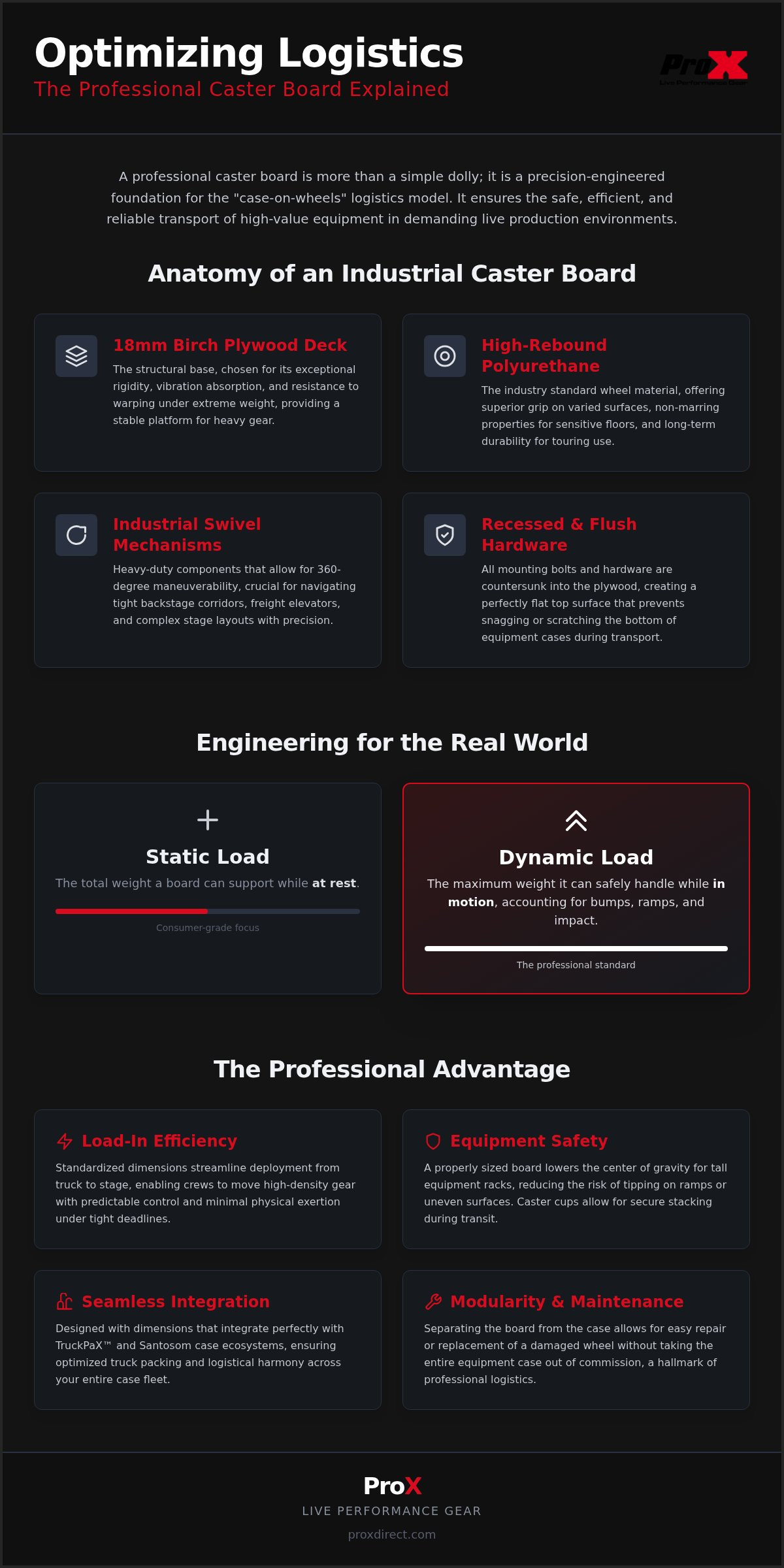
The structural base of an industrial board utilizes 18mm high-density birch plywood. This material is chosen for its ability to absorb vibration and resist warping under extreme weight. The mechanical efficiency depends on the Caster (wheel) assembly. Professional components include:
- High-Rebound Polyurethane: These treads provide necessary grip on concrete ramps while remaining non-marring on sensitive stage floors.
- Industrial Swivel Mechanisms: These allow for 360-degree maneuverability in tight backstage corridors and freight elevators.
- Recessed Hardware: Mounting bolts are countersunk to ensure a flush top surface that won't snag or scratch the bottom of the cases being transported.
Why Production Crews Prioritize Dedicated Boards
Production crews prioritize dedicated boards because they solve specific logistical bottlenecks. During a tight load-in window, speed is the primary metric of success. Standardized dimensions allow for rapid deployment from the truck directly to the stage. They also improve storage efficiency. When cases aren't in use, boards can be stacked vertically or nested, saving valuable square footage in the warehouse. Most importantly, a properly sized board lowers the center of gravity for tall equipment racks. This reduces the risk of tipping on uneven surfaces or steep loading ramps, protecting both the crew and the high-value electronics inside the cases.
Engineering Specifications: Load Ratings and Materials
Engineering precision determines the lifespan of a professional caster board. While consumer-grade dollies focus on static weight, industrial production requires an understanding of dynamic forces. A board must support its contents while traversing ramps, thresholds, and uneven loading docks. Material selection starts with the deck. Industry standards dictate the use of 18mm birch plywood. This specific thickness provides the structural rigidity needed to prevent bowing under the weight of large-format consoles or AV broadcasting cases. Unlike cheaper particle boards or thin composites, high-grade plywood maintains its integrity across hundreds of load-in cycles.
Calculating Your Dynamic Load Requirements
A dynamic load rating accounts for the increased stress placed on the hardware during movement and impact. For touring hardware, dynamic load capacity is the maximum weight a board can safely transport while in motion over varied surfaces without mechanical failure. To calculate this, you must combine the weight of the external case with the internal equipment and apply a safety factor. Professional rigs often reference OSHA load rating standards to ensure that every component can handle its proportional share of the intended load. When a rig hits a threshold or a ramp transition, the momentary force can double or triple the static weight, making high-spec bearings essential.
Polyurethane vs. Rubber: Choosing the Right Wheels
The choice between wheel materials impacts both maneuverability and floor protection. Polyurethane is the preferred standard for professional production. It offers a higher weight capacity than rubber and maintains its shape under pressure, which prevents "flat spotting" during long-term storage in the warehouse. These wheels are non-marring, which is a critical requirement for corporate event spaces and ballrooms with sensitive flooring. If you are building out a custom fleet, evaluating the replacement parts and hardware options ensures your gear remains operational regardless of the venue environment.
Environmental factors also dictate hardware specifications. Outdoor festival environments expose equipment to moisture and humidity, which can lead to oxidation. Professional boards utilize zinc-plated or stainless steel mounting hardware to resist corrosion. This engineering detail prevents the seizure of swivel mechanisms, ensuring that the caster board remains fully functional across multiple seasons of outdoor use. By prioritizing these technical specifications, production managers can reduce equipment downtime and minimize the physical strain on their crews.
Stability and Maneuverability in High-Stakes Environments
Stability in production logistics isn't merely about weight capacity; it's about the physics of the center of gravity. A professional caster board must be engineered with a footprint that matches the dimensions of the load to prevent lateral instability. When moving tall racks or stacked ProX Cases, the width of the board directly influences the tipping point. Narrow boards are susceptible to oscillating during transit, especially when encountering floor transitions or cable bridges. Precision tracking is achieved through high-tolerance swivel bearings that allow for effortless direction changes in tight backstage corridors.
Braking systems are another critical factor in high-stakes environments. Locking casters are essential when staging gear on inclined surfaces or loading ramps. A dual-locking mechanism, which secures both the wheel rotation and the swivel axis, provides the highest level of security. Adhering to ANSI/ICWM performance standards ensures that these braking and swivel components meet the structural requirements for industrial use.
Preventing Tip-Overs During Transport
Tip-overs often occur due to improper case alignment or top-heavy loading. Production crews must ensure that the heaviest components are positioned at the bottom of the rack and that the case is centered perfectly on the board surface. Safe handling involves pushing from the lower third of the case rather than the top. This technique keeps the force vector closer to the board, minimizing the leverage that causes a rig to tilt. For tall equipment, such as LED Video Panel Wall Support systems, using a board with a wider wheel stance is a standard safety protocol.
Navigating Ramps and Loading Docks
Wheel diameter is the primary factor in a board's ability to clear thresholds and gaps. Large 4-inch wheels roll over dock plates and elevator gaps with significantly less resistance than smaller wheels. Managing the momentum of a 400lb+ case requires a combination of physical control and mechanical reliability. The caster board acts as the interface between the gear and the truck ramp. If the wheels are too small, they can catch on the smallest obstruction, causing the load to stop abruptly while the momentum of the case continues forward. Proper truck loading involves securing these boards with E-track or straps to ensure they remain stationary during transit, preventing internal shifting that could damage high-value electronics.
Implementation: Integrating Caster Boards with Your Case Fleet
Integration requires more than just placing a case on a platform. It involves a calculated alignment with the entire logistics ecosystem. Standardizing dimensions ensures that every caster board fits into the TruckPaX™ Truck Pack system without creating "dead space" in the trailer. When boards share a common footprint, they can be tessellated efficiently, maximizing the density of the load. This is especially critical for high-value Santosom Cases, where the board must precisely match the case's structural extrusions to prevent shifting. If the board is even an inch out of spec, it can disrupt the entire truck row, leading to unsecured gear and potential damage.
Secure stacking is another implementation priority. Caster cups, or wheel dishes, allow for the safe vertical accumulation of cases. By nesting the wheels of the top case into the cups of the board or case below, crews create a locked column. This prevents lateral movement during the vibration-heavy environment of transit. It also allows for the safe storage of empty cases in the warehouse, utilizing vertical space without risking a collapse.
Standardizing Your Logistics
Consistent board sizes simplify the complex math of truck loading patterns. When a fleet uses uniform dimensions, load masters can predict exactly how many units will fit across the width of a standard trailer. Labeling these boards with stenciled inventory numbers or color codes ensures that specific boards remain paired with their intended cases. This level of organization reduces the time spent searching for matching hardware during a hectic load-out. For those building out a new fleet, you can Browse ProX Case Accessories to find the necessary hardware for standardized assembly.
Maintenance and Replacement
Maintenance prevents the sudden failure of a caster board in the middle of a venue. Crews should inspect bearings for "caster flutter" or grinding sounds which indicate debris ingress or grease depletion. Cleaning polyurethane wheels with mild solvents removes venue tape residue that causes uneven rolling and floor marring. A touring-grade caster board typically provides 3 to 5 years of reliable service under heavy rotational use before hardware fatigue necessitates component replacement. Replacing individual casters is often more cost-effective than retiring the entire 18mm plywood deck. For long-term hardware reliability, you should source high-grade replacement casters to maintain your fleet's mobility standards.
The ProX Advantage: Engineering the Foundation of Your Rig
ProX has been engineering performance gear since 1984. This decades-long history informs every aspect of our logistics hardware. We recognize that a caster board is the primary point of contact between high-value technology and the physical world. Our boards aren't generic accessories; they are foundational components designed to integrate flawlessly with the full range of ProX Cases. By controlling the manufacturing process, we ensure that the mechanical tolerances of the board match the structural requirements of the cases they support, providing a level of compatibility that third-party dollies cannot replicate.
Why Professional Reliability Matters
The hidden cost of sub-standard logistics hardware often manifests at the most inconvenient times. A failed bearing or a cracked deck during a load-in can stall a production and lead to cascading delays. ProX hardware is engineered to survive the high-compression "truck pack" environment, where gear is subjected to constant vibration and shifting forces. While basic dollies might suffice for light-duty storage, they lack the structural reinforcement necessary for global touring. For a deeper understanding of how these components fit into a broader protection strategy, consult The Ultimate Guide to Flight Cases. Choosing the right foundation prevents the premature wear of your case fleet and minimizes long-term maintenance expenses.
Custom Solutions for Specialized Gear
Not every equipment rig fits a standard footprint. We offer bespoke solutions, including boards tailored for ZCASE Custom Builds manufactured in Poland. These specialized platforms account for the unique weight distribution and dimensions of high-value production gear, ensuring the center of gravity remains stable during transit. Similarly, our heavy-duty options for Truss and Base Plate transport are built to handle the extreme density of structural aluminum and steel. These boards utilize reinforced mounting points and high-capacity casters that exceed standard industrial ratings, allowing for the safe movement of thousands of pounds of structural gear.
Maintaining a consistent standard across your inventory is essential for operational efficiency. Accessing the ProX dealer network allows production companies to execute bulk fleet upgrades, ensuring that every piece of gear moves on a reliable foundation. This commitment to engineering precision helps you avoid the risks associated with hardware failure and crew fatigue. Investing in professional-grade mobility is a strategic decision that protects your hardware, your staff, and your reputation in the high-stakes world of live events. When the success of a tour depends on the speed and safety of the load-in, the quality of your caster board is a critical variable in the logistical equation.
Optimizing Your Production Logistics for 2026 and Beyond
Standardizing your transport fleet is a strategic necessity for high-stakes production environments. By prioritizing industrial-grade materials like 18mm birch plywood and high-rebound polyurethane wheels, you ensure that every caster board provides a stable foundation for high-value electronics. These technical specifications directly influence load-in speed and long-term hardware durability. Integrating these tools with standardized systems like TruckPaX™ and Santosom creates a predictable logistics ecosystem that minimizes the risk of equipment failure.
ProX has engineered performance gear since 1984, building a reputation for reliability that's trusted by major touring artists and production houses worldwide. Our hardware is designed to meet the rigorous demands of global transit, ensuring your gear remains protected across every venue rotation. Don't let inferior mobility hardware compromise your operational standards or crew safety. Explore Professional Caster Boards and Case Accessories at ProX to secure the foundation of your next tour. Professional logistics start with engineering precision; we're here to support your most demanding technical needs.
Frequently Asked Questions
What is the standard weight capacity of a professional caster board?
Standard weight capacity varies by configuration, but a professional caster board typically supports hundreds of pounds per wheel. High-grade polyurethane casters often have individual ratings exceeding 300 lbs, allowing a four-wheel board to handle significant static loads. You must prioritize the dynamic load rating, which accounts for the stress of moving over ramps and thresholds. Engineering standards since 1984 emphasize that total capacity should always include a safety margin to prevent hardware failure during transit.
Can I use a caster board with any type of equipment case?
While a caster board is technically compatible with various cases, you should match the board dimensions to the footprint of your specific gear. ProX designs boards for seamless integration with TruckPaX™ and Santosom systems to ensure the center of gravity remains stable. Using a board that is too small for a large console case increases the risk of tipping. Proper alignment with the case extrusions is critical for maintaining structural integrity across your entire logistics fleet.
How do I maintain the wheels on my caster board for touring?
Maintaining wheels for touring involves regular inspections for debris ingress and bearing wear. You should clean the polyurethane treads with mild solvents to remove adhesive residue from venue tape, which can cause uneven rolling. Check the swivel mechanisms for "caster flutter" and apply industrial-grade lubricant to the bearings if movement becomes restricted. Periodically tightening the recessed mounting bolts ensures the board remains a rigid foundation for your high-value production electronics.
Why are polyurethane wheels preferred over rubber for production?
Polyurethane wheels are preferred for production because they offer a superior weight-to-size ratio compared to rubber. They provide higher dynamic load capacities and are resistant to "flat spotting," which occurs when heavy cases sit stationary for long periods. Additionally, polyurethane is non-marring, making it safe for use on sensitive ballroom floors. These wheels provide the necessary grip on steep loading ramps while maintaining the smooth maneuverability required in tight backstage corridors.
What is the difference between a swivel caster and a fixed caster?
A swivel caster rotates 360 degrees to allow for multi-directional movement, while a fixed caster only moves in a straight line. Most production crews utilize four swivel casters on a single caster board to maximize maneuverability in freight elevators and narrow hallways. However, some large-format speaker arrays use a combination of two fixed and two swivel casters to improve tracking during long pushes across arena floors, providing better control over the rig's momentum.
How do I secure cases to a caster board during transport?
You can secure cases to a board using integrated caster cups, also known as wheel dishes, which are recessed into the top surface of the deck. These cups allow the wheels of a case to nest securely, preventing lateral shifting during transit. For truck loading, you should use E-track straps or heavy-duty tie-downs to pull the board against the trailer wall. This creates a locked column that resists the vibrations and sudden movements inherent in the trucking environment.
Is it better to have wheels integrated into the case or use a separate board?
It's generally better to use a separate board for heavy-duty production gear rather than integrated wheels. Boards allow for a wider wheel base, which significantly improves stability for tall racks. If a wheel fails, you can swap the entire board or replace the individual caster without needing to open or modify the equipment case. This modular approach simplifies maintenance and allows you to stack empty cases more efficiently in the warehouse or truck.
What plywood thickness is recommended for heavy-duty production boards?
The industry standard for heavy-duty production boards is 18mm high-density birch plywood. This thickness provides the necessary structural rigidity to prevent the deck from bowing under the weight of large-format mixers or lighting rigs. Thinner materials or lower-grade composites are prone to warping and cracking under the stress of dynamic loads. Using 18mm plywood ensures that the board remains a flat, reliable foundation for your high-value gear throughout multiple years of global touring.
Disclaimer
Any trademarks, trade names or brand names appearing herein that do not belong to ProX are the property of their respective owners and/or companies, and such appearance doesn't and shall not constitute or imply endorsement, sponsorship or recommendation by ProX.


