

Would you trust a $50,000 digital mixing console to a container that was designed as an afterthought? In the high-stakes environment of global touring, the structural integrity of your transport housing is the only thing standing between a successful load-in and a catastrophic equipment failure. Most professionals understand that a standard box is insufficient for sensitive electronics, yet many still struggle with cases that don't stack correctly in standard trailers or fail to provide adequate clearance for complex cabling. This custom flight case design guide provides the technical framework required to engineer high-performance protection that meets the rigorous demands of professional production.
We recognize that precision is a non-negotiable requirement for your logistical workflow. You need gear that survives the physical stress of repeated transit while maximizing space in the truck. This article outlines the essential engineering specifications, from ATA 300 Category I standards to the mechanical properties of polyethylene foam. We will examine how to calculate internal tolerances, ensure thermal management, and select hardware that maintains long-term durability. By following these industrial standards, you can secure your investment and improve your operational efficiency on every tour.
Key Takeaways
- Understand the engineering requirements of ATA 300 Category 1 standards to ensure your case maintains structural integrity over 100 trips in high-intensity transit environments.
- Use this custom flight case design guide to accurately calculate the maximum external footprint while accounting for fixed protrusions such as knobs, antennas, and heat sinks.
- Learn how to select specific foam densities, such as Ester or Etha foam, to provide optimal G-force protection tailored to the weight and sensitivity of your equipment.
- Improve logistical efficiency by designing cases that adhere to industry-standard Truck Pack dimensions for secure stacking and maximized trailer volume.
- Discover how to leverage CAD-based design verification and specialized partnerships, including ZCASE custom builds, for complex console and workstation requirements.
The Foundations of Custom Flight Case Engineering
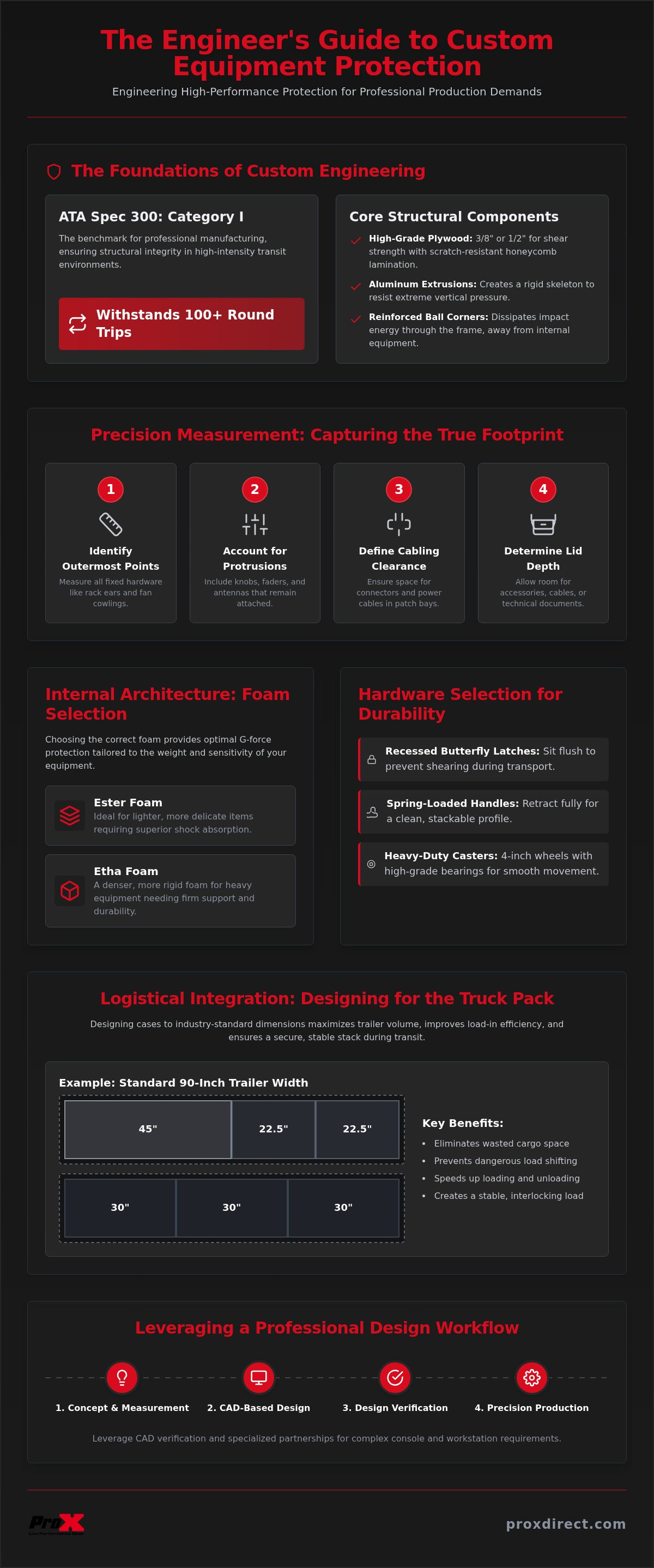
Engineering a container for high-stakes production environments requires a shift from simple storage to rigorous mechanical protection. The benchmark for professional manufacturing is the ATA Spec 300 Category I standard. This specification dictates that a reusable shipping container must withstand a minimum of 100 round-trip shipments without structural failure. Achieving this level of durability requires a deep understanding of The Foundations of Custom Flight Case Engineering, where every component is selected based on its ability to absorb kinetic energy and resist environmental stressors. In this custom flight case design guide, we prioritize the technical specifications that differentiate professional-grade housing from consumer-level alternatives.
Structural integrity depends on the integration of high-grade plywood and precision-engineered aluminum extrusions. These extrusions create a rigid skeleton that maintains the case's shape under extreme vertical pressure. Reinforced ball corners are essential for impact distribution; they ensure that the energy from a drop is dissipated through the frame rather than transferred directly to the internal equipment. Designers must balance this ruggedization with the practical realities of international transit. While maximum protection is the goal, excessive weight can lead to increased freight costs and logistical bottlenecks. Utilizing a comprehensive range of professional cases allows engineers to select the exact level of reinforcement needed for specific gear profiles.
Material Standards: Plywood vs. Composite
Professional case construction typically utilizes 3/8" or 1/2" plywood. For larger consoles or heavy amplifiers, 1/2" plywood offers the necessary shear strength to prevent bowing. We utilize honeycomb digital lamination on our plywood surfaces to provide a high level of scratch and scuff resistance, which is critical for maintaining professional aesthetics over years of use. In scenarios where air freight weight restrictions are the primary constraint, lightweight composite materials may be substituted. These materials offer a high strength-to-weight ratio but often require different assembly techniques compared to traditional wood-based designs.
Hardware Selection for Performance Gear
Hardware is the most frequent point of failure in poorly designed cases. Secure transport requires recessed butterfly latches that sit flush with the case surface, preventing them from being sheared off during automated sorting or truck loading. Spring-loaded handles are equally vital; they must be rated for the total loaded weight of the case and should retract fully to ensure a clean profile in high-density truck packs. When selecting casters, engineers must calculate the total load capacity, often opting for 4-inch heavy-duty wheels with high-grade bearings to ensure smooth movement across uneven venue floors and loading ramps.
Precision Measurement: Capturing the True Footprint
Accuracy in measurement is the critical first phase in any custom flight case design guide. Relying solely on manufacturer spec sheets often leads to fitment failure because real-world equipment frequently features minor revisions or external protrusions not documented in basic CAD files. Engineers must perform a physical audit of the gear to capture its absolute maximum footprint. This process ensures the internal architecture provides a secure fit without putting undue stress on the chassis.
The measurement process follows a methodical four-step progression:
- Step 1: Identify the outermost points of the chassis. This includes all fixed hardware such as rack ears, cooling fan cowlings, and non-removable handles.
- Step 2: Account for components that remain attached during transit. Antennas, control knobs, and faders are common items that crews leave in place for efficiency. Measuring these ensures the internal lining doesn't exert damaging pressure on sensitive controls.
- Step 3: Define the necessary clearance for internal cabling. A perfectly fitted case is useless if there's no room for XLR connectors or power cables to remain plugged into a patch bay.
- Step 4: Determine the required depth for the lid. Custom lids often house technical documentation, spare fuses, or mounting hardware that must stay with the unit.
Accounting for Protrusions and Hardware
Fixed protrusions like mounting brackets and rubber feet are the primary causes of case fitment failure. If the equipment features a hinged screen or foldable components, you must measure the full arc of movement for these parts. This prevents them from striking the case walls during operation or transit. Digital calipers provide the millimetric accuracy required for high-precision builds. This level of detail prevents the equipment from shifting within the housing, which is essential for maintaining long-term durability.
Designing for Operational Clearance
Operational requirements extend beyond simple storage. For high-output gear like amplifiers or effects racks, you must calculate space for heat dissipation to prevent thermal shutdown during use. Providing enough hand-room is another logistical necessity; it allows technicians to safely extract the gear without pinching fingers or snagging cables. For more specialized applications, consult our Professional DJ Equipment Case Purchase Guide to understand how these clearances impact touring performance. If your project involves a complex workstation, you can explore ProX custom build options to ensure every technical specification is met through precise engineering.
Internal Architecture: Foam Density and Specialized Inserts
The internal architecture of a container represents the final line of defense against mechanical failure. While the external shell provides structural integrity, the internal lining is responsible for managing G-force loads during transit. Effective protection requires a design that absorbs kinetic energy and prevents it from reaching sensitive internal components. This custom flight case design guide prioritizes the engineering of these internal systems to ensure that equipment survives the repeated shocks and vibrations inherent in global logistics.
Mechanical failure often occurs when gear is subjected to rapid deceleration. High-quality internal architecture uses specific foam densities to extend the deceleration time, effectively lowering the G-force impact on the equipment. CNC-cut foam inserts are utilized for multi-component arrays to provide a precise fit for every item, from primary consoles to peripheral accessories. For ultra-fragile broadcast or laboratory gear, engineers often implement "float" systems. These systems consist of an internal equipment sleeve separated from the outer case walls by a thick layer of high-performance foam, providing a secondary layer of isolation from external impacts.
Selecting the Right Foam Density
Foam selection depends entirely on the weight and fragility of the payload. Soft Ester foam, a polyurethane-based open-cell material, is ideal for lightweight electronics and delicate optics because it provides gentle cushioning without exerting excessive pressure on the chassis. In contrast, high-density Polyethylene (Etha) foam is a closed-cell material designed for heavy mixers and lighting fixtures; its rigid structure prevents heavy gear from "bottoming out" against the case walls during a drop. Progressive density foam utilizes laminated layers of varying firmness to provide initial shock absorption for minor vibrations followed by firm support for high-impact events.
Advanced Internal Configurations
Not all gear requires a static foam cutout. Utility and storage cases often utilize carpet-lined interiors, which offer a durable, non-abrasive surface for general equipment transport. For evolving equipment kits, adjustable partitions provide the flexibility to reconfigure the internal layout as technical requirements change. These partitions are typically secured using heavy-duty mechanical tracks or friction-fit systems to maintain stability. You can Explore ProX Cases Categories to see how these different internal configurations are applied across various industry standards. Whether your needs involve a fixed CNC-cut layout or a modular partition system, the priority remains the mitigation of transit-related stress on your professional assets.
Logistical Integration: Designing for the Truck Pack
Engineering a case for protection is only half the technical challenge. A professional housing must also function as a modular unit within a complex logistical chain. This custom flight case design guide emphasizes the importance of external dimensions that align with standardized freight environments. In North America, most 53-foot trailers feature an interior width of approximately 98 to 99 inches. By designing cases in increments of 22.5 or 45 inches, production crews can achieve a "tight pack" that eliminates lateral movement during transit, which is essential for protecting the structural integrity of the cases and the gear inside.
Vertical stability is equally vital for maximizing cube utilization. Integrated caster cups, precision-recessed into the lid, allow the wheels of the case above to lock into a fixed position. This mechanical alignment prevents the stack from shifting during sudden deceleration or sharp turns. When cases are engineered to stack securely, they utilize the full height of the trailer, which significantly reduces the total number of vehicles required for a tour. This efficiency directly impacts the bottom line by lowering fuel consumption and freight expenses.
The TruckPaX™ Advantage
The TruckPaX™ system is engineered specifically for these logistical footprints. By standardizing on 22.5 inch and 45 inch widths, these cases allow for three-across or two-across loading in standard trailers without wasted space. This standardization drastically increases load-in and load-out speeds because it removes the guesswork from trailer packing. For a deeper technical analysis of these standards, see our article on TruckPaX™ Truck Pack Cases: Engineering Logistical Efficiency.
Designing for Multi-Modal Transport
International touring often requires transitioning between truck, sea freight, and air cargo. Air cargo containers have specific contour requirements that may limit stacking height compared to standard trailers. To maintain efficiency across these modes, consider the following technical requirements:
- Recessed Shipping Plates: These provide a protected surface for barcodes, ensuring tracking data isn't lost during automated handling.
- Forklift Access: Heavy mixer consoles and workstations should feature skids or forklift pockets to facilitate safe movement by warehouse crews.
- Labeling Standards: Clear, permanent marking of weight and center of gravity is required for many international air freight carriers.
To ensure your gear meets these global standards, you can explore our professional Truck Pack case offerings to find the right configuration for your tour.
The ProX Custom Design Workflow: From Concept to Production
Transitioning from a theoretical blueprint to a physical container requires a structured manufacturing workflow that eliminates margin for error. While the custom flight case design guide principles established in previous sections provide the technical foundation, the execution phase relies on advanced CAD-based verification. This process ensures that every internal tolerance and external dimension aligns with the mechanical requirements of the gear. By collaborating with an established engineering team, you can verify that the proposed housing maintains structural integrity under the specific G-force loads anticipated during international transit.
The workflow begins with the submission of technical specifications through the professional dealer portal. This platform allows for precise project tracking and facilitates the exchange of technical drawings between the client and the manufacturing floor. For complex requirements, such as integrated workstations or large-format mixer consoles, our engineers utilize these digital models to simulate internal clearances and heat dissipation paths. This level of scrutiny prevents the common fitment failures associated with manual measurement or generic template-based construction. Every custom build undergoes a rigorous quality control protocol to ensure compliance with ATA 300 Category I standards before it leaves the facility.
Bespoke Engineering for Complex Rigs
High-value production gear often requires more than a standard rectangular enclosure. We specialize in designing integrated workstations for AV broadcasting and lighting control that allow for rapid deployment. Utilizing specialized ZCASE technology, these builds facilitate faster setup times by allowing consoles to remain partially patched during transit. This engineering approach is particularly beneficial for touring professionals who manage tight load-in schedules. For a detailed analysis of these specialized systems, consult the ZCASE Custom Build Cases Engineering Guide. These designs prioritize functional excellence, ensuring that the case acts as an active component of your technical workflow rather than just a passive shipping container.
Final Approval and Manufacturing
The manufacturing phase only commences after a thorough review of the final technical drawings. This stage confirms that all recessed hardware, internal foam densities, and external TruckPaX™ dimensions meet the project's logistical requirements. CNC precision is central to this process; it allows for the high-volume production of custom components with millimetric consistency. This automated cutting technology ensures that every plywood panel and foam insert matches the verified CAD model exactly. To initiate your project, you should contact an authorized ProX dealer who can provide custom quotes and facilitate the engineering review. This methodical approach ensures that your custom flight case design guide objectives result in a durable, high-performance logistical asset.
Securing Your Technical Assets for Global Transit
Mastering the technical specifications outlined in this custom flight case design guide ensures your equipment survives the physical demands of international touring. Professional protection requires more than a simple container; it demands strict adherence to ATA 300 Category I standards and a meticulous approach to internal foam architecture. By prioritizing millimetric accuracy in measurement and logistical compatibility with standard truck pack dimensions, you eliminate the risks of equipment failure and inefficient trailer loading. These engineering choices provide the structural foundation necessary for long-term durability in high-stakes production environments.
Since 1984, we've engineered ruggedized protection for high-value production gear using precision CAD design and industrial-grade materials. Our workflows are trusted by touring professionals worldwide to deliver consistent results across every stage of the logistical chain. You can Find an Authorized ProX Dealer to Start Your Custom Build and verify your technical requirements with our engineering team today. Investing in precision-engineered housing is the most effective way to protect your professional assets and ensure operational reliability on every tour.
Frequently Asked Questions
How do I ensure my custom case fits both the equipment and the cables?
Ensure a proper fit by measuring the absolute maximum footprint, including all fixed protrusions like knobs and antennas. You must also account for a minimum of 2 to 3 inches of clearance at the rear for connectors and cable bends. This operational space prevents stress on the input and output panel during use. This custom flight case design guide recommends performing a physical audit of the gear with cables attached to verify the necessary internal volume.
What is the difference between ATA 300 and standard utility cases?
ATA 300 Category I is a specific airline standard that requires a container to withstand at least 100 round-trip shipments. Standard utility cases are often designed for general storage and don't meet these rigorous impact absorption and material requirements. Professional ATA cases utilize 3/8" or 1/2" plywood, reinforced aluminum extrusions, and heavy-duty hardware to ensure long-term durability. These specifications are essential for protecting high-value assets during international transit and repeated truck loading.
Why should I use millimetric measurements for my custom case design?
Millimetric measurements are required to ensure a secure fit that prevents internal gear movement. Even minor shifting during transit can cause mechanical failure or aesthetic damage to the equipment chassis. Using digital calipers for high-precision builds allows engineers to create CNC-cut foam inserts with exact tolerances. This level of detail is a core component of any custom flight case design guide, as it ensures the internal architecture functions as intended to dissipate kinetic energy.
Can I design a custom case for multiple pieces of equipment?
You can design a single case for multiple components using CNC-cut foam inserts or adjustable partitions. This approach is common for microphone cases, lighting kits, and complex AV broadcasting workstations. By housing an entire equipment array in one container, you improve logistical efficiency and reduce the total number of items to track during load-out. Our engineering team uses CAD-based verification to ensure each component remains isolated and protected from internal collisions during transit.
What foam density is best for heavy professional audio mixers?
High-density Polyethylene (Etha) foam is the industry standard for protecting heavy professional audio mixers. This closed-cell material provides the necessary rigid support to prevent heavy equipment from bottoming out against the case walls during a drop. Unlike softer Ester foam, which is better suited for lightweight optics, Etha foam maintains its structural integrity under significant weight. For complex console needs, we often utilize these materials in specialized ZCASE custom builds for maximum protection.
How do custom case dimensions affect my tour shipping costs?
External dimensions directly impact shipping costs by determining how efficiently cases pack into a trailer. Cases designed with Truck Pack dimensions, such as 22.5 inch or 45 inch widths, maximize the interior volume of standard 53-foot trailers. This logistical integration reduces the total number of vehicles required for a tour and prevents freight damage caused by shifting loads. Standardizing your case footprint is a critical step in lowering long-term operational expenses for touring professionals.
What is the standard lead time for a custom ZCASE build?
Lead times for bespoke ZCASE projects are determined by the complexity of the engineering and the current manufacturing queue in Poland. Professionals should confirm current lead times for 2026 projects through the authorized dealer portal. This platform provides real-time project tracking and allows you to review technical drawings before production begins. For standard TruckPaX™ or utility cases, availability is typically faster, but custom workstation builds require a more thorough CAD-based design and verification phase.
Are custom cases worth the investment compared to universal fits?
Custom cases are a superior long-term investment because they are engineered for a precise fit and standardized logistics. Universal cases often result in equipment damage due to internal shifting or inefficient truck packs that increase shipping costs. A bespoke build using the standards in this custom flight case design guide ensures the housing survives 100 or more trips. This durability justifies the initial cost by extending the lifespan of your gear and reducing the frequency of case replacements.
Disclaimer
Any trademarks, trade names or brand names appearing herein that do not belong to ProX are the property of their respective owners and/or companies, and such appearance doesn't and shall not constitute or imply endorsement, sponsorship or recommendation by ProX.


