
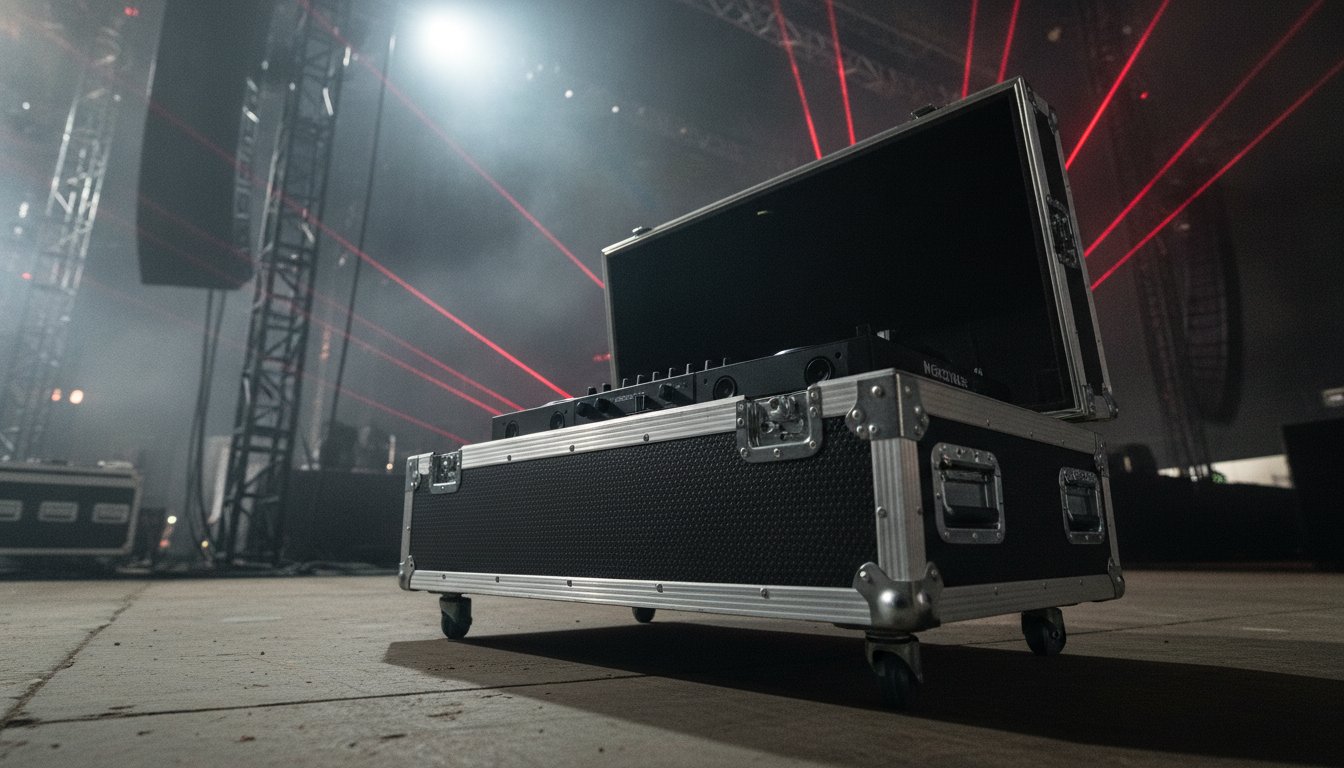
A professional-grade case is a precision-engineered logistical asset rather than a simple storage container. You recognize that equipment failure during transit is an unacceptable risk in high-stakes professional production. Vibration and impact during rigorous tour cycles demand structural integrity that exceeds basic consumer standards. Inefficient load-in times and non-standard dimensions often lead to logistical bottlenecks that compromise schedule adherence.
By mastering the technical specifications outlined in this guide, your next dj equipment case purchase will ensure zero equipment damage over multiple tour cycles and provide standardized solutions for fleet management. It's essential to align your hardware with the physical demands of the road to maintain operational consistency. We will examine the engineering requirements of ATA Specification 300 Category I standards, the utility of integrated workstations, and the material science behind high-density protective inserts. This technical overview provides the data necessary to select hardware that withstands the physical demands of 2026 touring environments while accelerating your operational workflow.
Key Takeaways
- Identify the technical requirements of ATA Specification 300 Category I to ensure structural integrity across 100 round-trip tour cycles.
- Evaluate material density and plywood thickness benchmarks to inform a dj equipment case purchase that balances protective mass with logistical portability.
- Analyze how integrated workstations and ergonomic features facilitate faster load-in times and streamlined performance setups on tour.
- Apply standardized dimensioning through the TruckPaX™ system to maximize density and stability within standard 90-inch and 96-inch truck pack configurations.
- Leverage custom engineering solutions from Santosom and ZCASE to meet precise hardware tolerances for specialized professional production environments.
Engineering Standards for Professional DJ Case Purchases
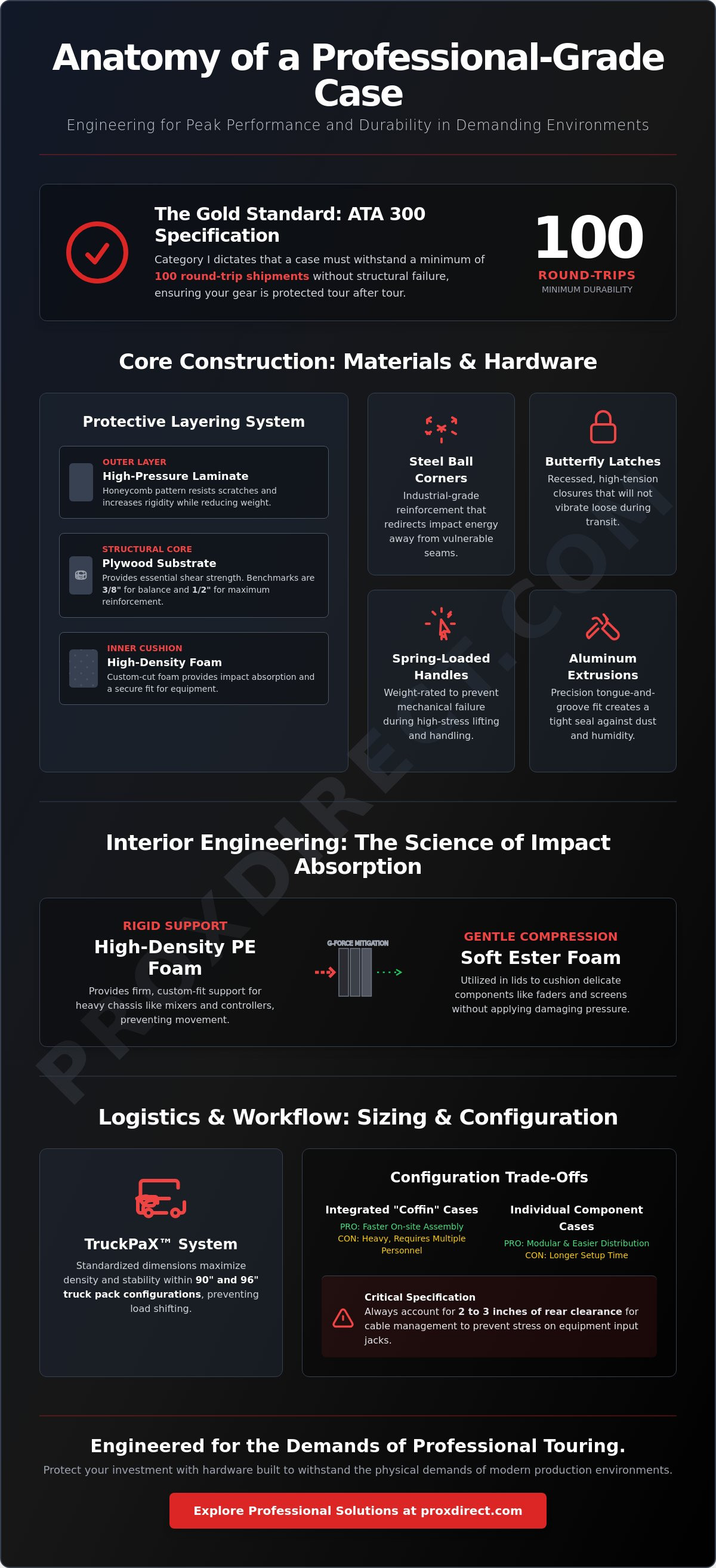
Professional production environments demand hardware that exceeds standard protective enclosures. A technical dj equipment case purchase requires an understanding of the ATA 300 Specification. This standard, specifically Category I, dictates that a case must withstand a minimum of 100 round-trip shipments without structural failure. Engineering for this level of durability begins with the substrate. Industry benchmarks utilize 3/8-inch or 1/2-inch plywood. These thicknesses provide the necessary shear strength to resist penetration and frame deformation during heavy stack loading in truck packs.
Surface protection involves high-pressure laminates, often featuring a honeycomb digital pattern. This design serves two functions. It increases scratch resistance and provides a structural texture that aids in weight reduction while maintaining surface rigidity. Inside the enclosure, foam engineering is critical. High-density polyethylene (PE) foam provides rigid support for heavy mixers and controllers. Conversely, soft ester foam is often utilized in lids to provide compression without applying excessive pressure to delicate faders or touchscreens.
Hardware Durability and Mechanical Integrity
Mechanical security depends on recessed butterfly latches. These components utilize a draw-bolt mechanism to create high-tension closures that won't vibrate loose during transit. Spring-loaded handles are another essential specification. They must be rated for the specific weight-bearing load of the gear to prevent mechanical failure during high-stress lifting. Industrial-grade steel ball corners reinforce the chassis. They redirect impact energy away from the plywood seams, preserving the structural integrity of the box during drops or shifting loads.
The Science of Impact Absorption
Protecting sensitive digital circuit boards requires calculating G-force mitigation. Professional ProX cases utilize multi-layered foam densities to decelerate equipment during sudden impact. Thermal management is also a factor. Cases designed for amplifiers or integrated players must account for heat dissipation through vented panels or specific internal clearances. Finally, environmental sealing protects internal components from dust and humidity. Precision-fit aluminum tongue-and-groove extrusions ensure a tight seal. This is vital for maintaining equipment longevity across diverse touring climates where moisture ingress can lead to catastrophic component failure.
Selecting Cases Based on DJ Hardware Configurations
A technical dj equipment case purchase depends entirely on the physical footprint and mechanical sensitivity of your hardware. While EVA molded shells offer a weight advantage for local mobile applications, they lack the load-bearing capacity required for professional touring environments. For high-density transport, a plywood enclosure with reinforced aluminum extrusions is the industry standard. Large-format controllers like the Pioneer DJ DDJ-FLX10 or the Rane Four require specific internal tolerances to prevent lateral movement during transit. This precision fit ensures that the impact-absorbing foam aligns perfectly with the chassis of the device, protecting delicate internal components from vibration damage.
Choosing between individual component cases and integrated "coffin" setups involves a logistical trade-off. Coffin-style cases house two media players and a mixer in a single chassis, which significantly reduces onsite assembly time. However, these units are heavy and require multiple personnel for safe handling. Individual cases for units like the Pioneer CDJ-3000 offer modularity, allowing for easier distribution within a truck pack. Regardless of the configuration, cable management space is a critical factor. You must account for at least 2 to 3 inches of rear clearance to accommodate high-gauge power cables and XLR connectors without putting stress on the equipment's input jacks.
Vinyl carrying cases represent a specialized category for audiophile-grade setups. These units must prioritize weight distribution to prevent the plywood from bowing under the significant mass of 50 to 70 records. Thermal protection is equally vital. Professional vinyl cases often utilize specific insulation layers to protect records from warping when stored in non-climate-controlled vehicles. For heritage or non-standard gear, custom engineering ensures that the internal foam blocking matches the unique dimensions of the hardware, preventing the equipment from shifting during turbulent transport.
Digital Controller and Media Player Protection
Modern digital hardware requires specialized internal engineering. Cases for the Pioneer DJ XDJ-RX3 or Rane One must include specific cutouts for ventilation and access to front-panel controls. When evaluating a ProX-Cases category selection, verify that the internal foam density is optimized for your specific model. This prevents the "floating" effect where equipment shifts within the case, a common cause of fader snap-off. If you're managing a diverse inventory, selecting cases with adjustable foam inserts allows for future-proofing your investment as hardware models evolve.
Utility and Accessory Management
A comprehensive touring rig includes more than just primary performance gear. Small-format hardware, including wireless microphone systems and signal processors, requires dedicated protection. Utilizing specialized microphone cases and utility storage units ensures that these critical components don't shift during transit. For production teams managing live-streaming or remote feeds, AV-Broadcasting-Cases provide the necessary rack space and monitor mounts to maintain a professional broadcast environment. Organizing these peripherals into standardized enclosures improves load-out efficiency and reduces the risk of lost inventory. For those requiring the highest level of customization, consider exploring ProX Cases for precision-engineered solutions tailored to your inventory.
Performance Efficiency and Integrated Workstations
Integrated workstations represent a paradigm shift in equipment housing. They move beyond basic containment to become active components of the performance environment. When finalizing a dj equipment case purchase, you must evaluate how the enclosure facilitates workflow. Modern workstations incorporate sliding laptop shelves that maintain ergonomic viewing angles throughout extended performances. These shelves utilize heavy-duty ball-bearing slides to support the mass of specialized hardware without mechanical deflection. This stability is essential for maintaining precision during high-intensity sets where equipment vibration can compromise software stability.
Cable management is another critical engineering factor. Integrated routing ports allow for permanent internal wiring of controllers, mixers, and power supplies. This pre-configured setup eliminates the complexity of on-site signal routing. By maintaining internal connections, production teams can reduce strike times significantly. Some industry professionals report that deployment-optimized designs can reduce setup and strike durations by nearly 50% compared to traditional loose-gear configurations. This efficiency is vital for high-frequency tour cycles where every minute of load-in impacts the production schedule and technical rehearsal window.
Flip Ready Technology and Rapid Deployment
Flip Ready Cases Made by ZCASE in Poland address the physical demands of large-format console management. These units utilize a patented mechanical lift system that allows a single technician to deploy heavy consoles from a vertical transport position to a horizontal performance position. This engineering eliminates the need for traditional manual removal and heavy lifting. By leveraging mechanical tension and balanced pivot points, Flip Ready technology significantly reduces the risk of physical strain or injury to technicians. It ensures that the transition from truck pack to performance state is both rapid and controlled, maintaining the mechanical integrity of the internal components.
Professional Stage Presence with Control Tower Stands
High-end event production requires an aesthetic that matches technical capability. Control Tower DJ Stands Made by ZCASE in Poland provide a sophisticated stage presence that conceals cables and power distribution units. These stands feature a modular design, allowing them to be disassembled and transported in standard protective cases. This modularity ensures compatibility with fleet management standards while providing a custom-look booth for mobile performers. The design incorporates branding opportunities and clean lines, reinforcing the professional identity of the production. For those seeking comprehensive solutions, the Control Tower series offers a benchmark in performance-integrated hardware that bridges the gap between transport logistics and on-stage presentation.
Logistics and Longevity: Truck Pack and Maintenance
Logistical efficiency is the foundation of profitable touring and equipment longevity. When executing a dj equipment case purchase, the exterior dimensions are as critical as the internal foam density. Standard North American and European trailers utilize 90-inch or 96-inch internal widths. Enclosures that don't adhere to these specific increments create "air" in the truck, leading to higher shipping costs and unsecured cargo. The TruckPaX™ system addresses this by utilizing standardized footprints that allow for four-wide or six-wide stacking. This optimization ensures maximum density and load stability across entire production fleets, preventing the shifting that leads to catastrophic gear failure during transit.
Stacking integrity is a primary safety requirement for high-volume transport. Professional cases must feature precision-aligned caster cups on the top surface to facilitate secure vertical stacking. These cups lock the wheels of the case above into place, preventing lateral movement during vehicle acceleration or braking. This mechanical interlocking system reduces the risk of stack collapse, which is a leading cause of equipment damage in the production industry. Beyond stability, proper alignment ensures that weight is distributed evenly across the plywood chassis of the lower units, preventing long-term structural fatigue and frame deformation.
Optimizing Truck Pack Density
Standardizing your inventory around specific exterior dimensions simplifies load planning for technicians and reduces logistical overhead. Utilizing footprints in increments of 22.5 inches and 45 inches allows for mathematical certainty when calculating truck space. This unified approach is particularly effective when integrating ProX-Truss cases into a larger production rig. By maintaining a consistent footprint across different gear categories, you ensure that every cubic inch of the trailer is utilized efficiently. This reduction in cargo movement translates directly to a lower risk of equipment damage over multiple tour cycles, as the gear remains locked in a stable block during transport.
Field Repairs and Component Replacement
Extending the lifecycle of touring gear requires a proactive maintenance protocol and access to industrial-grade components. Technicians should inspect recessed butterfly latches for mechanical tension and check all spring-loaded handles for weight-bearing stability at the end of every tour cycle. If casters show signs of flat-spotting or the internal foam shows significant compression fatigue, immediate replacement is necessary to maintain the original protective specifications. Sourcing professional replacement parts ensures that the enclosure continues to meet Category I requirements throughout its service life. Under 2026 standards, ATA-300 maintenance requires regular verification of seal integrity and hardware metallurgy to ensure continued protection against environmental and mechanical stress.
To optimize your fleet logistics and ensure maximum protection for your hardware, invest in standardized TruckPaX™ solutions designed for professional touring environments.
The ProX Advantage: Custom Engineering and Santosom Quality
A professional dj equipment case purchase through ProX leverages over four decades of industrial engineering expertise. Since 1984, we've focused on the functional excellence and mechanical integrity of performance gear. This longevity provides a deep understanding of the physical demands placed on equipment during high-stakes tour cycles. Our engineering philosophy prioritizes durability and precision over aesthetic trends, ensuring that every enclosure acts as a reliable backbone for your production. By choosing hardware with a verified engineering heritage, you mitigate the risk of equipment failure and ensure long-term operational consistency.
The Santosom partnership enhances our ability to provide bespoke solutions for complex technical needs. This prominent Portuguese manufacturer is recognized for high-end material science and precision assembly. By combining their European engineering heritage with our global distribution network, we offer a comprehensive range of solutions that go beyond standard protective boxes. This partnership allows us to address the unique logistical requirements of international production fleets. It ensures that specialized hardware receives the same level of protection as standard components, maintaining the structural integrity of your entire rig across diverse touring climates.
Bespoke Engineering Services
The workflow from conceptual requirements to a physical enclosure follows a rigorous, CAD-driven process. We utilize CNC technology for precise manufacturing, ensuring that internal foam blocking and external hardware meet exact tolerances. This precision is non-negotiable for new equipment releases where standard off-the-shelf solutions don't exist. Our ZCASE custom builds have supported global tours, providing the mechanical lift systems and rapid deployment features discussed in previous sections. Prototyping allows us to test structural capabilities and impact resistance before full-scale production, ensuring that sensitive digital circuit boards remain protected under extreme G-force loads.
Sourcing and Dealer Support
Production companies require a robust support infrastructure to manage large-scale fleet acquisitions. Our authorized dealer network provides immediate access to standard inventory and essential replacement parts. The dealer portal is a critical tool for professionals, offering real-time compatibility data and technical specifications to inform your dj equipment case purchase. This system ensures that your logistics remain standardized, even when sourcing gear across different regions. Our dealers act as authoritative guides, helping you navigate the technical requirements of ATA 300 standards and fleet density optimization. To secure the hardware necessary for your 2026 tour cycle, find your nearest dealer or browse the full ProX catalog for precision-engineered solutions.
Securing Technical Continuity for Future Tour Cycles
Professional touring in 2026 requires a shift from reactive equipment protection to proactive logistical engineering. A strategic dj equipment case purchase ensures that your hardware remains functional across 100 round-trip cycles by strictly adhering to ATA-300 Category 1 specifications. By standardizing your production fleet with TruckPaX™ dimensions, you eliminate cargo instability and reduce shipping overhead through optimized density. Integrated workstation solutions like Flip Ready technology further streamline onsite operations, allowing your technical team to focus on performance rather than mechanical assembly. These engineering choices provide the foundation for consistent, damage-free tour cycles and improved schedule adherence.
ProX has engineered performance gear since 1984. Our strategic partnerships with ZCASE and Santosom provide access to European precision and mechanical lift systems that redefine deployment efficiency for large-scale consoles. These ATA-300 Category 1 certified designs represent the industry benchmark for industrial reliability in the professional production sector. Maintaining the structural integrity of your rig is essential for long-term operational success. It's time to align your hardware with the physical demands of modern global touring.
Explore the ProX Professional Case Catalog and secure the backbone of your production fleet today.
Frequently Asked Questions
What is the difference between an ATA-300 case and a standard shipping box?
ATA-300 Category I cases are engineered to withstand a minimum of 100 round-trip shipments, while standard boxes lack certified impact resistance. These cases utilize reinforced aluminum extrusions and steel ball corners to maintain structural integrity under heavy stack pressure. This certification ensures that your dj equipment case purchase meets the rigorous demands of professional air and ground transport. It's a technical standard that prioritizes mechanical survival over simple containment.
How do I choose the correct plywood thickness for my DJ controller case?
Select 3/8-inch plywood for mid-sized controllers to balance protection with portability; utilize 1/2-inch plywood for large-format consoles requiring maximum shear strength. The 1/2-inch specification remains the industry benchmark for heavy stacking in high-density truck packs. Thicker plywood reduces the risk of chassis deformation when cases are subjected to the weight of multiple units in a production rig. It's the standard for long-term durability on the road.
Can I customize the interior foam of a pre-built ProX case?
You can customize the interior foam using high-density polyethylene inserts or soft ester foam blocks to accommodate specific hardware revisions. ProX provides multi-layered foam that technicians can modify to create a precision fit for non-standard gear. Maintaining a tight fit is critical to prevent lateral movement and protect internal circuit boards from vibration during transit. It's essential for ensuring that your gear doesn't shift during turbulent transport.
Why are standardized truck pack dimensions important for production companies?
Standardized truck pack dimensions, such as the 22.5-inch and 45-inch footprints in the TruckPaX™ system, maximize cargo density within 90-inch and 96-inch trailers. This standardization prevents equipment from shifting and eliminates dead space that increases shipping costs. For production companies, using uniform dimensions simplifies load planning and ensures fleet-wide compatibility. It's a logistical necessity for managing large-scale tours where space and stability are paramount.
How do Flip Ready cases improve setup times for large-scale events?
Flip Ready cases by ZCASE utilize a mechanical lift system that allows a single technician to deploy a console from transport to performance position in seconds. This engineering eliminates the need for manual lifting and heavy-duty assembly onsite. By automating the transition, these cases can reduce total strike times by nearly 50% compared to traditional setups. It's a deployment-optimized solution that reduces physical strain on your technical crew during load-in.
What maintenance is required to keep professional cases in touring condition?
Maintain professional cases by inspecting recessed butterfly latches for mechanical tension and ensuring caster wheels are free of debris. Lubricate moving parts periodically and replace internal foam if it shows signs of compression fatigue. ProX Cases Replacement Parts are available to ensure that every enclosure maintains its original safety specifications and structural integrity. Regular maintenance extends the lifecycle of your touring gear and prevents mechanical failure during transit.
Are ProX cases compatible with the latest Pioneer DJ and Rane hardware?
ProX cases are engineered with specific internal tolerances for the latest hardware from Pioneer DJ and Rane, including the DDJ-FLX10 and Rane Four. These cases account for front-panel control access and rear cable clearance. Verifying model-specific compatibility ensures that the impact-absorbing foam aligns perfectly with the hardware chassis. This precision fit prevents mechanical stress on faders and knobs, ensuring your dj equipment case purchase provides maximum protection for digital components.
What is the advantage of honeycomb laminate over traditional smooth plywood?
Honeycomb digital laminate offers superior scratch resistance and structural texture compared to traditional smooth plywood surfaces. This design aids in weight reduction while maintaining high surface rigidity. The textured surface also improves grip during handling and masks the minor abrasions that occur naturally during rigorous tour cycles. It's a functional choice that preserves the professional appearance of your fleet while providing an extra layer of impact resistance.
Disclaimer
Any trademarks, trade names or brand names appearing herein that do not belong to ProX are the property of their respective owners and/or companies, and such appearance doesn't and shall not constitute or imply endorsement, sponsorship or recommendation by ProX.


