
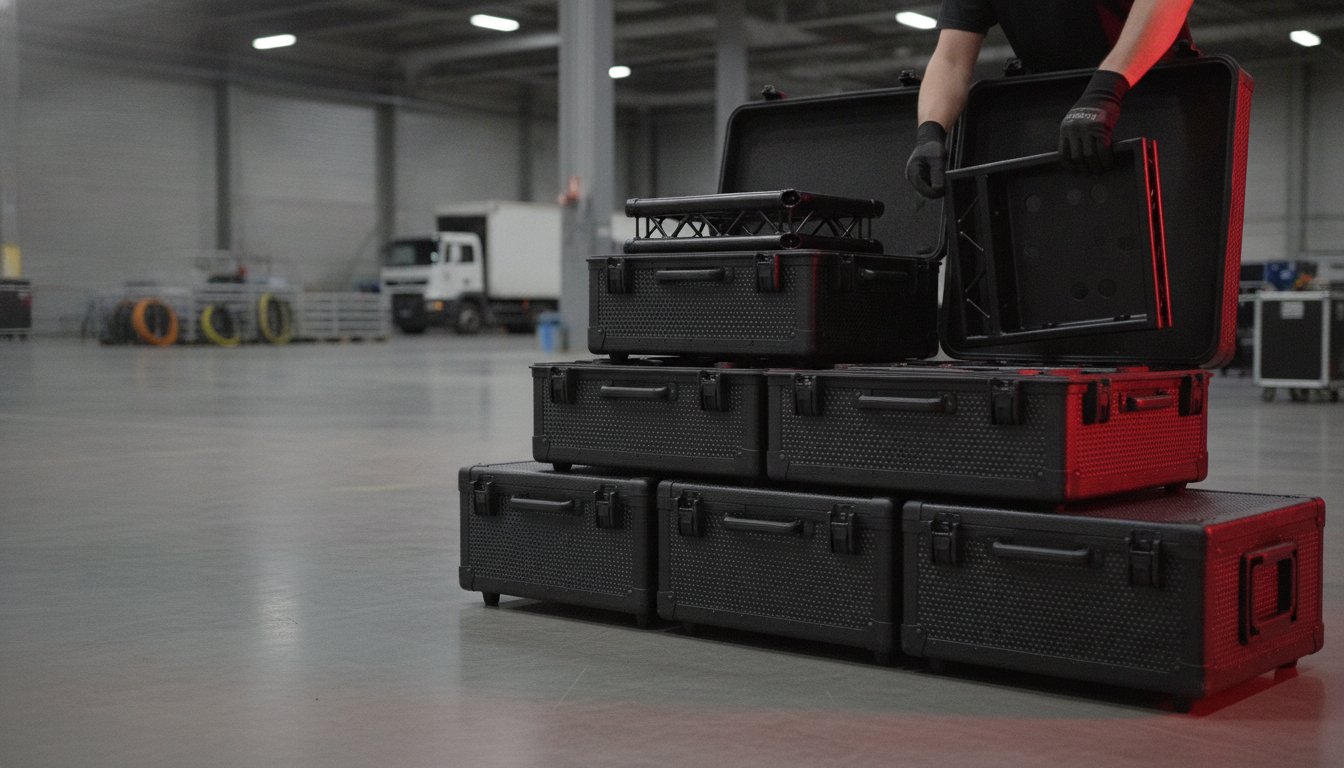
Your aluminum truss is the structural backbone of the production, yet it's often the most neglected asset during transit. You've likely dealt with the frustration of seeing a premium matte black finish ruined by a sliding steel plate or felt the physical strain of manhandling irregular shapes into a tight truck pack. These aren't just cosmetic concerns; they're logistical bottlenecks that increase labor costs and create unnecessary workplace hazards. Utilizing dedicated Stage Truss and Base Plate Cases is the only way to treat your staging infrastructure with the engineering respect it requires.
We understand that in a high-stakes production environment, equipment failure isn't an option. This guide explores how standardized transport solutions protect your inventory and optimize your logistics for heavy components. We'll examine the technical specifications of professional-grade cases, their impact on load-in efficiency, and how they help your crew maintain compliance with ANSI E1.2-2021 safety standards. You'll learn how to turn disorganized hardware into a streamlined, modular system that preserves your gear for the long term.
Key Takeaways
- Learn how specialized transport solutions mitigate the physical toll of handling heavy staging and prevent structural damage to aluminum truss components.
- Understand the structural requirements of Stage Truss and Base Plate Cases, including the necessity of ATA 300-style construction and high-grade plywood for heavy-duty loads.
- Identify the logistical advantages of matching specific case dimensions to common truss lengths and evaluating single-unit versus multi-plate storage systems.
- Master best practices for production crew safety, focusing on maintaining a low center of gravity and utilizing vehicle securing systems like E-track for transit stability.
- Discover how engineering innovations like honeycomb digital laminate provide professional-grade durability and long-term protection for your staging infrastructure.
The Logistics of Heavy Staging: Why Specialized Cases are Essential
Staging components are heavy, irregular, and often manufactured from specialized alloys that require precise handling. Stage Truss and Base Plate Cases serve as the critical interface between the warehouse and the venue. These specialized touring-grade transport solutions are engineered to withstand the rigors of frequent transit while maintaining the structural integrity of the gear inside. Without proper housing, loose steel base plates and aluminum truss segments act as destructive weights inside a trailer. This uncontrolled movement doesn't just damage the equipment; it compromises the vehicle's interior and increases insurance liability due to shifting loads during transit.
Modern event production relies on the concept of logistical modularity. This principle requires every piece of hardware to fit into a standardized footprint for efficient truck packs. Irregularly shaped truss segments and flat, high-density plates are notoriously difficult to secure as standalone items. Professional cases transform these logistical liabilities into stackable, uniform units. This optimization speeds up load-in times and ensures a tighter, safer load that won't shift when the driver encounters rough terrain or sudden stops.
Protecting the Finish and Structural Integrity
Metal-on-metal friction is the primary cause of aesthetic degradation during long-haul tours. When you examine the engineering principles of a truss, you realize that structural safety depends on the precision of every chord and webbing member. Constant vibration causes unprotected aluminum to grind against adjacent components, creating unsightly scratches and structural burrs. These burrs can make assembly difficult or even hazardous for the crew. Investing in Stage Truss and Base Plate Cases is a strategic financial decision. The cost of a professional case is significantly lower than the expense of frequent equipment replacement or the labor-intensive process of refinishing a matte black truss system after a single tour.
Safety Risks of Manual Handling
Moving raw steel base plates presents significant physical risks to production crews. These plates are thin, exceptionally heavy, and typically lack ergonomic grip points. Finger pinch injuries and lumbar strains are frequent occurrences when crews are forced to manhandle loose plates from the floor of a truck. Wheeled cases fundamentally change this dynamic by eliminating the need for high-risk manual lifting. By transitioning to a rolling system, you ensure better compliance with workplace safety standards. It's about engineering a workflow that prioritizes the physical health of the crew alongside the longevity of the technical infrastructure.
Engineering Standards for Truss and Base Plate Protection
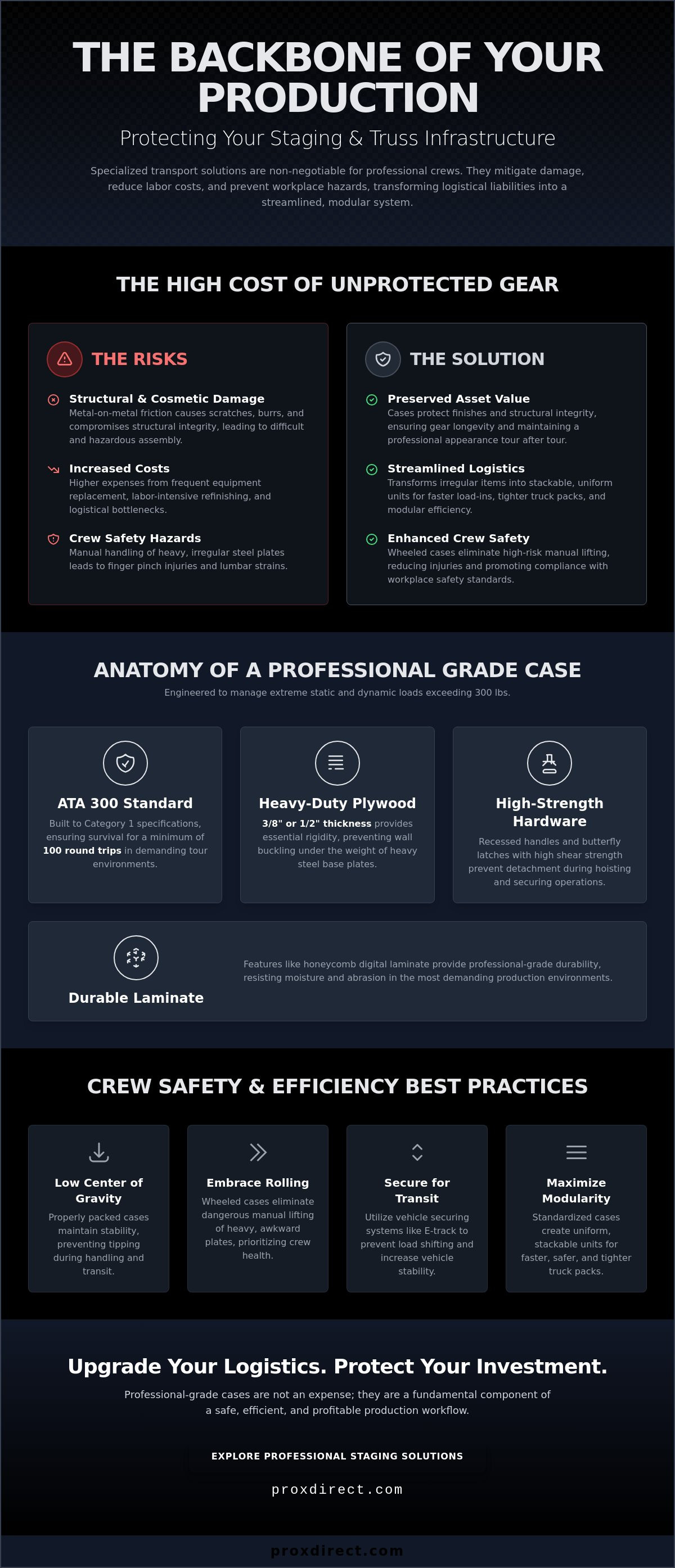
The structural integrity of a transport system is defined by its ability to manage extreme static and dynamic loads. While a single piece of aluminum truss is relatively light, a fully loaded case can easily exceed a 300lb payload. Professional Stage Truss and Base Plate Cases utilize ATA 300 Category 1 construction to ensure they survive a minimum of 100 round trips. This standard requires the use of 3/8" or 1/2" plywood. This thickness provides the necessary rigidity to prevent the walls from buckling under the weight of heavy steel base plates. The plywood is typically finished with a high-durability laminate to resist moisture and abrasion in demanding environments.
Reliable load management is a core component of the Stage Rigging and Mechanics course curriculum. This training emphasizes the physical forces at play during equipment handling. These same principles apply to case design. Reinforced internal dividers are essential for base plate stability. Without these dividers, the plates would shift laterally during transit. This movement concentrates all their kinetic energy on a single point of the case wall. This often leads to structural failure in inferior transport solutions that don't account for these specific physics.
Hardware Specifications for High-Weight Loads
Every hardware component must be rated for the specific stresses of staging logistics. Recessed handles and butterfly latches require high shear strength to prevent detachment when the case is hoisted or secured. We utilize industrial-grade 4-inch casters equipped with integrated braking systems to manage high-mass payloads safely. These casters are bolted through the plywood with reinforcing plates to distribute weight evenly. These plates prevent the bolts from pulling through the wood when the case encounters a threshold or ramp. Aluminum extrusions are used to reinforce all case edges, protecting the plywood from impact damage and maintaining the squareness of the frame over years of use.
Internal Lining and Custom Fitment
Internal protection strategies differ based on the component type. High-density foam inserts are ideal for aluminum truss to absorb vibration. Carpeted wood dividers are often preferred for heavy steel plates to resist tearing. Custom-fitted slots ensure that each plate remains upright and isolated, preventing the metal-on-metal friction discussed in previous sections. This prevents the plates from acting as a battering ram against the case lid during transport. Internal bracing is also integrated into the design to prevent case wall bowing under lateral pressure during tight truck packs. For those seeking these engineering benchmarks, exploring our comprehensive range of professional-grade cases provides a clear path to equipment longevity.
Selecting the Right Case for Your Truss Inventory
Selecting the appropriate Stage Truss and Base Plate Cases depends on the specific composition of your inventory. A production house managing a fleet of square F34 truss segments has different requirements than a specialty firm handling circular truss or custom arc segments. The primary goal is to minimize the internal volume of the case while providing enough clearance for rapid retrieval. When evaluating your needs, you must decide between single-unit cases, which offer maximum flexibility for small setups, and high-density multi-component storage designed for large-scale tours.
Case dimensions must align with common industry lengths such as 1m, 1.5m, and 2m. A case that is too long allows for longitudinal shifting during braking; conversely, one that is too short puts pressure on the welds of the end plates. For circular segments or irregular staging components, utility-style cases with adjustable bracing are often the most viable solution. You must also balance the total loaded weight of the case against the lifting capacity of your ramp systems. Overloading a case to maximize truck space can create a physical hazard that exceeds the safe operating limits of your crew and equipment.
Vertical vs. Horizontal Base Plate Storage
Footprint efficiency is a critical metric for truck packs. Vertical storage, often referred to as "toast rack" style, is the standard for 24x24 inch plates. This orientation allows for high-density storage and easy identification of individual plates during load-outs. Horizontal stacking is typically reserved for oversized 30x30 or 36x36 inch plates where the center of gravity must remain as low as possible to prevent tipping. Vertical cases provide superior access, as you can pull a single plate without disturbing the rest of the inventory.
Universal vs. Brand-Specific Fits
Achieving a precise fit requires accurate measurement of your truss segments, including the outer diameter of the chords and the total width across the webbing. You can reference the specific dimensions found in our ProX Truss Categories to ensure compatibility. Universal cases are engineered with adjustable foam blocks to accommodate slight variations between manufacturers. However, excessive "slop" or movement within the case must be avoided. If a truss segment moves more than a few millimeters within its housing, the cumulative force of repeated impacts can lead to structural fatigue over time.
Handling and Safety: Best Practices for Production Crews
Safety in live production begins with understanding the physics of high-mass payloads. Stage Truss and Base Plate Cases are designed to consolidate heavy components, but their effectiveness depends on proper handling by the crew. When loading these units, always maintain a low center of gravity. Place the heaviest base plates at the bottom of the case to prevent top-heaviness, which can lead to dangerous tip-overs on loading ramps or uneven venue floors. This center-of-gravity management is a fundamental safety protocol for any professional production environment.
Securing the load within the transport vehicle is equally critical. Even the most robust cases can become projectiles during sudden braking if they aren't properly anchored. Use E-track systems or high-tension ratchet straps to lock cases into position. This prevents lateral and longitudinal shifting, which protects both the equipment and the vehicle's structural integrity. Regular maintenance of the case hardware is another pillar of safety. Inspect casters and hinges after every tour to remove debris and ensure smooth operation. A seized caster on a 400lb case is a significant workplace injury risk during a rapid load-out.
Large-scale fleets benefit from digital inventory management. Using RFID tags or high-visibility labels on each case allows for rapid tracking and ensures that the correct truss lengths reach the correct venue. This level of organization prevents the logistical "missing link" scenarios that delay builds. For those looking to upgrade their transport fleet, our Stage Truss and Base Plate Cases provide the industrial durability required for rigorous touring schedules.
Optimizing Truck Pack Density
Efficiency in logistics is often measured by how well you utilize every cubic inch of a trailer. Standardized case footprints allow for a "Tetris-style" truck loading strategy where units fit together with minimal wasted space. Many of our professional cases feature integrated caster cups on the lid, which facilitate secure stacking. This allows crews to maximize vertical truck space without the risk of cases sliding off one another during transit. Uniform case sizing reduces transit shifting by creating a solid, interlocking block of gear that moves as a single mass.
On-Site Efficiency and Setup Speed
Time is the most expensive variable on a show site. Organized cases significantly reduce the time spent hunting for specific base plates or short truss segments. By color-coding or clearly labeling cases by content, you streamline the workflow for the local crew. Some multi-functional cases are engineered with flat, reinforced lids that serve as temporary work surfaces during the build. For the most efficient load-in sequence, staging cases should be positioned for easy access immediately after the audio and lighting racks are offloaded. This ensures the structural foundation is ready before the technical elements need to be flown.
Ready to optimize your logistics? Explore our full catalog of specialized transport solutions to enhance your production workflow.
ProX Solutions for Professional Staging Infrastructure
The ProX engineering philosophy centers on the physical realities of the touring industry. We recognize that staging hardware is subjected to extreme mechanical stress during every transit cycle. Our Stage Truss and Base Plate Cases are built to exceed standard expectations for structural durability. This commitment to functional excellence is visible in our use of signature honeycomb digital laminate. This hexagonal surface pattern isn't just an aesthetic choice; it provides a ruggedized exterior that resists deep scuffs while offering a superior grip surface for crew members during manual handling. This design ensures that even after years of use, the cases maintain their professional appearance and structural integrity.
The extensive range of ProX Cases for trussing provides solutions for every standard configuration, from F31 single tubes to heavy-duty F34 square truss. We maintain a global dealer network that ensures touring professionals have access to compatible hardware and support regardless of their geographic location. This availability is critical for production companies that need to scale their infrastructure quickly to meet the demands of a growing market. With the global stage truss market projected to reach $1,563.95 million by 2033, having a reliable backbone of transport infrastructure is a competitive necessity.
The ProX Advantage: Custom Engineering Services
Standardization is the foundation of efficiency, but unique production designs often require bespoke transport solutions. ProX offers custom engineering services to address irregular staging and AV requirements. We collaborate with equipment manufacturers to ensure precision fitment for proprietary hardware. This engineering precision eliminates internal movement and protects sensitive components from vibration-induced fatigue. If your production involves specialized signal distribution or monitoring hardware, we recommend consulting our AV Broadcasting Cases category for technical transport solutions that integrate seamlessly with your staging fleet.
Built for the Long Haul
Longevity is a core metric of professional-grade equipment. We utilize high-grade materials like 6061-T6 aluminum extrusions and reinforced steel ball corners to ensure our cases withstand years of rigorous use. To further extend the operational life of your investment, we maintain a comprehensive inventory of ProX Cases Replacement Parts. This allows technicians to replace worn casters or damaged latches in the field; it maintains the integrity of the transport system without requiring a full unit replacement. Professional staging is a high-stakes environment where equipment failure isn't an option. Our cases provide the reliability you need to focus on the performance, not the logistics.
Explore the full Stage Truss and Base Plate Case catalog to secure your staging infrastructure for your next tour.
Secure Your Production Infrastructure for Future Tours
Professionalizing your transport strategy is a direct investment in the operational lifespan of your staging assets. By transitioning from loose hardware to standardized Stage Truss and Base Plate Cases, you eliminate the mechanical wear caused by metal-on-metal friction and reduce the physical risks associated with manual handling. These solutions provide the structural integrity required to maintain equipment safety standards while maximizing every cubic inch of your truck pack. Efficient logistics are the foundation of every successful show, and the right protection ensures your inventory is ready for deployment at a moment's notice.
ProX has been engineering performance gear since 1984, providing the industrial reliability that global touring professionals trust for high-stakes environments. Our cases feature the signature Honeycomb Digital™ protective finish, ensuring your gear remains protected against the high-impact realities of modern production. Maintaining a modular and well-protected inventory allows your crew to focus on the technical precision of the build rather than the limitations of the load-in. We invite you to integrate these engineering standards into your next tour to ensure long-term equipment viability.
Find a Dealer for ProX Stage Truss and Base Plate Cases and upgrade your production fleet today.
Frequently Asked Questions
How much weight can a standard truss base plate case hold?
A professional-grade transport unit is typically engineered to manage payloads exceeding 300 lbs. This high weight capacity is achieved through the use of 3/8" or 1/2" plywood and industrial-grade 4-inch casters. These Stage Truss and Base Plate Cases are built to ATA 300 Category 1 standards, ensuring they remain structurally sound even when fully loaded with high-density steel plates.
Are these cases compatible with both aluminum and steel base plates?
Yes, these cases are engineered to accommodate both aluminum and steel components. While steel plates are thinner and significantly heavier, aluminum plates require more physical space due to their thicker profile. Internal dividers are often adjustable or utilize multi-slot configurations to ensure a precision fit for either material, preventing lateral movement that could damage the case walls during transit.
Do I need different cases for 12-inch and 20-inch box truss segments?
Distinct cases are required for different truss profiles to ensure equipment stability. A 12-inch (F34) segment will shift dangerously if placed inside a case designed for 20-inch truss, which can lead to structural fatigue or finish degradation. Matching the internal dimensions of the case to the specific chord and webbing measurements of your truss is essential for professional-grade protection.
How do casters impact the safety of moving heavy staging equipment?
Industrial-grade casters are critical for reducing the risk of workplace injuries during load-ins. High-quality 4-inch casters distribute the weight of heavy staging gear across a wider surface area, making it safer to navigate ramps and venue thresholds. Integrated braking systems provide necessary control, preventing high-mass payloads from becoming runaway hazards in high-stakes production environments.
Can these cases be stacked in a standard production truck?
Professional cases are designed specifically for vertical stacking to maximize truck pack density. Most units feature integrated caster cups on the lid, which allow the wheels of the top case to lock securely into the unit below. This interlocking design creates a stable block of gear that resists shifting during transit, making it an ideal solution for standard trailer dimensions.
What is the benefit of a "toast rack" style case for base plates?
The "toast rack" design provides superior footprint efficiency and rapid access to individual components. By storing plates vertically, you can identify and retrieve a specific plate without the need to unstack multiple heavy items. This Stage Truss and Base Plate Case configuration also helps maintain a lower center of gravity, which improves the overall stability of the case during manual handling.
How do I maintain the hardware on my staging cases for long-term use?
Regular inspection and cleaning of moving parts are required to prevent field failures. You should clear debris from caster bearings and check butterfly latches for proper alignment after every tour. Using ProX replacement parts for worn components allows you to extend the operational life of the case without a full unit replacement. Proper maintenance ensures the hardware remains reliable for years of rigorous use.
Are custom dimensions available for non-standard truss segments?
Custom engineering services are available to address the needs of bespoke staging and AV infrastructure. This includes specialized housing for circular truss segments, custom arc pieces, or proprietary hardware that doesn't fit standard dimensions. Custom-fitted foam inserts and internal bracing can be integrated to ensure that even the most irregular staging components are protected during long-haul transport.
Disclaimer
Any trademarks, trade names or brand names appearing herein that do not belong to ProX are the property of their respective owners and/or companies, and such appearance doesn't and shall not constitute or imply endorsement, sponsorship or recommendation by ProX.


