

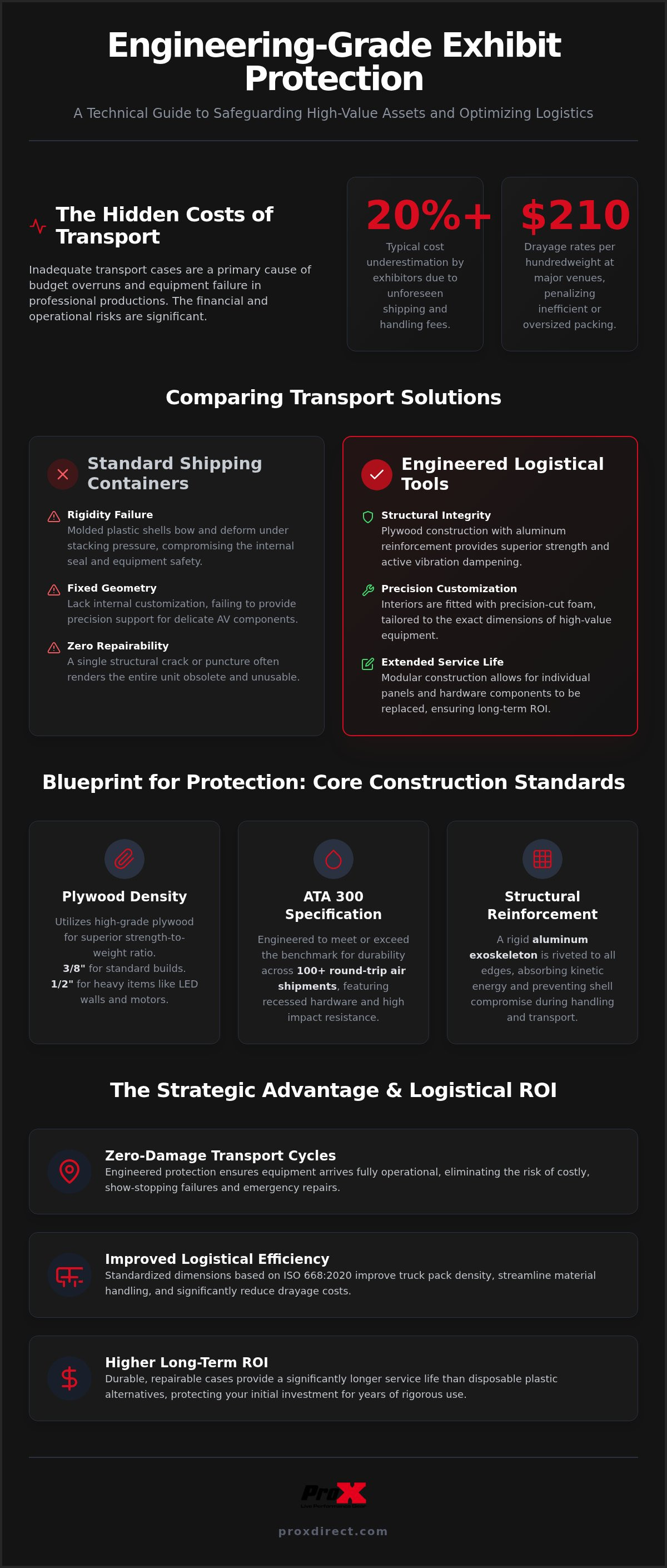
Did you know that most exhibitors underestimate their total event costs by 20% or more, with shipping and drayage being the primary contributors to this discrepancy? It's a calculated risk every time you hand over high-value exhibit technology to a common carrier. You've likely experienced the frustration of equipment damage or the logistical friction caused by inconsistent case dimensions that disrupt truck pack efficiency. A standard trade show display transport case is often the weakest link in a professional production's supply chain, especially when dealing with drayage rates that can reach $210 per hundredweight at major 2026 venues.
We understand that equipment failure is not an option in high-stakes environments. This guide details how to implement engineering-grade transport solutions that safeguard your assets during rigorous global logistics. You'll learn how to achieve zero-damage transport cycles and standardized logistics for faster load-ins. We'll provide a technical overview of ATA 300 Specification requirements, ISO 668:2020 dimensional standards, and the long-term ROI of durable housing like Santosom and TruckPaX™ systems. By the end of this guide, you'll have the data necessary to optimize your exhibit's physical security and logistical footprint.
Key Takeaways
- Identify the technical distinctions between standard shipping containers and specialized logistical tools designed for high-value exhibit technology.
- Understand the structural requirements for professional protection, including the necessity of 3/8" or 1/2" plywood density for long-term shell integrity.
- Utilize a professional framework to select the optimal trade show display transport case based on the specific fragility of AV, lighting, and truss components.
- Maximize logistical ROI by implementing standardized dimensions that improve truck pack efficiency and reduce material handling costs.
- Leverage engineering-grade solutions like the Santosom line to ensure zero-damage transport cycles during rigorous global logistics.
Beyond Molded Plastic: The Evolution of Trade Show Display Transport Cases
A trade show display transport case functions as a precision logistical tool, not merely a storage box. While standard shipping containers prioritize volume and weight reduction, an engineered flight case prioritizes the mechanical integrity of its contents. The evolution of transport cases shows a shift from simple wooden crates to sophisticated housing units capable of neutralizing external kinetic energy. For exhibitors transporting high-value LED panels, delicate sensors, or complex AV systems, the case must provide active vibration dampening. Without these features, the micro-vibrations inherent in long-haul trucking can lead to solder joint failure and component misalignment. Professional production environments demand equipment integrity across dozens of tour cycles, making the choice of housing a critical financial decision.
The Limitations of Lightweight Plastic Solutions
Molded plastic shells often fail in high-density logistics environments. Under the weight of heavy stacking in a semi-trailer, these shells exhibit structural fatigue, leading to permanent deformation. This lack of rigidity compromises the internal seal and puts direct pressure on the equipment. Beyond shell integrity, these solutions present several functional deficits:
- Rigidity Failure: Plastic lacks the tensile strength to resist bowing when stacked under heavier crates.
- Fixed Geometry: Molded designs offer limited internal customization, whereas high-value AV components require precision-cut foam inserts tailored to specific chassis dimensions.
- Zero Repairability: Unlike professional plywood builds, a single structural crack in plastic usually renders the entire unit obsolete.
Aluminum-reinforced plywood cases allow for the replacement of individual panels or hardware components, extending the asset's service life significantly. This durability ensures that the housing remains functional through years of rigorous handling.
Defining Industrial-Grade Protection Standards
Reliable logistics rely on standardized engineering. ATA 300 Category 1 represents the highest tier of these standards, focusing on durability and impact resistance. The ATA 300 standard is the benchmark for 100+ round-trip air shipments. To meet these requirements, cases utilize recessed hardware, including spring-loaded handles and butterfly latches. This design ensures that protruding elements don't snag on other freight or conveyor systems during sorting. For specialized AV broadcasting gear, these standards ensure the shell can withstand significant drop forces without transferring the shock to internal processors. Investing in these specifications ensures that your trade show display transport case remains an asset rather than a liability, keeping gear operational show after show.
Engineering Standards for High-Value Exhibit Protection
Professional grade housing relies on material density and structural reinforcement. For a trade show display transport case, shell integrity begins with furniture-grade plywood. 3/8" plywood serves as the industry standard for most exhibit components, while 1/2" panels are required for heavy items like large-scale LED walls or motor hoists. Many modern builds utilize honeycomb laminates. These hexagonal cell structures provide high impact resistance while reducing the overall weight of the crate, which is vital for managing drayage costs at major venues.
Material Science in Case Construction
Plywood offers a superior strength-to-weight ratio compared to molded plastic because it doesn't suffer from the same thermal expansion or structural creep. Structural performance is often validated through testing protocols such as ASTM D4169, which simulates the stresses of the distribution cycle. To further reinforce the shell, aluminum extrusions are riveted to every edge and corner. This creates a rigid exoskeleton that absorbs kinetic energy before it reaches the payload. For a deeper look at these technical specifications, consult The Ultimate Guide to Flight Cases.
Internal protection is equally technical. We utilize specific foam densities to counteract different forces. Polyethylene (PE) foam is used for its load-bearing capabilities and shock absorption. In contrast, Ethylene-vinyl acetate (EVA) foam provides a high-density, non-abrasive surface for finish protection. This dual-layer approach ensures that components don't shift during transit, maintaining the alignment of sensitive optical or electronic parts.
Hardware Precision: Latches, Handles, and Casters
Hardware selection dictates the logistical efficiency of the crate. Spring-loaded handles are mandatory because they retract into a recessed dish, allowing for flush stacking in a truck pack without creating gaps. Butterfly latches provide a mechanical advantage by pulling the lid and base together under tension, preventing the seal from breaking during high-vibration transport. These components are typically zinc-plated or made of stainless steel to resist corrosion during sea freight or humid storage conditions.
Caster selection is another critical variable. While 4" wheels are standard, 5" casters are preferred for crates exceeding 250 lbs to improve maneuverability over door thresholds and dock plates. You can explore our full range of industrial-grade equipment housing to see these standards in practice. High-quality casters feature integrated brakes and reinforced mounting plates to prevent shear failure during lateral impacts. This level of hardware precision ensures that your trade show display transport case remains functional through years of rigorous handling.
Analyzing Case Construction: Materials, Hardware, and Durability
Case construction determines the long-term viability of an exhibit asset. While soft-sided bags and molded plastic containers are common in the industry, they often fail under the mechanical stresses of common carrier freight. Soft bags offer zero protection against crushing forces, typically lasting only one or two event cycles before the fabric tears or the zippers fail. Molded plastic cases provide better impact resistance but remain prone to stress cracking and cannot be easily repaired once the shell is compromised. In contrast, a plywood-based trade show display transport case provides a rigid, multi-layered defense that can withstand a decade of professional use.
Evaluating the lifespan of these materials reveals a significant difference in ROI. Plywood cases, reinforced with high-pressure laminates, resist environmental factors such as moisture and temperature fluctuations that cause plastic to become brittle. These exteriors are designed for the high-friction environment of loading docks and cargo holds. Maintenance is a primary advantage of this construction method; because the components are riveted rather than molded, hardware like casters, latches, and handles can be replaced individually. This modularity ensures that a single damaged component doesn't require the decommissioning of the entire transport unit.
Logistical Efficiency and Truck Pack Standardization
Logistical planning is often overlooked during the case selection process. The TruckPaX™ system addresses this by optimizing trailer floor space through precise dimensional engineering. When cases are designed with standardized footprints, they eliminate the "dead air" that leads to shifting loads and transit damage. Standardized case footprints allow for 90-degree rotation to fit 90" or 96" truck widths. This mathematical approach to packing ensures that every cubic inch of the trailer is utilized, directly reducing shipping costs and improving the stability of the entire shipment during long-haul transit.
Custom vs. Standard Utility Solutions
Not every exhibit component requires a bespoke housing solution. We offer a wide range of Utility/Storage Cases for miscellaneous hardware, cables, and base plates that don't demand specific internal cradling. However, for delicate branding elements or high-resolution monitors, custom-cut foam inserts are essential. These inserts are engineered to the exact CAD specifications of the equipment, providing 360-degree decoupling from the outer shell. For more information on managing complex inventories, refer to our guide on TruckPaX™ Truck Pack Cases. Balancing standard utility crates with custom-engineered housing creates a streamlined logistical workflow that protects your most sensitive assets while maintaining cost efficiency.
Strategic Selection: Matching Cases to Exhibit Components
Selecting a professional trade show display transport case requires a calculated assessment of equipment fragility and replacement lead times. A universal approach often results in either excessive weight for structural items or insufficient protection for sensitive electronics. We categorize exhibit assets into four primary tiers: structural elements, high-resolution displays, AV processing gear, and branding graphics. Lighting fixtures, specifically those with moving heads or delicate filaments, also fall into a high-risk category that demands specialized internal decoupling to prevent mechanical failure during transit.
Protecting LED Video Walls and Monitors
Large-format screens are susceptible to pixel damage from even minor chassis torsion. Our Flat Panel LED TV Cases utilize internal shock-absorbing mounts that decouple the display from the outer plywood shell. Precision foam engineering ensures that no pressure points exist on the screen surface itself, which prevents "dead pixel" clusters caused by transit vibration. These units are designed to house integrated cable arrays and power supplies, allowing for streamlined deployment once the crate is opened at the venue.
Housing AV Broadcasting and Workstation Gear
Onsite production centers require more than just a shell; they need functional housing that supports operation. AV Broadcasting Cases serve as mobile control centers for live trade show presentations. These workstations must account for thermal management, as equipment often undergoes testing or pre-show configuration while still inside the housing. Strategic ventilation and cable pass-throughs allow for full technical functionality without compromising the structural integrity of the trade show display transport case during the transition from the loading dock to the show floor.
Truss and Base Plate Transport
Structural components present a different logistical challenge: concentrated weight. Heavy base plates can exert enough force to cause floor failure in standard crates during a hard impact. Our Stage Truss and Base Plate Cases feature reinforced bottom panels and specialized internal dividers. These dividers prevent metal-on-metal abrasion, which preserves the aesthetic finish of the truss. Proper weight distribution within these crates is essential for maintaining a stable center of gravity during forklift maneuvers. To optimize your structural logistics, explore our professional-grade equipment housing to ensure your heavy exhibit hardware arrives in showroom condition.
ProX Engineering: Custom and Standard Logistics Solutions
ProX has engineered performance gear since 1984, establishing a rigorous standard for industrial-grade exhibit protection. For high-stakes production environments where equipment failure is not an option, the Santosom line provides a high-end solution tailored for the physical demands of frequent global touring. These cases utilize specific material thicknesses and hardware configurations verified for the 2026 catalog to ensure maximum structural integrity. Every trade show display transport case in this line is built to ATA 300 standards. This provides a reliable backbone for professional production teams who require functional excellence over emotional appeal.
Bespoke Protection via ZCASE Engineering
When standard dimensions cannot accommodate unique exhibit geometries, our ZCASE engineering division provides a custom design-and-build workflow. This process utilizes 3D modeling to ensure a precision fit for high-value production gear, eliminating the internal movement that leads to component fatigue. You can learn more about this specialized process in our guide to ZCASE Custom Build Cases. This bespoke approach allows for the integration of specialized mounting brackets or multi-layer foam configurations. These solutions are engineered for specific mechanical assemblies that standard cases simply cannot support.
Maintaining Your Transport Fleet
Long-term ROI depends on a proactive maintenance schedule for your logistics fleet. Routine inspection of casters, butterfly latches, and rubber gaskets prevents minor wear from becoming a catastrophic failure during transit. We simplify this process by offering a comprehensive inventory of ProX Cases Replacement Parts. Replacing a worn caster or a compromised seal extends the service life of your trade show display transport case by years. This modularity ensures that the shell remains an active asset through dozens of show cycles.
Maintaining the internal environment is just as critical as the external hardware. Dust and debris trapped in foam inserts can act as an abrasive against equipment finishes. Regular cleaning of the high-density foam ensures that sensitive surfaces remain in showroom condition. This methodical approach to maintenance reflects a commitment to detail and a respect for the professional’s time. It reinforces our position as an authoritative guide for those who value durability and the practical realities of professional use.
Securing Your Exhibit Assets for Long-Term Logistical Success
Achieving zero-damage transport cycles requires a shift from generic storage to engineered housing. By prioritizing industrial-grade materials like 1/2" plywood and recessed hardware, you eliminate the structural fatigue common in molded plastic shells. Standardizing your trade show display transport case dimensions ensures maximum truck pack efficiency and reduces material handling costs at major venues. ProX has been engineering performance gear since 1984, providing the structural backbone for high-stakes production environments. Our solutions are trusted by industry leaders like Pioneer DJ and Roland to safeguard high-value technology through rigorous global logistics. With a global dealer network for easy fulfillment, you can maintain a standardized fleet that supports faster load-ins and professional-grade reliability. This methodical approach to equipment housing ensures that your technical assets remain functional across dozens of show cycles. Protect your investment and ensure your exhibit arrives in showroom condition every time.
The growth of specialized technical markets has led to new innovations in direct-to-consumer gear. For instance, you can learn more about E-commerce sales of technical padel apparel to see how Pulco Studios brings professional-grade engineering directly to athletes.
Browse the full catalog of ProX professional cases to find the ideal housing for your next event.
Frequently Asked Questions
What is the difference between a shipping case and a professional flight case?
A standard shipping case is typically a single-use or limited-use container, while a professional flight case is an engineered logistical tool designed for hundreds of tour cycles. Flight cases utilize a plywood exoskeleton reinforced with aluminum extrusions and recessed hardware to neutralize the kinetic energy of freight transit. Standard shipping containers often rely on molded plastic shells that suffer from structural creep and lack the modular repairability found in industrial-grade builds.
How does the ATA 300 standard apply to trade show display transport cases?
The ATA 300 standard establishes the benchmark for reusable shipping containers, specifically Category 1, which requires a case to withstand at least 100 round-trip shipments. When selecting a trade show display transport case, this standard ensures the unit has undergone rigorous impact and vibration testing. It guarantees that the hardware, such as butterfly latches and spring-loaded handles, will remain functional under the mechanical stresses of common carrier logistics and repeated loading cycles.
Can I customize the internal foam for my specific exhibit technology?
Yes, bespoke internal foam is essential for protecting high-value components like LED panels or AV processors. We utilize 3D modeling and CAD-driven precision cutting to create foam inserts that match the exact chassis dimensions of your gear. This ensures 360-degree decoupling from the outer shell, preventing internal movement during transit. Utilizing different foam densities, such as PE for shock absorption and EVA for surface protection, provides a tailored defense for sensitive exhibit technology.
Why are recessed handles and latches preferred for freight shipping?
Recessed hardware is a requirement for industrial logistics because it eliminates protruding elements that could snag on other freight or conveyor systems. By housing handles and butterfly latches within deep-dish metal plates, the case maintains a flush exterior profile. This design allows for tighter truck packs and prevents the shear forces of lateral impacts from damaging the hardware. It's a critical safety feature that ensures the case remains sealed and maneuverable throughout the distribution cycle.
How do standardized case dimensions save money on logistics?
Standardized dimensions allow for maximum truck pack efficiency by eliminating "dead air" in the trailer. When a trade show display transport case is designed with a footprint that fits 90" or 96" truck widths, it stabilizes the entire load and reduces the need for secondary bracing. This efficiency can significantly lower material handling and drayage costs, which industry data from 2026 indicates can account for 8% to 18% of a total trade show budget.
What weight capacity should I look for in a heavy-duty display case?
Weight capacity should be determined by the specific payload and the rating of the installed casters. For heavy exhibit components like base plates or large truss segments, you should look for cases with 1/2" plywood floors and 5" industrial casters. A standard heavy-duty crate should comfortably support 250 lbs or more without floor bowing. It's vital to verify that the caster mounting plates are reinforced to prevent shear failure during high-impact loading maneuvers.
Is it possible to repair a professional flight case if it gets damaged in transit?
Professional flight cases are designed with modularity in mind, allowing for the replacement of individual components. Because the aluminum extrusions and hardware are riveted rather than molded, you can replace damaged casters, latches, or even entire plywood panels. This repairability is a primary advantage over molded plastic solutions, which must be decommissioned if the shell cracks. Maintaining a stock of replacement parts significantly extends the ROI of your transport fleet.
Do I need a separate case for my trade show truss and base plates?
Yes, structural components require specialized housing due to their concentrated weight and the risk of metal-on-metal abrasion. Heavy base plates exert significant force on the crate floor and should be housed in cases with reinforced bottom panels and internal dividers. These dividers prevent the truss segments from shifting and scratching each other during long-haul transit. Specialized housing ensures that structural elements remain aesthetically pristine and logistically manageable for the setup crew.
Disclaimer
Any trademarks, trade names or brand names appearing herein that do not belong to ProX are the property of their respective owners and/or companies, and such appearance doesn't and shall not constitute or imply endorsement, sponsorship or recommendation by ProX.


