

What if your transport solution is actually compromising your hardware through thermal trapping and structural stress? Roland DJ controllers function as high-performance hybrid instruments that generate significant internal heat during extended sets. You already know that a generic, one-size-fits-all container cannot account for the specific ventilation requirements or the delicate fader alignments of these professional units. This guide explores why a custom case for Roland DJ controller hardware is a technical necessity for maintaining equipment integrity during rigorous transit and performance cycles.
We'll examine how precision engineering ensures zero-damage transport while providing the thermal management your controller needs to avoid mid-set overheating. You'll discover the benefits of ATA-300 construction standards and how integrated workstation features can drastically reduce your setup times at the venue. This 2026 guide provides a detailed look at ZCASE Flip Ready technology and Santosom engineering, offering a roadmap for DJs who prioritize functional excellence and long-term gear reliability. We'll break down the material specifications and logistical advantages that turn a simple transport box into a professional-grade production asset.
Key Takeaways
- Understand why specialized internal foam layouts and rear-port accessibility are critical for maintaining the structural and thermal integrity of Roland DJ-808 and 707M models.
- Identify the technical benefits of ATA-300 style construction using 3/8-inch plywood and Honeycomb Digital™ laminated surfaces for superior impact and scratch resistance.
- Learn how a precision-engineered custom case for Roland DJ controller units eliminates internal shifting during transit, preventing mechanical stress on sensitive faders and knobs.
- Evaluate how integrated workstation features like laptop shelves and low-profile wheels optimize solo DJ mobility and reduce setup friction at professional venues.
- Explore the advantages of bespoke engineering through ZCASE Flip Ready technology and Santosom cases for high-stakes touring where equipment failure is not an option.
The Engineering Requirements for Roland DJ Controller Protection
Roland DJ controllers represent a distinct category of performance hardware. Unlike standard mixing consoles, these units integrate active drum machines, sequencers, and AIRA-derived processing that demand specific environmental controls. A custom case for Roland DJ controller units must function as more than a static transport vessel. It acts as a structural exoskeleton that accounts for high-density components and complex rear-facing input/output (I/O) arrays found on flagship models like the DJ-808 and 707M. Engineering a protective solution requires a deep understanding of these physical variables to ensure the equipment remains operational under the stress of professional touring.
Anatomy of a Roland-Specific Custom Interior
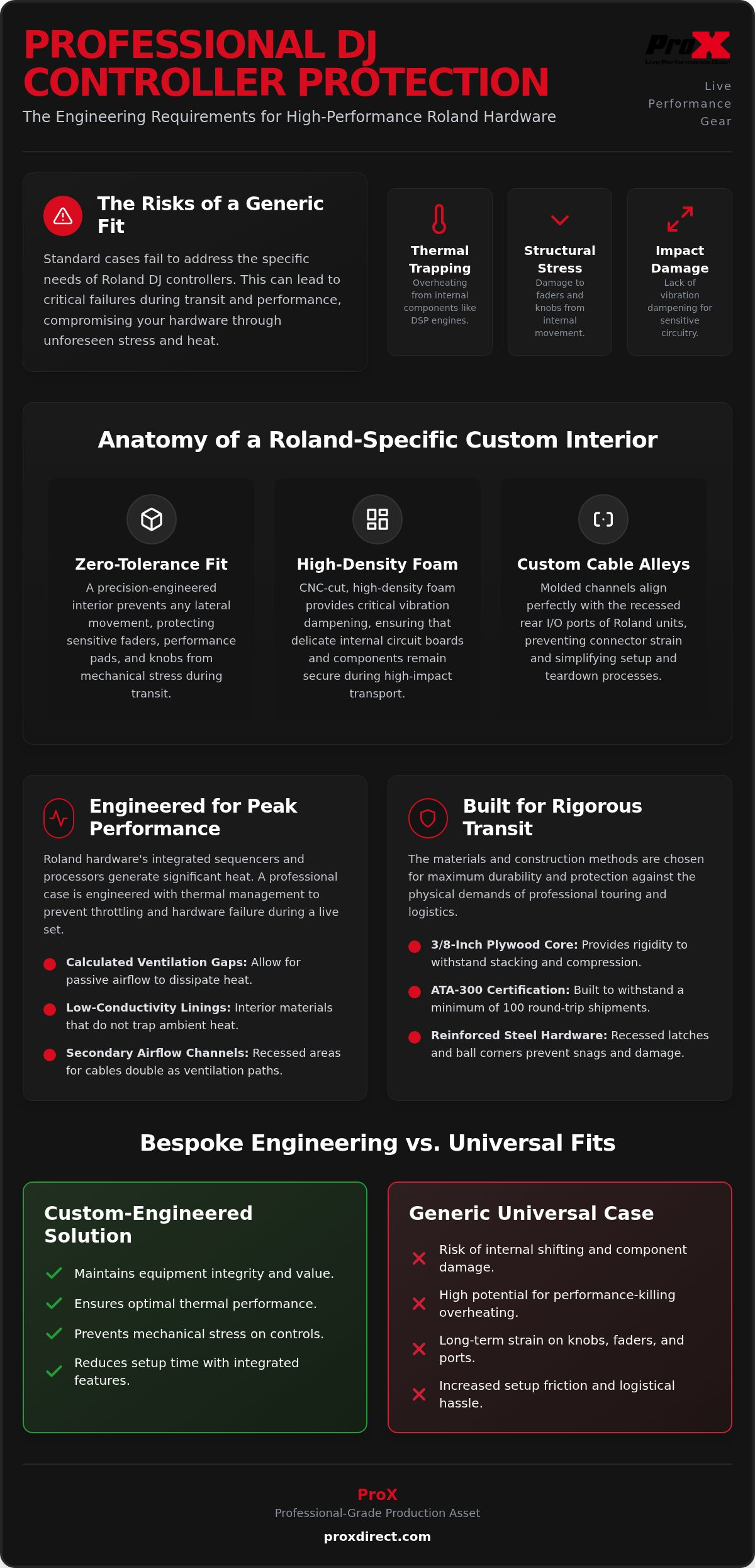
The internal architecture of a professional industry-standard road case utilizes precision-engineered components to mitigate logistical risks. High-density CNC-cut foam provides critical vibration dampening; this ensures that delicate internal circuit boards remain seated during high-impact transport. Custom-molded cable alleys are positioned specifically to align with the recessed rear ports of the Roland architecture. This design prevents connector strain during setup and strike. To maintain the long-term accuracy of the hardware, the interior provides a zero-tolerance fit that prevents even microscopic lateral movement of the precision faders and performance pads.
Thermal Considerations for High-Performance Hardware
Thermal management is a critical engineering requirement for Roland hardware due to the integrated TR-S sequencer and internal DSP engines. These components generate significant heat during continuous operation in high-stakes environments. Pro-grade ProX cases incorporate calculated ventilation gaps that allow for passive airflow. This prevents processor throttling that can lead to software latency or hardware failure during a live set. High-performance cases are designed to facilitate heat dissipation through specific structural choices:
- Strategic spacing around the TR-S sequencer section to facilitate constant airflow.
- Low-conductivity interior linings that do not trap ambient heat.
- Recessed areas for cable runs that double as secondary airflow channels beneath the chassis.
The transition from a simple protective shell to a performance-integrated workstation is defined by these technical details. A well-engineered custom case for Roland DJ controller equipment ensures that the hardware performs at its thermal and mechanical peak regardless of the venue's environmental conditions. This level of precision is the baseline for professional production reliability.
Material Science: Standards for Professional-Grade Cases
Professional touring environments demand materials that resist both structural deformation and surface degradation. While lightweight bags might suffice for local transit, they offer zero protection against the vertical compression of a heavy truck pack. A custom case for Roland DJ controller hardware typically utilizes 3/8-inch or 1/2-inch plywood. This material density provides the necessary rigidity to support the weight of stacked equipment without bowing or cracking under load. It's the foundation of a reliable transport solution that prioritizes the safety of your internal electronics over mere portability.
Compliance with ATA-300 Category 1 standards is a non-negotiable requirement for international air travel. This specification ensures the case can withstand a minimum of 100 round-trip shipments. It involves rigorous drop testing and water resistance verification to protect the internal circuitry of your Roland unit from the unpredictable nature of logistical handling. These standards guarantee that your investment remains secure regardless of the transport method or the frequency of your tour schedule.
Reinforced Hardware and Mechanical Assembly
Mechanical integrity depends on the quality of the assembly hardware. Industrial-grade rivets and steel components distribute tension across the plywood panels, preventing joint separation under mechanical stress. Recessed hardware and reinforced ball corners are essential because they eliminate snag points during loading and unloading. If a component wears down over years of heavy use, maintaining your gear is simplified through ProX Cases Replacement Parts, ensuring the shell remains functional for the life of the controller. Spring-loaded handles provide ergonomic reliability, staying flush against the case during transit to prevent accidental damage.
Surface Protection and Longevity
Plywood density significantly outperforms plastic alternatives in energy absorption. High-impact testing protocols demonstrate that multi-layer wood panels dissipate kinetic energy across the surface rather than transferring the shock directly to the internal hardware. Laminated finishes, such as the Honeycomb Digital™ surface, provide a barrier against chemical spills and environmental extremes like high humidity. This hexagonal pattern isn't just aesthetic. It increases surface area to resist deep scratches and provides a non-slip texture for handling in damp or dimly lit environments. You can explore these material specifications further in the ProX cases catalog to find the right fit for your rig.
Comparing Bespoke Engineering vs. Universal Fits
Universal cases are designed for broad compatibility, which inherently means they fit nothing perfectly. For the specialized layout of Roland hardware, this lack of precision creates a high-risk environment during transit. Shifting is the leading cause of bent fader stems and cracked pots when equipment is handled by stagehands or logistical crews. A custom case for Roland DJ controller units eliminates this risk through exact-fit CNC-cut foam that supports the chassis rather than the sensitive controls. This ensures that the weight of the unit remains centered, providing a stable center of gravity that prevents the case from tipping on ramps or uneven surfaces.
The long-term ROI of bespoke engineering is clear when compared to the cost of emergency gear replacement. While a universal box might seem cost-effective initially, the mechanical friction caused by internal movement leads to premature hardware failure. A precision-engineered shell acts as a protective exoskeleton, absorbing kinetic energy that would otherwise be transferred directly to the controller's internal circuit boards. This level of protection is essential for maintaining the tight tolerances required by professional performance standards.
The Problem with Universal "Adjustable" Solutions
Universal "adjustable" foam is a temporary solution that degrades under the weight of professional gear. As the foam compresses over time, it loses its structural memory, allowing the controller to slide within the case. This is particularly dangerous for Roland’s unique AIRA-style illuminated buttons and high-profile knobs. By opting for high-end solutions like Santosom Cases, you ensure a rigid internal environment that maintains its integrity over hundreds of shows. These bespoke designs provide dedicated support zones that protect every fader and slider from lateral pressure.
Workflow Efficiency in Custom Designs
Efficiency at the venue is a direct result of case architecture. Custom designs allow for pre-wired internal connections, significantly reducing your "time-to-first-beat" once you arrive at the booth. Instead of managing loose cables and searching for power adapters, a performance-integrated workstation keeps your essentials organized and ready for immediate deployment. This reduces setup friction and allows you to focus on the technical aspects of your performance.
- Integrated power blocks that eliminate the need for external power strips.
- Designated compartments for Roland-specific power bricks and secondary cables.
- Pre-routed I/O channels that protect ports from frequent plugging stress.
A well-planned custom case for Roland DJ controller hardware turns your transport solution into a functional part of your rig. It provides a professional stage presence while ensuring that your setup and strike processes are as methodical as your performance.
Functional Features for Modern Professional Performance
Modern DJing requires a workstation that facilitates rapid deployment and organized stage management. A custom case for Roland DJ controller units often incorporates 1U rack spaces positioned beneath the main controller deck. These spaces allow for the permanent installation of wireless microphone receivers or power conditioners, centralizing all technical components within a single chassis. This level of integration minimizes external wiring and reduces the risk of connection failure during high-pressure transitions between sets.
Integrated Performance Workstations
The integrated laptop shelf has evolved from a simple accessory into a mechanically stable platform. Precision-engineered sliding mechanisms ensure that the shelf remains locked in position even in high-vibration environments near large subwoofer arrays. These platforms are designed at specific ergonomic heights to maintain optimal viewing angles for the performer, reducing physical strain during extended sets. For professionals requiring the fastest possible deployment, Flip Ready technology allows the case to transition from a transport configuration to a performance-integrated workstation in seconds. This ensures your custom case for Roland DJ controller hardware remains stable and functional in any booth environment.
Clean stage management is achieved through dedicated cable access ports and "doghouse" designs. A doghouse is a recessed area at the rear of the case that conceals all I/O connections and power strips. This architecture protects the rear ports of the Roland controller from accidental impact. It provides a professional, clutter-free appearance on stage. It also allows for pre-wiring the rig, so only the main power and audio outputs need to be connected at the venue.
Mobility and Logistical Integration
Mobility is a logistical necessity for solo DJs and touring crews. Low-profile, industrial-grade rubber wheels facilitate smooth movement across urban terrain. They don't transfer excessive vibration to the internal hardware. These wheels are selected for their load-bearing capacity and durability in high-frequency use across varied surfaces. They provide the agility needed to navigate tight backstage corridors or loading ramps without compromising the safety of the equipment.
Efficient truck pack density is achieved through standardized stacking features. Recessed dishes on the top of the case lid align perfectly with the wheels of the case stacked above it. This prevents lateral movement during transit in a trailer or van. It's a critical feature for long-haul logistics where cargo shifting can lead to significant damage. You can see how these features integrate into a larger logistical strategy by reviewing the engineering behind TruckPaX™ Truck Pack Cases.
To optimize your performance setup with professional-grade hardware, browse the full selection of ProX custom cases for your specific Roland model.
ProX Custom Solutions for Roland DJ Equipment
ProX has maintained a position of industrial authority in the performance gear sector since 1984. The current catalog provides specific, engineering-led solutions for the Roland DJ-202, 505, and 808 series. Every custom case for Roland DJ controller units is built to exact specifications, ensuring the hardware's physical attributes are protected against the logistical demands of professional touring. This legacy of reliability is built on a foundation of technical superiority and a deep understanding of the physical stresses placed on production equipment during long-haul transit.
The brand functions as an authoritative guide for industry professionals, offering a range of solutions that prioritize structural integrity over aesthetic trends. By focusing on mechanical assembly and material science, the engineering team ensures that every case provides a stable environment for sensitive electronics. This methodical approach to manufacturing allows for a comprehensive overview of compatibility, ensuring that your Roland hardware remains seated and secure regardless of the transport method.
ZCASE and Santosom: The Pinnacle of Protection
For high-value production environments requiring bespoke configurations, ZCASE Custom Build Cases represent the pinnacle of protection. These units are manufactured in European facilities using advanced CNC processes to achieve tolerances that standard universal cases cannot match. This level of precision is essential for unique production needs where equipment failure is not a viable option. The partnership with Santosom further expands the range of bespoke engineering services available to the professional market.
Large production houses often require more than just a protective shell. Custom branding and color-coding options are available to streamline inventory management for complex logistical operations. These features allow for quick identification of specific rigs during loading and unloading, reducing the margin for error in high-stakes environments. The use of specialized materials and logistical standards ensures that these cases withstand the rigors of international touring while maintaining a professional stage presence.
Ordering and Dealer Support
Accessing these specialized solutions is managed through an extensive dealer network. The dealer portal facilitates custom engineering requests, allowing professionals to specify exact requirements for their Roland rigs. This structured approach ensures that every technical detail is addressed before the manufacturing process begins. It reflects a commitment to detail and a respect for the professional’s time, providing a clear path from technical specification to final delivery.
To extend the operational lifecycle of your investment, a comprehensive inventory of ProX Cases replacement parts is maintained. This modularity ensures that a damaged latch or handle doesn't compromise the entire shell. It's a practical reality of professional use that gear will face wear; having access to factory-spec components is a critical part of long-term equipment maintenance. You can explore the full range of ProX Roland-compatible cases to secure a solution that meets your specific logistical standards and protects your custom case for Roland DJ controller hardware for years to come.
Optimizing Your Touring Logistics
Maintaining the operational integrity of Roland DJ hardware requires a transition from generic storage to precision engineering. These controllers demand specific thermal management and structural support to protect integrated sequencers and delicate I/O ports. By utilizing ATA-300 Category 1 certified construction and high-density CNC-cut foam, you eliminate the mechanical risks associated with universal fits. Equipment failure is not an option. Selecting a custom case for Roland DJ controller units ensures that your equipment remains a reliable asset throughout its service life.
ProX has been engineering performance gear since 1984, providing the industry with a dependable backbone for logistical success. With a global dealer network for local support and a commitment to functional excellence, we provide the technical specifications required for modern touring. Whether you need the rapid deployment of Flip Ready technology or the bespoke precision of ZCASE and Santosom, it's clear that your gear deserves a professional-grade environment. Find Your Precision-Engineered Roland Case at ProX and ensure your next performance is backed by decades of manufacturing expertise.
Frequently Asked Questions
Is a custom case for my Roland DJ controller worth the extra weight?
The mass of 3/8-inch or 1/2-inch plywood provides the structural rigidity necessary to absorb kinetic energy during impact. While it adds weight, this mass prevents the transfer of shock to internal circuit boards. This technical trade-off is essential for professional touring where equipment failure isn't an option. It's a necessary investment for protecting the high-density components and AIRA-derived processing found in Roland hardware.
Can I fit other accessories inside a Roland-specific custom case?
Most precision-engineered cases include dedicated compartments for power bricks, XLR cables, and secondary accessories. These storage zones are strategically placed to maintain the center of gravity. Utilizing these internal alleys ensures that your workflow remains organized and all technical components are centralized for rapid deployment. This architecture prevents loose items from shifting and causing mechanical damage to the controller's surface during transit.
What is the difference between ATA-300 and standard flight cases?
ATA-300 Category 1 is a logistical standard certifying that a case can withstand at least 100 round-trip shipments. Standard containers lack the specific drop-test and water-resistance verification required for international air travel. Investing in an ATA-300 certified custom case for Roland DJ controller units ensures compliance with global transport regulations. It provides a level of engineering precision that generic alternatives simply don't match.
Do ProX cases for Roland controllers include laptop shelves?
Many models feature integrated performance workstations with sliding laptop platforms. These shelves use industrial-grade hardware to maintain stability in high-vibration environments near large subwoofer arrays. This design allows the performer to maintain optimal viewing angles while keeping the laptop securely locked during the set. It eliminates the need for external stands, which often compromise the limited space available in professional DJ booths.
How do I maintain the foam interior of my custom case?
Maintenance involves regular inspection of the high-density CNC-cut foam for signs of compression or debris. Use a low-moisture vacuum to remove dust from cable alleys and ventilation gaps. Keeping the interior clean prevents abrasive particles from scratching the controller's surface or interfering with the precision faders and performance pads. This methodical care ensures the foam continues to provide a zero-tolerance fit for years.
Can I order a custom case with integrated rack space for my Roland rig?
Bespoke engineering services through ZCASE and Santosom allow for the integration of 1U or 2U rack spaces. These configurations are ideal for housing wireless receivers or power conditioners directly beneath the controller. This technical setup centralizes your I/O connections and simplifies the cable management process at the venue. It's an efficient solution for professionals who require a self-contained production rig in a single chassis.
Are these cases compatible with the latest Roland firmware updates for hardware?
Physical case compatibility is independent of software firmware. The cases are designed to accommodate the static physical dimensions of specific Roland models. If a firmware update changes the operational heat output, the built-in ventilation gaps in a custom case for Roland DJ controller units will continue to facilitate necessary heat dissipation. The engineering focus remains on the structural and thermal requirements of the hardware chassis.
What happens if a latch or handle breaks during a tour?
ProX maintains a comprehensive inventory of replacement parts to ensure the long-term utility of the shell. Industrial-grade rivets allow for the straightforward replacement of handles, latches, or ball corners. This modularity extends the lifecycle of the case, allowing it to remain functional throughout years of rigorous touring. It's a practical solution that respects the professional's time and resources in high-stakes production environments.
Disclaimer
Any trademarks, trade names or brand names appearing herein that do not belong to ProX are the property of their respective owners and/or companies, and such appearance doesn't and shall not constitute or imply endorsement, sponsorship or recommendation by ProX.


