

If your stage truss design ideas prioritize visual impact over verified load-bearing limits, are you engineering a production or a liability? In a professional environment where equipment failure is not an option, the pressure to deliver complex, immersive geometries often conflicts with the rigid demands of structural safety and tight load-in schedules. You likely recognize that a rig is only as effective as its weakest connection point, especially when managing the high-stakes integration of heavy LED video walls and automated lighting fixtures.
This article provides a technical framework for modular truss configurations and engineering-grade design strategies that elevate production value while maintaining strict structural integrity. We will explore a library of modular design concepts, clarify essential safety standards such as ANSI E1.2-2021, and detail efficient transport strategies using specialized stage truss and base plate cases. By focusing on 6082-T6 alloy specifications and logistical precision, you'll ensure your systems remain durable through the physical demands of professional use. You will gain a clear understanding of how to balance creative aesthetics with the practical realities of structural engineering and gear protection.
Key Takeaways
- Identify the structural advantages of 6082-T6 aluminum alloy for maintaining safety and integrity in complex modular builds.
- Discover innovative stage truss design ideas including multi-dimensional box grids and goal post systems to enhance audience immersion.
- Determine the precise engineering requirements for integrating heavy LED video walls and high-output lighting fixtures into a stable rig.
- Improve logistical efficiency and reduce crew labor by standardizing segment lengths for rapid assembly and streamlined transport.
- Learn how to scale production capabilities using a modular ecosystem that addresses unique architectural challenges in diverse venues.
Engineering Foundations for Modular Stage Truss Design
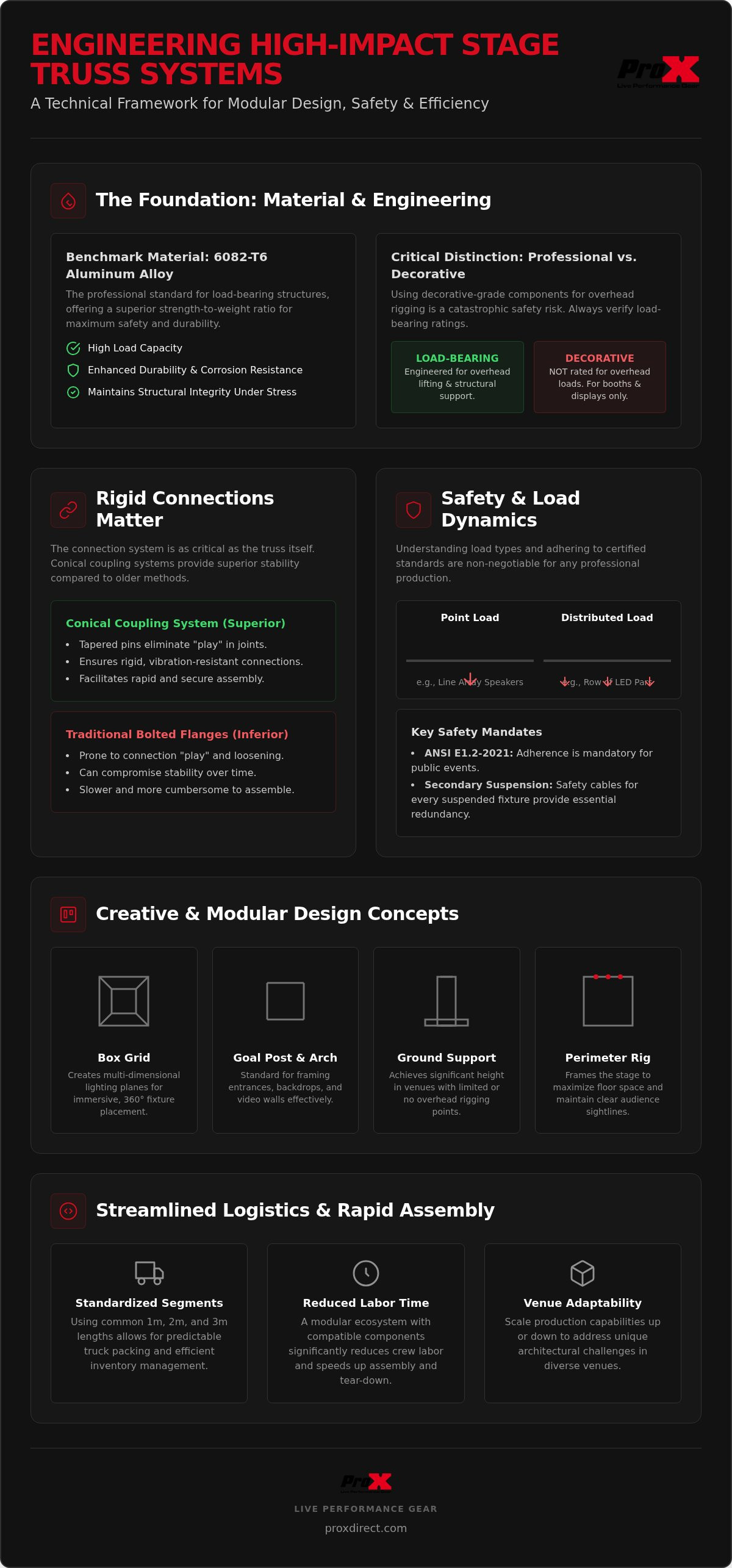
Modular truss design utilizes standardized segments to create scalable event skeletons that adapt to diverse venue architectures. In professional-grade structural engineering, 6082-T6 aluminum alloy is the benchmark material. It offers a superior strength-to-weight ratio and durability compared to lower-grade alternatives. A deep grasp of the engineering principles of a truss allows designers to maximize span lengths without compromising safety. These structures aren't merely aesthetic; they're critical support systems for high-value production gear that must withstand significant physical stress.
Conical coupling systems facilitate rapid setup while ensuring rigid, vibration-resistant connections. Unlike traditional bolted flanges, conical couplers utilize tapered pins to eliminate "play" in the joints. This rigidity is essential for live sound applications where low-frequency vibrations can compromise structural stability over time. Designers must strictly differentiate between decorative trussing used for trade show booths and professional load-bearing systems. Using decorative-grade components for overhead rigging is a catastrophic safety violation that ignores material fatigue and stress limits.
Load-Bearing Dynamics and Safety Factors
Accurate rigging begins with calculating point loads versus distributed loads. A line array of speakers exerts a significant point load, whereas a row of LED par cans represents a distributed load. Engineers use these metrics to determine the maximum deflection of a span and ensure it stays within safe tolerances. Secondary suspension systems, including safety cables for every fixture, provide an essential layer of redundancy. Structural engineering certifications, such as ANSI E1.2-2021, are non-negotiable requirements for public event spaces. These standards ensure that your stage truss design ideas translate into safe, compliant realities, especially when accounting for dynamic forces like wind loads in outdoor environments.
Modular Components: The Building Blocks of Design
Standardized segment lengths of 1m, 2m, and 3m provide the modularity needed for logistical efficiency. These dimensions allow for predictable truck packing and rapid inventory management. Integrating corner blocks, T-junctions, and cross-junctions permits the creation of complex 3D structures like box grids or multi-level tiers. For ground-based setups, selecting the correct base plate is vital for stability. While standard plates work for simple goalposts, larger footprints or ground support towers are necessary for high-elevation rigs. Utilizing a professional ProX Truss ecosystem ensures all components are compatible and rated for heavy-duty professional use. These stage truss design ideas form the foundation of a reliable production that protects both the crew and the audience.
Creative Truss Configurations for High-Impact Events
Creative configurations transform a structural skeleton into a visual focal point. The box grid is a primary example of this. It creates multi-dimensional lighting planes that immerse the audience by providing depth in the overhead rig. Unlike simple linear runs, a box grid allows for 360-degree fixture placement and complex cable routing. Circular and curved truss segments break standard linear patterns. These specialized segments are essential for creating aesthetic focus, such as highlighting a central podium or creating a halo effect over a drum riser. Using these non-linear stage truss design ideas helps separate a high-end production from a standard setup.
Ground support towers offer a critical solution for venues with restricted overhead rigging points or low weight-bearing ceilings. These systems achieve significant height by utilizing sleeve blocks, motor hoists, and hinge sets. Goal post and arch systems remain the standard for effective framing of entrance ways and backdrop support. When implementing these designs, designers must prioritize the mechanical compatibility of every junction and the total weight of the suspended load. Ensuring that each segment is properly rated for the intended configuration prevents structural failure during the event.
The Perimeter Rig: Maximizing Floor Space
A perimeter rig frames the stage area without central vertical obstructions. This configuration keeps sightlines clear for the audience by integrating top-mounted lighting fixtures on the outer edges of the performance space. It's an ideal setup for corporate events where clean, unobstructed aesthetics are mandatory. Stability depends on securing perimeter base plates in high-traffic areas. Using heavy-duty steel base plates provides the necessary ballast to prevent tipping without requiring bulky outriggers in narrow aisles. For complex venue layouts, exploring the ProX Truss catalog provides a range of modular options for custom perimeter framing.
Cantilevered Designs for Dynamic Angles
Cantilevered designs extend truss segments beyond vertical supports to create dramatic lighting angles and forward-leaning aesthetics. These structures require precise balancing of counterweights at the base or the opposite end of the span. Designers must calculate leverage ratios to ensure the rig doesn't exceed the tipping point when fixtures are added to the leading edge. Using outriggers is a best practice to stabilize tall, narrow truss structures and increase the structural footprint. All assembly and rigging must strictly adhere to OSHA safety regulations regarding structural integrity and fall protection. Failure to account for leverage forces can lead to catastrophic equipment damage or injury.
Integrating LED Video Walls and High-Output Lighting
Modern stage truss design ideas must account for the massive weight and surface area of high-resolution LED panels. These components aren't merely visual additions; they represent significant structural loads that require precise engineering. Adhering to ANSI E1.2-2021 safety standards is mandatory when calculating the total capacity of a rig. Beyond load limits, high-output lighting and LED processors are sensitive to structural harmonics. Minimizing vibration through rigid conical coupling and ensuring adequate airflow to prevent heat buildup are essential for protecting high-value electronics during multi-day productions.
Cable management is a critical factor in maintaining a professional aesthetic. Utilizing the truss spine for primary power and data runs prevents "cable spaghetti" that can distract from the visual design. For long-term installations or multi-week tours, accessibility for maintenance is a logistical necessity. Rigs should be designed with enough clearance for technicians to access rear-mounted connectors or replace power supplies without dismantling the entire structure. This foresight reduces downtime and ensures the show remains operational under demanding schedules.
Ground Support Systems for LED Panels
When overhead rigging is unavailable, designing specialized back-support structures is the only viable solution for large screens. Utilizing a dedicated system for LED Video Panel Wall Support ensures that the vertical load is distributed evenly across the floor. These systems must manage significant weight and, in outdoor environments, the wind-load factors that turn a screen into a sail. Adjustable feet and leveling systems are vital for stabilizing these structures on uneven venue floors. Without precise leveling, the seams between LED panels can misalign, resulting in visible gaps or physical damage to the module edges.
Lighting Rig Logistics and Positioning
Optimal spacing for moving-head fixtures is required to prevent mechanical interference during high-speed pan and tilt movements. Designers should calculate the maximum radius of every fixture to ensure no "collisions" occur mid-show. Layered lighting depths can be achieved using drop-down pipes and side-arms, which allow fixtures to sit at different elevations within the same truss span. Calculating power distribution paths along the truss spine minimizes clutter and reduces the risk of data interference. This methodical approach to stage truss design ideas ensures that the technical execution is as clean as the creative vision, providing a reliable foundation for complex lighting sequences.
Strategic Planning for Transport and Rapid Assembly
Logistical efficiency is the silent partner of successful stage truss design ideas. A rig that looks impressive on a CAD drawing but fails to fit into a standard transport vehicle creates unnecessary overhead and delays. Standardizing segment lengths to 1m, 2m, or 3m increments optimizes truck pack density. This consistency allows logistics managers to calculate volume with precision; it reduces the number of vehicles required for transit. Modular design significantly impacts labor costs. Standardized components allow crews to internalize assembly patterns, which slashes setup and strike times across multiple tour dates.
Color-coded labeling systems provide a secondary layer of efficiency. By marking specific truss types or lengths with durable industrial tags, technicians can identify components at a distance. This practice eliminates the phase of sorting through mixed inventory on a dark stage. Implementing these logistical standards ensures that the creative vision of the production is supported by a reliable, repeatable workflow. Protection of these assets is equally vital. High-grade aluminum is susceptible to gouges and structural deformations if mishandled during transit. Such damage can compromise the integrity of the entire rig.
Protecting Structural Integrity with Dedicated Cases
Maintaining the professional aesthetics and structural safety of a rig requires specialized storage. Utilizing Stage Truss and Base Plate Cases prevents the dents and scratches that lead to structural stress points. Even minor surface damage can hide deeper material fatigue in 6082-T6 alloy. Organization is a safety requirement. Specialized utility compartments for couplers, pins, and R-clips ensure that critical hardware is never missing during a build. Securely storing these small components prevents the use of makeshift hardware that has not been load-rated for the specific application. For professional transport solutions, browse our selection of protective equipment cases to safeguard your inventory.
Streamlining the Setup Process
Pre-rigging lighting fixtures onto truss segments is a proven strategy for rapid deployment. When fixtures remain attached to the truss during transit, the onsite workload shifts from mounting gear to simply connecting data and power. This approach requires specialized dollies and carts designed for the safe movement of truss bundles. These transport tools allow a small crew to move large sections of the rig through narrow venue corridors without manual lifting. Every assembly workflow must include a pre-show structural inspection. Technicians should verify the seating of every conical coupler and the tension of every safety cable before the rig is hoisted. These methodical stage truss design ideas ensure that the transition from the truck to the air is both fast and architecturally sound.
Advanced Customization with ProX Modular Solutions
Scaling production capabilities requires a modular ecosystem that offers both standardization and specialized adaptability. The ProX Truss system provides this balance; it allows production companies to expand their inventory without sacrificing mechanical compatibility. Investing in high-durability staging infrastructure, constructed from 6082-T6 aluminum alloy, ensures a significant long-term ROI because these components withstand the rigorous physical demands of constant touring. Professional-grade hardware standards in this ecosystem exceed standard commercial expectations. They provide the mechanical reliability necessary for high-stakes environments where equipment failure is not an option. This reliability is the backbone of the professional production industry.
Bespoke Engineering for Unique Event Needs
Custom design projects are often required for permanent installations or specialized tours that encounter unique venue architectural challenges. Adapting modular systems for non-traditional spaces, such as historic theaters with limited rigging points or outdoor arenas subject to wind loads, requires an authoritative understanding of structural dynamics. These stage truss design ideas must be supported by rigorous safety and load-bearing certifications to ensure public safety and compliance with local building codes. Collaborating on custom design projects allows for the creation of unique geometries that standard segments cannot achieve. Custom-engineered components, such as specialized corner blocks or heavy-duty hinge sets, allow designers to bypass venue limitations while maintaining the structural integrity of the entire rig.
Building a Professional Staging Ecosystem
A unified staging ecosystem goes beyond the truss itself. It involves coordinating stage truss design ideas with bespoke protection solutions like ZCASE Custom Build Cases. This ensures that high-value production gear, from lighting consoles to LED processors, is protected during transit between venues. Selecting matching base plates and ground support stands provides a cohesive, professional appearance that reflects the engineering precision of the build. Future-proofing your inventory is achieved by adhering to industry-standard 290mm and 400mm truss formats. These standards ensure that your modular components remain compatible with future hardware acquisitions and global rental networks. Integrating these components with specialized ProX Cases for transport ensures that your investment remains in peak condition for years of professional use. This methodical approach to inventory management prioritizes functional excellence and logistical reliability.
Engineering the Future of Professional Production
Professional production requires a shift from purely aesthetic choices to engineering-grade structural decisions. This guide has detailed how modular 6082-T6 aluminum systems provide the durability needed for evolving event demands. By prioritizing ANSI safety standards and utilizing standardized segment lengths, you ensure that your rigs are both visually impactful and logistically efficient. Your stage truss design ideas must integrate load-bearing precision with specialized protection to maintain asset value over years of touring.
Since 1984, we have engineered performance gear that meets rigorous safety standards and material certifications. Our commitment to functional excellence includes providing comprehensive protection solutions for touring gear to prevent structural fatigue. Adopting a modular ecosystem allows you to scale your capabilities while ensuring mechanical compatibility across all venue types. It's about building a reliable backbone for every show you produce.
Browse Professional ProX Truss Systems and Components to elevate your next production with reliable, engineering-grade hardware. Your commitment to safety and innovation starts with the right structural foundation.
Frequently Asked Questions
What is the most versatile stage truss design for a touring DJ?
A goalpost configuration using 290mm square truss is the most versatile setup for a touring DJ. It provides a stable frame for backdrops and lighting while maintaining a compact footprint for transit. This configuration allows for rapid assembly in diverse venues. You can easily expand it into a perimeter rig as production needs grow. It's a foundational element for many stage truss design ideas that prioritize both aesthetics and logistical speed.
How do I calculate the load-bearing capacity of my truss rig?
You must consult the manufacturer's load tables to determine the specific capacity for your span and truss type. Calculations must differentiate between point loads and uniformly distributed loads. For complex rigs, software modeling or professional engineering review is necessary to ensure compliance with ANSI E1.2-2021 standards. Never exceed the maximum deflection limits. Structural integrity depends on accurate weight distribution across all support points to prevent material fatigue or catastrophic failure.
Is aluminum or steel truss better for professional stage design?
Aluminum 6082-T6 is the superior choice for professional stage design due to its high strength-to-weight ratio. It reduces transport costs and simplifies manual handling during setup. While steel offers higher absolute strength, it's typically reserved for permanent, heavy-duty industrial installations. Aluminum's natural corrosion resistance and modularity make it the industry standard for touring environments where rapid deployment and durability are critical requirements for structural performance and safety.
Do I need a structural engineer for a ground-supported truss design?
A structural engineer is required for any complex, high-elevation, or outdoor ground-supported rig. Professional review ensures the structure can withstand dynamic forces like wind loads and seismic activity. Many jurisdictions mandate stamped engineering drawings for public events to verify safety and compliance. Even for smaller setups, following manufacturer-provided ballast requirements is essential. Engineering oversight is a non-negotiable step for any stage truss design ideas involving significant vertical height or heavy overhead loads.
How can I protect my truss segments from damage during transport?
Utilizing dedicated stage truss and base plate cases is the most effective way to prevent transport damage. These cases protect segments from dents and scratches that can create dangerous stress points in the aluminum. Maintaining a clean, professional appearance is a secondary benefit. Specialized compartments for small hardware like conical pins and couplers ensure that critical components aren't lost during transit, preventing the use of unrated makeshift hardware during assembly.
What are the essential safety components for any stage truss design?
Essential safety components include rated conical couplers, safety cables for every fixture, and secondary retention systems. For ground-supported rigs, base plates and appropriate ballast weights are mandatory to prevent tipping. Every connection point must be verified for proper seating before the rig is hoisted. These components form a redundant safety network. They're critical for protecting the crew, performers, and audience from potential equipment failure during high-stakes live productions where failure isn't an option.
How does modular truss design improve setup and strike times?
Modular design improves efficiency by utilizing standardized segment lengths and intuitive conical coupling systems. Standardized parts allow crews to develop repeatable assembly workflows, which reduces the time spent sorting through mixed inventory. The use of uniform 1m, 2m, or 3m segments also simplifies truck packing. This logistical precision slashes both setup and strike times, allowing production teams to meet tight load-in schedules without compromising the structural integrity or safety of the build.
Can I use circular truss segments with standard square truss grids?
You can integrate circular truss segments with standard square grids provided the coupling systems and tube diameters are identical. Most professional 290mm systems utilize universal conical couplers to ensure mechanical compatibility. This allows for creative non-linear highlights, such as halo rigs over drum risers, within a larger box grid. Always verify that the load ratings for the curved segments match the requirements of the overall span to maintain structural safety throughout the rig.
Disclaimer
Any trademarks, trade names or brand names appearing herein that do not belong to ProX are the property of their respective owners and/or companies, and such appearance doesn't and shall not constitute or imply endorsement, sponsorship or recommendation by ProX.


