

A single mechanical failure in a touring amplifier doesn't just silence a stage; it compromises the entire production's financial and operational integrity. For the professional engineer, the rack is far more than a transport vessel. It's a critical thermal and mechanical interface that must mitigate high-impact vibrations and facilitate constant airflow. You've likely encountered the logistical headaches of inconsistent rack depths or the high stakes of equipment overheating within enclosed spaces. Selecting the right Amp & Effects Rack Cases requires a move beyond aesthetic choices toward rigorous engineering specifications that prioritize functional excellence.
This article outlines the technical requirements for professional rackmount protection, from shock-mount assembly to optimized rear-panel accessibility for complex cabling. You'll learn how to master thermal management for high-output amplifiers and signal processors while maintaining standardized truck pack dimensions. We provide a comprehensive analysis of material science, including the use of 3/8 inch and 1/2 inch plywood with honeycomb digital designs, to ensure your gear survives the physical demands of global touring. By the end of this guide, you'll have the technical data needed to maximize equipment lifespan and streamline your logistical workflow through methodical hardware selection.
Key Takeaways
- Understand the mechanical physics of shock-mount engineering and how internal floating rails isolate delicate circuitry from high-impact transit vibrations.
- Identify the optimal specifications for your hardware by comparing 3/8 inch and 1/2 inch plywood constructions across depths ranging from 7 to 24 inches.
- Learn how to implement effective thermal management within Amp & Effects Rack Cases to prevent equipment overheating while maintaining standardized truck pack dimensions.
- Evaluate the operational efficiency of Slam Door technology compared to traditional removable lids to reduce setup time and minimize logistical hardware loss.
- Balance the trade-offs between extreme protection levels and overall transport weight to select the most efficient enclosure for specific touring requirements.
The Engineering of Professional Amp & Effects Rack Cases
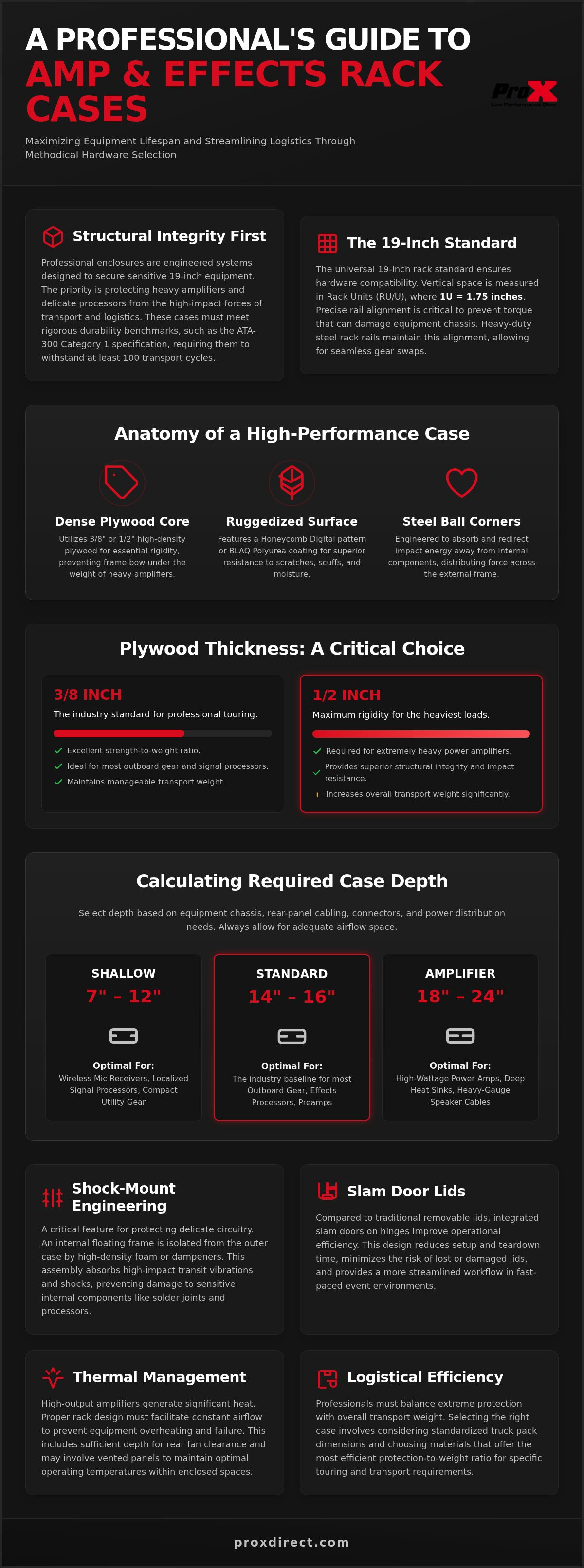
Professional Amp & Effects Rack Cases serve as precision-engineered enclosures designed to secure sensitive 19-inch equipment against the rigors of global logistics. Unlike consumer-grade solutions, these cases prioritize structural integrity to protect heavy power amplifiers and delicate signal processors. The primary benchmark for this level of protection is the ATA-300 Category 1 specification. This standard dictates that a case must withstand the mechanical stresses of at least 100 round trips. Consumer racks might satisfy stationary studio needs, but they often fail under the concentrated weight and vibration of professional touring environments. Stress points like the rack rails and corner joints are the first to compromise when subjected to the high-G forces of a truck pack or air cargo handling.
The Role of the 19-Inch Rack Standard
The 19-inch rack standard provides the foundational framework for all professional audio assembly. This measurement, defined in Rack Units (RU or U), ensures that hardware from various manufacturers remains compatible within a single enclosure. Each unit represents 1.75 inches of vertical space. Maintaining precise horizontal alignment is critical for mechanical stability. If the rails are misaligned, the resulting torque can damage equipment chassis or cause mounting screw failure during transit. Professional cases utilize heavy-duty, tapped or cage-nut steel rack rails to maintain this alignment across multiple generations of gear. This standardization allows engineers to swap processors or amplifiers between different setups without logistical delays.
Anatomy of a High-Performance Case
The physical build of a case determines its utility in the field. Plywood thickness is a primary variable; while 1/4 inch panels are suitable for light utility, professional touring demands 3/8 inch or 1/2 inch high-density plywood. These materials provide the necessary rigidity to prevent bowing under the weight of high-wattage amplifiers. Many ProX Cases utilize a Honeycomb Digital surface design. This hexagonal pattern creates a ruggedized exterior that resists scratches and scuffs better than traditional smooth laminates. Impact absorption is further enhanced by reinforced steel ball corners. These components are engineered to redirect the kinetic energy of a drop away from the internal equipment, distributing the force through the external frame instead. This mechanical redirection is essential for signal processors that contain delicate internal soldering and glass components. By combining dense plywood with reinforced hardware, the case acts as a sacrificial barrier that preserves the integrity of the internal electronics.
Technical Specifications: Depth, Ply, and Shock Mounting
Engineering a professional enclosure requires balancing mechanical protection with logistical efficiency. Modern Amp & Effects Rack Cases are no longer just wooden boxes; they are sophisticated protective systems designed with specific weight-to-strength ratios in mind. Utilizing 3/8 inch or 1/2 inch high-density plywood ensures the frame remains rigid under heavy loads. Specialized coatings like BLAQ Polyurea provide a chemical bond that exceeds the durability of standard laminates, offering superior resistance to moisture and abrasion. This material science approach allows for a case that is lighter yet structurally superior to older, legacy designs.
Calculating Required Case Depth
Measuring for a rack case involves more than the equipment's physical chassis dimensions. You must account for rear-panel cabling, XLR connectors, and power distribution units. Standard depths vary significantly based on the intended application:
- Shallow Racks (7 to 12 inches): These are becoming essential for wireless microphone receivers and localized signal processing where rack space is at a premium and rear access is limited.
- Standard Effects (14 inches): This depth serves as the industry baseline for most outboard gear and signal processors.
- Amplifier Racks (18 to 24 inches): These deep enclosures are required for high-wattage power amps that feature deep heat sinks and require substantial rear-panel clearance for heavy-gauge speaker cables.
Inconsistent depth planning leads to logistical failures or unnecessary cable strain. When planning your next build, reviewing the comprehensive inventory of Amp & Effects Rack Cases ensures you select the correct depth for your specific hardware configuration.
The Mechanics of Shock Protection
Internal protection strategies differ based on the sensitivity of the electronics. While foam-lined interiors provide basic dampening, internal rail suspension systems offer superior protection for high-value signal processors. These floating rails are isolated from the external shell by shock-absorbing polymers, allowing the equipment to move independently of the outer impact. G-force attenuation in the context of rack suspension is the calculated reduction of peak acceleration forces transmitted from the external case shell to the internal equipment rails during a mechanical impact. For demanding touring environments, dual shock mount engineering is the standard for protecting delicate circuitry from the high-frequency vibrations found in transport. This system effectively decouples the equipment from the plywood shell, ensuring that the internal soldering and glass components of high-end processors remain intact despite the rigors of the road.
Specialized Rack Designs: Standard vs. Slam Door Systems
Transitioning from the internal protection discussed previously, the external access mechanisms of Amp & Effects Rack Cases significantly impact on-site workflow. Traditional removable lids remain the industry baseline, yet they present logistical challenges in high-density environments. In cramped stage wings or narrow Front of House (FOH) positions, storing detached lids creates a physical footprint that can obstruct technician movement and increase the risk of hardware loss. The choice between standard lids and integrated door systems isn't merely aesthetic; it's a decision based on the spatial constraints and speed requirements of professional production.
Slam Door Engineering and Benefits
Slam Door technology addresses spatial constraints through an integrated mechanical design where the doors retract into the case body rather than being removed entirely. This retractable system utilizes heavy-duty sliding tracks and reinforced hinges that undergo rigorous durability testing to ensure long-term reliability under touring conditions. By keeping the enclosure self-contained, engineers eliminate the need for lid storage and reduce the time required for setup and strike. This design also facilitates superior side-access for maintenance. It allows for better cooling and easier cable management without the need for full lid removal in tight spaces. The mechanical integrity of the sliding track is paramount; it must resist debris and maintain smooth operation even after repeated cycles in dusty or high-humidity environments.
Wireless and Signal Management Racks
Professional rack systems often require specialized configurations for wireless microphone arrays and antenna distribution. Designing for signal integrity involves more than just mounting hardware; it requires front-facing XLR patches and dedicated space for antenna paddles. Integrating 2U or 4U drawers into these Amp & Effects Rack Cases provides secure storage for transmitters, cables, and testing equipment within the same footprint as the signal processors. This consolidation is essential for maintaining a standardized truck pack and reducing the number of individual items during load-in. For engineers managing complex RF environments, you can explore AV Broadcasting Cases for specialized signal needs that require higher levels of connectivity and I/O customization. These systems prioritize clean signal paths and rapid deployment, reflecting the practical realities of modern production where efficiency is as critical as equipment safety. Clean cable routing within these racks prevents electromagnetic interference, ensuring that high-gain amplifiers don't compromise the performance of sensitive wireless receivers housed in the same enclosure.
Thermal Management and Logistical Efficiency
Mechanical protection is only half of the engineering equation for professional equipment enclosures. Thermal management and logistical compatibility are equally critical for maintaining long-term hardware reliability. High-wattage power amplifiers generate significant thermal energy that must be dissipated to prevent component failure. While the previously discussed shock-mount systems protect against physical impact, they can also create pockets of stagnant air if not properly vented. Professional Amp & Effects Rack Cases must balance these competing needs through calculated airflow paths and standardized external dimensions that facilitate rapid transport.
Heat Dissipation in Enclosed Racks
Heat dissipation remains a primary concern for high-density touring builds. Engineers must account for the "chimney effect," where hot air naturally accumulates at the top of the enclosure. Placing heat-sensitive signal processors below power amplifiers is a fundamental layout strategy to prevent premature circuitry degradation. Strategic use of vented rack panels and internal fan units ensures active heat extraction during operation. Vented panels allow for passive intake, while rear-mounted fan kits pull hot air away from amplifier heat sinks. This thermal regulation is essential for maintaining the maximum equipment lifespan of processors that lack internal cooling systems. Without these measures, internal temperatures can quickly exceed the safe operating thresholds defined by hardware manufacturers.
Optimizing the Truck Pack
Logistical efficiency depends on standardized dimensions that simplify the loading process. When cases share a uniform footprint, they interlock more securely, reducing shifting and potential damage during transit. The implementation of TruckPaX™ standards allows production companies to maximize every square inch of a 90-inch or 96-inch truck width. You can learn more about TruckPaX™ Truck Pack Cases and how they integrate into modern production logistics. To facilitate rapid load-ins, these cases often feature integrated caster plates with 4-inch heavy-duty wheels. This hardware allows a single technician to move high-RU racks with minimal physical strain, which is vital for tight production schedules.
Cable routing within deep enclosures requires a methodical approach to avoid obstructing airflow. Technicians should utilize horizontal and vertical lace bars to secure cabling away from exhaust ports. This organization doesn't just improve cooling; it also provides easy access to rear panels for troubleshooting. Inconsistent cable management often leads to localized heat pockets that can trigger thermal shutdown in modern digital amplifiers. By maintaining clean signal and power paths, you ensure the mechanical and thermal integrity of the entire system. For engineers looking to standardize their fleet, you can view our standardized truck pack solutions to optimize your next tour's logistical footprint.
Selecting the Right ProX Solution for Your Production
Selecting the correct enclosure for Amp & Effects Rack Cases requires an objective assessment of the touring environment. If the production involves frequent international air travel, the trade-off favors maximum protection levels despite the increased weight of 1/2 inch plywood. Conversely, for regional ground transport, 3/8 inch panels often provide a more efficient weight-to-strength ratio. Santosom cases represent the pinnacle of European engineering within the ProX catalog, utilizing CNC-precision assembly and high-grade materials to meet the most demanding technical specifications. These enclosures are designed for engineers who prioritize absolute structural reliability over entry-level pricing.
Long-term reliability isn't solely a function of initial build quality; it also requires consistent maintenance protocols. Technicians should regularly inspect recessed latches and spring-action handles for mechanical fatigue. Lubricating moving parts with dry silicone spray prevents oxidation and ensures smooth operation during rapid load-outs. Additionally, checking the tension of rack rail screws prevents equipment shifting, which can lead to chassis warping over time. A methodical approach to maintenance ensures that the case continues to perform as a precision-engineered protective barrier throughout its service life.
Evaluating Long-Term ROI
The financial justification for professional-grade enclosures becomes clear when comparing the cost of the case against the expense of equipment repair or total replacement. A single failure in a high-wattage power amplifier due to transit vibration can exceed the cost of a premium shock-mount rack. Well-maintained, branded enclosures also retain significant resale value in the secondary market, acting as a protected asset for the production company. To explore the diverse options available for your inventory, you can browse the full range of ProX Cases to find the specific protection level required for your gear.
Custom Engineering for Specialized Gear
Standardized depths and heights satisfy the majority of industry needs, but specialized hardware often requires a bespoke approach. When standard 18-inch or 24-inch depths can't accommodate unique heat sinks or complex rear-panel I/O configurations, custom engineering becomes necessary. This process allows for the integration of dedicated power distribution units (PDUs) and custom-labeled I/O panels directly into the rack frame. By consolidating these elements, you reduce setup complexity and ensure signal integrity. You can discover ZCASE Custom Build Cases to learn more about engineering bespoke protection for high-value production gear that falls outside standard dimensions. These custom solutions ensure that even non-standard equipment receives the same level of mechanical and thermal protection as traditional 19-inch rackmount units.
Advancing Your Production Standards
Professional rack management requires a shift from reactive protection to proactive engineering. By integrating shock-mount technology with precise thermal extraction, you ensure that high-wattage amplifiers and delicate signal processors remain operational under the most rigorous touring conditions. Standardizing your inventory through uniform dimensions also streamlines logistics, directly impacting the long-term ROI of your production assets. Implementing these engineering standards ensures your hardware survives the mechanical stresses of high-impact transit and the thermal demands of enclosed environments. Whether you utilize the space-saving Slam Door technology or the extreme protection of the Santosom line, the priority remains functional excellence.
ProX has been engineering performance gear since 1984, providing ATA-300 style protection that meets international shipping standards. With a global dealer network support system, you gain access to a reliable backbone for your technical needs. Selecting the right Amp & Effects Rack Cases isn't a decision to take lightly. It's an investment in the structural integrity of your entire signal chain and the overall reliability of your production. Secure Your Gear with ProX Amp & Effects Rack Cases and ensure your setup remains a model of professional reliability. Your gear deserves the technical superiority that comes from decades of manufacturing expertise.
Frequently Asked Questions
What is the difference between an effects rack and an amp rack?
An amp rack is specifically engineered with greater depth and structural reinforcement to accommodate high-wattage power amplifiers, which often require 18 to 24 inches of clearance. In contrast, an effects rack is typically shallower, ranging from 12 to 14 inches, as signal processors have smaller footprints. Amp & Effects Rack Cases must be selected based on these specific mechanical requirements to ensure proper support and rear-panel protection for the varying chassis sizes.
How much extra depth should I allow for cables in my rack case?
You should allow a minimum of 2 to 3 inches of additional depth beyond the equipment chassis to accommodate rear-panel cabling and connectors. This clearance prevents excessive strain on XLR or power cables and allows for the integration of internal power distribution units. Proper depth planning ensures that the rear lid can be secured without compressing the wiring, which is critical for maintaining signal integrity and preventing mechanical damage to the hardware ports.
Are shock-mount rack cases worth the extra weight for digital gear?
Shock-mount engineering is highly beneficial for digital equipment because it isolates sensitive surface-mount components and internal soldering from high-frequency vibrations. While digital gear is often lighter than analog amplifiers, its internal circuitry is more susceptible to failure from the micro-fractures caused by constant transit impact. Investing in the extra weight of a floating rail system effectively decouples the hardware from the external shell, significantly increasing the operational lifespan of high-value processors.
Can I stack different brands of rack cases safely?
Stacking different brands is generally discouraged because variations in external dimensions and ball corner offsets can lead to unstable stacks. Professional production environments rely on standardized footprints to ensure that cases interlock securely during transport. Inconsistent stacking heights create shifting loads in the truck, which increases the risk of mechanical failure. Standardizing your inventory with a single manufacturer ensures compatibility and facilitates a safer, more efficient logistical workflow on site.
What is the ATA-300 standard and why does it matter for touring?
The ATA-300 Category 1 specification is a technical standard that ensures an enclosure can withstand a minimum of 100 round trips in professional transport environments. This standard is critical for touring as it validates the durability of the plywood, hardware, and assembly techniques against the rigors of air cargo and heavy truck logistics. Cases meeting this specification provide a verifiable level of protection that consumer-grade racks cannot match, ensuring equipment survives global transit.
How do I maintain the latches and casters on my rack cases?
Maintenance should involve regular cleaning of the caster wheels to remove debris and the application of a dry silicone lubricant to the recessed latches. It's essential to inspect the rivets and bolts for any signs of mechanical fatigue or loosening caused by vibration. Avoid using oil-based lubricants that attract dust; instead, focus on keeping the sliding tracks and hinges clear of grit to ensure the long-term reliability of the enclosure's moving parts.
What is the benefit of a Slam Door rack versus a removable lid?
A Slam Door system provides superior space management by allowing the doors to retract into the case body, eliminating the need for lid storage on stage. This integrated design reduces setup time and prevents the logistical headache of lost or damaged lids in cramped stage wings. While traditional lids are reliable, retractable doors offer a self-contained solution that maintains a smaller footprint, which is essential for narrow Front of House positions or busy backstage areas.
How do I calculate the total weight of a loaded 12U rack for transport?
To calculate the total weight, you must sum the empty weight of the rack enclosure, the individual weights of all mounted hardware, and the weight of internal cabling. A loaded 12U rack can easily exceed 150 pounds depending on the amplifier density and plywood thickness used. Accurate weight calculations are vital for staying within truck load limits and ensuring that the selected caster plates and wheels are rated for the total static and dynamic load.
Disclaimer
Any trademarks, trade names or brand names appearing herein that do not belong to ProX are the property of their respective owners and/or companies, and such appearance doesn't and shall not constitute or imply endorsement, sponsorship or recommendation by ProX.


