

In the high-stakes environment of professional production, a DJ workstation case isn't merely a storage container; it's a mechanical assembly designed to transform logistical chaos into a standardized, efficient performance environment. You recognize that equipment failure during global transport is a catastrophic operational risk rather than a simple inconvenience. Mobile professionals often face the challenges of slow breakdown times and disorganized cable management that compromise their professional stage presence.
This guide provides a technical deep dive into the specifications and logistical advantages of professional-grade housing. You'll master the engineering requirements for zero-fail protection, including adherence to ATA-300 Category 1 standards and the mandatory 2026 IATA regulations requiring a 30% or less state of charge for lithium-ion batteries shipped with equipment. We'll examine the structural capabilities of 3/8-inch laminated plywood construction, the efficiency of standardized TruckPaX™ dimensions, and the specialized engineering of custom ZCASE and Santosom designs. This overview ensures your setup remains secure and your workflow remains precise in any touring environment.
Key Takeaways
- Define the technical differences between a standard utility enclosure and a professional DJ workstation case to ensure maximum equipment longevity.
- Analyze the structural benefits of 3/8-inch laminated plywood and specialized honeycomb surfaces for scratch resistance and improved grip during transport.
- Streamline your performance workflow using integrated sliding trays and Flip Ready technology to minimize setup and breakdown durations.
- Utilize custom ZCASE engineering services to create a tailored production environment that matches your specific controller and mixer requirements.
- Implement TruckPaX™ standardized dimensions and routine maintenance protocols to optimize logistics and extend the service life of your protective gear.
What Defines a Professional DJ Workstation Case?
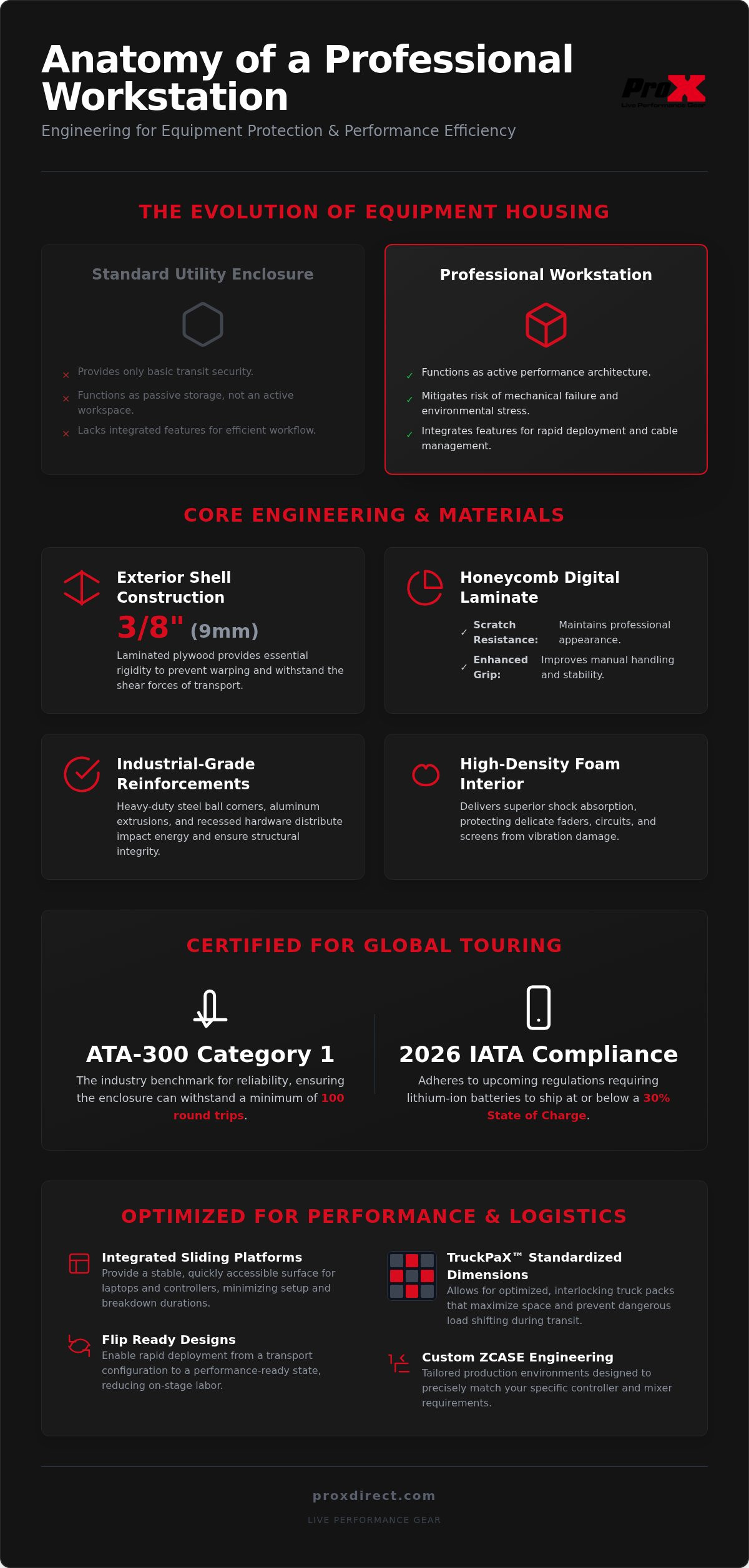
A professional DJ workstation case represents a shift from passive storage to active performance architecture. A standard utility case provides basic transit security, but a workstation functions as a centralized hub for high-value digital controllers and mixers. These assemblies are engineered to mitigate the risks associated with mechanical failure and environmental stressors encountered during global touring. Professional-grade protection is mandatory for modern digital gear. Sensitive internal components and high-resolution touchscreens require more than just a simple shell.
The Evolution of Professional Protection
Early equipment housing focused exclusively on physical impact resistance. Modern engineering has transitioned toward setup-integrated designs that accommodate complex audio, power, and data management requirements. Mobile professionals now utilize systems like Flip Ready cases made by ZCASE, which prioritize ergonomics and rapid deployment. These sophisticated solutions allow for a seamless transition from transit to performance. They effectively reduce the labor required for stage assembly. This evolution reflects the industry's shift toward multi-functional environments where the case is a part of the hardware interface itself.
Core Components of a Heavy-Duty Workstation
Structural integrity begins with material science. Professional builds utilize high-density internal foam for superior shock absorption. This protects delicate faders and circuits from vibration damage. The exterior usually consists of 3/8-inch laminated plywood, reinforced with heavy-duty ball corners and recessed hardware to ensure load-bearing stability. Adherence to Road Case Construction Standards like the ATA-300 Category 1 specification ensures the unit can withstand at least 100 round trips.
Logistical efficiency is another hallmark of professional design. Utilizing a DJ workstation case with TruckPaX™ standardized dimensions allows for optimized truck pack configurations. This maximizes space and prevents load shifting. Every component is selected for its ability to prevent equipment downtime. Reliability isn't an accident. It's the result of precise mechanical assembly and a deep understanding of the physical demands placed on professional production gear.
Engineering Specifications: Materials and Structural Integrity
The mechanical integrity of a DJ workstation case depends on the selection of industrial-grade materials. Most professional-tier builds utilize 3/8-inch (9mm) laminated plywood. This thickness provides the necessary rigidity to prevent warping under heavy loads while maintaining a manageable weight for transport. Thinner alternatives often fail under the shear forces encountered during air transit or rough vehicle loading. A robust build ensures that the internal components remain isolated from external kinetic energy.
Adherence to the ATA 300 Specification serves as the baseline for touring reliability. This standard ensures the enclosure survives the repetitive stress of loading docks and cargo holds over a minimum of 100 trips. Structural longevity is further enhanced by industrial-grade ball corners. These steel components distribute impact energy across the frame rather than allowing it to penetrate the equipment compartment. The integration of heavy-duty aluminum extrusions around the lid and base creates a tongue-and-groove fit that prevents moisture and dust ingress during transit.
Laminate Technology and Surface Protection
Surface protection involves more than just aesthetics. Professional workstations often feature a honeycomb-style digital laminate. This hexagonal texture serves two functional purposes. It provides superior scratch resistance compared to flat surfaces, and it increases surface friction. This improved grip is vital for manual handling and prevents cases from shifting in a truck pack. This material science ensures the unit maintains a professional appearance through hundreds of performance cycles. If you're looking for high-durability options, exploring professional-grade case categories can help you find the right material specs for your tour.
Hardware and Fastening Systems
Hardware selection defines the operational lifespan of the assembly. Recessed butterfly latches are the industry standard because they sit flush with the case surface. This design prevents snagging on other gear or clothing during transport. Spring-action handles are similarly recessed to maintain a clean profile while offering high load ratings for manual lifting. These handles utilize rubber grips to reduce hand fatigue during long load-ins.
The assembly's strength relies on industrial rivets placed at calculated intervals. These fasteners secure the aluminum extrusions to the plywood panels, creating a unified structural cage that resists torsion. For larger workstations, load-rated casters are essential. These wheels must withstand high static loads and provide smooth movement across varying stage surfaces. Every fastener, hinge, and brace is a critical point of potential failure. Engineering precision in these components is non-negotiable for touring professionals who require zero-fail performance.
Performance Features: Setup Efficiency and Ergonomics
Technical performance in a professional environment is often dictated by the efficiency of the physical workspace. While software handles data processing, the physical assembly of a rig remains a significant manual bottleneck. A high-quality DJ workstation case addresses this through integrated hardware features like sliding trays and cable ports. These mechanical solutions allow for a permanent internal wiring harness. You don't spend valuable pre-show time reconnecting data cables or power supplies. Instead, the workstation arrives with the core signal path already established, reducing the margin for human error during high-pressure changeovers.
Integrated Shelving and Accessory Support
Ergonomics play a vital role in maintaining artist focus during long-duration sets. Positioning laptops and controllers at the correct height and angle is essential for optimal line-of-sight to touchscreens and faders. Integrated sliding shelves provide a stable platform for peripherals without requiring additional external stands. These trays are often engineered with ventilation slots to facilitate heat dissipation. Thermal management is critical in enclosed environments where processors generate significant heat. Secure mounting systems ensure that interfaces remain stationary during aggressive performance movements, maintaining the integrity of the technical setup.
Flip Ready Systems for Mobile Production
For high-volume mobile production, the Flip Ready cases made by ZCASE in Poland represent the peak of setup optimization. These units utilize a specialized hydraulic-assisted hinge and integrated stand system. This engineering allows a single operator to transition a heavy console from a truck pack state to a performance state in under three minutes. Reducing the labor required for stage assembly directly impacts the bottom line by lowering crew costs and minimizing physical fatigue.
Adhering to Ergonomic Safety Principles is a priority for any professional production company. Traditional setups often require multiple technicians to lift heavy consoles onto separate tables, increasing the risk of musculoskeletal injury. Flip Ready technology eliminates this requirement through mechanical leverage. The internal routing solutions within these workstations also ensure a clean workspace. Disorganized cables are a mechanical risk; they lead to accidental disconnections and signal interference. By utilizing dedicated channels and pass-through ports, you achieve a standardized, professional stage presence that reflects the reliability of your brand.
Selecting the Right Configuration for Your Hardware
Selecting a DJ workstation case requires a meticulous calculation of mechanical tolerances and electrical accessibility. A generic fit might accommodate the physical footprint of a controller, but it often fails to provide the precise lateral support needed to prevent internal component shifting. Professional touring environments demand custom-molded foam inserts that mirror the specific contours of your hardware. This ensures that impact energy is distributed across the chassis rather than being focused on sensitive points like faders or touchscreen interfaces. You don't want your gear moving even a millimeter during transit.
Evaluating rack space requirements is a critical step in the configuration process. Many touring professionals integrate outboard gear such as power conditioners, wireless microphone receivers, or digital processors directly into their workstation. Cases with 1U or 2U rack compartments below the main controller area allow for a fully self-contained ecosystem. This configuration minimizes external cabling and centralizes power distribution. It's a logistical necessity for maintaining a clean and reliable technical environment. For bespoke production rigs that require non-standard dimensions, ZCASE custom build services in Poland offer tailored engineering solutions that accommodate complex hardware arrays.
Compatibility with Professional Standards
Engineering for industry-standard hardware, such as Pioneer DJ controllers, involves more than matching height and width. A professional design must provide adequate clearance for rear-panel ports, side-access faders, and cooling vents. If the foam is too tight or the port access is restricted, you risk overheating your equipment or damaging expensive cables. Future-proofing your selection is also vital. Choosing a case with modular foam inserts allows you to adapt the internal configuration when you upgrade your hardware, extending the ROI of your protective investment.
Santosom Engineering: The Premium Standard
Santosom designs represent the peak of structural builds for high-performance touring. These cases are engineered with a focus on mechanical consistency. Every panel and extrusion is selected to withstand the extreme rigors of international logistics. The precision engineering of these units ensures that they maintain their structural integrity even after repetitive high-impact cycles. For those who require the highest level of reliability, Santosom Cases: Engineering Excellence provides a deeper look into the material science that defines this tier of protection.
The integrity of your performance depends on the stability of your housing. Select your configuration from our comprehensive range of professional workstations to ensure total equipment compatibility and long-term durability.
Professional Logistics and Case Maintenance
Logistical efficiency in touring operations is measured by trailer density and load-in speed. A professional DJ workstation case should not have arbitrary dimensions. Using TruckPaX™ standardized dimensions allows production managers to calculate exact footprints for truck packs. This standardization eliminates dead space in the trailer, which directly reduces fuel and transport costs over a tour's duration. Stacking protocols require that cases with identical footprints are placed vertically to maintain center-of-gravity stability. This methodical approach to spatial management ensures that gear remains secure during high-vibration transit environments.
Air travel introduces additional regulatory hurdles that demand meticulous attention. As of January 1, 2026, IATA regulations mandate that lithium-ion batteries packed with equipment must maintain a State of Charge (SoC) of 30% or less. Non-compliance results in significant fines and transport delays. Professional workstations often house integrated battery backups or portable power stations, making this SoC requirement a critical pre-flight checklist item. Beyond battery safety, air freight demands the ATA-300 Category 1 durability previously discussed to survive the mechanical stresses of automated sorting systems and rough tarmac handling.
Optimizing the Truck Pack
Trailer density is maximized when the protective housing fits within a 90-degree grid. Standardized dimensions ensure that every DJ workstation case aligns with other utility and lighting cases. This predictability allows for faster load-ins and load-outs, as crews don't have to solve a new puzzle at every venue. Secure transport is achieved through the use of high-friction surfaces, such as the honeycomb laminates mentioned in previous sections, which prevent lateral movement when stacked. Standardizing your inventory around these dimensions transforms logistical chaos into a repeatable, efficient process.
Long-Term Maintenance and Repair
Mechanical fatigue is an inevitable result of rigorous touring. Routine maintenance protocols are essential for extending the service life of your enclosure. Inspect recessed butterfly latches for alignment issues and check spring-action handles for tension loss. Industrial foam should be monitored for compression set, which reduces shock absorption capabilities over time. If hardware fails, it's critical to use high-grade components to maintain the original engineering specs. You can find specific hardware in the ProX Cases Replacement Parts catalog to ensure structural consistency. Cleaning the exterior with non-abrasive industrial cleaners maintains the professional appearance required for high-profile stage environments. Consistent care prevents equipment downtime and preserves the integrity of the build.
Standardizing Your Touring Infrastructure
The transition from a simple transport shell to a sophisticated DJ workstation case is a fundamental requirement for the modern touring professional. Engineering-grade protection ensures that your high-value digital assets remain isolated from the physical stressors of international logistics. By prioritizing structural integrity through 3/8-inch laminated plywood and adopting logistical standards like TruckPaX™ dimensions, you minimize operational risks and maximize trailer density. These mechanical standards are the difference between a successful load-in and an expensive equipment failure.
We've provided engineering-grade protection since 1984. Our solutions are trusted by touring professionals worldwide, and we offer custom design-and-build services for bespoke production needs. Maintaining your housing through routine hardware inspections and adhering to the latest 2026 IATA state-of-charge regulations ensures your setup remains reliable through every performance cycle. Precision in your protective gear translates directly to precision on the stage.
Invest in the durability and engineering excellence your production demands. Browse Professional DJ Workstations and Cases to secure your gear for the upcoming season. Your equipment is the backbone of your performance; give it the protection it deserves.
Frequently Asked Questions
What is the difference between a standard case and an ATA-300 style workstation?
An ATA-300 Category 1 workstation is a mechanical assembly engineered to withstand a minimum of 100 round trips in rigorous touring environments. Standard utility cases often lack the 3/8-inch laminated plywood and reinforced steel ball corners required for this specification. Professional workstations also integrate performance architecture, such as internal cable management and sliding trays, which standard storage boxes don't provide.
Can I use a universal DJ workstation case for different controller models?
Universal designs utilize modular high-density foam inserts to accommodate various hardware footprints within a single enclosure. While this offers flexibility for inventory management, a dedicated DJ workstation case tailored to a specific model provides superior lateral stability. If you frequently update your equipment, choose a universal configuration that allows for internal foam adjustments without compromising the exterior structural integrity.
How do I maintain the foam interior of my DJ equipment case?
Maintaining the foam interior of a DJ workstation case requires regular inspection for compression set and debris. Use a vacuum with a soft brush attachment to remove dust that can migrate into your controller's faders or touchscreens. If the foam shows signs of permanent indentation or loses its shock-absorbent properties, replace the sections with industrial polyethylene foam to ensure continued equipment isolation.
What are the benefits of integrated laptop shelves in a workstation?
Integrated laptop shelves improve ergonomic alignment and optimize the vertical footprint of your performance area. These sliding trays allow you to position your computer directly over the controller, maintaining a clear line-of-sight to both the software and the hardware interface. This design eliminates the need for external stands, which reduces stage clutter and minimizes the time required for signal path assembly.
How does case weight affect professional touring logistics?
Case weight directly impacts fuel efficiency and manual handling safety during load-ins. While 3/8-inch plywood is heavier than plastic, its structural density is required for high-density truck packs. Standardizing your setup with TruckPaX™ dimensions helps manage this weight by ensuring stable centers of gravity. This predictability reduces the risk of load shifting and protects the mechanical assembly from torsional stress during transit.
Are custom-engineered cases necessary for standard DJ gear?
Custom engineering is necessary when standard enclosures can't accommodate specific outboard gear or bespoke controller arrays. While many professionals utilize off-the-shelf Santosom designs for standard Pioneer DJ hardware, ZCASE custom builds allow for the integration of power conditioners and wireless receivers. This level of customization ensures your specific technical requirements are met without compromising the enclosure's durability or logistical standards.
What hardware features should I look for to ensure setup efficiency?
Prioritize recessed butterfly latches and spring-action handles to prevent snagging during transport. Setup efficiency is further enhanced by Flip Ready hydraulic-assisted hinges and integrated cable management ports. These features allow for a permanent internal wiring harness. This enables a single technician to transition from a truck pack to a stage-ready state in under three minutes, which significantly reduces crew labor requirements.
How do I choose between a Flip Ready case and a mobile workstation tower?
The choice depends on your required stage footprint and the complexity of your outboard gear. A Flip Ready case is engineered for rapid deployment from a horizontal state, making it ideal for high-volume mobile production. A Control Tower DJ stand or mobile workstation provides a more permanent, vertical stage presence with expanded rack space for processors. Both systems utilize industrial-grade materials to ensure zero-fail protection.
Disclaimer
Any trademarks, trade names or brand names appearing herein that do not belong to ProX are the property of their respective owners and/or companies, and such appearance doesn't and shall not constitute or imply endorsement, sponsorship or recommendation by ProX.


