

A single 4-inch caster determines whether a high-value lighting console survives a cross-country tour or requires extensive repair before the first load-in. For production professionals, choosing the best wheels for road cases is a critical engineering decision rather than a simple hardware selection. You understand that frequent wheel failure and excessive floor vibration during transport represent significant threats to both equipment longevity and crew safety. Improper caster alignment also complicates truck loading, reducing logistical efficiency when every minute counts.
This article provides a technical framework for mastering caster specifications to ensure zero-fail transport and optimized truck pack density. We will examine the implications of the updated ANSI ICWM-2026 standards, which published on July 14, 2026, and increased brake holding force requirements to 10% of load capacity. You'll learn how to evaluate polyurethane tread durability, load ratings, and the structural benefits of precise wheel height. By prioritizing engineering precision over generic hardware, you can reduce physical strain on your team while maintaining the integrity of your professional gear throughout its service life.
Key Takeaways
- Define the technical distinction between static and dynamic load capacities to ensure hardware remains within safe operating limits during high-impact transport.
- Evaluate the performance benefits of polyurethane versus thermoplastic rubber treads for vibration dampening and long-term durability on varied surfaces.
- Streamline logistical operations by choosing the best wheels for road cases that maintain uniform height standards for optimized truck pack density.
- Master the configuration of swivel and fixed casters to balance 360-degree maneuverability with straight-line stability during heavy load-ins.
- Establish a preventative maintenance schedule focusing on bearing lubrication and tread inspection to prevent catastrophic failure in the field.
Mechanical Integrity: Evaluating Load Capacity in Case Mobility
Structural failure during transport often stems from a misunderstanding of weight distribution and mechanical stress. Choosing the best wheels for road cases isn't just about matching a weight rating to a scale reading; it's about accounting for the physics of motion. A case that seems manageable on a flat warehouse floor can become a liability on a steep truck ramp or over a threshold. Professional gear requires a hardware configuration that maintains integrity under peak stress rather than just meeting average requirements.
Static vs. Dynamic Load Specifications
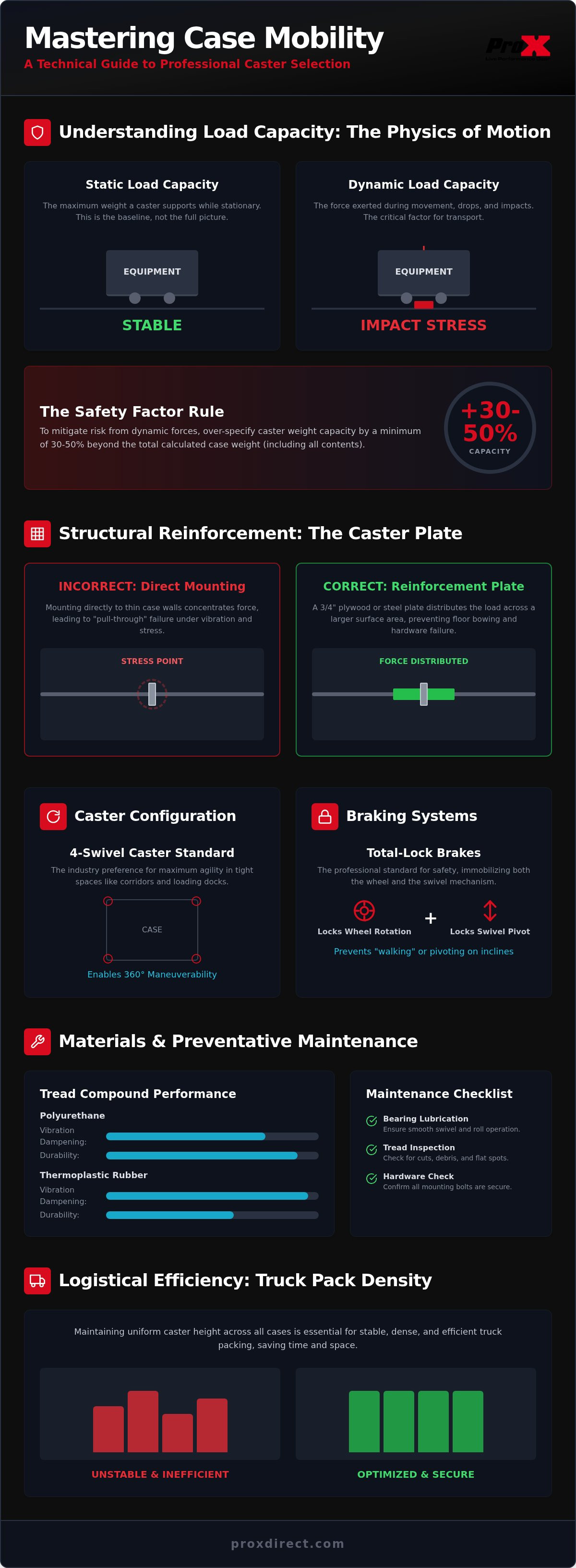
Load ratings are categorized into two distinct metrics: static and dynamic. A static rating refers to the maximum weight a wheel can support while stationary. However, touring environments demand a focus on dynamic capacity. Understanding Caster wheel basics is essential for calculating how weight shifts during transit. A wheel rated for 500 lbs static might fail at 300 lbs during a high-impact load-in because the force of hitting a gap in a ramp multiplies the effective weight. Dynamic load is the force exerted during movement and impact.
Engineers utilize the Safety Factor rule to mitigate these risks. This protocol suggests over-specifying weight limits by at least 30% to 50% beyond the calculated total case weight. When calculating this total, you must include cabling, internal shock mounts, and external accessories. For tall rack cases, the center of gravity plays a pivotal role. A high center of gravity increases lateral stress on the caster's swivel bearings during turns, necessitating a higher dynamic rating than a low-profile trunk of the same weight.
The Role of Caster Plates
The point where the hardware meets the case is a frequent site of structural compromise. When building high-capacity professional cases, the interface between the caster and the case body is the most common point of failure. Direct mounting to a thin laminate floor often leads to "pull-through" failures in high-vibration environments. To prevent this, 3/4-inch birch plywood caster boards or steel reinforcement plates are mandatory for heavy loads.
- Weight Distribution: Reinforcement plates spread the downward force across a larger surface area of the case floor.
- Bolt Patterns: Using a standardized four-bolt pattern with locking nuts ensures the hardware remains seated despite constant road vibration.
- Structural Integrity: Caster plates provide the necessary rigidity to prevent the case floor from bowing under the concentrated weight of heavy amplifiers or power distribution units.
Choosing the best wheels for road cases requires this holistic view of the build. By reinforcing the mounting surface and respecting dynamic load limits, you ensure the hardware survives the physical demands of professional logistics.
Configuration Standards: Swivel, Fixed, and Braking Systems
Touring logistics demand hardware that balances agility with absolute stability. In most professional production environments, a four-swivel caster configuration is the preferred standard. This setup allows for 360-degree rotation, making it easier to maneuver heavy equipment through narrow backstage corridors or tight warehouse aisles. While fixed casters provide superior tracking for long-haul pushes, they lack the multi-directional flexibility required for rapid load-ins. When choosing the best wheels for road cases, the decision between swivel and fixed hardware must be dictated by the specific transit path the gear will follow.
Safety during transit is governed by rigorous mechanical standards. Adhering to OSHA load capacity standards ensures that mobile equipment remains secure under stress. For production gear, braking mechanics are equally vital. Total-lock systems are the industry benchmark because they simultaneously immobilize the wheel rotation and the swivel housing. This dual-action locking mechanism prevents the case from "walking" or pivoting on an incline. In contrast, directional-lock systems only freeze the swivel pivot, which is useful for converting a swivel caster into a temporary rigid unit for long, straight pushes.
Total-Lock vs. Swivel-Lock Mechanics
The security of a total-lock brake is essential when securing cases inside a trailer. These systems utilize a foot-activated lever to apply pressure to both the tread and the swivel raceway. Maintaining proper brake tension is a critical maintenance task for multi-city tours. Over time, vibration can loosen the engagement point, requiring technical adjustment to ensure the brake holds firmly against the wheel tread. Directional locks serve a different purpose. They help crews maintain a straight line on ramps without the case drifting laterally, which reduces the physical strain of guiding heavy loads.
Optimal Caster Placement for Stability
Stability is a function of the wheel's footprint relative to the case's center of gravity. For standard utility trunks, a four-wheel layout at the corners is sufficient. However, oversized utility cases often require a six-wheel configuration to prevent floor bowing and to distribute weight more evenly. When integrating hardware for AV Broadcasting Cases, you must ensure adequate clearance for larger wheels. A 4-inch or 5-inch wheel improves movement over door thresholds but raises the unit's height. This change can shift the tipping point on tall, narrow rack units. Integrating professional-grade hardware components ensures your fleet maintains these configuration standards over years of service.
Material Science: Matching Tread Compounds to Environments
Selecting the correct tread material is a technical requirement that directly impacts the lifespan of your equipment. Polyurethane and Thermoplastic Rubber (TPR) represent the two primary choices for high-stakes production environments. While polyurethane is known for its high load-bearing capacity and resistance to abrasion on rough arena concrete, TPR provides enhanced shock absorption. Choosing the best wheels for road cases requires an understanding of how these materials react to different surfaces and environmental stressors.
Vibration Attenuation for Sensitive Gear
Delicate electronics, such as high-output amplifiers and digital consoles, are susceptible to failure from micro-shocks encountered during transit. Softer durometer wheels act as a primary defense by absorbing high-frequency vibrations before they reach internal components. This protection is vital for preventing solder joint fatigue and mechanical displacement within professional cases. Following established ergonomic guidelines for casters also ensures that the rolling resistance remains low, which reduces the force needed to initiate movement. 4-inch wheels bridge floor gaps more effectively than 3-inch variants, significantly lowering the impact force during transit.
Floor Protection and Grip
Corporate production standards often mandate the use of non-marking hardware to protect ballroom floors and high-end event spaces. Non-marking blue or grey rubber treads are the industry standard for these applications. Unlike black rubber, these compounds won't leave carbon streaks on sensitive surfaces. Traction is another safety factor, especially on steep ramps or wet loading docks. High-grip treads ensure that heavy-duty 4-inch casters maintain control on slick surfaces without sacrificing load integrity.
Temperature resistance is a final consideration for global touring. Polyurethane maintains its structural properties in a wide range of temperatures, from freezing outdoor stages to high-heat desert environments. In contrast, some lower-grade rubber compounds can become brittle or lose traction when exposed to extreme thermal shifts. Industrial-grade wheels also provide chemical resistance, which prevents tread degradation when cases are stored in warehouses where oils or cleaning agents might be present on the floor. By matching the tread compound to the specific environment, you ensure that choosing the best wheels for road cases results in long-term reliability and equipment safety.
Logistical Efficiency: Wheels as a Factor in Truck Pack Density
Logistical efficiency in professional touring relies on the mathematical predictability of case dimensions. Choosing the best wheels for road cases involves more than just load ratings; it requires an analysis of how those wheels integrate into a standardized transport system. When every inch of trailer space is accounted for, the vertical and horizontal footprint of your casters dictates the success of your truck pack. Inconsistent hardware selection leads to uneven stacking, which compromises both safety and volume utilization.
Standardizing the Fleet
Mixing wheel brands or models across a production house often results in minor height discrepancies. Even a 1/4-inch variance in caster height can cause a stack of three cases to lean, creating instability during transit. Utilizing uniform ProX Cases hardware ensures that every unit in the inventory maintains a consistent profile. This standardization is particularly critical when deploying TruckPaX™ Truck Pack Cases, which are engineered specifically to fit standard trailer widths in 90-inch or 96-inch increments.
- Stackability: Top-mounted caster cups must align perfectly with the wheel footprint to lock cases together.
- Footprint Precision: Standardized swivel radii prevent casters from colliding when cases are packed tight, wall-to-wall.
- Pallet Jack Clearance: Uniform wheel height ensures that cases maintain enough ground clearance for standard pallet jacks and lift gate transitions.
Maximizing Trailer Volume
Vertical space is often the most wasted resource in logistics. While a 4-inch caster is the industry standard for rolling over obstacles, it adds significant height to a stack. In contrast, 2-inch low-profile options save vertical space but increase rolling resistance. To balance protection and density, engineers often utilize recessed caster dishes. These allow the wheels to sit partially inside the case structure, lowering the overall center of gravity and maximizing the number of units that can be tiered in a standard trailer.
Recessed wheels also improve stability during high-G transport maneuvers by reducing the leverage exerted on the case floor. For a deeper look at how these components integrate into the overall build, refer to the Ultimate Guide to Flight Cases. This structural context helps you decide when to prioritize low-profile density over large-diameter mobility. To ensure your fleet meets these rigorous logistical standards, standardize your inventory with professional-grade hardware designed for high-density packing.
Maintenance and Precision Replacement Protocol
A proactive maintenance cycle is essential to prevent hardware failure in high-stakes touring environments. Choosing the best wheels for road cases is a long-term investment that requires regular technical oversight to maintain mechanical integrity. Without a structured protocol, minor issues like bearing play or debris buildup can escalate into catastrophic failures during a load-in. Establishing a rigorous inspection schedule ensures that every component in your fleet remains within operational specifications.
Visual inspections should focus on three primary areas: tread condition, bearing movement, and mounting stability. Flat spots are a common failure point, typically caused by leaving heavy cases stationary for extended periods. These deformities increase rolling resistance and introduce vibration that can damage sensitive internal electronics. Additionally, swivel bearings must be checked for lateral play, which indicates internal raceway wear. Any hardware showing significant deviation from its original tolerances should be flagged for immediate replacement.
Identifying Failure Points
Bearing fatigue often manifests as a subtle grinding sound or increased resistance during rotation. Detecting these signs before a wheel seizes is critical for maintaining logistical efficiency. For cases exposed to outdoor mud or stage dust, cleaning protocols are mandatory. Debris trapped in the swivel mechanism or axle can act as an abrasive, rapidly degrading the hardware. You'll also need to verify bolt torque after long-distance ground transport, as constant road vibration can loosen mounting hardware and compromise the connection between the caster and the reinforcement plate.
The Replacement Process
When hardware reaches the end of its service life, precision fitment is the priority. Engineers follow the "One-Wheel Rule," which dictates that casters should be replaced in pairs or full sets rather than individually. This practice prevents height imbalances that lead to unstable stacking and uneven weight distribution. Sourcing ProX Cases Replacement Parts ensures that mounting hole alignment matches existing caster plates perfectly, eliminating the need for structural modifications to the case floor.
Upgrading from standard to heavy-duty wheels requires a thorough evaluation of the existing build. Ensure the case can support the increased load capacity and that the new hardware doesn't interfere with standard truck pack dimensions. To maintain your fleet's professional standards, you can browse the full range of ProX replacement casters for professional reliability and guaranteed compatibility with your existing inventory.
Optimizing Your Mobile Infrastructure
Maintaining professional standards across a touring fleet requires a commitment to engineering precision. Choosing the best wheels for road cases involves balancing dynamic load capacities with the material science of tread compounds to ensure long-term reliability. By standardizing your hardware, you achieve predictable truck pack density and reduce the mechanical stress placed on sensitive internal electronics. Industrial-grade bearing systems and non-marking high-durometer treads aren't just optional features; they're essential safeguards against the physical demands of high-frequency transport.
Standardization also simplifies your maintenance cycle. Utilizing hardware that offers direct compatibility with Santosom and ProX designs eliminates the guesswork during the replacement process. This structured approach to hardware management allows your crew to focus on the production rather than struggling with failing casters or unstable stacks. It's the difference between a seamless load-in and a logistical bottleneck.
Upgrade your gear with ProX Professional Replacement Parts to ensure your equipment remains secure and mobile through every city on the itinerary. Your commitment to technical excellence starts with the hardware that carries your show.
Frequently Asked Questions
What is the standard wheel size for professional production cases?
The 4-inch (100mm) caster is the established industry standard for professional production gear. This size provides the optimal balance between high load capacity and the mechanical ability to roll over door thresholds and truck ramps without seizing. While 2-inch low-profile options exist for specific high-density needs, the 4-inch diameter remains the primary choice for ensuring consistent mobility over uneven surfaces in arena and warehouse environments.
How do I calculate the load capacity needed for my road case wheels?
To calculate required capacity, divide the total loaded case weight by three rather than four. This safety factor accounts for uneven floors where only three wheels might be in contact with the ground at once. When choosing the best wheels for road cases, ensure the dynamic load rating of each individual caster exceeds this calculated value to prevent mechanical failure during high-impact transit or ramp movement.
Which caster material is best for protecting sensitive audio and lighting gear?
High-durometer polyurethane or Thermoplastic Rubber (TPR) treads are the most effective materials for vibration attenuation. These compounds absorb high-frequency micro-shocks that can lead to solder joint fatigue in sensitive electronics. Polyurethane is particularly valued for its high load capacity and resistance to flat-spotting, making it superior for heavy amplifiers and digital consoles that remain stationary for long durations between tours.
Can I mix different brands of casters on the same case?
Mixing caster brands is not recommended because of minor variations in overall height and swivel radius. Even a 1/4-inch difference between hardware brands can cause a case to lean, creating unstable stacks in a trailer. For professional reliability, replace casters in full sets or identical pairs to maintain a level center of gravity and ensure compatibility with standard caster cups during tiered stacking operations.
What is the difference between a total-lock and a directional-lock brake?
A total-lock brake immobilizes both the wheel rotation and the swivel raceway, providing absolute stability on inclines. In contrast, a directional-lock only freezes the swivel mechanism, essentially converting a swivel caster into a rigid unit for long, straight pushes. The updated ANSI ICWM-2026 standard requires a brake holding force of 10% of the load capacity to ensure these systems meet the safety requirements for heavy mobile equipment.
How often should I lubricate my road case casters during a tour?
Lubrication schedules depend on environmental exposure, but a standard maintenance interval is every three to six months. Swivel bearings and axles require high-quality lithium grease to prevent seizing and reduce friction. If your gear is frequently exposed to outdoor mud, stage dust, or extreme humidity, you should perform maintenance more often. Regularly cleaning debris from the raceways will extend the service life of industrial-grade bearing systems.
Why are blue wheels so common in the professional event industry?
Blue wheels signify a specific non-marking, high-durometer polyurethane compound that has become a professional standard. These wheels don't leave carbon streaks on ballroom floors or high-end venue surfaces. When choosing the best wheels for road cases, selecting these non-marking blue variants allows you to comply with strict venue requirements while maintaining the structural durability needed for heavy production equipment and high-frequency transport cycles.
Should I use recessed caster dishes for all my touring gear?
Recessed caster dishes are highly beneficial for tall rack units and high-density truck packs because they lower the center of gravity and reduce overall height. This configuration improves stability during transport and maximizes vertical trailer space. However, they may not be suitable for cases requiring maximum ground clearance for steep ramps. Evaluate the specific logistical needs of your production house before standardizing recessed hardware across all case types.
Disclaimer
Any trademarks, trade names or brand names appearing herein that do not belong to ProX are the property of their respective owners and/or companies, and such appearance doesn't and shall not constitute or imply endorsement, sponsorship or recommendation by ProX.


