

The heaviest case in your inventory isn't necessarily the most protective; it's often just the most expensive to ship. For engineers managing complex touring logistics, the decision between a plywood vs molded plastic flight case is rarely about aesthetics and always about the physics of protection. You've likely felt the impact of rising freight costs as airlines enforce strict 50-pound weight limits, often imposing prohibitive fees for anything exceeding 70 pounds. While 12mm plywood remains a staple for ATA 300 Category I durability, the added mass can compromise your logistical efficiency.
We understand that equipment failure isn't an option when high-value gear is in transit. This article provides a technical framework to help you select the optimal structural material based on your specific travel frequency and equipment sensitivity. We'll analyze the mechanical properties of high-density polyethylene versus traditional birch laminates, examining how each material handles vibration, moisture, and stacking density in standard truck dimensions. This comparison delivers a clear strategy for choosing materials like the TruckPaX™ system for density or UltronX™ for watertight requirements. By the end of this guide, you'll have the data required to lower your logistical overhead without sacrificing the structural integrity of your mobile workstations or rack systems.
Key Takeaways
- Analyze the mechanical properties of multi-layer birch versus high-density polyethylene to ensure your material choice aligns with specific equipment sensitivity.
- Assess the logistical implications of a plywood vs molded plastic flight case, focusing on weight-to-strength ratios and the impact on long-term freight expenses.
- Discover why standardized dimensions and systems like TruckPaX™ are critical for maximizing cargo space and efficiency during large-scale touring logistics.
- Determine when to prioritize the custom engineering capabilities of plywood for complex consoles versus the watertight, lightweight protection of molded shells.
- Establish a clear framework for material selection based on the physical demands of professional production environments and ATA 300 durability standards.
Structural Integrity: Plywood and Molded Plastic Engineering Defined
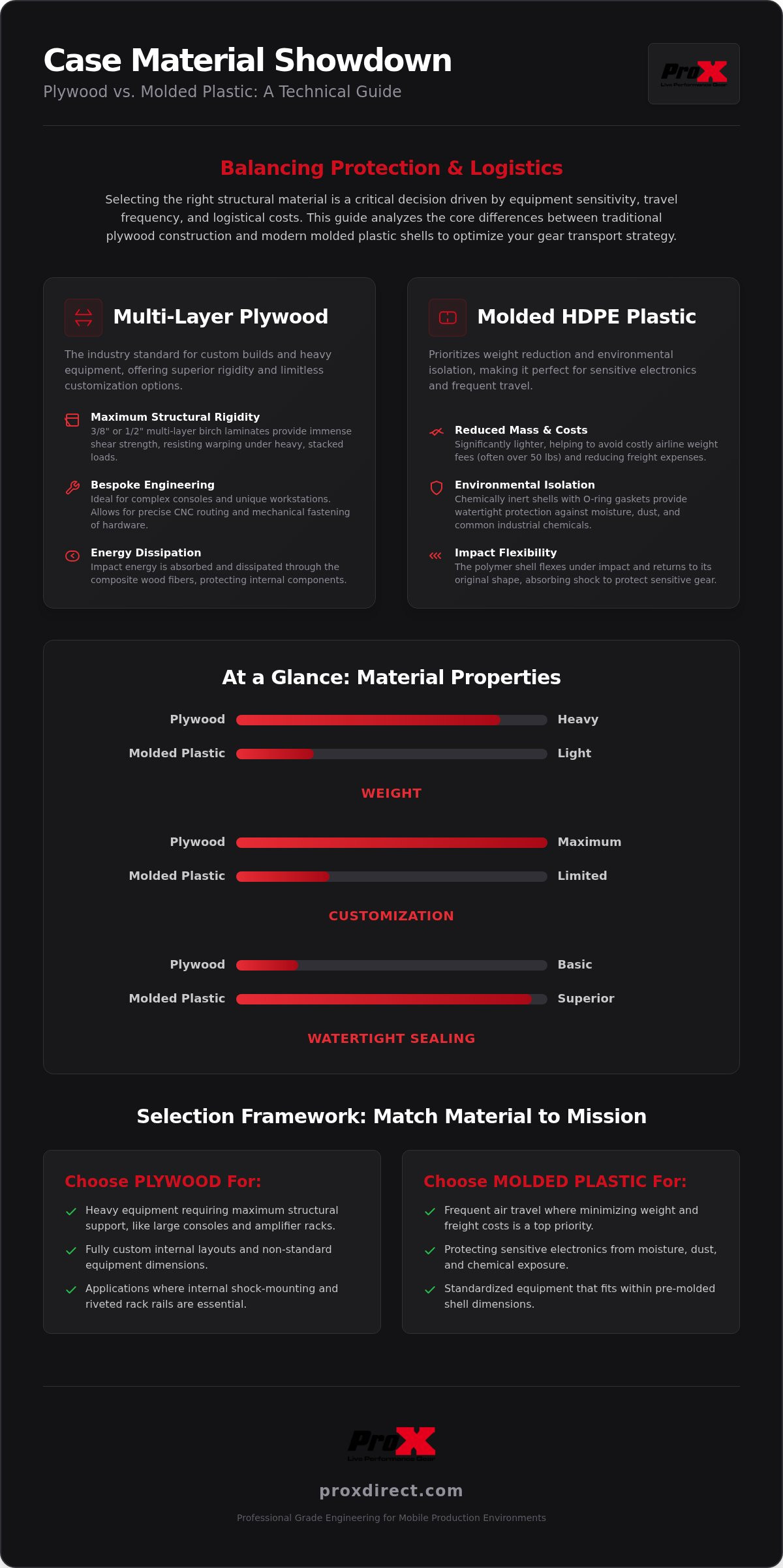
Professional grade shipping container design relies on specific material properties to mitigate kinetic energy during transit. A plywood vs molded plastic flight case comparison begins with the base substrate. Plywood builds utilize multi-layer birch laminates, where thin veneers are bonded with alternating grain directions. This cross-grain construction creates a dimensionally stable panel that resists warping under heavy vertical loads. In contrast, molded cases utilize high-density polyethylene (HDPE), formed through high-pressure injection or rotational molding. Selecting between a plywood vs molded plastic flight case requires an understanding of how these materials react to mechanical stress and environmental exposure.
The Role of Plywood in Professional Production
Structural rigidity in plywood cases depends on panel thickness. We utilize 3/8-inch or 1/2-inch plywood to provide the necessary shear strength for heavy rack gear and consoles. The external surface often features advanced laminates like Honeycomb Digital™, which provides a hexagonal grid pattern for superior scratch resistance. Plywood is the preferred material for complex ProX Cases because it allows for precise CNC routing and the mechanical fastening of aluminum extrusions. Rivets pass through the wood and the aluminum, creating a unified bond that distributes stress across the entire frame. This traditional assembly remains the industry standard for custom workstations where internal geometry is unique and requires bespoke engineering.
Molded Plastic and High-Density Polyethylene (HDPE)
Molded cases prioritize environmental isolation and weight reduction. HDPE is chemically inert, which makes these shells resistant to hydraulic oils, fuels, and acids common in industrial or warehouse settings. The manufacturing process allows for integrated features like reinforced corners and stacking ribs directly in the mold. Unlike plywood, plastic possesses a mechanical memory that enables the shell to flex under impact and return to its original shape. This flexibility acts as a primary shock absorber for sensitive electronics. For extreme environments, molded designs incorporate O-ring gaskets and pressure equalization valves to maintain watertight integrity. These features ensure that internal components remain dry even during significant atmospheric pressure changes or accidental immersion. The choice often comes down to whether the gear requires the rigid, customizable frame of plywood or the lightweight, sealed environment of a molded shell.
Comparative Analysis: Durability, Weight, and Mechanical Resistance
Analyzing the mechanical resistance of a plywood vs molded plastic flight case requires looking beyond initial surface hardness. Plywood excels at energy dissipation. Because it's a composite of organic fibers and adhesive layers, impact energy travels through the material, vibrating the fibers and losing force before it reaches the internal foam. Plastic cases, particularly injection-molded shells, rely on the elasticity of the polymer to absorb shock. While high-density polyethylene (HDPE) has a high strength-to-density ratio, it doesn't offer the same thermal insulation as wood. Extreme heat can lead to structural softening in some plastics, whereas plywood remains dimensionally stable across a wider temperature range, protecting sensitive electronics from rapid thermal shifts.
The Weight Penalty vs. Protection Premium
Logistical planning often centers on the 50-pound airline baggage threshold. Plywood cases, especially those using 1/2-inch panels and heavy casters, quickly exceed this limit. For production professionals, the weight of traditional builds is a necessary trade-off for gear that requires internal shock-mounting. Heavy amplifiers or large-format mixers need the rigid anchorage provided by riveted rack rails. If your logistics involve frequent air travel or fly-dates, the reduced mass of a molded shell like the UltronX™ series can significantly lower freight costs. Understanding the environmental impacts of flight case materials and their lifecycle is also becoming a factor in large-scale procurement for sustainable touring.
Long-Term Durability and Maintenance
Maintenance is where the two materials diverge most sharply. Plywood cases are built using a modular assembly of aluminum extrusions, steel ball corners, and recessed latches. These steel components are designed to take the brunt of an impact, protecting the plywood edges from splitting. If a corner is crushed or a latch is sheared off, the hardware can be drilled out and replaced with standard tools. Plywood cases are often considered 'lifetime' investments because the structural panels and hardware can be refurbished or replaced indefinitely. Molded plastic cases often feature integrated, molded-in handles and hinges. If the structural ribbing or a hinge point fails on a molded case, the entire shell typically requires replacement. For those managing long-term inventories, choosing a plywood vs molded plastic flight case often comes down to this modularity. ProX Cases built with plywood offer a lower total cost of ownership through this sustained repairability.
Logistical Impacts: Customization vs. Standardized Dimensions
Logistical efficiency in professional production is defined by dimensional compatibility. The decision between a plywood vs molded plastic flight case often rests on how well the container integrates into a standardized transport environment. Plywood cases dominate the professional touring sector because they are manufactured to "truck pack" standards. These dimensions allow cases to sit flush against trailer walls, maximizing cubic volume and preventing load shifts. Molded cases offer high durability but are constrained by the fixed dimensions of the molding tools, which often lead to wasted space in a high-density cargo environment.
Optimizing for Truck Pack Efficiency
Achieving maximum density requires uniform external dimensions that align with standard trailer widths. TruckPaX™ Truck Pack Cases utilize 22.5-inch and 45-inch widths to ensure that three or four cases fit perfectly across the interior of a production truck. This modularity is difficult to achieve with molded plastic shells, which often feature tapered walls and protruding handles that create air gaps between units. While molded options are excellent for individual kits, plywood remains the logistical standard for large-scale deployments where every square inch of floor space translates to freight savings. This technical context is supported by industry data on Hard Cases: Types, Uses & Accessories, which notes how material selection dictates the scalability of a container system.
Bespoke Engineering for High-Value Gear
Precision protection for non-standardized equipment requires the flexibility of CNC-routed plywood. Molding processes involve significant upfront tooling costs, making them impractical for low-volume or custom builds. ZCASE Custom Build Cases leverage the structural versatility of birch panels to create bespoke internal geometries for audio consoles and broadcasting workstations. This allows engineers to integrate specialized hardware like flip-up workstation mechanisms or internal cable management trays that are impossible to execute in a fixed plastic mold.
When comparing a plywood vs molded plastic flight case for sensitive electronics, the internal management system is just as critical as the outer shell. Plywood builds allow for the use of high-density polyethylene (HDPE) or ester foam inserts tailored to the specific center of gravity of the gear. Molded cases often rely on pick-and-pluck foam, which provides immediate utility but lacks the long-term durability required for repetitive professional use. For gear that requires a perfect mechanical fit and complex internal architecture, the engineering freedom provided by plywood remains unmatched.
Application Guide: Selecting Material Based on Equipment Type
Choosing between a plywood vs molded plastic flight case requires a precise audit of your equipment's mechanical requirements. For large-format audio consoles, plywood is the objective choice. The mass of 1/2-inch birch panels provides a stable operating base, preventing the console from shifting during fader-heavy performances. This weight acts as a natural dampener against stage vibrations. While previous sections detailed the logistical benefits of plywood, its application in audio is primarily about providing a rigid, non-resonant housing for sensitive electronics.
High-Value Audio and Lighting Logistics
For high-voltage gear, amplifier rack cases built from plywood offer superior shock-mounting capabilities. These builds allow for internal rack rails to be mechanically decoupled from the outer shell, protecting internal transformers from impact. Lighting fixtures present a different challenge. Large-scale rigs often involve hundreds of units, where the cumulative weight of plywood cases can exceed the load limits of a truck's lift gate. In these scenarios, engineers often use molded cases for individual high-value moving-head fixtures to protect delicate sensors while utilizing large plywood trunks for bulk items like stage truss and base plates. Plywood remains the standard for utility storage because it allows for custom internal dividers that maximize organization for cables and hardware.
The Mobile Professional's Dilemma
Individual operators often face a different set of physical transport limits. Selecting a DJ equipment case involves balancing professional aesthetics with the need for solo transport. While plywood provides a classic industrial appearance that clients associate with high-end production, molded cases offer a significant weight advantage for stairs and frequent vehicle loading. Watertight molded options are essential for outdoor festivals where humidity and rain pose a direct threat to sensitive microphone diaphragms and wireless receivers. These cases utilize O-ring gaskets to create a sealed environment that plywood cannot replicate without extensive custom sealing.
Ultimately, the decision between a plywood vs molded plastic flight case is determined by the specific failure points of your gear. If you need modularity and mass for stability, choose plywood. If you need environmental isolation and low mass for air travel, choose molded plastic. Explore our full range of ProX Cases to find the engineered solution that fits your specific touring profile.
ProX Engineering Standards: Implementing Plywood and Molded Solutions
ProX has maintained a commitment to industrial-grade protection since 1984. We don't view the plywood vs molded plastic flight case debate as a choice between superior and inferior materials, but as a selection between two distinct engineering paths. Our manufacturing process utilizes technical data from decades of field use to determine which substrate provides the highest survival rate for specific equipment. By offering both high-density polyethylene shells and multi-layer birch builds, we ensure that production professionals have access to the exact mechanical properties their logistics demand.
The UltronX™ Advantage for Field Production
The UltronX™ series is engineered for environments where environmental isolation is the primary requirement. These cases utilize high-density polyethylene (HDPE) to achieve watertight and dustproof seals that meet rigorous IP67 standards. A critical component of this design is the integrated pressure equalization valve. This valve automatically manages internal pressure during rapid altitude shifts in air transport, preventing the vacuum lock that often compromises lesser molded shells. For AV Broadcasting Cases and field recording rigs, the UltronX™ line provides a lightweight, chemically resistant barrier against moisture, sand, and impact. The molded-in stacking ribs ensure that even when loaded into a mobile unit, the cases remain locked in place to prevent lateral shifting.
Santosom and the Future of Plywood Engineering
For large-scale touring and high-value console protection, the Santosom by ProX line represents the peak of European plywood craftsmanship. These cases integrate modern CNC precision into the traditional assembly of 9mm and 12mm birch panels. This partnership allows for tighter tolerances in the mechanical bond between the plywood and the aluminum extrusions. Santosom cases often feature specialized laminate textures that provide superior grip and scratch resistance compared to standard PVC finishes. This engineering-forward approach ensures that the "give" of the plywood substrate is perfectly calibrated to the weight and center of gravity of the gear it houses.
Selecting the correct container requires an objective analysis of your tour's physical demands. Whether you need the rigid modularity of a birch build or the environmental sealing of an HDPE shell, ProX dealers are equipped to provide technical consultations for custom engineering projects. Explore our full range of professional cases to find the material solution that optimizes your logistical efficiency and equipment safety.
Optimizing Your Technical Logistics Strategy
Selecting the correct plywood vs molded plastic flight case is a strategic decision that directly impacts equipment longevity and logistical overhead. Plywood remains the industry standard for high-density truck packs and bespoke engineering, while molded plastic provides the environmental isolation and weight savings required for modern air travel. Professionals must balance these mechanical properties against the specific failure points of their inventory to maintain operational reliability.
Our engineering team has prioritized functional excellence since 1984 to support the high-stakes demands of professional production. Industry veterans using Pioneer DJ and QSC equipment rely on our builds for consistent performance in extreme environments. Whether you require the rigid precision of Santosom plywood or the watertight integrity of the UltronX™ series, we offer the technical expertise needed to secure your gear. We also provide custom engineering services for bespoke builds that require non-standardized protection.
It's time to secure your inventory with solutions built for the physical realities of the road. Browse the ProX Catalog for Professional Touring Cases and upgrade your logistical efficiency today.
Frequently Asked Questions
Is plywood or molded plastic better for international air travel?
Molded plastic is superior for international air travel due to its lower tare weight. Airlines enforce strict 50-pound baggage limits and 70-pound maximums for standard freight. Utilizing lightweight high-density polyethylene shells helps production teams keep the total weight of their kits within these thresholds. This prevents the excessive overweight fees often triggered by heavy-duty 1/2-inch plywood builds during global tours.
Can molded plastic cases be repaired if the shell cracks?
Structural cracks in molded plastic shells are generally non-repairable. If the high-density polyethylene substrate fails, it compromises the unit's mechanical integrity and environmental seal permanently. This differs from plywood builds where damaged panels or hardware can be drilled out and replaced with standard tools. A cracked molded shell usually requires the replacement of the entire case to ensure equipment safety.
Why are plywood cases still the standard for professional touring?
Plywood cases remain the professional touring standard due to their modularity and dimensional consistency. The TruckPaX™ system utilizes standardized 22.5-inch and 45-inch widths to maximize cargo density in logistics trailers. Molded cases often feature tapered walls and integrated handles that create air gaps between units. Plywood's rigid, square dimensions ensure a stable truck pack that prevents load shifting during long-distance transit.
Do molded cases offer better protection against moisture and humidity?
Molded cases offer superior protection against environmental factors compared to plywood. The UltronX™ series utilizes O-ring gaskets and pressure equalization valves to create a watertight, dustproof environment. Plywood is an organic, porous material that can absorb moisture or warp in extreme humidity over time. For outdoor festivals or marine environments, the sealed high-density polyethylene shell provides the most reliable barrier against atmospheric damage.
How do I calculate the weight difference for a full truck pack?
Calculate the weight difference by comparing the tare weight of a molded shell against an equivalent plywood build. A standard 2U rack in molded plastic is significantly lighter than a 3/8-inch birch equivalent. When multiplied across a full truck pack of fifty cases, this weight reduction can reach several thousand pounds. This data is essential for staying within the gross vehicle weight rating of tour trailers.
Are plywood cases more expensive than molded plastic alternatives?
Initial investment costs depend on the manufacturing process and hardware requirements. Plywood cases involve higher manual labor costs for assembly and riveted hardware installation. Molded cases require significant upfront capital for injection or rotational molding tools. When evaluating a plywood vs molded plastic flight case, consider that plywood offers a lower long-term cost of ownership because its modular components are easily refurbished.
Which material is better for custom-sized production equipment?
Plywood is the optimal material for custom-sized production equipment. CNC routing technology allows for the creation of bespoke internal geometries and non-standard external dimensions without expensive tooling. Molded cases are limited to fixed sizes determined by existing molds. For unique audio consoles or specialized broadcasting workstations, the engineering flexibility of birch panels remains the only cost-effective solution for precision protection.
What is the lifespan of a professional-grade plywood case vs. plastic?
Professional-grade plywood cases typically offer a longer service life due to their modular construction. Every component, from the steel ball corners to the 12mm birch panels, can be replaced if damaged. While molded cases are extremely durable, a single structural breach often renders the unit obsolete. A well-maintained plywood vs molded plastic flight case investment can remain in active service for decades through routine hardware refurbishment.
Disclaimer
Any trademarks, trade names or brand names appearing herein that do not belong to ProX are the property of their respective owners and/or companies, and such appearance doesn't and shall not constitute or imply endorsement, sponsorship or recommendation by ProX.


