

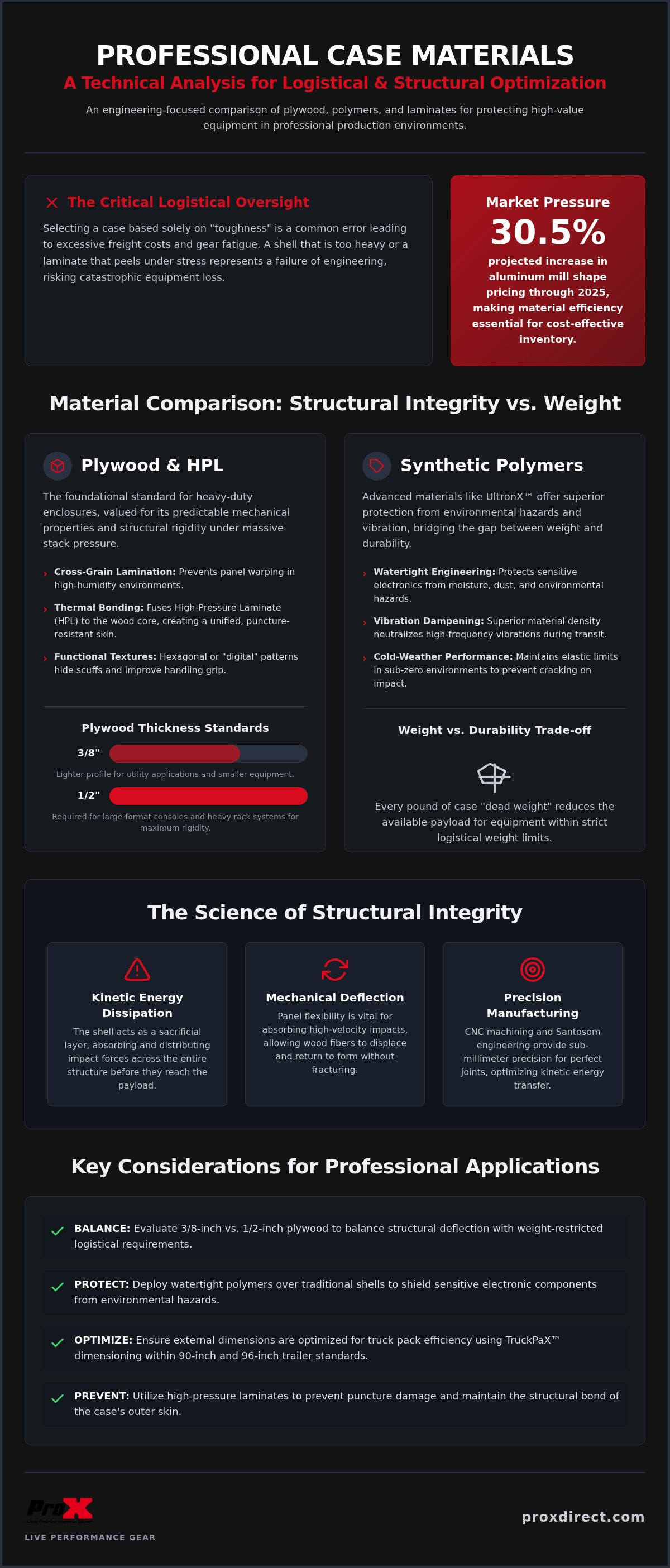
Selecting a flight case based solely on "toughness" is a logistical oversight that often leads to excessive freight costs and avoidable gear fatigue. You recognize that in professional production, the integrity of the build is the only thing standing between a successful load-in and a catastrophic equipment loss. A shell that's too heavy for logistical limits or a laminate that peels under thermal stress isn't just an inconvenience; it's a failure of engineering.
This flight case materials comparison provides a technical analysis of plywood, advanced polymers, and laminates to help you select the optimal protection for high-value equipment. We'll examine the structural benefits of 3/8-inch versus 1/2-inch plywood standards and identify when to deploy watertight polymers like UltronX™ over traditional builds. This guide also explores how material selection impacts truck pack efficiency using TruckPaX™ dimensioning. With aluminum mill shape pricing increasing by 30.5% through 2025, understanding these material trade-offs is essential for maintaining a high-performance, cost-effective inventory. You'll gain the data required to optimize your gear protection for long-term durability and logistical precision.
Key Takeaways
- Evaluate the mechanical properties of 3/8-inch and 1/2-inch plywood to balance structural deflection with weight-restricted logistical requirements.
- Identify when to deploy UltronX™ watertight polymers over traditional ABS shells to protect sensitive electronic components from environmental hazards.
- Perform a comprehensive flight case materials comparison to ensure external dimensions optimize truck pack efficiency within 90-inch and 96-inch trailer standards.
- Learn how CNC machining and Santosom engineering provide the sub-millimeter precision necessary for the high-stakes environment of professional production.
- Understand the role of high-pressure laminates in preventing puncture damage and maintaining the structural bond of the case's outer skin.
Structural Integrity and Material Science in Professional Case Engineering
Case integrity isn't just about a hard shell. It's about mechanical energy management. The primary function of a professional enclosure is to dissipate kinetic energy before it reaches the internal payload. This requires a calculated flight case materials comparison to ensure the shell can absorb shock without transferring it directly to sensitive electronics or optical components. A shell must act as a sacrificial layer that manages impact through controlled deformation and force distribution across the entire assembly.
The outer skin acts as the primary defense against puncture and shear forces. High-density plywood or engineered polymers prevent external objects from breaching the interior during aggressive handling. Exploring road case construction and history shows that the evolution of these materials has moved toward maximizing rigidity while maintaining manageable weight. While aesthetics matter for branding, professional standards prioritize structural rigidity to prevent the shell from collapsing under the massive stack pressure found in modern touring logistics. Precision engineering ensures the shell remains a stable barrier against the physical demands of the production environment.
The Physics of Impact Resistance
Impact resistance depends on how effectively the shell transfers force to the aluminum extrusion frame. When a case hits the ground, the force travels through the panels and into the riveted corners. Mechanical deflection in a 1/2-inch plywood panel refers to the temporary displacement of the wood fibers under load that returns to its original state without fracturing the core. This flexibility is vital for absorbing high-velocity impacts. During air cargo transport, temperatures can drop significantly. This environmental shift increases the brittleness of certain low-grade polymers. Engineering-grade materials must maintain their elastic limits even in sub-zero environments to prevent cracking upon impact. CNC-cut panels ensure that every joint fits perfectly, which optimizes the transfer of kinetic energy across the entire structure.
Weight vs. Durability: The Touring Trade-off
Managing the ratio between "dead weight" and "payload" is a constant challenge for production managers. Every pound added to the case shell reduces the available weight for the equipment within logistical limits. Advanced composites and high-density polymers are bridging the gap between heavy traditional plywood and lighter, often flimsier, consumer plastics. These materials offer superior density, which is critical for vibration dampening. For sensitive gear, the material density helps neutralize high-frequency vibrations that occur during transit on rough roads or during air travel. You can find these principles applied across the diverse range of ProX cases, where material selection is tailored to specific equipment requirements. Prioritizing the right material density ensures that the equipment arrives functional, regardless of the transport method.
Plywood and High-Pressure Laminates: The Traditional Heavy-Duty Standard
Plywood remains the foundational component for most heavy-duty enclosures because of its predictable mechanical properties. Any flight case materials comparison must distinguish between the 3/8-inch and 1/2-inch standards. While 3/8-inch panels offer a lighter profile for utility applications, 1/2-inch high-density plywood is the requirement for large-format consoles and heavy rack systems. The structural integrity depends on cross-grain lamination. By alternating the direction of the wood grain in each layer, manufacturers prevent the panels from warping when exposed to the high-humidity environments common in outdoor festivals or tropical shipping routes.
The bond between the High-Pressure Laminate (HPL) and the wood core is where many entry-level cases fail. Industrial-grade assembly involves thermal bonding processes that fuse the laminate to the plywood, creating a unified structural component. Surface textures play a functional role beyond aesthetics. Hexagonal or "digital" textures, such as the Honeycomb Digital™ finish, serve to hide visible scuffing and provide a high-friction surface. This improved grip is essential for safe handling during rapid load-ins and load-outs where moisture or stage fluids might be present on the case surface.
Grade A Plywood vs. Commercial Construction Grade
Professional builds require void-free Grade A plywood. Commercial construction-grade materials often contain internal gaps or "voids" that compromise the grip of rivets and hardware. If a rivet is fired into a void, the mechanical connection is significantly weakened, leading to hardware failure under stress. Adhering to the ATA Spec 300 ensures that the material can withstand the rigors of at least 100 trips without structural degradation. An increase in ply-count directly correlates to higher torsional stiffness and reduced panel deflection under load. Inferior materials risk delamination when moisture penetrates the edge, causing the layers to separate and the case to lose its protective capabilities.
Protective Coatings and Aesthetic Durability
ABS plastic laminates offer a superior protection profile compared to traditional painted or carpeted finishes. While paint chips and carpet traps dust and moisture, HPL surfaces resist oils, chemicals, and common stage fluids. This chemical resistance ensures the shell remains easy to decontaminate after a tour. You can explore our range of professional-grade cases to see how these laminates are integrated into modern designs. Choosing a high-density laminate over a simple coating ensures that your investment maintains its structural and aesthetic integrity over years of heavy use. If you need a custom solution that utilizes these high-grade materials, consider reviewing our specialized workstation and console builds.
Synthetic Polymers and Watertight Engineering: ABS vs. Polypropylene
While plywood is the standard for large-scale logistics, synthetic polymers offer specialized protection profiles that wood cannot match. A technical flight case materials comparison reveals that polymers like ABS and Polypropylene are essential for reducing "dead weight" while maintaining high impact resistance. ABS (Acrylonitrile Butadiene Styrene) is frequently used for lightweight shells due to its excellent tensile strength and stiffness. It provides a rigid exterior that resists scratching and impact, making it ideal for rack-mounted electronics and utility storage where weight is a primary constraint.
Polypropylene, conversely, is favored for its chemical resistance and flexibility. This material is the foundation of the UltronX™ series, where the goal is absolute environmental isolation. One critical engineering factor to consider is the thermal expansion coefficient. Plastic shells expand and contract more significantly than plywood when moving from extreme sun to cold storage. High-grade polymer blends are engineered to minimize this movement, ensuring that latches and seals remain aligned regardless of the ambient temperature. Molded-in features, such as stacking ribs and reinforced corners, are integrated directly into the shell to provide structural support without adding the weight of additional hardware.
Watertight Integrity and Environmental Protection
Gasket-sealed polymer cases are engineered to achieve IP67 ratings, signifying they're completely dust-tight and capable of withstanding immersion in water up to one meter. This level of protection is vital for sensitive AV gear. Utilizing UltronX™ watertight technology ensures that broadcast equipment remains operational in rain or high-humidity environments. These cases also feature integrated pressure equalization valves. These valves allow air to pass through a semi-permeable membrane, balancing internal and external pressure during air transport while preventing the entry of moisture. This prevents the "vacuum lock" that often makes cases impossible to open after a flight.
Molded vs. Fabricated Shells
The manufacturing method significantly impacts the shell's performance. Injection-molded shells are seamless, one-piece units that offer superior structural uniformity and impact distribution. These are ideal for standardized equipment sizes. Fabricated polymer cases, which use CNC-cut sheets joined by aluminum extrusions, provide the flexibility needed for custom dimensions while retaining the lightweight benefits of synthetics. UV stability is another critical factor for outdoor events. Professional polymer blends include UV inhibitors to prevent the material from becoming brittle or fading when exposed to prolonged sunlight. This ensures the case maintains its impact resistance over a multi-year service life.
Logistical Considerations: Weight, Dimensions, and Truck Pack Efficiency
Logistical efficiency is often overlooked in a flight case materials comparison, yet it dictates the operational cost of every tour. Material thickness directly influences the external footprint of the enclosure. While the difference between 3/8-inch and 1/2-inch plywood seems marginal on a single unit, those fractions accumulate across a full truck pack. In a standard 90-inch or 96-inch wide trailer, every millimeter matters. If a case exceeds its calculated footprint due to oversized material selection, it can disrupt the entire loading grid, leading to wasted space or the need for additional vehicles.
TruckPaX™ dimensioning is a critical engineering feature designed to solve these logistical bottlenecks. By utilizing standardized external dimensions that are multiples of truck widths, these cases ensure a perfect "tetris" fit. Engineering the shell with specific material tolerances allows for predictable stacking. This precision is vital for maximizing volume and minimizing movement during transit. Calculating the cumulative weight of a fleet is also essential. Switching from heavy 1/2-inch plywood to advanced polymers for smaller utility items can reduce the total payload by hundreds of pounds, potentially keeping a load within legal weight limits and reducing fuel consumption.
Optimizing Truck Pack Density
Uniform material thickness is the foundation of a stable truck pack. When cases share consistent external dimensions, they stack securely, reducing the risk of shifting loads that cause equipment damage. Heavy-duty casters and their mounting plates must be integrated into the material strategy. The mounting area experiences high localized stress; therefore, the shell material must be dense enough to hold bolts securely without stripping under the vibration of a moving trailer. You can learn more about TruckPaX™ logistical efficiency to understand how these dimensions are calculated for professional touring.
Handling and Ergonomics for Production Crews
Shell weight significantly impacts workplace safety. A case that is excessively heavy due to over-engineering increases the risk of strain during manual handling. Production crews require gear that balances high-level protection with manageable weight for rapid deployment. Recessed hardware placement is another factor. Cutting into the material to install handles or latches can create weak points if the material density is insufficient. Meticulous engineering ensures that hardware is recessed deep enough for protection but positioned to maintain the structural integrity of the shell. To optimize your inventory for both protection and portability, view our full selection of TruckPaX™ and utility cases designed for logistical precision.
Manufacturing Precision: How ProX Integrates Advanced Materials and Hardware
The performance of an enclosure is dictated by the precision of its assembly as much as the quality of the raw components. A comprehensive flight case materials comparison must evaluate how these materials are processed into a finished structural unit. Manufacturing excellence depends on the intersection of material science and mechanical precision. Even the highest-grade 1/2-inch plywood or advanced polymer shell will fail under stress if the assembly tolerances are loose. Professional-grade manufacturing utilizes Computer Numerical Control (CNC) machining to achieve sub-millimeter precision, ensuring that every tongue-and-groove extrusion and hardware recess fits the shell with absolute consistency.
Hardware integration is a specialized engineering task where the choice of rivets, extrusions, and corners must be calibrated to the specific shell material. For instance, the sheer force required to pull a rivet through high-density plywood is significantly higher than that of standard commercial wood. This mechanical relationship ensures that the aluminum frame and the plywood core act as a single, rigid body. Looking ahead, the industry is moving toward hybrid composites and additive manufacturing to create lighter, more complex components. These advancements, combined with sustainable wood sourcing, are defining the next generation of professional gear protection.
Precision CNC Engineering for Santosom and ZCASE
Digital design and CNC cutting allow for perfectly fitted internal components that manual assembly cannot replicate. Hand-built cases often suffer from slight misalignments that compromise the structural integrity of the frame. Conversely, Santosom engineering utilizes automated precision cutting to ensure that internal bracing and external panels align perfectly. This is particularly critical for high-value console protection, where the internal chassis must be supported at specific stress points. ZCASE projects further demonstrate this precision, utilizing CNC-cut materials to create bespoke solutions for complex workstations that require integrated cable management and specialized cooling paths.
Hardware and Shell Synergy
There is a critical mechanical relationship between steel ball corners and the substrate they protect. These corners are designed to absorb and redirect the force of a high-velocity impact into the aluminum extrusions. For this transfer to be effective, the underlying material must be robust enough to resist compression. This is why 1/2-inch plywood is the preferred substrate for heavy-duty workstations and large-format racks. The thickness provides the necessary depth for deep-seated rivets to maintain their grip during the vibration and turbulence of long-haul transport. To understand the full scope of these engineering choices, you can read the ultimate guide to engineering excellence in flight cases. Selecting the right combination of shell thickness and hardware grade ensures your gear remains functional in the high-stakes environment of professional production.
Optimizing Your Inventory for Long-Term Touring Success
Selecting the correct shell is a technical decision that impacts both gear safety and logistical overhead. This flight case materials comparison has demonstrated why high-density 1/2-inch plywood remains the standard for heavy workstations, while UltronX™ polymers provide essential environmental isolation for sensitive broadcast gear. You've seen how CNC precision and Santosom engineering eliminate the variables of manual assembly. This ensures every rivet and extrusion maintains structural integrity under the high-velocity impacts of global touring.
ProX has delivered industrial-grade protection since 1984. Our worldwide dealer network facilitates easy procurement, while specialized ZCASE engineering services are available for bespoke technical requirements. Prioritizing engineering precision over simple aesthetics allows you to build a reliable backbone for your production fleet. Browse the full catalog of ProX professional cases to secure your high-value equipment for the seasons ahead. Your gear deserves the highest standard of structural integrity.
Frequently Asked Questions
What is the most durable material for a professional touring case?
High-density 1/2-inch plywood combined with a thermal-bonded high-pressure laminate (HPL) is the industry standard for maximum durability. This construction provides the necessary torsional stiffness and impact resistance required for heavy payloads like mixer consoles and stage truss components. For smaller, sensitive electronics, advanced polymers offer superior shock absorption and environmental isolation in a lightweight form factor.
Is there a significant difference between 3/8-inch and 1/2-inch plywood?
The difference lies in the mechanical deflection limits and total weight capacity of the enclosure. 1/2-inch plywood is utilized for large-format workstations and heavy rack systems to prevent the panels from bowing under massive stack pressure. 3/8-inch plywood is the preferred choice for smaller utility cases where reducing dead weight is essential for maintaining logistical efficiency without sacrificing structural integrity.
When should I choose a polymer case over a traditional plywood build?
You should select a polymer case when your equipment requires absolute protection from moisture, dust, or extreme environmental shifts. Polymer shells, such as those in the UltronX™ series, are engineered with gasket seals and pressure equalization valves to achieve watertight integrity. These are ideal for AV broadcasting gear and sensitive optics that are frequently deployed in unpredictable outdoor environments.
How does the laminate surface affect the longevity of the case?
The laminate surface serves as a sacrificial barrier that prevents puncture damage and moisture ingress into the wood core. High-pressure laminates with hexagonal or digital textures hide visible scuffing and provide a high-friction surface for safer handling. This protective skin ensures that the plywood core remains dry and structurally sound, preventing the delamination that often occurs in inferior, non-laminated materials.
What are the weight implications of different case materials for air travel?
Material selection is a primary factor in managing freight costs and staying within strict air cargo weight limits. A technical flight case materials comparison shows that high-impact polymers can significantly reduce the weight of a case fleet compared to traditional plywood. Optimizing the shell material for the specific payload ensures you maintain professional-grade protection while minimizing the cumulative weight of your logistical footprint.
Do plastic cases offer the same level of protection as ATA 300-style plywood cases?
Engineering-grade plastic cases are designed to meet or exceed the ATA 300 Category I specification for reusable shipping containers. While plywood provides excellent rigidity for large-scale stacking, injection-molded polymers offer superior impact energy dissipation and watertight seals. The choice depends on whether your priority is structural stacking strength or the environmental isolation of the internal equipment.
Can custom dimensions be achieved with all flight case materials?
Custom dimensions are most effectively achieved through CNC-engineered plywood and fabricated polymer sheets. While injection-molded cases are restricted to fixed mold dimensions, ZCASE custom builds utilize precision-cut panels to create bespoke solutions for any equipment footprint. This allows for the integration of specialized internal bracing and cable management systems tailored to the exact specifications of your high-value gear.
How do I maintain the exterior material of my cases to ensure long-term reliability?
Maintenance involves regular cleaning of the laminate or polymer surface to remove oils, chemicals, and stage fluids. For plywood cases, inspect the rivets and aluminum extrusions to ensure the mechanical bond remains tight. For polymer enclosures, verify the integrity of the gasket seals and the functionality of the pressure equalization valves to ensure the case remains watertight throughout its multi-year service life.
Disclaimer
Any trademarks, trade names or brand names appearing herein that do not belong to ProX are the property of their respective owners and/or companies, and such appearance doesn't and shall not constitute or imply endorsement, sponsorship or recommendation by ProX.


