

The integrity of a protective enclosure is only as reliable as its internal architecture. If high-value production gear shifts during transit, the case ceases to be a protective asset and becomes a potential source of impact damage. Professional operators understand that standard foam solutions often crumble and lose structural memory over time, leaving sensitive components vulnerable to shock and moisture-induced corrosion. Integrating custom foam inserts for equipment cases is a technical necessity for any high-stakes environment where equipment failure is not an option.
We recognize that your gear requires more than just generic padding; it demands a permanent, professional-grade solution that reflects the precision of the equipment it holds. This article demonstrates how to engineer the perfect internal protection through rigorous material selection and CAD-driven design. You will learn the specific performance differences between high-density polyethylene and open-cell polyurethane, the advantages of CNC-cut precision for optimizing setup efficiency, and how to achieve maximum shock absorption for delicate mechanical assemblies. By moving beyond unprofessional DIY fixes, you can ensure your equipment remains secure and presentable for long-term industrial use.
Key Takeaways
- Identify the critical distinction between static storage protection and the dynamic shock absorption required for high-impact transport environments.
- Analyze the material science behind polyethylene and polyurethane foams to determine which density best serves your specific equipment weight and fragility.
- Evaluate the performance gap between DIY pick-and-pull foam and CNC-machined custom foam inserts for equipment cases regarding structural integrity and longevity.
- Learn technical measurement strategies for specialized production gear, including essential allowances for heat dissipation and ventilation in active equipment cases.
- Understand how bespoke engineering and advanced manufacturing processes provide a permanent solution for protecting high-value assets during global transit.
The Engineering Role of Custom Foam in Professional Equipment Cases
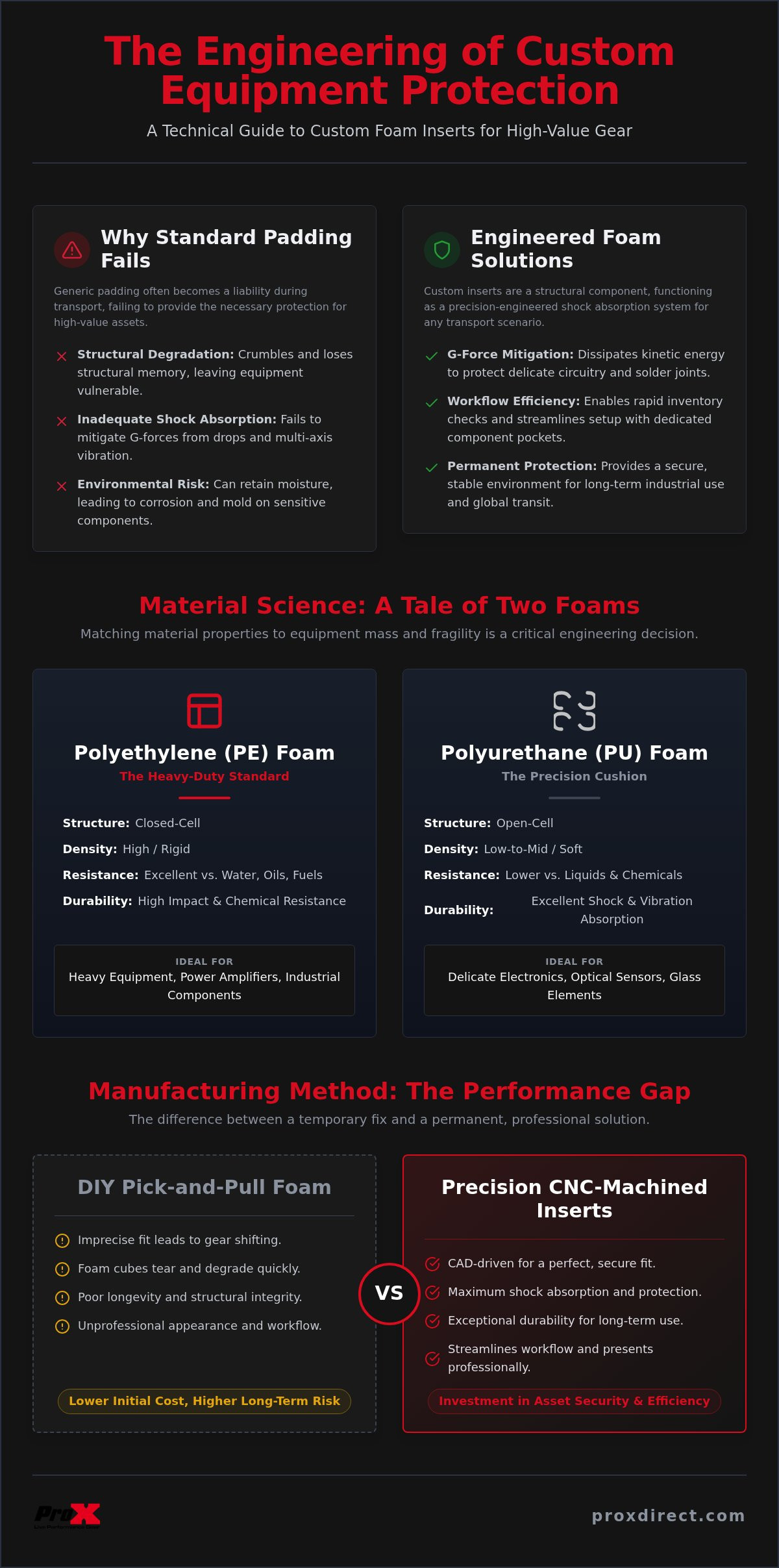
Custom foam isn't merely a soft lining; it's a structural component of a case's overall engineering. While standard padding provides basic abrasion resistance, professional custom foam inserts for equipment cases function as a precision-engineered shock absorption system. This distinction is critical when transitioning from static storage to dynamic transport. In a warehouse, equipment remains stationary and faces minimal risk. During global logistics, that same gear faces multi-axis vibration, sudden deceleration, and vertical drops. Standardized padding often fails because it lacks the specific density required to decelerate high-value electronic components without bottoming out against the case shell.
The relationship between the outer shell and the internal foam is symbiotic. A rigid plywood or plastic exterior provides the primary structural defense, but the foam must manage the kinetic energy that penetrates that shell. Selecting appropriate package cushioning materials based on the fragility and weight of the gear ensures that internal components don't experience damaging G-forces. High-density foams are necessary for heavy power amplifiers to prevent shifting, while softer, more resilient foams are required to protect delicate optical sensors and glass elements.
Shock Absorption and G-Force Mitigation
Effective foam design dissipates kinetic energy by converting impact forces into mechanical work through cell deformation. Engineers calculate a cushion curve to determine the exact thickness and density required to protect delicate internal solder joints and sensitive circuitry. If the foam is too firm, the shock is transmitted directly to the gear. If it's too soft, the equipment hits the interior case wall during a drop. Precision-cut custom foam inserts for equipment cases ensure the gear is suspended in a controlled environment, significantly mitigating the risk of micro-fractures in circuit boards during rough handling by logistics crews.
This degree of precision and protection is also a priority in other commercial sectors; for example, the Australian hospitality industry utilizes specialized solutions from topshelfconcepts.com to ensure that delicate food displays and catering equipment are maintained to professional standards.
Organization and Workflow Efficiency
Protection isn't the only engineering goal in a professional environment. Custom layouts allow for rapid inventory checks at the end of a production day. By standardizing the internal architecture, you can see instantly if a specific cable, transceiver, or accessory is missing. Professionals often incorporate finger pulls and dedicated accessory pockets to improve setup speed and cable management. This level of organization is a hallmark of professional case engineering, ensuring that every component has a designated, secure location that prevents internal collisions and streamlines the technical workflow on site.
Material Science: Comparing Polyethylene and Polyurethane Foam
Selecting the correct polymer is a fundamental engineering decision that dictates the long-term performance of custom foam inserts for equipment cases. While various foam types exist, industrial applications primarily utilize Polyethylene (PE) and Polyurethane (PU). Each material offers distinct mechanical advantages based on cell structure and density. Choosing the wrong material leads to accelerated degradation or inadequate protection for sensitive equipment surface finishes. Material selection is not about finding the softest padding; it's about matching the material's structural response to the gear's mass and fragility.
Environmental resistance is another critical factor in professional logistics. Some foams retain moisture, which can lead to corrosion on metal components or mold growth in humid environments. Chemical outgassing is also a concern for high-value gear. Certain low-grade foams release volatile organic compounds (VOCs) that can fog camera lenses or react with specialized powder coatings. Meticulous engineering ensures that the foam remains chemically inert over years of service. This prevents the chemical breakdown often seen in cheaper, non-industrial alternatives that eventually turn into a sticky residue or fine dust.
Polyethylene (PE) Foam: The Heavy-Duty Standard
Polyethylene is a closed-cell foam known for its rigidity and durability. Because the cells are sealed, PE resists the absorption of water, oils, and fuels, making it ideal for harsh industrial environments. Its high load-bearing capacity ensures that heavy items, such as power mixers or large lighting fixtures, remain securely positioned without compressing the material to its limit. PE foam maintains its structural memory even after repeated impacts, preventing the 'bottoming out' effect. This material is the standard for high-mass gear that requires a firm, unyielding support structure within the case.
Polyurethane (PU) Foam: The Delicate Specialist
In contrast, Polyurethane is an open-cell foam characterized by its flexibility and superior cushioning. The Polyurethane Foam Association highlights how these materials excel in managing energy dissipation for lightweight, highly fragile items. PU foam is the preferred choice for AV Broadcasting Cases, where sensitive optics and delicate glass elements require a soft touch. It effectively controls rebound, preventing equipment from bouncing within the case during rapid deceleration. While PU is less resistant to moisture than PE, its ability to conform to complex shapes makes it indispensable for protecting specialized production gear.
Engineering a multi-layer insert often provides the best results for complex kits. You can use a rigid PE base for structural support and a soft PU top layer for surface protection. This hybrid approach is a common practice for high-stakes production environments. For professional-grade protection tailored to your specific technical requirements, explore the full range of ProX Cases.
DIY Pick-and-Pull vs. Precision CNC Custom Engineering
Consumer-grade pick-and-pull foam relies on a grid of pre-scored cubes designed for convenience rather than logistical durability. While these solutions offer an immediate fix for static storage, they lack the structural integrity required for professional production environments. Once the pre-scored cubes are removed, the surrounding material loses its lateral tension and "wall" strength. In contrast, custom foam inserts for equipment cases that are CNC-machined from solid blocks of high-density polymer maintain their physical properties across the entire surface area. This ensures the gear remains immobilized even during multi-axis vibration or sudden deceleration.
Precision fitting is a technical requirement, not a luxury. A gap as small as 1mm can lead to catastrophic equipment failure. In a high-vibration transport environment, any internal movement allows kinetic energy to build up, which eventually shears internal solder joints or cracks delicate optical housings. Beyond the mechanical protection, the aesthetic impact of a precision-engineered insert cannot be overlooked. Utilizing professional-grade inserts projects a sense of industrial authority to clients and artists. To ensure this professional standard extends to your external branding, Transfers by MoreTranz offers durable solutions that signal your production company manages its assets with meticulous care.
Structural Integrity and Longevity
The "tearing" problem is the most common failure point for DIY solutions. After a single tour, the perforated edges of pick-and-pull foam begin to separate due to the constant friction of removing and re-inserting equipment. CNC routing provides a significantly cleaner finish than laser cutting, as it avoids the scorched or "melted" edge effect that can occur with certain polyethylene blends. By using multi-layered depth control during the machining process, engineers can create complex 3D shapes that conform to the irregular profiles of modern electronics. This ensures that every component is supported equally across its entire base, preventing pressure points that could damage sensitive controls.
When to Invest in Professional Engineering
Determining when to transition to bespoke solutions involves a straightforward risk assessment. If the replacement cost or repair downtime of a single piece of gear exceeds the cost of a precision insert, the investment is justified. For mission-critical assets, ZCASE Custom Build Cases offer an engineered solution that meets global production standards. This is particularly vital for production rental companies that must standardize fleet protection. Having an identical, precision-cut layout across an entire inventory allows technicians to perform rapid inventory checks and ensures that every case in the fleet provides the same level of technical security.
Designing Custom Inserts for Specialized Production Gear
Designing custom foam inserts for equipment cases requires a systematic approach to measurement that goes beyond basic exterior dimensions. You must account for protruding knobs, fader caps, and connector ports. A common engineering error is failing to provide clearance for active ventilation. Because foam acts as a thermal insulator, cases designed for active operation must include dedicated air-flow channels to prevent thermal throttling or component failure. Precision measurement involves mapping the entire chassis to ensure the gear sits level while providing enough clearance for heat dissipation during long production days.
High-efficiency workflows often require integrated cable runs and power supply compartments. By milling dedicated channels for looms and power bricks directly into the foam layout, you reduce setup time and prevent unnecessary cable strain. For "top-heavy" equipment, such as moving-head lighting fixtures, the foam architecture must distribute the mass across the base while securing the yoke and head independently. This prevents mechanical stress on the motors and gears during vertical transit, where sudden drops could otherwise shear internal components.
Audio and Lighting Console Layouts
Console layouts must prioritize fader and touchscreen protection. Foam should never apply direct vertical pressure to sensitive fader banks or glass surfaces. Instead, the insert should support the chassis edges and utilize a "doghouse" area for permanent cabling. This allows for a clean workspace and protects connectors from accidental impact. For those managing complex mobile setups, this professional DJ equipment case purchase guide provides further insight into engineering for the physical demands of modern touring.
Broadcast and LED Wall Components
For LED wall components, the foam must incorporate zero-contact zones. Any direct pressure on the surface of an LED module can dislodge or damage sensitive diodes. Specialized LED Video Panel Wall Supports utilize precision-cut polyethylene to isolate modules from impact while maintaining structural alignment. Managing arrays of wireless receivers or microphones also requires dedicated slots that prevent internal collisions. This organized approach allows for rapid serial number verification during load-out and ensures that delicate antennas aren't bent or crushed.
To ensure your specialized gear is protected by industrial-grade engineering, view our complete selection of ProX Cases.
The ProX and ZCASE Bespoke Solution: Touring-Grade Protection
ProX has established a reputation for industrial authority by providing bespoke protection solutions that meet global production standards. Through the ZCASE division, based in Poland, we offer advanced manufacturing for high-value assets that require more than off-the-shelf padding. Integrating custom foam inserts for equipment cases into our standard ProX Cases allows for a seamless transition from engineering specifications to physical hardware. Our team works directly with production managers to translate CAD drawings into precise internal architectures; this ensures that every mechanical assembly is secured against the rigors of international logistics.
Working with specialized engineers allows for the development of internal layouts that account for the practical realities of professional use. This collaboration ensures that the case shell and the foam insert work as a unified system to manage kinetic energy. Whether you're housing a large-format mixing console or a sensitive lighting rig, the goal remains functional excellence. Much like how financial professionals rely on the SPX to SPY Converter for exact data translation, our use of precision-cut materials eliminates the guesswork associated with generic protection, providing a reliable backbone for high-stakes production environments where equipment failure isn't an option.
Engineering Collaboration Process
The development of a custom insert begins with a comprehensive analysis of equipment specifications. We utilize 3D modeling and rapid prototyping to verify fitment before final production. This process includes material testing tailored to specific touring environments, accounting for variables like extreme heat, humidity, and constant vibration. For large-scale operations, standardizing these inserts across TruckPaX™ Truck Pack Cases ensures logistical consistency. This standardization allows for uniform truck loading and predictable protection levels across an entire equipment inventory, regardless of the destination.
The Long-Term Value of Engineered Protection
Investing in professionally engineered custom foam inserts for equipment cases provides a measurable return on investment. High-quality protection reduces the frequency of insurance claims and minimizes equipment downtime caused by transit damage. Beyond operational reliability, well-protected gear maintains a significantly higher market price when it's time for inventory rotation. Equipment that shows no signs of internal impact damage or chassis stress is a more valuable asset on the secondary market. By prioritizing the integrity of the build, you ensure that your technical infrastructure remains a dependable asset. For bespoke engineering and professional-grade protection, contact a ProX engineer for custom case solutions.
Securing Your Technical Infrastructure
Maintaining the structural integrity of your gear requires a move beyond temporary padding toward engineered internal architecture. The choice between polyethylene and polyurethane depends entirely on the mass and fragility of your components. Professional custom foam inserts for equipment cases provide a permanent solution that resists the degradation common in DIY alternatives. By utilizing CNC-machined precision, you ensure every sensitive fader, lens, and circuit board stays immobilized against the G-forces of global transport.
ProX has been engineering performance gear since 1984, providing the reliable backbone needed by global touring professionals. Our specialized ZCASE bespoke engineering services allow you to translate complex equipment specifications into a standardized, touring-grade protection system. This meticulous approach reduces equipment downtime and preserves the long-term resale value of your technical assets. We invite you to Explore ProX Professional Case Solutions to find the exact configuration for your production needs. Your equipment represents a significant investment; don't leave its safety to chance when industrial-grade engineering is available.
Frequently Asked Questions
What is the best foam for heavy audio equipment?
High-density polyethylene (PE) is the industry standard for high-mass audio gear like power amplifiers and large-format mixers. Its closed-cell structure provides the necessary load-bearing capacity to prevent heavy components from bottoming out against the case shell during impact. Unlike softer materials, PE maintains its structural memory and won't compress permanently under the weight of industrial equipment.
Can I use custom foam inserts in my existing equipment cases?
Yes, custom foam inserts for equipment cases can be engineered to fit almost any professional enclosure. You must provide precise internal dimensions of the existing shell to ensure a secure friction-fit. This allows you to upgrade your current technical infrastructure with professional-grade protection without the need to replace the outer case hardware entirely.
How do I measure my gear for a custom foam insert?
Measuring requires mapping the entire equipment chassis, including protruding knobs, fader caps, and rear connector ports. Use digital calipers for manual mapping or 3D scanners to create CAD files for CNC machining. It's critical to include specific allowances for heat dissipation and cable management to ensure the equipment remains functional and accessible within the layout.
Does custom foam protect against moisture and humidity?
Closed-cell polyethylene foam provides excellent resistance to moisture because its sealed cells don't absorb water or oils. This characteristic helps prevent corrosion on internal circuitry and metal chassis components during transit in humid environments. In contrast, open-cell polyurethane is more susceptible to moisture retention and typically requires desiccant packs for long-term environmental protection.
What is the difference between laser-cut and CNC-routed foam?
CNC routing is the preferred method for complex 3D equipment profiles because it allows for precise depth control across multiple layers. Laser cutting is generally restricted to 2D profiles and can leave scorched or melted edges on certain polymer blends. CNC machining ensures a cleaner, more professional finish that maintains the structural integrity of the foam walls.
Is pick-and-pull foam suitable for international touring?
Pick-and-pull foam isn't recommended for international touring or high-frequency logistics. Once the pre-scored cubes are removed, the material lacks the lateral tension and "wall" strength required to withstand multi-axis vibration. Professional custom foam inserts for equipment cases utilize solid-block construction to ensure gear remains immobilized throughout the entire global logistics chain.
How long does professional custom foam typically last?
Professional-grade industrial foam is designed to last for the entire lifecycle of the equipment it protects. High-density polyethylene is particularly resistant to mechanical wear and chemical degradation. Unlike consumer-grade foam that eventually crumbles or loses its shape, these engineered materials retain their shock-absorption capabilities even after years of heavy use on the road.
Can custom foam inserts be made for waterproof equipment cases?
Custom inserts are frequently integrated into watertight enclosures, such as our UltronX™ series. Using closed-cell polyethylene in these cases is essential because it won't trap moisture inside the sealed environment. This combination provides a technical solution for protecting sensitive electronics against both mechanical shock and extreme environmental conditions in maritime or outdoor production settings.
Disclaimer
Any trademarks, trade names or brand names appearing herein that do not belong to ProX are the property of their respective owners and/or companies, and such appearance doesn't and shall not constitute or imply endorsement, sponsorship or recommendation by ProX.


