

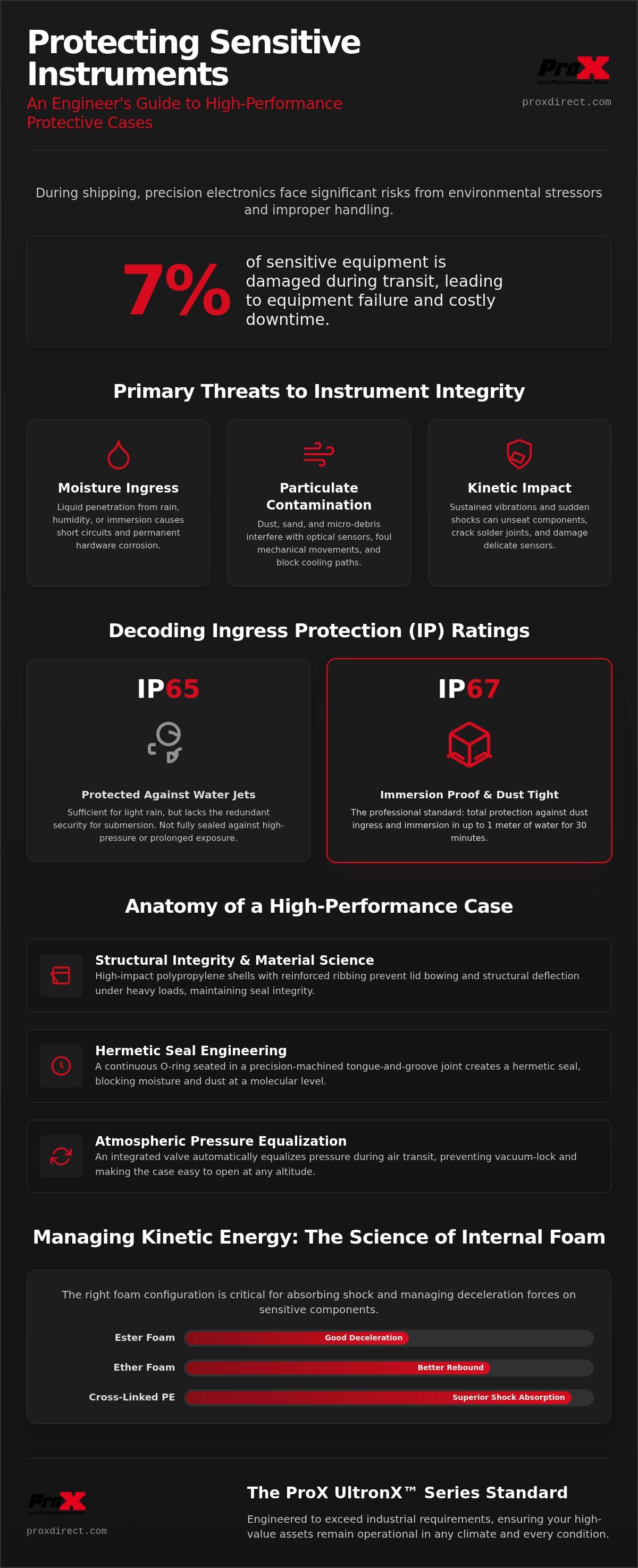
Recent data from FleetWorks | AI indicates that precision electronics face damage rates of up to 7% during shipping due to environmental stressors and improper handling. For engineers and production professionals, these figures represent more than just logistics; they represent the potential for total equipment failure and costly downtime. Finding a high-performance waterproof case for sensitive instruments is not merely about buying a container, it is about implementing a technical solution that manages atmospheric pressure and blocks moisture ingress at a molecular level.
You recognize that the integrity of a seal is the only thing standing between your calibration tools and a total loss during a transcontinental flight. For professionals handling specialized diagnostic imaging hardware from Dextro Imaging Solutions, this level of protection is critical to ensuring equipment accuracy. This article provides the technical framework needed to evaluate protective enclosures against rigorous industrial standards. You will learn to determine the correct IP rating for your specific environment, understand the structural benefits of injection-molded resins, and identify why custom-engineered protection is the standard for high-value assets. We will examine the mechanics of pressure equalization and the specific engineering behind the UltronX™ series to ensure your gear remains operational in any climate.
Key Takeaways
- Understand the technical distinctions between IP67 and IP68 ratings to ensure your enclosure meets the specific immersion requirements of your production environment.
- Evaluate the mechanics of hermetic seals and O-ring engineering to prevent moisture ingress and particulate contamination in high-value gear.
- Learn how to select a professional waterproof case for sensitive instruments by analyzing material science, specifically high-impact polypropylene and reinforced wall geometry.
- Master the science of kinetic energy management by comparing the deceleration properties of Ester, Ether, and Cross-linked Polyethylene foam types.
- Identify the necessity of integrated atmospheric pressure equalization valves to maintain structural integrity and ease of access during air transit.
The Physical Demands of Transporting Sensitive Instruments
Transporting high-value calibration tools and electronic sensors requires an understanding of the entire logistical lifecycle. Your equipment moves through a chain of custody that includes temperature-controlled warehouses—a standard of care mirrored in the industrial storage and terminal solutions provided by DPP Logistics Company Ltd—high-vibration freight environments, and eventually, the unpredictable conditions of an outdoor production site. Throughout this process, the primary threats remain moisture ingress, particulate contamination, and kinetic impact. For precision instruments, even minor exposure to environmental variables can lead to calibration drift or catastrophic board failure. High-precision electronics are particularly vulnerable to humidity and salt spray, which can degrade sensitive components before the gear even reaches the stage.
The primary threats to instrument integrity include:
- Moisture Ingress: Liquid penetration that causes short circuits and permanent hardware failure.
- Particulate Contamination: Dust and micro-debris that interfere with optical and mechanical precision.
- Kinetic Impact: Sustained vibration and sudden shocks that unseat internal components or crack solder joints.
Environmental Hazards in Professional Production
Micro-particulates and dust represent a significant risk to optical sensors and circuit cooling paths. While a standard enclosure might block large debris, it often fails to stop sub-micron particles that settle on sensitive components. Thermal shock poses an additional hidden danger. When gear moves rapidly between extreme temperatures, the air trapped inside the case reaches its dew point. This leads to internal condensation that ruins electronics from the inside out. In coastal regions, the presence of salt spray accelerates the oxidation of exposed connectors and internal traces. Adhering to specific IP Code ratings ensures that the enclosure provides a verified barrier against these microscopic and atmospheric threats.
Why Standard Cases Fail Precision Gear
Standard transport cases are built for durability, but they often lack the structural rigidity required for sensitive instrument protection. When a case is stacked at the bottom of a heavy load, the lid must resist bowing. A specialized waterproof case for sensitive instruments utilizes reinforced ribbing to prevent this deflection. Generic builds often rely on simple friction fits that allow atmospheric moisture to transfer freely into the interior. Structural failure isn't always a shattered shell; it's often a microscopic gap in a seal caused by a warped latch. Professional grade enclosures use precision-engineered hardware to maintain a constant, even pressure across the entire gasket. Utilizing a ProX case designed for watertight integrity addresses these engineering gaps through reinforced geometry and high-performance material science, ensuring the internal environment remains isolated from external humidity.
Understanding the Engineering Standards of Waterproof Cases
The engineering behind a waterproof case for sensitive instruments relies on standardized testing protocols rather than subjective claims. The Ingress Protection (IP) rating system provides a quantifiable measure of an enclosure's ability to resist solids and liquids. The IP67 standard is defined as protection against immersion in 1 meter of water for 30 minutes. Achieving this requires a hermetic seal, typically utilizing an EPDM or silicone O-ring seated within a precision-machined tongue-and-groove joint. When the case latches are engaged, the compressive force creates a continuous barrier that prevents capillary action from drawing moisture into the interior. This mechanical interface is what distinguishes a professional enclosure from a standard storage box.
Decoding IP Ratings for Production Environments
Selecting between IP65 and IP67 depends on the anticipated exposure. IP65 protects against low-pressure water jets, which is sufficient for light rain, but lacks the redundant security of an IP67 immersion-rated build. For high-precision calibration tools, dust-tight certification (indicated by the first digit "6" in IP67) is equally critical. Particulate ingress can foul mechanical movements and obscure optical sensors. This level of environmental sealing is a standard requirement for field-deployed surveillance assets from CCTVSecurityPros - Professional Security Cameras and Systems, where optical clarity and internal circuit protection are paramount. Engineering these seals involves testing for chemical resistance and long-term elasticity to ensure the gasket doesn't take a permanent set or degrade when exposed to cleaning agents or industrial lubricants found in production environments.
Pressure Equalization and Atmospheric Changes
Atmospheric management is a core requirement for instruments transported via air or through significant elevation changes. As altitude shifts, the pressure differential between the interior and exterior of a sealed case can create a vacuum lock, making it nearly impossible to open the lid upon arrival. Automatic pressure equalization valves utilize a semi-permeable membrane that allows air molecules to pass while blocking water and dust. This ensures the case remains accessible and prevents structural stress on the shell walls. Beyond environmental sealing, maintaining high standards for equipment enclosures aligns with broader NIST security guidelines regarding the physical protection of critical technological assets during transit.
Integrating desiccant packs within the internal foam further stabilizes the environment by absorbing residual moisture trapped during the packing process. For professionals requiring this level of technical precision, the UltronX™ series provides a standardized solution for logistical security. These cases are engineered to maintain internal equilibrium regardless of external pressure shifts or immersion risks, providing a reliable backbone for high-stakes professional use. By prioritizing these engineering standards, you eliminate the variables that lead to equipment failure in extreme environments.
Structural Integrity: Material Science and Hardware Precision
The structural reliability of a waterproof case for sensitive instruments depends on the convergence of material science and precision hardware. High-impact polypropylene serves as the primary substrate for professional-grade enclosures due to its exceptional energy absorption properties. Unlike traditional plywood or thin-walled plastic containers, injection-molded resins allow for complex geometries and consistent wall thickness. This manufacturing process eliminates the structural weak points common in lower-tier builds, ensuring the shell doesn't fail under the compressive loads of a fully loaded logistics vehicle. For engineers, the priority isn't just a hard shell; it's a reinforced system that maintains its dimensions under extreme physical stress.
Reinforcement geometry is a critical component of this design. Strategically placed exterior ribbing provides the rigidity necessary to prevent structural deflection. When cases are stacked at the bottom of a heavy load, these ribs distribute the weight across the entire frame, protecting the internal gasket from losing its seal. This stability is essential for maintaining a secure truck pack, where lateral movement can lead to equipment damage or logistical delays.
Injection-Molded High-Impact Resin vs. Traditional Builds
Engineered polymers offer a superior weight-to-strength ratio compared to traditional materials, which is vital for global transport efficiency. In extreme environments, the temperature can fluctuate from sub-zero tarmac conditions to high-heat warehouse storage. Standard plastics often become brittle in the cold or lose structural integrity in the heat. High-impact resins are specifically formulated to maintain their mechanical properties across this wide thermal range, ensuring they don't shatter upon impact. To find an enclosure that meets these rigorous specifications, explore our range of professional cases designed for high-stakes production environments.
Latches, Seals, and Reinforcement Hardware
The mechanical performance of an enclosure is only as reliable as its secondary hardware. Stainless steel pins are utilized in all hinges and latch assemblies to prevent corrosion and mechanical fatigue over years of use. Trigger-release latches are a standard requirement for high-value instrument protection. These latches provide a positive lock that prevents accidental opening during rough transit while ensuring the gasket remains under constant, even compression. This consistent pressure is what allows the enclosure to meet the IEC 60529 standard for Ingress Protection, keeping the internal environment isolated from external contaminants.
Security and ergonomics also factor into the hardware design. Reinforced padlock protectors prevent the housing from being compromised at the lock point, a common vulnerability in generic cases. Large, over-molded handles provide a secure grip for technicians, even when wearing gloves in wet conditions. These features aren't aesthetic choices; they're functional requirements that ensure your equipment remains secure and manageable throughout the entire logistical chain.
Selecting the Right Internal Configuration for Precision Gear
The external shell provides the primary barrier against environmental threats, but the internal configuration is responsible for managing kinetic energy. Effective protection for high-value gear relies on the science of deceleration. When a case experiences a sudden drop, the internal foam must compress at a controlled rate to minimize the G-force transferred to the instrument. Foam density must be matched to the instrument's weight and fragility to prevent bottoming out during impact. If the foam is too soft, the instrument will strike the inner wall of the shell; if it is too rigid, the shock will pass directly through to the electronics.
Polyurethane foams, such as Ester and Ether, offer excellent cushioning but differ in their chemical and environmental resistance. Ester foam is generally more resistant to hydrocarbons, while Ether foam performs better in high-humidity environments where hydrolysis might occur. For a waterproof case for sensitive instruments, closed-cell Cross-linked Polyethylene (XLPE) is often the preferred technical choice. XLPE is non-absorbent and does not off-gas, ensuring that moisture isn't trapped within the foam cells and that sensitive optical coatings aren't compromised by chemical vapors.
Custom Foam Engineering for Maximum Shock Absorption
Designing an insert requires calculating the static loading and the fragility factor of the specific gear. This ensures the foam thickness is sufficient to absorb energy during a worst-case scenario drop. Closed-cell foams provide a significant advantage in watertight applications because they do not act as a sponge. For those requiring a bespoke approach to internal architecture, you can learn more about Engineering Bespoke Protection with ZCASE, where precision CNC routing creates an exact fit for complex geometries.
Modularity and Organizational Efficiency
Modularity allows for a versatile logistics strategy. Adjustable divider systems provide flexibility for changing kit requirements, while multi-layer inserts facilitate the organization of complex instrument arrays. Utilizing lid organizers for cables and smaller peripherals keeps the primary compartment clear of loose items that could cause internal impact damage. This level of organization is standard in Specialized AV and Broadcasting solutions, where rapid deployment and equipment accountability are critical.
To secure your precision gear with an engineered internal solution, browse our UltronX™ series for standardized watertight protection.
UltronX™ Watertight Cases: The ProX Standard for Extreme Conditions
The UltronX™ series represents the culmination of 40 years of engineering expertise in performance gear and global logistics. While previous sections detailed the theoretical requirements of a waterproof case for sensitive instruments, the UltronX™ line implements these standards through a specialized manufacturing process. These enclosures are built for the rigors of professional touring, where equipment is subjected to rapid multi-modal transport and extreme environmental shifts. By standardizing the hardware and shell dimensions, the series provides a reliable backbone for high-stakes production environments.
Key mechanical features include ruggedized, trigger-release latches that maintain constant gasket compression and automatic atmospheric valves that manage internal pressure. Reinforced hinges with stainless steel pins ensure the lid remains aligned even after thousands of cycles. These components aren't merely added features; they're integral to the system’s ability to prevent moisture ingress and vacuum lock. The external dimensions are designed to integrate seamlessly into standard logistical footprints. This allows for efficient truck packs without the wasted space common with consumer-grade hard cases.
Engineering Specifications of the UltronX™ Series
The material composition of the UltronX™ series utilizes a high-impact resin that offers excellent UV resistance. This is critical for outdoor event applications where prolonged sun exposure can degrade standard plastics. Testing protocols for the series verify watertight integrity at depths of 1 meter for 30 minutes, adhering to the IP67 standard. Impact resilience is maintained across a broad thermal range, ensuring the shell doesn't become brittle in cargo holds or soft in high-heat storage. For a broader perspective on protective standards, consult The Ultimate Guide to Professional Protection.
Integrating Watertight Solutions into Your Tour Logistics
Standardizing an inventory with UltronX™ cases improves truck pack density and simplifies logistical planning. When every waterproof case for sensitive instruments follows a consistent form factor, technicians can stack and secure loads with greater precision. This systematic approach reduces equipment downtime by eliminating the variables that lead to transit-related damage. Specialized cases protect the long-term calibration of your assets, ensuring precision gear arrives at the venue in the same state it left the warehouse. For unique dimensions or specialized internal requirements, Contact our engineering team for custom instrument protection to discuss bespoke solutions tailored to your inventory.
Securing Technical Assets for Global Logistics
Professional instrument protection is a matter of precise engineering rather than simple containment. By prioritizing IP-rated enclosures and high-impact resins, you eliminate the environmental variables that threaten precision electronics. Whether you're managing the rigors of a global tour or a local production, a high-performance waterproof case for sensitive instruments remains your primary defense against moisture, particulate ingress, and kinetic shock. Selecting the right internal foam density and atmospheric valves ensures that your gear arrives in calibration, regardless of altitude shifts or external pressure.
While technical gear requires specialized hard-shell protection, many production teams also prioritize sustainability for their wider logistical needs by sourcing eco-friendly materials from Duboxx Packaging LLC for auxiliary equipment and accessories.
ProX has been engineering performance gear since 1984, providing the industry with heavy-duty hardware designed to withstand the most demanding logistical chains. Our commitment to functional excellence ensures that your equipment remains operational regardless of atmospheric changes or transit conditions. For unique dimensions or specialized requirements, our team offers custom engineering services to deliver bespoke protection for your most valuable assets. You can rely on our established history of technical superiority to safeguard your inventory.
Explore the UltronX™ Series for Uncompromising Protection
Invest in a system that values durability and technical precision to ensure your gear remains protected for the long term.
Frequently Asked Questions
What is the difference between a water-resistant and a truly waterproof case?
Water-resistant enclosures are designed to repel light splashes or vertical rainfall, typically meeting IP65 standards for low-pressure water jets. A truly waterproof case for sensitive instruments must meet immersion standards, such as IP67 or higher. These cases utilize a compressive O-ring seal and precision-engineered latches to prevent moisture ingress even when the unit is temporarily submerged in water.
Does an IP67 rating mean I can submerge my instrument case indefinitely?
No, an IP67 rating certifies that the enclosure is protected against immersion in up to 1 meter of water for exactly 30 minutes. It's not designed for continuous underwater storage or high-pressure deep-sea applications. If your logistical requirements involve deeper or longer submersion, you should consult with our engineering team to evaluate cases with higher specialized ratings.
Why do I need a pressure equalization valve for air travel?
Pressure equalization valves prevent the "vacuum lock" effect that occurs when atmospheric pressure changes during flight. As a plane ascends or descends, the pressure differential between the sealed interior and the external environment can make the lid impossible to open. The valve utilizes a semi-permeable membrane to balance this pressure while blocking liquid water and dust from entering the case.
Can I use standard foam in a waterproof case for sensitive electronics?
Standard open-cell foam is generally unsuitable for a waterproof case for sensitive instruments because it can absorb and retain moisture. For professional electronics, closed-cell polyethylene foam is the preferred choice. It's non-absorbent and won't off-gas harmful chemicals, ensuring that your precision gear remains dry and free from corrosive vapors during long-term storage.
How do I maintain the O-ring seal to ensure long-term watertight integrity?
Maintaining the seal requires regular inspection to ensure the gasket and the matching groove are free of debris, hair, or grit. You should wipe the O-ring with a clean, lint-free cloth and apply a light coating of silicone lubricant if the material appears dry. This prevents the rubber from cracking and ensures it maintains the elasticity needed to create a hermetic seal under latch compression.
What material is best for a waterproof case used in extreme cold?
High-impact polypropylene and engineered resins are the most reliable materials for sub-zero environments. These polymers are specifically formulated to maintain their mechanical properties and impact resistance at low temperatures. Standard plastics often become brittle and shatter upon impact in the cold, but professional-grade resins remain flexible enough to absorb kinetic energy without structural failure.
Are these cases compatible with standard professional logistical systems?
Yes, these enclosures are designed to integrate with standard truck pack dimensions and industrial pallet footprints. The external geometry allows for stable stacking and high-density loading in freight environments. This ensures that your specialized protection doesn't interfere with established warehouse workflows or global transport standards used by professional production crews.
Can ProX engineer a custom watertight case for non-standard instrument dimensions?
ProX provides custom engineering services for clients with bespoke protection requirements for unique or oversized gear. We can adapt shell configurations and design precision-cut internal inserts to accommodate non-standard dimensions. This service ensures that high-value assets receive a tailored fit that maximizes shock absorption and environmental sealing regardless of the instrument's shape.
Disclaimer
Any trademarks, trade names or brand names appearing herein that do not belong to ProX are the property of their respective owners and/or companies, and such appearance doesn't and shall not constitute or imply endorsement, sponsorship or recommendation by ProX.


