

The structural integrity of a professional lighting rig is defined not by the aluminum spans themselves, but by the mechanical precision of the hardware at every junction. When you're suspending thousands of dollars in AV assets above a crowd, the margin for error is non-existent. This truss clamps and connectors guide serves as a technical resource for production professionals who demand 100% safety compliance. We understand the pressure of managing load-bearing limits while facing the practical challenges of hardware compatibility between different manufacturers.
Professional rigging requires more than just a visual inspection; it demands a deep understanding of material science and logistical standards. You've likely dealt with the frustration of mismatched couplers or the uncertainty of shear force ratings during a complex build. This guide provides the engineering data you need to eliminate these risks. We'll cover essential ANSI E1.2-2021 standards, specific load ratings for high-performance clamps, and the protocols necessary to protect your equipment. By the end of this article, you'll have a methodical framework for selecting hardware that ensures structural stability and optimizes setup efficiency for every production.
Key Takeaways
- Identify the critical mechanical interface between fixtures and structures to ensure weight transfers correctly through the truss chord.
- Utilize this truss clamps and connectors guide to select the appropriate wrap-around or hook-style hardware for specific suspension and mounting applications.
- Master the technical interpretation of Working Load Limit (WLL) and Safe Working Load (SWL) based on specific vertical or horizontal mounting orientations.
- Implement essential safety protocols, including the mandatory use of secondary safety attachments and proper torque techniques to prevent structural damage.
- Protect high-value AV and lighting assets by utilizing engineering-grade hardware designed for industrial reliability and maximum structural integrity.
The Engineering Role of Truss Clamps and Connectors
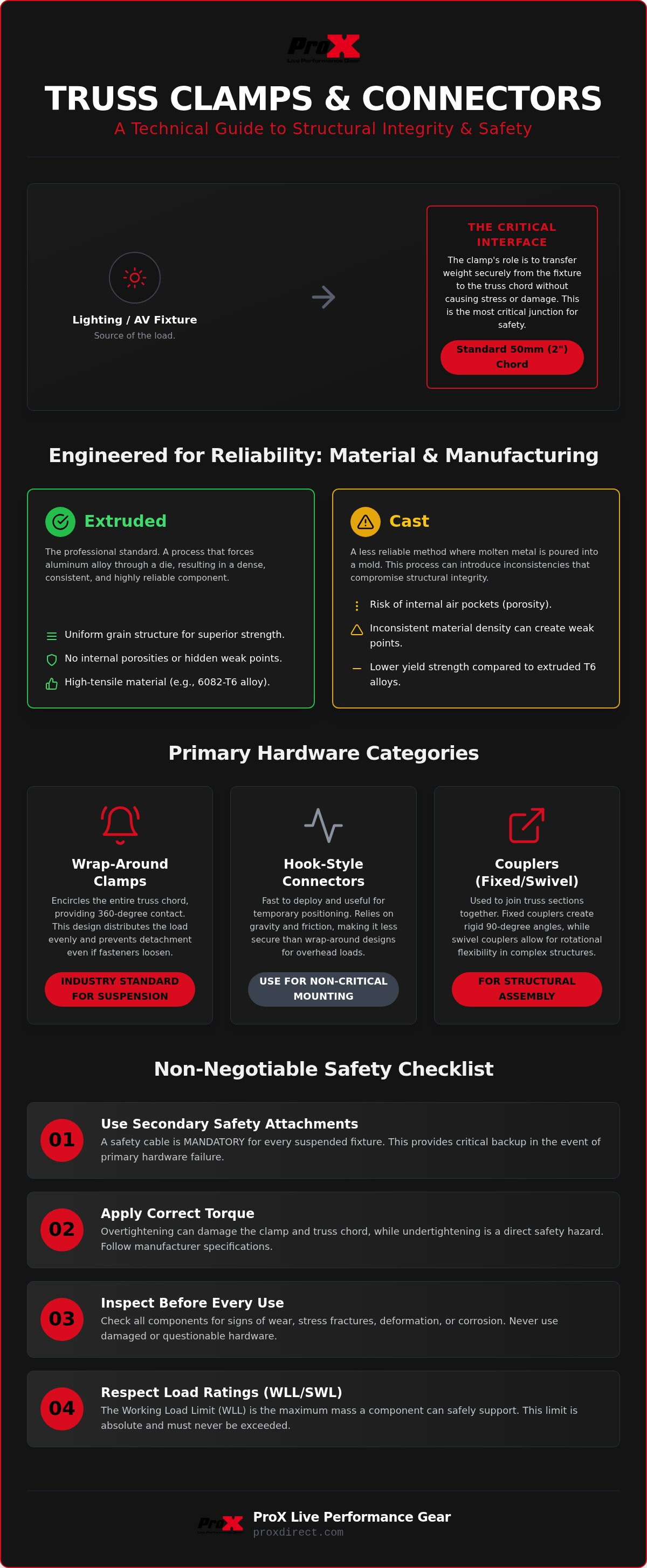
A professional truss system is a complex assembly of structural members designed to distribute weight efficiently across a span. However, the system's overall stability depends entirely on the hardware used to attach payloads. Truss clamps and connectors function as the critical mechanical interface between high-value production equipment and the support structure. This truss clamps and connectors guide emphasizes that a clamp is not merely a mounting bracket; it's a load-bearing component that must maintain structural integrity under dynamic conditions.
Weight transfers from the fixture’s yoke, through the connector, and directly onto the truss chord. This load path must be direct and secure to prevent torsional stress on the aluminum tubing. Most professional rigs utilize a standardized 50mm (2-inch) outer diameter for main chords. Using engineered hardware designed for these specific dimensions is mandatory. Generic alternatives often lack the precision required for a flush fit, leading to point-loading that can deform the metal. For those building comprehensive systems, selecting components from the ProX Truss catalog ensures that every piece of hardware meets these rigorous dimensional standards.
Mechanical Integrity and Load Distribution
Connection points represent the most frequent failure locations in temporary structures. While a span may have a high total Uniformly Distributed Load (UDL), a poorly seated clamp creates a localized stress concentration. Professional rigging relies on specific clamping force rather than simple friction. A secure wrap-around design ensures the load is distributed around the entire circumference of the chord, preventing the "crushing" effect common with inferior hook-style mounts. Rated load capacity is the maximum weight a connector is engineered to support safely.
Material Standards for Professional Rigging
Industrial-grade hardware typically utilizes high-tensile aluminum alloys, such as 6082-T6. The T6 tempering process is vital because it increases the material's yield strength through solution heat treatment and artificial aging. This creates a metal that can withstand the rigors of frequent assembly without losing its structural profile. The manufacturing process also dictates reliability. Extruded hardware generally offers superior structural consistency compared to cast alternatives. Casting can introduce internal porosities or air pockets that compromise the unit's density. Extrusion ensures a uniform grain structure, which is essential for components subjected to repetitive stress cycles in live production environments where failure is not an option.
Primary Categories of Truss Hardware
Rigging hardware is classified by its specific mechanical function within a system. Professionals generally categorize these components into three primary applications: suspension of equipment, joining structural segments, and mounting accessories. Selecting the correct category is the first step in maintaining compliance with ANSI E1.2-2021 standards. While hook-style connectors are useful for temporary positioning, wrap-around clamps provide superior security by encircling the entire truss chord. This design prevents the fixture from detaching if the mounting bolt loosens due to vibration or movement. This truss clamps and connectors guide highlights that wrap-around hardware is the industry standard for overhead suspension.
Specialized hardware is required for high-density loads such as large-scale audio arrays or LED video walls. These systems exert significant vertical force and require connectors that can handle concentrated weight without compromising the chord's integrity. You can explore ProX Truss hardware categories to identify the specific mounts engineered for these heavy-duty applications. Using the wrong hardware for specialized assets often leads to mechanical failure or damage to the truss itself. For those managing complex visual displays, utilizing dedicated LED video panel wall supports ensures that the weight is distributed according to engineered specifications.
Couplers and Half-Connectors
Couplers are the primary tools for establishing rigid connections between structural members. Fixed couplers maintain a precise 90-degree or parallel alignment, which is essential for building square grids and goalpost structures. Swivel couplers offer 360 degrees of rotation. This flexibility allows riggers to create diagonal bracing or complex geometric designs that aren't possible with fixed hardware. Half-connectors serve as the mechanical bridge between truss segments and external surfaces. They're frequently used to secure trussing to base plates or custom mounting brackets in permanent installations where a direct bolt-on connection is required.
Trigger Clamps and Quick-Release Mechanisms
Trigger clamps are engineered for efficiency and safety during the initial hang. The unique trigger mechanism allows a single technician to hook a fixture onto a chord and let it hang securely before tightening the wing nut. This self-locking design is a significant safety advantage during high-altitude rigging where managing heavy fixtures with two hands is often difficult. While these mechanisms prioritize speed and ease of use, riggers must always verify the static load capacity. Some quick-release designs trade a portion of their maximum weight rating for mechanical convenience. Always consult the manufacturer's specifications to ensure the clamp meets the requirements of your specific payload.
Technical Specifications: Load Ratings and Compatibility
Precision in rigging requires strict adherence to technical data sheets. Understanding the distinction between Working Load Limit (WLL) and Safe Working Load (SWL) is fundamental to structural safety. WLL refers to the maximum mass that a piece of hardware is authorized to support under specific conditions. SWL is a more conservative value determined by the rigger after considering environmental factors and the specific configuration of the rig. This truss clamps and connectors guide emphasizes that these ratings aren't suggestions but hard engineering limits. Exceeding them compromises the molecular integrity of the aluminum alloy.
Engineered hardware incorporates a Safety Factor, often expressed as a ratio like 5:1 or 10:1. A 5:1 ratio means the component's ultimate breaking strength is five times its rated WLL. This overhead provides a buffer for unforeseen stresses, though it must never be used to justify overloading. Hardware orientation also dictates capacity. A clamp rated for 500kg in a vertical orientation might see its capacity reduced by 40% or more when mounted horizontally due to increased shear force on the bolt. Cross-brand compatibility is another critical variable. While many manufacturers use the 50mm standard, you must ensure that conical connectors match the specific wall thickness of the truss chord to prevent loose junctions.
Calculating Total Rigging Loads
Effective load management distinguishes between static and dynamic forces. Static loads are constant, such as a stationary speaker cabinet. Dynamic loads are generated by moving heads or motorized effects, which create fluctuating forces during acceleration and deceleration. These dynamic spikes can momentarily double the effective weight on a connector. Professionals must also account for the cumulative effect of multiple fixtures on a single span to avoid exceeding the total deflection limit. Torque is the rotational force applied to a clamp when equipment is offset from the center of the chord.
Dimensional Standards and Fitment
The industry standard for professional touring and production is the 2-inch (50mm) outer diameter chord. Decorative or retail-grade truss often uses a 1.38-inch (35mm) diameter. Mixing these standards is a primary cause of structural failure. Under-clamping occurs when a 50mm clamp is forced onto 35mm tubing; the lack of surface contact reduces friction and creates dangerous point-loading. Conversely, using oversized hardware on small tubing prevents a secure mechanical lock. For large-scale installations, utilizing Professional LED Video Panel Wall Support systems ensures that all connectors are perfectly matched to the structural demands of the video tiles.
Rigging Safety: Installation Protocols and Inspection
Rigging safety protocols prioritize redundancy at every mechanical junction. Secondary safety attachments, specifically steel safety cables, are a non-negotiable requirement for all overhead suspension. These cables must be rated for the specific weight of the fixture and anchored to a structural member independent of the primary clamp. This ensures that if the mechanical interface fails, the asset remains suspended. Following a comprehensive truss clamps and connectors guide helps technicians identify the correct cable gauge and attachment points for various payloads. Every mechanical failure in a live environment is preventable through rigorous adherence to these established standards.
Proper tool usage is critical for preserving the lifespan of aluminum structures. Over-tightening wing nuts or eye-bolts with high-torque power tools can crush the thin-walled chords of a truss. This localized deformation compromises the tube’s structural integrity, making it susceptible to buckling under load. Technicians should use manual tools to achieve a firm seat, ensuring the clamp encircles the chord without deforming the metal. A secure fit relies on the surface area of the clamp rather than excessive force, which can lead to stress fractures over time.
Environmental factors like humidity and salt air in coastal regions accelerate material fatigue. Galvanic corrosion occurs when dissimilar metals, such as steel bolts and aluminum clamps, react in moist environments. This process can seize threads or cause pitting in the hardware surface, significantly reducing its load-bearing capacity. Regular inspection for oxidation and the application of appropriate lubricants are mandatory for gear used in outdoor productions. For more information on maintaining your structural assets, consult our Engineering Excellence: The Ultimate Guide to Stage Truss and Base Plate Cases.
The Pre-Show Inspection Checklist
A systematic inspection must occur before every load-in to identify potential mechanical weaknesses. Riggers should focus on the following high-stress areas:
- Inspect all aluminum welds for hairline cracks or signs of stress whitening, which indicates metal fatigue.
- Check eye-bolts, wing nuts, and threaded shafts for stripped or cross-threaded sections that could slip under tension.
- Verify that all conical coupler pins and R-clips are fully seated and locked to prevent accidental disconnection.
- Examine the interior surface of clamps for metal shavings or gouges, which suggest improper fitment or over-tightening.
Common Rigging Errors to Avoid
Identifying common pitfalls is essential for maintaining a 100% safety record. One of the most dangerous errors is mixing mismatched hardware from different manufacturers, even if the dimensions appear similar. Subtle differences in alloy composition or machining tolerances can lead to catastrophic failure. Additionally, overlooked wear on plastic-tipped or non-marring clamps can reduce friction, allowing fixtures to slide along the chord. Never utilize hardware that isn't specifically rated for overhead suspension, as retail-grade brackets don't possess the required safety factors for professional production. Ensure your rig meets industrial standards by sourcing engineered truss hardware from a trusted manufacturer.
ProX Truss Solutions: Professional Grade Hardware
ProX has designed and manufactured professional-grade trussing and hardware since 1984, establishing a reputation for engineering precision. This extensive history in the AV and lighting industry allows us to prioritize functional excellence over emotional appeals. In high-stakes production environments, equipment failure isn't an option, which is why riggers utilize this truss clamps and connectors guide to select hardware that ensures structural stability. Our components undergo rigorous structural testing to ensure they meet the physical demands of professional gear used in live events.
The ProX catalog offers an exhaustive range of solutions, from standard couplers to specialized mounts for heavy-duty AV infrastructure. Every component is manufactured with standardized dimensions, primarily the 50mm (2-inch) outer diameter, to ensure seamless integration across various systems. This focus on consistency supports global logistics, allowing touring crews to source compatible hardware through our extensive dealer network. Whether you're suspending a complex lighting rig or a large-scale video wall, our hardware provides the mechanical backbone required for a secure build. This truss clamps and connectors guide reinforces the importance of using components that maintain strict tolerances.
Rugged Reliability for Touring Professionals
The physical reality of touring involves constant setup and teardown cycles that place immense stress on connection points. This repetitive mechanical assembly requires hardware that doesn't just meet initial load ratings but maintains its structural profile over years of use. ProX hardware is engineered for this durability, utilizing high-tensile alloys and precise machining to prevent thread wear and material fatigue. Professionals can browse the full range of ProX Cases and Accessories to find integrated solutions that protect these critical assets during transport. By utilizing hardware that withstands the rigors of the road, you minimize the risk of equipment damage.
Support and Availability
Reliability extends beyond the physical product to include technical support and global availability. With over 40 years of engineering expertise, ProX acts as an authoritative guide for complex rigging needs. Our global dealer network ensures that production companies can acquire necessary components rapidly, maintaining show schedules without compromising safety standards. This commitment to professional reliability makes ProX a preferred partner for industry veterans who value functional excellence and engineering precision. You can contact a ProX dealer to engineer your next truss system and ensure your rig meets the highest standards of structural integrity.
Ensuring Structural Integrity in Professional Production
Achieving 100% safety compliance in live production requires a methodical approach to hardware selection. This truss clamps and connectors guide has established that structural stability depends on precise load calculations and the use of high-tensile aluminum components. By prioritizing rated load capacities and maintaining strict inspection protocols, you protect both your personnel and your high-value AV assets. Standardizing your inventory with engineered hardware eliminates the compatibility risks that often lead to mechanical failure at the connection point.
ProX has provided the industry with engineering performance gear since 1984. Our solutions are trusted by major brands like Pioneer DJ and QSC, reflecting a commitment to industrial-grade durability. With a global dealer network ready to provide professional support, you can build with confidence in any venue. It's time to elevate your rigging standards with hardware designed for the physical demands of modern touring.
Optimize your setup today: View the ProX Truss and Hardware Catalog to find the exact engineering-grade solutions your rig requires. We look forward to supporting your next professional build.
Frequently Asked Questions
How much weight can a standard 2-inch truss clamp hold?
A standard 2-inch (50mm) truss clamp typically supports a Working Load Limit (WLL) between 200kg and 500kg. You must always verify the specific manufacturer rating stamped on the hardware. These limits are calculated for vertical loads; horizontal mounting significantly reduces capacity. This truss clamps and connectors guide reminds riggers to account for the weight of the clamp itself when calculating total span loads.
What is the difference between a coupler and a half-connector?
A coupler is designed to join two structural members together, either in a fixed 90-degree alignment or a 360-degree swivel configuration. In contrast, a half-connector, or half-coupler, features a single clamping mechanism with a flat mounting base. This hardware is used to secure trussing to base plates, custom brackets, or fixture yokes where a direct bolt-on interface is required.
Are all truss clamps compatible with different brands of truss?
Compatibility depends entirely on the outer diameter and wall thickness of the truss chord. While most professional systems utilize the 50mm standard, subtle differences in machining tolerances between brands can affect the security of the fit. You should always verify that conical connectors and pins are perfectly matched to prevent mechanical play at the junction. Mixing mismatched hardware can lead to structural instability.
How often should I inspect my truss connectors for wear?
You should perform a visual inspection before every load-in and after every teardown. Riggers must look for hairline cracks in the aluminum, stripped threads on bolts, and any deformation of the clamp's radius. This truss clamps and connectors guide suggests an exhaustive annual review by a certified rigging professional to ensure long-term structural integrity and compliance with safety standards.
What is the safety factor for professional rigging hardware?
Professional rigging hardware typically utilizes a safety factor of 5:1 or 10:1. This means the ultimate breaking strength of the component is five to ten times its rated Working Load Limit. This buffer accounts for unexpected dynamic forces or material fatigue. However, you must never intentionally exceed the stated WLL, as the safety factor is an engineering redundancy, not an operational margin.
Can I use a truss clamp for outdoor events in rain or wind?
Truss clamps are suitable for outdoor use, but environmental conditions require additional precautions. Rain accelerates corrosion at the interface between steel bolts and aluminum bodies. Wind introduces dynamic lateral loads that aren't present in indoor environments. You must ensure all hardware is rated for these conditions and perform more frequent inspections to identify signs of oxidation or seized threads.
What are trigger clamps and when should I use them?
Trigger clamps are specialized hook-style connectors featuring a self-locking mechanism. They allow a single technician to hang a heavy fixture securely before the final tightening of the wing nut. You should use them during high-altitude installations or when speed is a priority. While they improve efficiency, always verify that the trigger clamp's static load capacity meets the requirements of your specific payload.
Why is a safety cable necessary if the clamp is rated for the load?
Safety cables provide essential mechanical redundancy in the event of a primary clamp failure. Even a rated connector can fail due to human error, such as improper tightening or undetected material fatigue. The safety cable acts as a secondary catch that prevents the fixture from falling if the main interface detaches. It's a non-negotiable protocol for all overhead suspension in live production environments.
Disclaimer
Any trademarks, trade names or brand names appearing herein that do not belong to ProX are the property of their respective owners and/or companies, and such appearance doesn't and shall not constitute or imply endorsement, sponsorship or recommendation by ProX.


