

A professional printer is only as functional as its internal mechanical calibration. Once the chassis warps or a print head misaligns during transit, the hardware becomes a liability rather than a production asset. You likely understand that even the most robust industrial units are surprisingly fragile when subjected to the high-frequency vibrations and impact shocks of a long-haul truck pack. Protecting these precision electronics requires more than just a sturdy exterior box; it demands an engineered solution designed to isolate the delicate internal mechanisms from external kinetic energy.
This guide demonstrates how a precision-engineered printer flight case preserves mechanical integrity through custom foam dampening and structural reinforcement. You'll discover how to achieve zero-damage transit for high-value equipment while improving your logistical efficiency. We will examine the technical specifications of Santosom engineering, the advantages of TruckPaX™ integration for standardized loading, and the methods for organizing workstations to eliminate wasted setup time. By prioritizing the structural stability of your gear, you ensure that your equipment arrives in peak operating condition at every destination.
Key Takeaways
- Understand how a precision-engineered printer flight case isolates fragile internal components from low-frequency vibrations that cause mechanical misalignment.
- Identify the structural specifications required for industrial-grade protection, focusing on plywood thickness, steel ball corners, and recessed hardware.
- Differentiate between specialized application requirements, including ventilation for thermal photo printers and gantry stabilization for 3D printers.
- Learn to maximize logistical efficiency using TruckPaX™ standardized dimensions and stackable designs for secure truck pack density.
- Evaluate the benefits of custom engineering and the CAD-to-build process for hardware that requires bespoke structural support.
The Critical Role of a Printer Flight Case in Professional Production
Printers represent a unique vulnerability within professional AV racks. While amplifiers and processors are largely solid-state, printers rely on microscopic mechanical tolerances. High-speed print heads and intricate gantry systems are susceptible to damage from kinetic energy transfer. A standard storage box fails to address these risks. An engineered printer flight case serves as an active barrier against the physical stressors of the logistics chain. It's not just a container; it's a structural insurance policy for your most sensitive hardware.
Mechanical misalignment often stems from low-frequency vibrations encountered during transit. These vibrations resonate through the truck chassis and into the equipment. Over hundreds of miles, this constant oscillation can loosen internal fasteners or shift the calibration of delicate optical sensors. The result is equipment that arrives non-functional, leading to immediate production delays. When a printer's chassis warps even a fraction of a millimeter, it can cause catastrophic failure in high-resolution output.
A rigorous cost-benefit analysis favors specialized housing. The initial investment in a high-grade case is minimal compared to the compounding costs of equipment repair, expedited shipping for replacements, and the loss of billable hours during downtime. Professional gear requires professional protection. Moving beyond basic storage to active equipment protection means treating the case as an extension of the printer's own chassis.
Vibration Dampening and Internal Stability
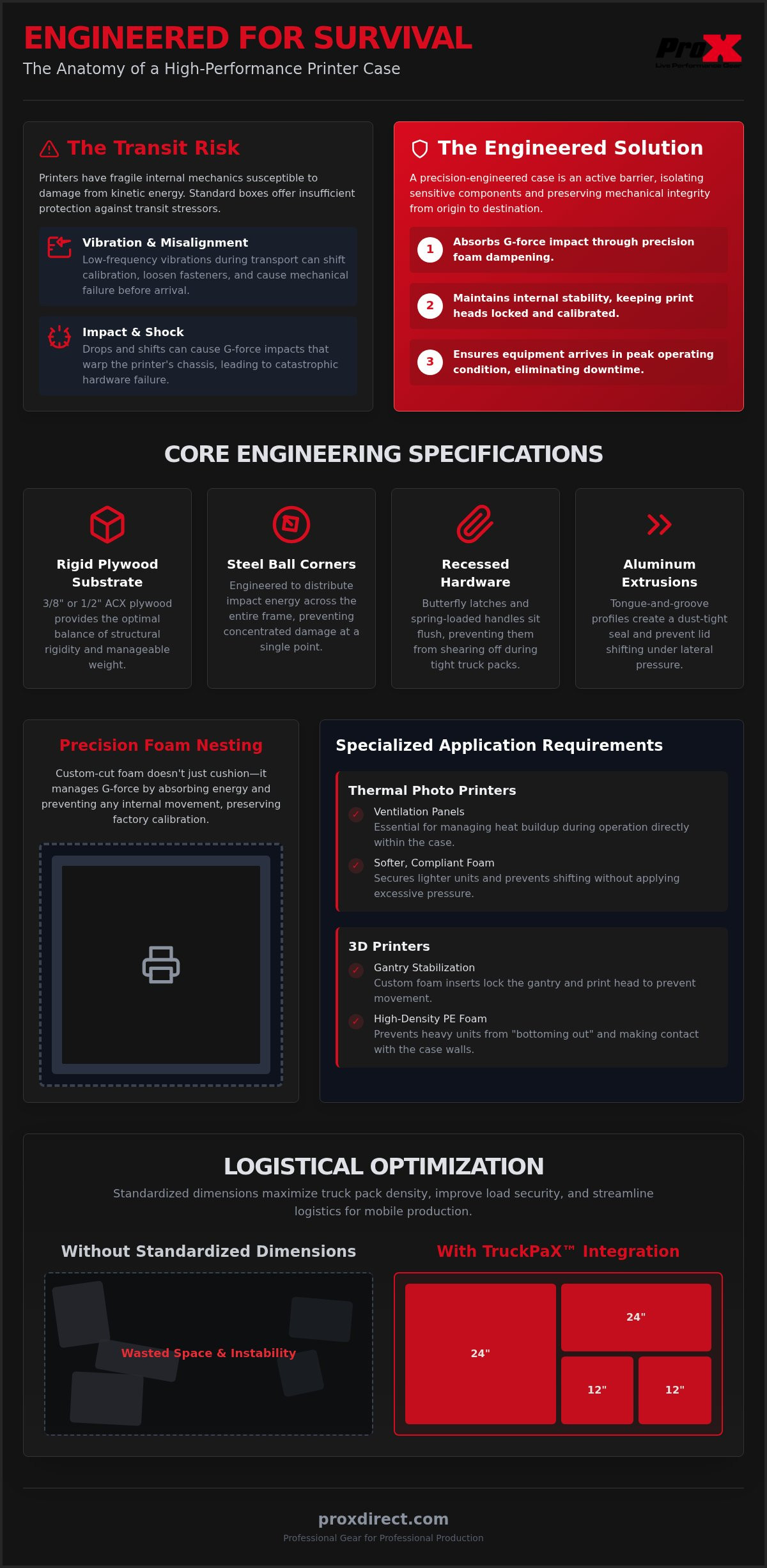
Effective protection relies on precision foam nesting. This isn't just about cushioning; it's about managing G-force impact. When a case is dropped or shifted, the internal foam must absorb the energy before it reaches the printer's internal mechanisms. Selecting the correct density is critical. Light thermal printers require softer, more compliant foam to prevent the unit from shifting, while heavy 3D printers need high-density polyethylene foam to prevent the unit from bottoming out against the plywood walls. This stability ensures the print head remains locked in its home position, preserving factory calibration throughout the journey.
Professional Reliability in High-Stakes Environments
Uptime is the primary metric of success in live production. Back-to-back event schedules leave no margin for troubleshooting hardware failures. Utilizing a dedicated workstation ensures that cables remain managed and mechanisms stay protected from dust and debris. Beyond technical utility, the aesthetic of a clean, organized setup builds client confidence. It demonstrates a commitment to equipment maintenance and operational excellence. You can explore our full range of ProX Cases to find solutions tailored to specific hardware dimensions and logistical requirements.
Engineering Specifications: What Defines a High-Performance Printer Case?
Technical superiority in a printer flight case begins with rigorous material selection. ATA-300 compliance standards dictate specific structural parameters to withstand the stresses of international logistics. This architectural foundation starts with the plywood substrate. Most professional builds utilize 3/8" or 1/2" ACX plywood, which provides a balance between structural rigidity and manageable weight. The exterior lamination isn't merely aesthetic; it serves as the primary barrier against abrasion, moisture, and chemical exposure during transit.
Hardware components are functional requirements, not decorative accents. Recessed butterfly latches are essential because they sit flush with the case surface, preventing them from shearing off during tight loading procedures. Spring-loaded handles provide necessary ergonomic utility while remaining protected within their housings. Heavy-duty steel ball corners are engineered to distribute impact energy across the entire structural frame rather than allowing it to concentrate at a single point. When engineering a printer flight case, aluminum tongue-and-groove extrusions are non-negotiable. These interlocking profiles ensure a dust-tight seal and prevent the lid from shifting under lateral pressure, maintaining the integrity of the internal electronics.
Internal protection relies on the science of foam density. Polyethylene (PE) foam is a closed-cell material with high load-bearing capacity. It's used at the base of the printer to support the unit's weight without permanent compression. Conversely, Polyurethane (PU) foam is softer and more flexible. It's typically utilized for the lid or side walls to create a gentle nest that absorbs high-frequency vibrations before they reach the printer's sensitive internal sensors.
Material Science and Build Quality
Choosing between 3/8" and 1/2" plywood depends on the total mass of the hardware. For smaller thermal printers, 3/8" offers sufficient protection while reducing the overall weight of the kit. Larger 3D printers require 1/2" walls to prevent bowing under the weight of the machine. Honeycomb laminates represent a significant advancement in material science, providing a high strength-to-weight ratio for frequently moved gear. Dual-anchor rivets secure hardware through the plywood and into the internal aluminum bracing, ensuring the structure doesn't pull apart under the stress of heavy touring. If you have non-standard hardware requirements, you can view our technical specifications for custom builds to ensure a precise fit.
Maintenance for Longevity
Even the most advanced engineering requires periodic maintenance to ensure long-term reliability. Hardware should be cleaned and lubricated to prevent oxidation and ensure smooth latch operation. It's vital to inspect the internal foam after every production cycle. Look for signs of "dusting" or permanent indentation, which indicates the foam has lost its dampening properties and needs replacement. For a comprehensive guide on preserving your investment, consult The Ultimate Maintenance Checklist for Touring Road Cases.
Specialized Protection: Photo Booth vs. 3D Printer Applications
Engineering a printer flight case requires a deep understanding of the specific operational mechanics of the hardware. Thermal photo printers and 3D printers present vastly different structural and thermal challenges. While a photo printer is characterized by its compact, dense mass and high heat output, a 3D printer often features a tall form factor with a high center of gravity and delicate moving parts that require absolute immobilization during transit.
Thermal dye-sublimation printers require constant airflow to maintain print head performance during high-volume events. A high-performance case design incorporates strategic ventilation ports and cable pass-throughs. This allows the unit to operate without being removed from its protective base. This in-case operation is essential for maintaining a clean workstation and reducing setup time. Conversely, 3D printers demand protection for the gantry system and extruder head. These components are susceptible to misalignment if the Z-axis is allowed to shift during vibration. Custom foam inserts must be engineered to lock the print bed and gantry in place, preventing kinetic energy from transferring to the precision stepper motors.
Logistical mobility also varies by application. For smaller photo printers, standard spring-loaded lift handles are sufficient for manual handling. However, industrial-scale 3D printers or multi-unit photo booth kits often require integrated trolley designs. Heavy-duty 4-inch casters with locking brakes allow for efficient movement across venue floors while providing a stable platform during operation. When selecting a printer flight case for oversized industrial hardware, ZCASE custom build options provide the necessary structural reinforcement to handle the extreme weight of professional additive manufacturing equipment.
Photo Booth Logistics and Efficiency
In the high-speed environment of event photography, rapid deployment is the primary objective. Specialized cases often include dedicated storage compartments for extra media rolls and ribbon ink, ensuring all necessary supplies remain with the hardware. This organization prevents lost inventory and streamlines the strike process after an event. For professionals managing complex setups, integrating these units into AV Broadcasting Cases for Mobile Production ensures a unified logistical footprint and standardized truck pack density.
3D Printer Transport Challenges
Transporting 3D printers involves managing fragile gantry systems and preventing filament spool damage. Bespoke foam inserts are designed to cradle the extruder assembly, ensuring it cannot collide with the frame during impact. Additionally, dedicated cavities for filament storage prevent spool cracking and protect the material from environmental contaminants. By utilizing ZCASE custom build services, technicians can specify exact dimensions for industrial printers. This ensures that even the largest gantry systems remain perfectly calibrated from the laboratory to the production site.
Logistical Optimization: Integrating Printer Cases into Your Truck Pack
Logistical efficiency in professional production is measured by how effectively equipment utilizes available trailer volume. A printer flight case must do more than protect its contents; it must integrate seamlessly into a standardized transport system. Non-standard case dimensions create "dead air," which leads to shifting loads and wasted fuel. By utilizing cases designed with truck-pack-friendly footprints, production managers ensure that every cubic inch of a trailer is utilized effectively. This systematic approach to loading reduces the number of vehicles required and lowers overall transport costs.
Stackability is a core requirement for high-density loading. Professional cases feature integrated caster cups on the top lid, allowing multiple units to be stacked vertically without the risk of sliding during transit. This vertical optimization is particularly valuable for photo booth operators and event photographers who frequently transport multiple units in a single vehicle. Multi-printer utility cases further reduce the logistical footprint by housing several units within a single external shell, simplifying inventory management and reducing the number of individual pieces to track during load-in and strike.
Achieving Truck Pack Density
Standardizing the width and depth of your gear allows for a cohesive loading pattern that minimizes movement. When cases are sized to be exact fractions of standard truck widths, they lock together to form a solid mass. This structural unity prevents individual cases from gaining momentum during sudden stops, which is a primary cause of external impact damage. For a deeper look at standardized transport, read TruckPaX™ Truck Pack Cases: Engineering Logistical Efficiency. Proper weight distribution is also essential; heavier industrial 3D printer units should be placed on the floor level, while lighter thermal printer cases can occupy the upper stacks to maintain a low center of gravity for the entire truck pack.
Heavy-Duty Mobility Solutions
The transition from the truck to the stage requires hardware that can handle varied terrain. High-grade casters are essential for navigating gravel, uneven asphalt, and steep loading ramps. Industrial-grade 4-inch casters with non-marring rubber protect venue flooring while providing smooth movement under heavy loads. Secure placement on uneven surfaces is managed through integrated braking mechanisms on at least two casters per unit. Ergonomic handle placement is another critical engineering detail; handles must be positioned to allow for a natural lifting posture, reducing crew fatigue and the risk of accidental drops. To optimize your logistical workflow, purchase professional printer cases designed for high-volume touring.
Bespoke Engineering: Custom Case Solutions for Unique Hardware
Standardized dimensions provide a foundation for logistics, but unique hardware configurations often require a bespoke approach. When an off-the-shelf printer flight case can't accommodate specialized cooling requirements or integrated peripheral racks, custom engineering becomes a necessity. This process ensures that the protective shell is built around the specific operational needs of the gear, rather than forcing the gear to fit a generic template. It's a strategic shift from simple containment to integrated system protection.
The ProX design-and-build process leverages decades of manufacturing expertise to deliver exact-fit solutions. Every project begins with an exhaustive analysis of the hardware's physical attributes and its role within the production environment. Using advanced CAD drawings, engineers map out internal nesting, cable management routes, and airflow channels. This meticulous planning prevents mechanical misalignment by ensuring that every component is supported at its primary structural points. It ensures that even non-standard industrial units receive the same level of protection as mass-market hardware.
Santosom engineering represents the pinnacle of this custom philosophy. Through a partnership focused on premium European craftsmanship, these cases offer enhanced durability for the most demanding touring schedules. The focus remains on functional excellence, utilizing material science to create structures that withstand extreme logistical pressures without compromising the safety of the precision electronics inside. This level of build quality is essential for high-value gear that requires absolute reliability.
The Custom Design Workflow
Achieving a zero-clearance fit requires precision measurement of the hardware's chassis and any protruding connectors. This workflow includes selecting specialized hardware, such as heavy-duty hinges or custom-milled foam inserts, to facilitate unique deployment needs. It's a methodical progression from concept to physical build. For those managing high-value assets, ZCASE Custom Build Cases for High-Value Production Gear provide the ultimate technical solution for bespoke protection.
Multi-Functional Workstation Designs
Modern production often requires the integration of multiple devices into a single mobile unit. Multi-functional workstations combine a printer flight case with dedicated rack space for laptops, networking gear, and power distribution. Flip-top designs and removable lids allow for ergonomic access to all controls while maintaining a professional stage presence. This consolidation reduces the number of individual cases to manage. It ensures that the entire workstation is operational within minutes of arrival. If your hardware requires a specialized structural solution, contact ProX for custom engineering services to begin the design process.
Securing the Future of Precision Print Logistics
Maintaining the mechanical integrity of professional printers requires a shift from passive storage to active, engineered protection. A high-performance printer flight case acts as a structural extension of the hardware, isolating sensitive print heads and gantry systems from the destructive forces of low-frequency vibrations. Whether you are managing high-volume photo booth deployments or industrial-scale 3D printing labs, the objective is consistent: ensuring equipment arrives in peak operational condition without the need for on-site recalibration.
Prioritizing ATA-300 compliance and logistical efficiency helps you eliminate the hidden costs of equipment downtime and mechanical failure. ProX has been a trusted partner for touring professionals since 1984, providing the industrial authority needed to protect high-stakes production gear. From standardized truck pack dimensions to custom CAD-designed internal nesting, our engineering team delivers the reliability your professional reputation depends on. You don't have to leave the safety of your precision electronics to chance.
Browse ProX Professional Printer Cases to secure your precision electronics for the 2026 season and beyond.
Frequently Asked Questions
What is the difference between a standard utility case and a dedicated printer case?
A dedicated printer flight case provides internal mechanical stabilization that a standard utility case lacks. While utility cases offer general protection, printer-specific designs utilize precision-cut foam to isolate print heads and delicate gantry systems from kinetic energy. This specialization prevents the mechanical misalignment often caused by low-frequency vibrations during transit. Dedicated cases also frequently include operational features like ventilation ports and cable management channels for in-case use.
Can I operate my photo printer while it is still inside the case?
You can operate a photo printer while it remains in the case if the unit is engineered with specific thermal management features. High-performance designs incorporate strategic ventilation ports to maintain airflow and prevent the print head from overheating during high-volume production. Additionally, integrated cable pass-throughs allow for power and data connectivity without removing the hardware. This setup maintains a clean workstation and reduces the risk of accidental damage during event strikes.
How do I choose the correct foam density for a heavy 3D printer?
Selecting the correct foam density requires balancing load-bearing capacity with vibration dampening. For heavy industrial 3D printers, high-density Polyethylene (PE) foam is utilized at the base to support the unit's mass without permanent compression. Softer Polyurethane (PU) foam is then applied to the lid and side walls to create a protective nest. This multi-layered approach ensures the machine remains stable while absorbing high-frequency shocks that could otherwise disrupt precision calibration.
Are these cases compliant with ATA-300 touring standards?
Professional cases are engineered to meet or exceed ATA-300 Category 1 standards for a minimum of 100 round-trip shipments. This compliance requires specific structural attributes, including 3/8" or 1/2" ACX plywood, steel ball corners, and recessed hardware. These specifications ensure the case can withstand the extreme physical stressors of international air travel and long-haul trucking. Maintaining these standards is essential for protecting high-value precision electronics in a demanding touring environment.
What is the best way to secure a printer gantry for transit?
Securing a printer gantry for transit is achieved through the use of bespoke foam blocks that lock the Z-axis and print bed into a fixed position. This prevents the extruder assembly from shifting or colliding with the frame when the case is subjected to impact. By immobilizing these moving parts, you protect the precision stepper motors and optical sensors from mechanical stress. It's a critical step in ensuring the printer remains calibrated upon arrival.
Do you offer custom foam inserts for specific printer models?
We provide custom-engineered foam inserts designed through a meticulous CAD measurement process for specific printer models. These bespoke internals ensure a zero-clearance fit, which is necessary for isolating fragile internal mechanisms from external shock. Technicians can specify exact dimensions for industrial 3D printers or specialized thermal units to guarantee absolute stability. This tailored approach is far superior to generic foam-filled options, as it targets the hardware's primary structural support points.
How do standardized case dimensions improve touring logistics?
Standardized case dimensions optimize truck pack density by eliminating "dead air" and creating a cohesive, interlocked load. When a printer flight case is sized as a precise fraction of a standard trailer width, it integrates seamlessly into the logistical chain. This reduces the risk of shifting during transit and improves fuel efficiency by maximizing volume utilization. Standardized footprints also facilitate the use of stackable designs, allowing for secure vertical optimization in high-volume production environments.
What maintenance is required for professional touring cases?
Professional touring cases require periodic hardware maintenance and internal foam inspections to ensure long-term reliability. You should clean and lubricate recessed latches and spring-loaded handles to prevent oxidation and ensure smooth operation. It's equally important to check the internal foam for signs of permanent indentation or "dusting," which indicates a loss of dampening properties. Replacing compromised foam and tightening dual-anchor rivets will extend the service life of your protective equipment.
Disclaimer
Any trademarks, trade names or brand names appearing herein that do not belong to ProX are the property of their respective owners and/or companies, and such appearance doesn't and shall not constitute or imply endorsement, sponsorship or recommendation by ProX.


