

Is your instrumentation truly protected, or are you simply relying on a layer of plywood and hope? Professional production managers know that a single failed latch or a shifted rack during international transit can jeopardize an entire tour schedule. High-value gear requires more than a generic container; it demands Pro Music Cases engineered with mechanical precision. These units serve as critical logistical tools designed to withstand the physical stresses of global transport while maintaining the structural integrity of the equipment inside.
You've likely dealt with the frustration of hardware failure in the field or cases that exceed weight limits, adding unnecessary costs to your logistics. We understand that equipment failure isn't an option when the stakes are this high. This guide provides a comprehensive analysis of the engineering standards and material specifications necessary to ensure zero-damage transit. We'll examine the importance of recessed hardware, honeycomb digital laminates, and the specific dimensions required for an efficient truck pack. By focusing on industrial durability and precise fitment, you can secure your inventory for years of rigorous touring.
Key Takeaways
- Analyze the mechanical stresses of global transit and learn why professional protection is required to mitigate vibration and impact.
- Identify the material requirements, including specific plywood thicknesses and honeycomb laminate, that define high-impact Pro Music Cases.
- Explore specialized housing solutions for complex signal chains and non-traditional instrument shapes to ensure a precise, shift-free fit.
- Optimize your logistics by utilizing standardized case dimensions that maximize truck pack density and warehouse efficiency.
- Understand how decades of manufacturing expertise and a global replacement parts network support the long-term reliability of your touring inventory.
The Critical Role of Professional Music Cases in Touring Integrity
Global logistics subject sensitive equipment to constant mechanical forces. High-value instruments on tour face a combination of high-frequency vibration, lateral impacts, and vertical stacking pressure. A standard Road case serves as the primary defense against these variables. Unlike consumer-grade storage solutions, Pro Music Cases are engineered to maintain internal alignment even when the outer shell is subjected to significant torque or weight loads during truck packing. This structural integrity is vital for maintaining the calibration of electronics and the physical safety of the instrument.
Consumer-grade gig bags or thin-walled plastic cases often fail because they lack structural rigidity. These lighter options offer protection against minor abrasions but cannot withstand the thousands of pounds of pressure generated in a fully loaded semi-trailer. Professional-grade protection establishes a baseline where the case itself absorbs the energy of an impact, preventing that force from reaching the delicate solder joints of electronics or the fragile finishes of vintage instruments. Without this mechanical barrier, equipment failure becomes a statistical certainty rather than a possibility.
Mechanical Protection vs. Environmental Shielding
Rigid outer shells, typically constructed from reinforced plywood, are designed to dissipate kinetic energy across the surface of the case. This prevents localized punctures or crushing. Inside the shell, the density of the internal foam is critical. High-density foam inserts ensure that gear does not shift during transit, which is a primary cause of hardware shearing. Additionally, professional casing provides a necessary buffer against the rapid humidity and temperature fluctuations common in cargo holds during international air travel. These environmental factors can cause wood to warp or electronics to develop condensation, leading to long-term degradation.
The Logistical Cost of Equipment Failure
Equipment downtime represents a significant financial drain on any production. When an instrument is damaged, the cost includes more than just the repair bill; it encompasses potential performance delays, emergency rental fees, and logistical disruptions. Investing in high-durability housing offers a measurable return on investment by extending the operational lifespan of the gear. For those seeking a deeper technical analysis of these protective standards, The Ultimate Guide to Flight Cases provides an exhaustive overview of the engineering required for professional production environments. Reliable casing ensures that your inventory remains functional and available for every scheduled date on the tour.
Engineering Standards: Materials and Hardware Specifications
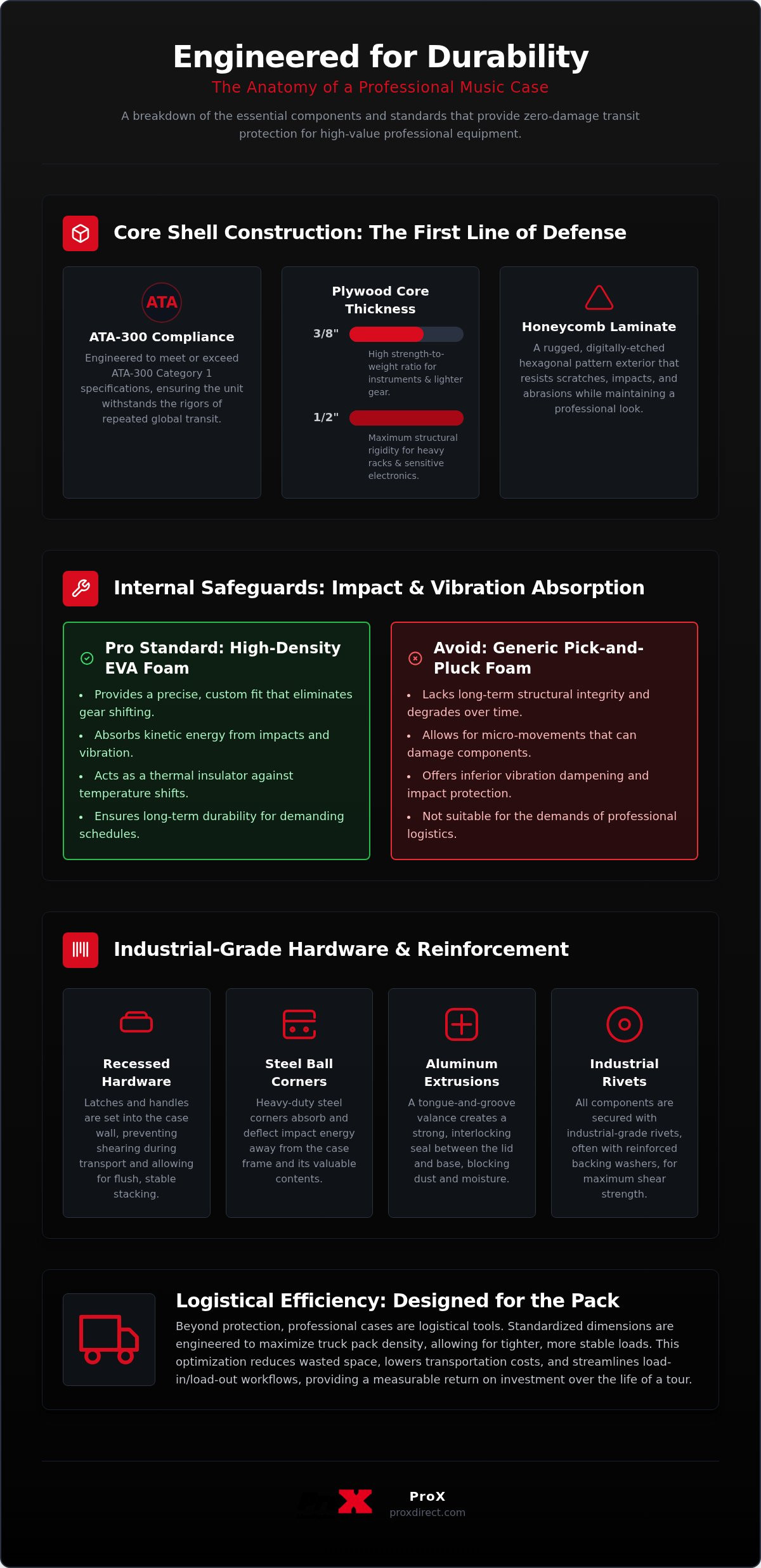
Professional production standards for Pro Music Cases are built upon technical specifications that exceed basic storage requirements. When evaluating a case, engineers look for ATA-300 Category 1 compliance, which ensures the unit can withstand the mechanical stresses of repeated global transit. The foundation of this protection is the material science behind the shell. Most high-performance cases utilize either 3/8-inch or 1/2-inch plywood. While 1/2-inch plywood offers maximum structural rigidity for heavy rack gear, 3/8-inch provides a lighter, high-strength alternative for individual instruments. Both options are typically bonded with a honeycomb digital laminate. This hexagonal surface pattern provides a rugged exterior that resists scratches and impacts while maintaining a professional appearance over years of use.
Internal engineering is equally critical for travelling safely with musical instruments. Unlike generic foam, custom-cut high-density EVA foam provides a precise fit that eliminates gear shifting. While pick-and-pluck foam offers temporary versatility, it lacks the long-term durability required for professional production schedules. High-density foam also acts as a thermal insulator, protecting sensitive wooden instruments from rapid temperature shifts during transport.
The Anatomy of a High-Impact Case
Aluminum tongue-and-groove extrusions create a mechanical lock between the lid and the base to prevent lateral shearing and maintain a secure, dust-resistant seal. Industrial-grade rivets are used in conjunction with reinforced backing washers to ensure that hardware remains attached even under extreme tension. This assembly method prevents the hardware from pulling through the plywood during heavy lifting or accidental drops. The integration of these components creates a unified structure that protects delicate internal electronics from external kinetic energy.
Hardware Durability and Field Serviceability
Recessed hardware is a non-negotiable requirement for professional logistics. Butterfly latches and spring-loaded handles are set into the plywood to prevent them from being sheared off during tight truck packs or warehouse stacking. These components are designed for high-cycle use, ensuring reliable operation in demanding environments. Because even the most durable gear can face extreme conditions, maintaining a fleet requires access to ProX Cases Replacement Parts to ensure your Pro Music Cases remain in peak operational condition. This focus on serviceability extends the life of the asset and supports consistent production workflows.
Categorizing Pro Music Cases by Application
Effective inventory management requires categorizing Pro Music Cases by their specific mechanical application. While the exterior shell provides general protection, the internal architecture must address the unique vulnerabilities of different equipment types. Pedalboard cases, for instance, are no longer just storage boxes; they are integrated performance platforms. ZCASE pedalboard solutions are engineered to house complex signal chains, including multi-effect units and expression pedals, without requiring the disconnection of patch cables or power supplies between shows.
Pedalboard Engineering and Signal Integrity
The use of a removable lid design allows for rapid stage setup, as the equipment stays mounted to the base of the case. This reduces setup time and minimizes the risk of cable fatigue or connector failure. By securing these components with precision-cut foam rather than generic adhesives, the signal integrity is maintained despite the vibration of transit. These units are built to manage the weight of multiple pedals while providing a stable foundation during use.
Heavy-Duty Protection for Strings and Keys
Professional guitars and basses require specific internal bracing to prevent lateral movement and provide adequate neck support. Standard universal cases often allow the headstock to carry weight during an impact, leading to catastrophic structural failure. High-performance Pro Music Cases utilize contoured foam inserts that distribute pressure across the body of the instrument; this keeps the neck suspended and protected. For keyboard players, managing the logistical footprint of an 88-key workstation involves balancing weight with structural rigidity. Large workstations are prone to chassis flex, which can damage internal circuit boards. Cases for these units feature reinforced base plates and heavy-duty casters to facilitate transport while ensuring that screens and sensitive encoders remain shielded from stacking pressure.
Bespoke Engineering for High-Value Assets
Universal fits are often insufficient for one-of-a-kind vintage instruments or complex production workstations. In these instances, choosing ZCASE Custom Build Cases ensures that every dimension is accounted for in the engineering phase. The process involves precise measurement of the equipment to create a bespoke internal environment that mirrors its specific geometry. In addition, the Santosom line offers European engineering standards, providing a range of specialized solutions for AV broadcasting and lighting consoles that require high-density protection within standardized truck pack dimensions. This methodical approach to casing ensures that even non-standard gear is integrated into the professional logistics chain.
Logistical Integration: Optimizing Production Workflows
Logistical efficiency is as critical as mechanical protection in professional production environments. For touring crews, Pro Music Cases must function as modular components within a larger transportation ecosystem. Standardizing case dimensions is a fundamental requirement for maximizing truck pack density. When cases are engineered with uniform exterior footprints, they eliminate the dead space that often leads to shifting loads and increased shipping overhead. Efficiency in the warehouse is equally dependent on hardware choices like heavy-duty 4-inch casters and stacking wheel wells. These features allow for stable, vertical storage and rapid deployment during load-in and load-out.
Maximizing Truck Pack Efficiency
Standardized exterior dimensions ensure that every cubic inch of a trailer is utilized effectively. This precision is particularly evident in TruckPaX™ Truck Pack Cases, which are designed to align with standard trailer widths to facilitate high-density logistics. Uniform stacking is not just a matter of space; it's a matter of safety. A level load is less likely to topple during transit, reducing the risk of impact damage from falling equipment. Heavy-duty casters with reinforced mounting plates support the weight of the case and the stacking pressure of multiple units. Integrated dish plates are recessed into the plywood to prevent them from snagging. These plates hold tour labels and barcodes, which are essential for maintaining an accurate manifest during complex global tours.
Touring Logistics and Air Travel
Navigating international air travel requires a balance between structural thickness and weight management. While 1/2-inch plywood offers superior rigidity, it can often push a case over commercial weight limits. Production managers often specify 3/8-inch shells for Pro Music Cases intended for air travel to avoid excess baggage fees while maintaining high-impact protection. These units are preferred for below-wing handling because their industrial-grade construction survives the aggressive mechanical sorting systems used by airlines. Low-profile wheels and integrated handles provide the mobility needed for independent transport through terminals without adding unnecessary bulk. Organization is a key component of this workflow. Recessed labeling dishes allow for the quick identification of contents without the risk of the label being torn off during handling. This ensures the right instrument reaches the right stage position every time.
To optimize your tour's logistical footprint and protect your inventory, explore our full range of standardized production cases.
The ProX Advantage: Engineering Excellence Since 1984
Success in the live performance industry is built on reliability. Since 1984, ProX has functioned as a technical partner for production professionals, prioritizing functional excellence over temporary industry trends. This four-decade legacy is grounded in a deep understanding of the physical demands placed on professional equipment. Our Pro Music Cases are not merely containers; they're the result of rigorous mechanical testing and material science. By maintaining a steady focus on engineering precision, we've established a standard that allows production houses to scale their operations with confidence in their hardware's performance.
A Legacy of Performance Engineering
Adapting to evolving instrument technology requires a methodical approach to design. As gear becomes more complex and sensitive, our engineering team refines case architectures to address new vulnerabilities. Every new design undergoes testing to ensure it meets the structural requirements of global transport. This commitment to quality is why production houses worldwide standardize on our hardware. They don't just buy a case; they invest in a system that integrates with their existing inventory. Our partnership with ZCASE in Poland further extends this capability, offering bespoke engineering for high-value assets that require specialized housing. This ensures even the most unique instruments receive the same level of protection as our standard utility units.
Finding the Right Solution for Your Gear
Sustainability in production gear means designing for a lifetime of use, not a single season. We prioritize durable materials like honeycomb digital laminate and recessed hardware because they withstand the friction of years of touring. If a component eventually shows wear, our global dealer network provides access to replacement parts, extending the operational life of the case. This approach reduces the total cost of ownership and prevents equipment from becoming obsolete due to simple hardware failure. Professionals can utilize the ProX Cases Category to identify specific fits for their current inventory or consult with dealers for complex custom projects. Whether you're managing a local rental fleet or a global tour, our engineering standards provide the backbone for your success. Browse our full catalog of Pro Music Cases to secure your high-value instruments with industry-leading protection.
Securing Your Touring Inventory for the Long Term
Maintaining the integrity of high-value instruments requires a commitment to engineering precision and material durability. We've examined how standardized dimensions and industrial-grade hardware create a reliable logistical framework for global transit. These technical standards ensure that your gear survives the mechanical stresses of stacking and vibration without compromising production schedules. By prioritizing recessed hardware and custom-fit foam, you eliminate the risks associated with shifting loads and hardware failure in the field.
Since 1984, our focus has remained on providing the structural backbone for the live performance industry. Whether you require standard utility housing or bespoke engineering through our ZCASE partnership, our Pro Music Cases are designed for years of rigorous use. This methodical approach to protection supports both your immediate logistical needs and the long-term value of your equipment. Explore our complete range of Pro Music Cases to find the right engineering solution for your specific gear. Your inventory is a critical asset; ensure it's protected by the industry's most reliable standards.
Frequently Asked Questions
What is the difference between a standard music case and a professional flight case?
A professional flight case differs from a standard case by its mechanical compliance with ATA-300 Category 1 standards. While standard cases provide basic protection against dust and minor abrasions, professional units are engineered for the stresses of repeated global transit. These units utilize reinforced plywood, aluminum extrusions, and recessed hardware to maintain structural integrity under thousands of pounds of stacking pressure. They're built as logistical tools rather than simple storage containers.
How do I measure my instrument for a custom ZCASE build?
Measuring for a bespoke ZCASE build requires providing the exact maximum exterior dimensions of your equipment. You must include all protruding hardware such as knobs, antennas, handles, and feet in your length, width, and height calculations. Our engineering team uses these precise specifications to design a custom internal environment. This ensures a shift-free fit that protects sensitive components from vibration and impact during rigorous production schedules.
What materials are used in ProX Pro Music Cases to ensure durability?
Pro Music Cases utilize industrial-grade materials including 3/8-inch or 1/2-inch plywood bonded with a rugged honeycomb digital laminate. This exterior is reinforced with aluminum tongue-and-groove extrusions and industrial-grade rivets with backing washers. Internally, we use high-density EVA foam for precise equipment fitment. These materials are selected for their ability to dissipate kinetic energy and resist environmental fluctuations during international air travel or long-distance truck transport.
Are replacement parts available if a latch or handle is damaged during touring?
Replacement parts are readily available to ensure the long-term field serviceability of your equipment. ProX maintains a comprehensive inventory of latches, handles, ball corners, and casters. This allows production managers to perform essential maintenance on their fleet without replacing the entire case structure. Accessing these components through our global dealer network extends the operational lifespan of your inventory and supports consistent production workflows across different touring regions.
Can I stack different types of ProX cases safely in a truck pack?
Safe stacking is possible when cases utilize standardized exterior footprints and integrated stacking features. Most professional units feature recessed wheel wells and steel ball corners that lock into place when stacked vertically. This mechanical integration ensures load stability during transit and maximizes warehouse storage efficiency. Standardizing your inventory allows for a more dense truck pack, reducing dead space and preventing equipment from shifting during lateral movement.
What makes the honeycomb laminate superior to standard smooth plywood?
Honeycomb digital laminate is superior to smooth plywood because its hexagonal surface pattern significantly reduces the visibility of scratches and scuffs. This material science approach provides an extra layer of impact resistance while maintaining a professional aesthetic over years of use. Unlike smooth surfaces that show every abrasion, the honeycomb texture dissipates surface friction. It's a non-negotiable standard for touring professionals who require their gear to remain visually and structurally intact.
How does internal foam density affect the protection of my instrument?
Internal foam density is a critical factor in preventing the shifting of internal components. High-density EVA foam provides a rigid support structure that holds the instrument in a fixed position, which is essential for protecting delicate solder joints and finishes. It acts as both a mechanical buffer against impact and a thermal insulator against rapid temperature changes. Lower density foams often compress over time, leading to dangerous gaps that allow gear to shift.
Does ProX offer cases for non-standard or vintage musical instruments?
We offer specialized solutions for non-standard and vintage instruments through our Pro Music Cases line and ZCASE custom builds. Our engineering team can create bespoke internal environments based on the specific geometry of your gear. This process ensures that even unique or irreplaceable assets receive modern protection standards. Whether you have a vintage synthesizer or a custom-shaped guitar, we provide the structural integrity required for safe global transport.
Disclaimer
Any trademarks, trade names or brand names appearing herein that do not belong to ProX are the property of their respective owners and/or companies, and such appearance doesn't and shall not constitute or imply endorsement, sponsorship or recommendation by ProX.


