

The Pioneer CDJ-3000 is a sophisticated multi-processing unit that functions as the digital backbone of a modern performance, making its physical protection a matter of technical necessity. Industry professionals recognize that standard transport solutions often fail to address the specific vulnerabilities of high-resolution screens and precision-balanced jog wheels. Selecting a professional flight case for Pioneer CDJ-3000 hardware requires an understanding of mechanical tolerances and material science to ensure the longevity of your investment.
We understand that in high-stakes production environments, equipment failure isn't an option. You'll discover the rigorous engineering standards, including ATA-300 Category I compliance, required to safeguard the advanced MPU and sensitive touch interface during global touring. This analysis details the structural requirements for long-term gear preservation, focusing on thermal management, cable efficiency, and the 3/8-inch plywood construction needed to eliminate transit-related vibration damage. By prioritizing functional excellence and engineering precision, you can maintain the operational integrity of your gear across hundreds of shows.
Key Takeaways
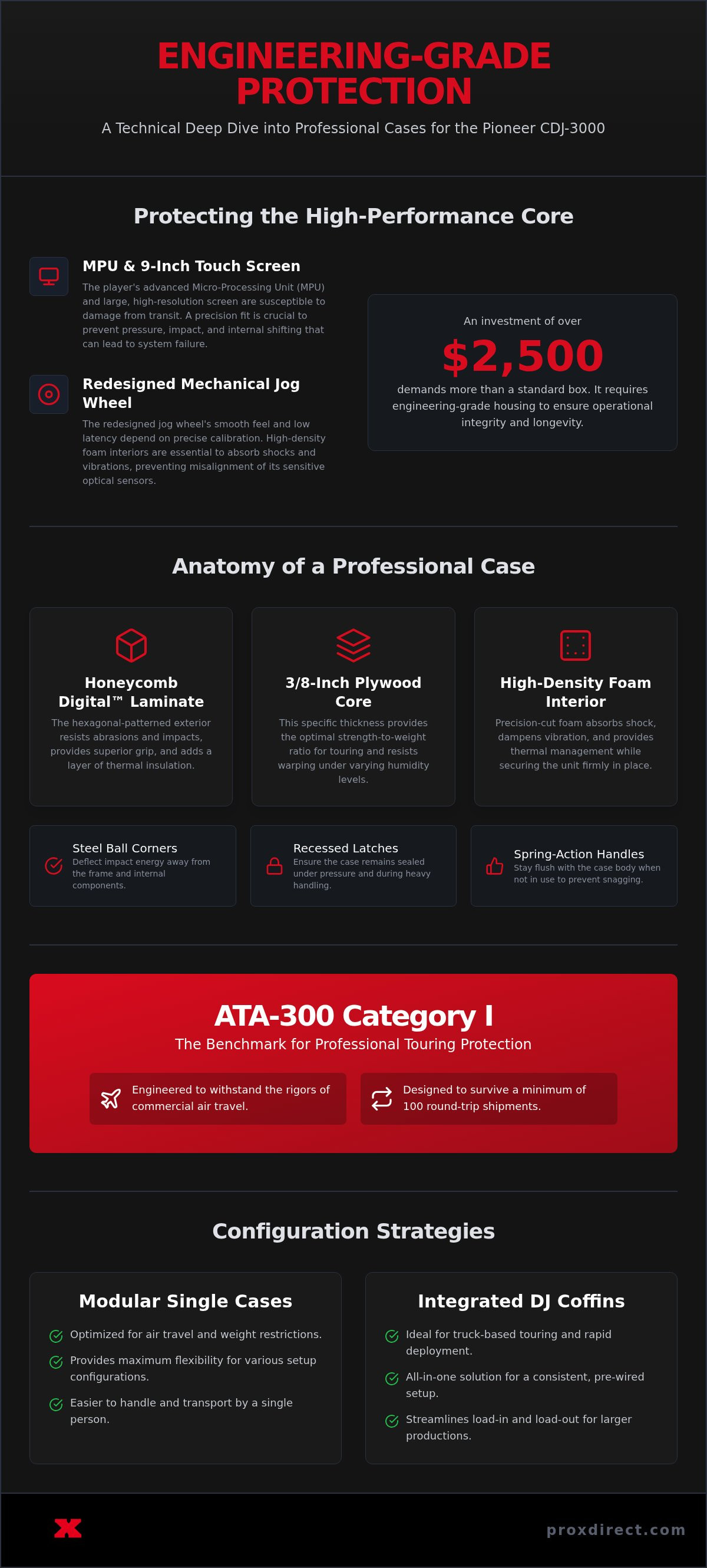
- Learn why the CDJ-3000's advanced MPU and 9-inch touch screen require specialized housing to prevent internal system failure and physical damage during transit.
- Understand the technical advantages of choosing a flight case for Pioneer CDJ-3000 built with 3/8-inch plywood and Honeycomb Digital™ lamination for superior structural integrity.
- Compare the logistical benefits of modular single cases against integrated DJ coffins to optimize your workflow for air travel or truck-based touring.
- Identify the ATA-300 Category I standards that ensure your transport containers are engineered to withstand the rigors of professional production environments.
- Discover how precision-fit high-density foam interiors maintain jog wheel alignment and provide the necessary thermal management for high-performance electronics.
Protecting the Pioneer CDJ-3000: Why Engineering-Grade Housing is Essential
The evolution of the Pioneer CDJ-3000 marks a significant departure from traditional mechanical media players. It operates as a high-performance micro-processing unit (MPU), effectively serving as a specialized computer for audio processing. This shift in internal architecture means that a standard storage box is no longer sufficient for professional use. To maintain digital integrity during transit, a specialized Flight Case Construction and Design approach is required. Professional-grade housing must move beyond simple containment to provide a stable, vibration-damped environment that adheres to strict industrial standards we've refined as an manufacturer since 1984. Selecting a professional flight case for Pioneer CDJ-3000 units ensures the MPU remains protected from the physical demands of touring.
Digital Vulnerabilities: The MPU and Touch Screen
The 9-inch high-resolution touch screen is the primary point of interaction and the most vulnerable component of the CDJ-3000 chassis. Unlike older models with smaller, recessed displays, this expansive glass surface is susceptible to pressure and impact damage. Internal component shifting during logistics can lead to firmware instability or permanent hardware failure. Ensuring a snug fit prevents screen-to-lid contact, which is critical for maintaining the capacitive touch sensors. For equipment valued at over $2,500, ATA-300 Category I style engineering is a mandatory requirement to ensure the player survives the rigors of commercial air travel and heavy handling. Utilizing a dedicated flight case for Pioneer CDJ-3000 hardware ensures that the MPU remains seated correctly on the motherboard and that the screen stays clear of the lid's interior surface.
Mechanical Integrity for the Redesigned Jog Wheel
Pioneer redesigned the jog wheel for the CDJ-3000 to offer reduced latency and a smoother mechanical feel. While this improves performance, it also introduces sensitivity to external pressure and lateral shocks. High-density foam plays a vital role in preventing jog wheel misalignment. If the internal mechanism is subjected to excessive vibration, the optical sensors can lose calibration, leading to drift or latency issues during a set. Professional production environments demand side-impact protection that generic cases simply don't provide. You can find more details on selecting the right materials in our Professional DJ Equipment Case Purchase Guide. Our engineering focuses on isolating these mechanical parts from the exterior shell, maintaining the precise tension and response times required by professional DJs.
Structural Anatomy: Engineering Standards for Professional Cases
Professional-grade protection begins with the selection of high-quality raw materials. A high-performance flight case for Pioneer CDJ-3000 units utilizes 3/8-inch plywood as its primary structural layer. This specific thickness provides the optimal strength-to-weight ratio required for heavy touring without adding unnecessary mass that complicates solo-gig logistics. These panels are engineered to resist warping under varying humidity levels, ensuring that the case's geometric integrity remains constant over years of use.
The exterior surface features Honeycomb Digital™ lamination. This hexagonal pattern isn't merely an aesthetic choice; it serves a functional purpose by increasing the surface area's resistance to abrasions and impacts. The unique texture provides additional grip for stagehands and technicians during load-in and load-out, reducing the risk of accidental drops. Furthermore, the honeycomb design adds a layer of air-pocket insulation, which helps buffer the sensitive electronics from rapid temperature fluctuations during transit.
Logistical safety relies on industrial-grade hardware components. Recessed butterfly latches ensure that the case remains sealed under extreme pressure, while spring-action handles are designed to stay flush with the case body when not in use to prevent snagging. These components are typically designed to survive at least 100 round trips in commercial shipping environments. Reinforced steel ball corners are strategically placed to deflect impact energy away from the internal player, acting as a primary buffer against the typical collisions encountered in dense truck packs.
The Science of Impact Absorption
Effective protection requires a dual-layer foam strategy. A rigid outer foam layer provides structural support for the player's chassis, while a softer inner contact layer prevents marring of the CDJ-3000's finish and absorbs high-frequency vibrations. This design ensures that the transport container meets the ATA 300 Specification for reusable shipping containers. For a deeper understanding of how these material layers interact to protect your gear, consult The Ultimate Guide to Flight Cases. The precision-cut foam also maintains the alignment of the jog wheel, preventing the internal sensors from losing calibration due to lateral shocks.
Thermal Management and Airflow Design
High-performance MPUs generate significant heat during extended performance sets. A well-engineered flight case for Pioneer CDJ-3000 hardware includes specific ventilation gaps to facilitate airflow around the player's integrated cooling vents. Rear-access panels allow for efficient cable management, ensuring that power and data lines don't obstruct cooling paths or create heat traps. Unlike consumer-grade alternatives that use adhesives, professional cases utilize mechanical rivets to secure all components, preventing structural failure caused by heat-related adhesive degradation. You can browse our full range of engineering-grade case solutions to find the right fit for your specific touring requirements.
Configuration Strategies: Single Cases vs. Integrated DJ Coffins
Selecting between modular units and integrated systems is a critical decision for production managers and touring artists. While both options utilize the same 3/8-inch plywood and industrial hardware standards discussed in previous sections, their utility differs significantly based on transport methods and stage requirements. A dedicated flight case for Pioneer CDJ-3000 players in a modular format offers the highest degree of logistical flexibility, allowing for easier handling during solo-gig scenarios where weight is a primary concern.
Modular Single-Player Solutions
Individual cases are the preferred choice for touring schedules that involve frequent air travel. This configuration allows technicians to distribute weight across multiple containers, which is essential for staying below the 50-pound threshold that often triggers heavy-handling fees from commercial carriers. Modular setups also provide adaptability for unconventional stage designs or tight DJ booths where a full-sized workstation cannot physically fit. Choosing a modular flight case for Pioneer CDJ-3000 hardware ensures that each unit remains an independent asset.
When coordinating international logistics, professionals must account for Logistical Considerations for Professional Touring and federal regulations regarding high-value electronics. Modular cases simplify the maintenance process because a single player can be removed for servicing without dismantling the entire performance rig. This isolation ensures that a technical fault in one unit doesn't compromise the transport security or operational status of the rest of the ecosystem.
Integrated DJ Coffins for Pioneer Ecosystems
Integrated workstations are engineered to house a complete setup, typically comprising a Pioneer DJM-900NXS2 mixer and two CDJ-3000 players. The primary advantage of this configuration is technical efficiency. Since the internal components remain pre-wired, technical teams often report that setup times are reduced by over 50% compared to modular systems. These cases frequently include integrated laptop shelves and dedicated cable management channels to maintain a clean workspace during high-pressure performances.
These all-in-one solutions often feature heavy-duty casters to offset the increased mass of a three-piece setup. For professionals managing large-scale tours, Santosom Cases for Touring Pros offer bespoke internal layouts that prioritize structural rigidity. While the total weight is higher, the inclusion of industrial wheels allows for efficient movement across venue floors. This approach is ideal for truck-based tours where the entire rig can be rolled onto the stage and powered up in minutes, providing a consistent performance environment regardless of the venue's local equipment.
Logistical Considerations for Professional Touring in 2026
Logistical planning for professional tours in 2026 emphasizes spatial efficiency as much as physical durability. When selecting a flight case for Pioneer CDJ-3000 units, production managers must consider the logistical footprint within a standard trailer. Standardizing case dimensions is not merely about organization; it’s about maximizing truck pack density to reduce transportation costs and prevent load-shifting. Our engineering team designs these cases to integrate seamlessly into professional logistics workflows, ensuring that every cubic inch of cargo space is utilized effectively. The 2026 touring landscape demands that every piece of hardware contributes to a faster, safer setup by eliminating the guesswork for loading crews.
Professional touring requires a balance between industrial-grade protection and ergonomic handling. While the 3/8-inch plywood provides the necessary structural integrity, the placement of recessed handles is calculated to allow for a natural lifting posture. This reduces physical strain on local crews and stagehands during the high-pressure environment of load-in. We prioritize functional excellence by ensuring that the case's center of gravity remains stable even when fully loaded with the CDJ-3000 and its associated cabling. This systematic approach to logistics ensures that gear arrives in the same condition it left the warehouse, regardless of the distance traveled.
Truck Pack Compatibility
Achieving a secure load requires cases with standardized footprints designed for 90-inch and 96-inch trailers. You can learn more about these engineering standards in our guide to TruckPaX™ Truck Pack Logistics. To ensure stability during long-distance transit, we utilize stackable designs featuring deep caster cups. These cups lock the wheels of the upper case into the lid of the lower case, creating a unified column that resists lateral movement. In these environments, caster wheels must be heavy-duty and industrial-grade to handle the high-load stresses of warehouse floors and steep loading ramps without failure. This engineering choice prevents the structural fatigue often seen in consumer-grade casters.
Cable Management and Rear Connectivity
The rear panel of the CDJ-3000 houses sensitive Pro DJ Link LAN ports and digital outputs that require specific clearance. A professional flight case for Pioneer CDJ-3000 must provide sufficient internal depth to accommodate 12-gauge power cables and high-speed networking lines without creating sharp bends. We design the rear-access area to protect RCA and Digital Out ports from tension, ensuring that cable weight doesn't strain the player's internal soldering points. This design also facilitates heat dissipation by preventing cable clutter from obstructing the player's cooling vents. For those managing complex touring rigs, you can explore our full inventory of professional case solutions to optimize your logistical workflow and protect your connectivity infrastructure.
ProX Engineering: Precision-Fit Solutions for Pioneer Gear
Our engineering history with Pioneer DJ equipment dates back to 1984, establishing a foundation of technical expertise that spans four decades of hardware evolution. We don't rely on generic dimensions; every flight case for Pioneer CDJ-3000 units is engineered using precise measurements of the actual chassis. This meticulous approach ensures that the high-resolution screen and internal MPU are isolated from the mechanical stresses of professional touring. Industry professionals rely on this level of precision because it eliminates the risk of equipment shifting, which is the primary cause of internal component failure in high-stakes production environments.
Heritage of Professional Reliability
The transition from early analog turntables to the sophisticated micro-processing units of the CDJ-3000 has required a parallel evolution in protective housing. We've refined our manufacturing processes to meet the increasing complexity of modern gear. For specialized requirements that exceed standard catalog specifications, we offer ZCASE Custom Build Cases. These bespoke solutions allow for the integration of specific cooling systems or unique connectivity layouts, ensuring that high-value production gear remains operational under the most demanding environmental conditions. Seasoned veterans prioritize our builds because they understand that a failure on stage is a failure of the entire production.
Finding Your Professional Setup
Our comprehensive catalog provides a variety of configurations designed to meet specific touring needs. You can choose from modular single-player cases, integrated DJ coffins, or full workstation models that incorporate laptop shelving and cable management. Each model adheres to the same industrial standards, including the use of 3/8-inch plywood and reinforced steel ball corners. To support global operations, we maintain an extensive dealer network that ensures technical support and replacement parts are accessible regardless of your location. You can utilize our dealer portal to request custom engineering quotes for large-scale fleet deployments or specialized tour rigs.
Selecting the right housing is a technical decision that directly impacts the lifespan of your digital assets. We remain committed to engineering precision, ensuring that every case provides a stable environment for the CDJ-3000's sensitive electronics. By choosing a manufacturer with a proven history in professional production, you're investing in the long-term reliability of your performance rig. Explore ProX Cases for Pioneer DJ Gear to find the configuration that aligns with your logistical requirements.
Securing Your Digital Performance Infrastructure
The transition to high-performance MPUs requires more than generic storage. We've established how 3/8-inch plywood, Honeycomb Digital™ lamination, and ATA-300 style construction provide the technical buffer necessary to withstand transit vibration and physical impact. Whether you deploy modular single cases for air travel or integrated coffins for rapid stage setup, the priority remains the structural integrity of your hardware. Investing in a precision-engineered flight case for Pioneer CDJ-3000 units is a commitment to equipment longevity and professional reliability.
Since 1984, we've focused on delivering the rigorous standards required for global touring and high-stakes production. This engineering heritage ensures your setup remains operational through every load-in and performance. By prioritizing functional excellence and material science, you protect the high-resolution screens and sensitive electronics that define modern performance. Take the next step in professional gear preservation by reviewing our technical specifications and finding the configuration that matches your logistical needs. Your equipment deserves the highest standard of protection.
Browse the Full Range of Professional Cases for Pioneer CDJ-3000
Frequently Asked Questions
Will a case for the CDJ-2000NXS2 fit the new Pioneer CDJ-3000?
No, the CDJ-3000 is longer than the CDJ-2000NXS2. The CDJ-3000 measures 453 mm in depth compared to the 414.4 mm of the older model. Attempting to use a case designed for previous generations will cause physical interference with the chassis and potentially damage the 9-inch touch screen. A dedicated flight case for Pioneer CDJ-3000 hardware ensures the high-density foam is cut to the exact 2026 industry standards for this specific player.
How much does a professional flight case for the CDJ-3000 typically weigh?
A standard single-player case constructed from 3/8-inch plywood typically weighs between 20 and 25 pounds when empty. This weight is necessary to achieve the structural rigidity required for ATA-300 Category I compliance. Total weight with the player installed reaches approximately 35 pounds. This balance of mass ensures the case can deflect impact energy while remaining manageable for a single technician during load-in or air travel logistics.
What is ATA-300 certification and why does it matter for professional touring?
ATA-300 is a specification established by Airlines for America that defines the standards for reusable shipping containers. Category I is the highest tier, requiring a container to withstand a minimum of 100 round trips in commercial shipping environments. For professional touring, this certification ensures that the recessed hardware and reinforced steel ball corners are engineered to protect high-value electronics from the extreme stresses of global logistics and heavy handling.
Can I leave my CDJ-3000 in the case during a performance without it overheating?
Yes, professional cases are engineered with specific thermal management features to allow for in-case operation. These designs include ventilation gaps and removable rear panels that facilitate airflow around the player's internal cooling system. Maintaining this airflow is critical because the CDJ-3000's high-performance MPU generates significant heat during extended sets. Proper cable management also prevents obstructions that could lead to heat buildup and subsequent performance throttling or hardware failure.
Do ProX cases include space for cables and the power supply?
Every professional flight case for Pioneer CDJ-3000 units includes a dedicated cable compartment located behind the player's rear ports. This space is designed to accommodate 12-gauge power cables, RCA lines, and high-speed LAN connections without creating tension on the hardware interfaces. This compartment also ensures that the power supply and data cables remain connected during transit, which significantly reduces the technical setup time required at the venue.
What is the difference between a standard plywood case and a honeycomb-textured case?
Standard plywood cases use a smooth laminate, while our cases feature the Honeycomb Digital™ surface design. This hexagonal texture increases the surface area's resistance to scratches and abrasions. Practically, the texture provides additional grip for technicians, which is a safety requirement in high-pressure production environments. The honeycomb pattern also adds a layer of air-pocket insulation that buffers the internal electronics from rapid temperature changes encountered during long-distance truck transport.
How do I maintain my flight case to ensure it lasts for years of touring?
Maintenance focuses on the integrity of the mechanical hardware and the cleanliness of the interior foam. You should periodically inspect the recessed butterfly latches and spring-action handles to ensure they remain free of debris and operate smoothly. Wiping the Honeycomb Digital™ exterior with a damp cloth prevents grime buildup. Avoid using chemical solvents that could degrade the high-density foam or the mechanical rivets that secure the 3/8-inch plywood panels together.
Are there cases that can hold both a CDJ-3000 and a laptop shelf?
Yes, integrated workstation models are specifically designed to accommodate the CDJ-3000 alongside sliding laptop shelves. These models utilize a reinforced rail system that allows the shelf to be positioned over the mixer or players during a performance. This configuration is ideal for digital workflows that require simultaneous access to the CDJ-3000 touch screen and a laptop. These workstations maintain the same ATA-300 engineering standards to ensure the entire rig is protected.
Disclaimer
Any trademarks, trade names or brand names appearing herein that do not belong to ProX are the property of their respective owners and/or companies, and such appearance doesn't and shall not constitute or imply endorsement, sponsorship or recommendation by ProX.


