
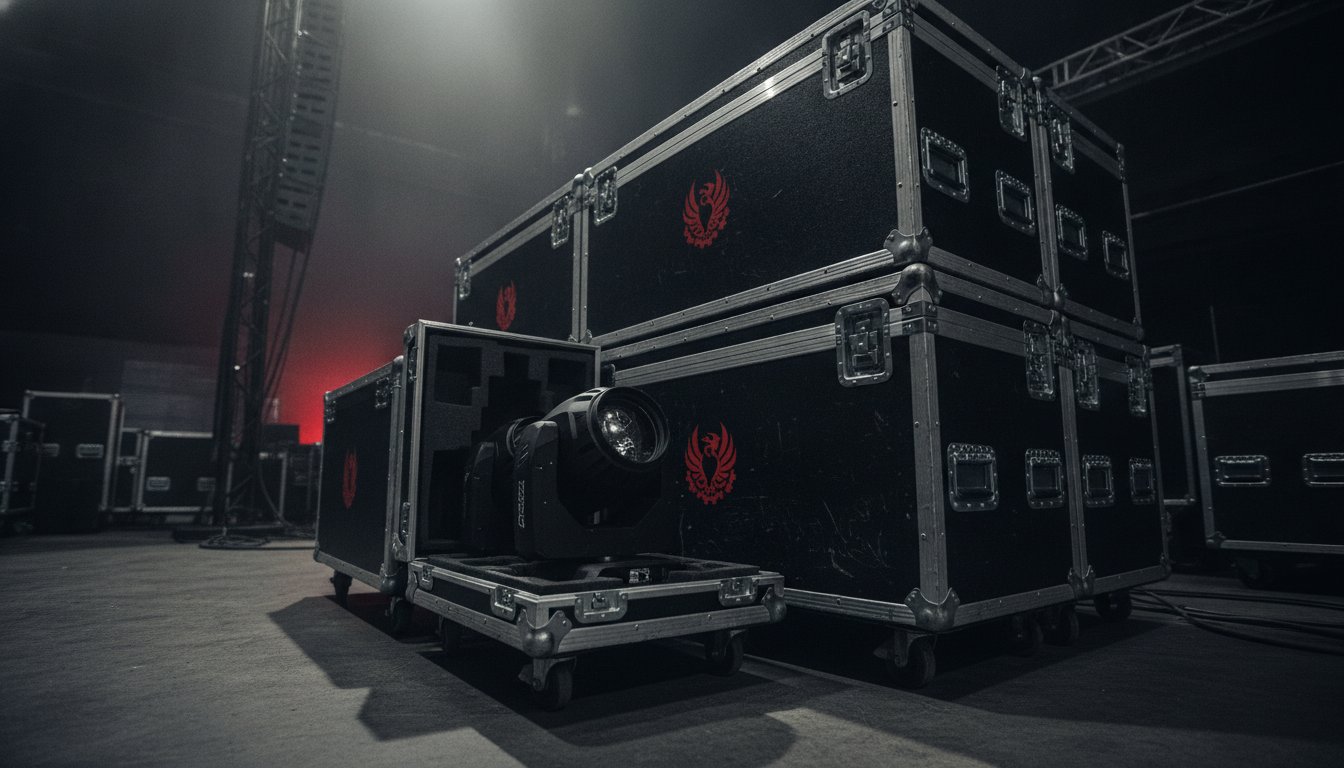
Large trucks are three times more likely than other vehicles to be struck from the rear in two-vehicle fatal crashes. This technical reality means the structural integrity of every moving head light case in your inventory is a matter of operational survival rather than just a storage preference. You recognize that a single hardware failure mid-tour or a minor shift in optical calibration during transit can result in costly equipment downtime and jeopardize production schedules.
Professional-grade protection is about more than just exterior shell thickness; it's a matter of precision engineering designed to withstand the rigors of high-frequency transport. We'll show you how standardized case dimensions and ATA 300 Category I specifications optimize truck density and ensure your fixtures remain within factory tolerances. This guide breaks down the technical requirements for long-term durability, from the impact of LED technology on case volume to the logistical advantages of standardized dimensions that factor into 96 or 100-inch truck widths.
Key Takeaways
- Understand why 3/8-inch and 1/2-inch digital-grade plywood construction is the industry standard for safeguarding delicate optical sensors and internal motors.
- Identify the engineering requirements of a precision-built moving head light case to prevent calibration drift and mechanical fatigue during high-impact transit.
- Learn how to maximize trailer volume and reduce logistical overhead by implementing standardized 22.5-inch and 45-inch TruckPaX™ footprints.
- Explore specialized engineering solutions through Santosom and ZCASE for oversized fixtures that require custom internal support structures.
- Discover how utilizing field-serviceable hardware and replacement parts can significantly extend the operational lifespan of your touring inventory.
Protecting High-Value Lighting Assets in Rigorous Touring Environments
Modern lighting fixtures are precision instruments housed in industrial shells. The transition toward LED technology has increased the complexity of internal optics and control electronics. While traditional discharge lamps were primarily sensitive to thermal shock, contemporary LED moving heads face significant vulnerabilities in their high-density circuit boards and micro-stepper motors. During transit, these components are subjected to constant kinetic energy. Without an engineered housing, this energy causes calibration drift or total mechanical failure. A professional Road case serves as a logistical tool designed to neutralize these physical threats. It's not just a box; it's a shock-absorption system. Standardized protective solutions are essential because they ensure that a moving head light case maintains the integrity of the gear across thousands of miles of transit.
The High Cost of Equipment Failure
Calculating the return on investment for superior protection requires looking beyond the initial purchase price. Mid-tour repairs are expensive. They involve overnight shipping of parts, technician labor, and potential rental costs to cover dead fixtures. A well-designed case prevents "dead on arrival" scenarios at the venue by absorbing the G-forces of rough handling. Touring-grade protection for sensitive optics is the integration of rigid external shielding with high-density internal damping to isolate fixtures from mechanical shock and harmonic vibration. By investing in high-specification ProX Cases, production companies reduce equipment downtime and protect their long-term capital assets.
Standards of Professional Protection
Industry standards dictate how a professional moving head light case should perform under stress. The ATA 300 Category I specification is the benchmark for reusable containers. It requires the case to survive at least 100 round-trip shipments. Achieving this level of durability involves specific mechanical assembly and material choices. Structural integrity must be maintained across multiple tour legs through the use of reinforced hardware and impact-resistant laminates. Internal foam density is critical. If the foam is too soft, the fixture bottoms out against the wood during a drop. If it's too hard, the vibration transfers directly to the internal motors. Professional engineering finds the balance that maintains fixture calibration. Key elements of this protection include:
- High-density polyethylene or ester foam for shock dissipation.
- Recessed steel hardware to prevent snagging and mechanical failure.
- Reinforced aluminum extrusions that maintain the case's geometric shape under heavy loads.
Maintaining these standards ensures that fixtures remain in peak operational condition, regardless of the logistical challenges of the tour.
The Anatomy of a Professional Lighting Case: Engineering Standards
Professional casing starts with the selection of high-grade raw materials. A standard moving head light case typically features a shell constructed from 3/8-inch or 1/2-inch digital-grade plywood. This material offers an optimal strength-to-weight ratio, ensuring the enclosure doesn't buckle under the vertical pressure of a four-high truck stack. These panels are often treated with impact-resistant laminates like the Honeycomb Digital™ finish. This hexagonal pattern provides a tactile grip and hides surface scuffs, but its primary engineering purpose is to add a layer of structural reinforcement against puncture and abrasion. This level of material science is what separates industrial solutions from consumer-grade boxes.
Mechanical hardware must be recessed to maintain a clean profile for logistical efficiency. Industrial-grade butterfly latches are engineered to pull the lid and base together with high torque, creating a secure seal. Spring-action handles stay flush against the case side when not in use, preventing snagging and damage during tight loading procedures. Mobility depends on caster technology. We utilize heavy-duty 4-inch wheels, often featuring dual-locking mechanisms that secure both the swivel and the roll. This is a safety requirement when navigating steep loading ramps or uneven venue floors during a fast-paced load-in.
Structural Integrity and Joinery
The strength of the enclosure relies on the precision of its joinery. Aluminum tongue-and-groove extrusions are fitted to the meeting edges of the lid and base, providing a dust-resistant seal and preventing lateral shifting during transit. Steel ball corners are a critical safety feature. They're designed to absorb and deflect the energy of a corner-first impact away from the internal payload. Every component is secured using industrial rivets and high-strength adhesive bonding. This ensures the case remains a single, cohesive unit through years of harmonic vibration on the road.
Internal Cushioning Systems
Protection continues inside the shell where the fixture is actually cradled. Custom-cut EVA foam is the preferred choice for a moving head light case because it offers superior shock absorption and won't crumble over time. For smaller fixtures or utility needs, adjustable hook and loop dividers provide necessary flexibility. Thermal management is another technical consideration. If a case houses traditional discharge lamps, the internal environment must account for residual heat after a show. Proper airflow and moisture management prevent the buildup of condensation, which can lead to corrosion on sensitive circuit boards. You can find these engineering standards across our full range of ProX Cases.
Optimizing Logistics with Standardized Truck Pack Dimensions
Logistical efficiency in professional touring is a calculation of cubic volume. Maximizing the density of a 53-foot trailer requires equipment enclosures designed with standardized footprints. When a moving head light case is engineered with a specific width and depth, it functions as a modular component in a larger system. Standardized dimensions, such as 22.5-inch and 45-inch modules, allow for precise alignment within truck widths of 96 or 100 inches. This precision eliminates the wasted space often found with non-standardized gear. Interlocking designs and caster dishes on the lid facilitate vertical stacking stability. These features ensure that the load remains secure during transit, reducing the risk of shifting and subsequent equipment damage.
Reducing freight costs is a direct result of logistical precision. By maximizing the "truck pack," production companies can often fit more equipment into fewer trailers. This optimization is critical when managing large-scale tours where every cubic inch of trailer space has a financial value. Beyond volume, the structural integrity of the stack depends on the mechanical alignment of the cases. Precision-milled caster dishes ensure that each moving head light case sits securely on the one below it, creating a unified block of equipment that resists the harmonic vibrations of the road.
TruckPaX™: The Logistical Standard
The primary goal of a standardized system is to eliminate air gaps in the load. Standard case dimensions often result in "dead space" that cannot be filled, leading to inefficient truck packs. By utilizing TruckPaX™ Truck Pack Cases, production managers can achieve a "wall-to-wall" pack. This logistical optimization directly impacts the bottom line by reducing the total number of trailers required for a tour. It also accelerates load-in and load-out speeds. Crews don't have to solve a "puzzle" at the back of the truck; they simply follow a grid-based loading plan that utilizes every available inch of floor space.
Mobility and Handling on the Road
Ergonomic handle placement is a technical necessity for safe handling. We position handles to facilitate two-person lifts, ensuring that the weight of the enclosure is distributed evenly across the lifting points. Proper weight distribution is also critical for high-density stacking. Cases must be balanced to prevent top-heavy loads that could tip during sharp turns or sudden stops. Heavy-duty 4-inch casters, as discussed in previous sections, must align perfectly with the caster dishes of the case below it. This creates a rigid column of equipment that resists lateral forces. By prioritizing these mechanical details, we provide a reliable backbone for the logistical demands of professional production.

Custom Engineering Solutions for Specialized Lighting Fixtures
Universal enclosures provide broad utility, but flagship fixtures often possess unique center-of-gravity requirements or non-standard dimensions. A standard moving head light case might not offer the specific internal bracing needed for a 100-pound hybrid fixture. Santosom Cases provide precision engineering for these high-stakes applications. By utilizing CNC-milled inserts, we ensure that every motor and optical assembly is supported according to the manufacturer's technical specifications. This level of customization is essential for maintaining the alignment of complex internal mirrors and lenses during international transit. It's a meticulous process that prioritizes functional integrity over a one-size-fits-all approach.
Our partnership with ZCASE in Poland allows us to offer bespoke builds that address the most demanding production environments. These cases aren't just protective shells; they're integrated logistical tools. When a fixture's profile doesn't align with standard catalog offerings, custom engineering becomes the only viable path to ensure zero equipment downtime. This involves analyzing the physical attributes of the gear, including cooling vent locations and connector positioning, to prevent mechanical stress on the chassis during transport.
Engineering Bespoke Protection
Engineering bespoke protection involves a methodical design phase. We utilize 3D scanning and CAD modeling to create fixture-perfect fits. This eliminates the "slop" found in universal foam blocks, which can lead to fixture migration inside the case. These designs also integrate dedicated storage for clamps, safety cables, and power looms, keeping all necessary hardware with the fixture. This organization speeds up the rigging process and ensures that critical accessories aren't lost between venues. You can read about the ZCASE Custom Build engineering process to see how these bespoke solutions are manufactured for global touring standards.
Specialized LED Video Wall Support
LED video panels present a different engineering challenge compared to a standard moving head light case. The primary vulnerability is the pixel edge, where even minor contact can cause module failure. Specialized LED Video Panel Wall Support cases utilize vertical storage configurations to prevent the weight of the panels from compressing the bottom modules. This vertical orientation is critical for maintaining the structural integrity of the LED masks. Our designs utilize high-density foam spacers that only contact the panel frame; this leaves the delicate LED face untouched. This engineering choice prevents the "dead pixel" issues that plague tours using generic utility cases for video panels. Secure your high-value production gear by exploring our ZCASE custom build options today.
Maintenance and Long-Term Reliability of Professional Gear
Professional production environments treat a moving head light case as a maintainable asset rather than a consumable expense. High-frequency touring places immense stress on mechanical components, making a field-serviceable design a technical necessity. Casters are typically the first point of failure due to the high-impact nature of loading docks and ramps. We utilize standardized mounting patterns that allow technicians to swap out damaged 4-inch wheels on the fly using basic tools. By providing direct access to ProX Cases Replacement Parts, we ensure that a single damaged component doesn't compromise the safety of an entire equipment stack. Routine inspection protocols should include checking rivet integrity and verifying that aluminum extrusions haven't been warped by excessive lateral pressure.
Technical support and procurement consistency are vital for fleet managers. When expanding an inventory, it's critical that a moving head light case purchased today matches the dimensions and stacking capabilities of units acquired years ago. This consistency ensures that truck pack plans remain valid across multi-year tours. Finding a professional dealer who understands these logistical requirements allows for streamlined bulk ordering and ensures that technical specifications are met for every production leg. We maintain rigorous manufacturing standards to guarantee that every enclosure provides the same level of protection as the first unit off the line.
Extending Case Lifespan
The accumulation of road grime and oxidation on butterfly latches can impede mechanical operation over time. Periodic cleaning and lubrication of hinges and latches prevent seized hardware mid-tour. Internal foam is also subject to wear; years of compression from heavy fixtures can reduce its shock-absorption capacity. Technicians should monitor foam density and replace inserts if the fixture begins to shift within the cradle. For a deeper technical analysis of these maintenance standards, refer to The Ultimate Guide to Flight Cases. These small maintenance steps significantly extend the lifecycle of your logistical investment.
The Manufacturer Advantage
Fleet managers benefit from direct access to engineering specifications. This data allows for precise calculations of trailer weight distribution and total cubic volume. Consistency in manufacturing across multi-year procurement cycles prevents the logistical "puzzles" that occur when case dimensions vary between batches. Our commitment to industrial-grade hardware and standardized assembly means your gear remains protected through hundreds of shows. Secure your touring fleet with ProX hardware to ensure long-term reliability and zero equipment downtime. Contact a professional dealer today to discuss your technical requirements and logistical needs for upcoming productions.
Securing Your Production Assets for Global Logistics
Professional production demands a logistical framework where equipment failure isn't an option. By integrating high-specification materials like digital-grade plywood and impact-resistant laminates, you ensure that every moving head light case provides the structural shielding necessary for international transit. We've established that logistical precision, through standardized TruckPaX™ footprints, directly correlates to reduced freight overhead and accelerated load-in schedules. These engineering standards are the difference between a successful tour and costly equipment downtime.
Since 1984, we've engineered performance gear that meets the rigorous demands of major global production companies. Through our specialized partnerships with ZCASE in Poland and Santosom, we offer bespoke solutions for fixtures that require unique center-of-gravity support. This commitment to functional excellence extends to our comprehensive range of replacement parts, allowing you to maintain your fleet with engineering-grade components. Maintaining your inventory with these standards ensures your fixtures arrive at every venue in factory-calibrated condition. Take the next step in optimizing your tour logistics and equipment safety.
Find a ProX Dealer for Professional Lighting Cases and secure your inventory today.
Frequently Asked Questions
What is the difference between a lighting bag and a professional touring case?
A professional touring case provides rigid structural protection and shock dissipation that fabric bags cannot offer. Bags are intended for light transport and storage, whereas a moving head light case is engineered to withstand the kinetic forces of truck transport and high-density stacking. The use of digital-grade plywood and high-density foam isolates internal motors and optics from mechanical stress during transit.
Why are standardized dimensions important for lighting cases?
Standardized dimensions are critical for maximizing cubic volume in professional transport trailers. By utilizing footprints that are factors of 96 or 100-inch truck widths, such as 22.5-inch or 45-inch modules, production crews can eliminate air gaps in the load. This geometric precision ensures a secure pack that prevents equipment shifting and reduces the total number of vehicles required for a tour.
How do I know if my moving head fixtures require custom foam inserts?
Custom foam inserts are necessary when a fixture's center of gravity or external chassis profile doesn't align with universal cradle designs. If the fixture migrates within the case during transit, it risks damaging micro-stepper motors or optical sensors. Bespoke engineering through Santosom or ZCASE ensures that support points are placed according to manufacturer specifications to prevent mechanical fatigue and calibration drift.
What plywood thickness is recommended for heavy lighting equipment?
We recommend 3/8-inch or 1/2-inch digital-grade plywood for heavy lighting enclosures. These thicknesses provide the necessary structural rigidity to support vertical stacking loads without bowing or panel failure. While 1/2-inch plywood offers maximum durability for oversized fixtures, 3/8-inch panels are often preferred for standard fixtures to balance structural protection with manageable weight for two-person lifts.
Can I replace the casters on my ProX lighting case if they wear out?
Yes, our cases are designed with field-serviceable hardware to extend their operational lifespan. We utilize standardized mounting plates for our heavy-duty 4-inch casters, allowing for quick replacement using basic hand tools. Access to ProX Cases Replacement Parts ensures that your fleet remains mobile and safe without requiring the procurement of entirely new enclosures when wheels reach their mechanical wear limits.
How do TruckPaX™ cases save money on tour logistics?
TruckPaX™ cases save money by optimizing truck density and reducing the total freight footprint. When every moving head light case in a load follows a standardized module system, it eliminates wasted space and allows for higher stacking heights. This efficiency can reduce the required trailer count for a large production, directly lowering fuel costs, driver fees, and overall logistical overhead.
Are these cases suitable for international air freight?
These cases are engineered to meet ATA 300 Category I standards, which is the benchmark for international air freight and reusable shipping containers. This specification requires the enclosure to withstand a minimum of 100 round-trip shipments. The combination of recessed hardware and reinforced aluminum extrusions ensures the case maintains its structural integrity during the rigorous handling typical of global air cargo hubs.
What is the benefit of steel ball corners on a lighting case?
Steel ball corners serve as the primary impact-deflection points for the enclosure. Their spherical design is engineered to absorb and redistribute the energy of a corner-first drop away from the internal payload. This prevents kinetic energy from transferring directly to the plywood panels or the sensitive internal electronics of the lighting fixture, maintaining the alignment of the optical path.
Disclaimer
Any trademarks, trade names or brand names appearing herein that do not belong to ProX are the property of their respective owners and/or companies, and such appearance doesn't and shall not constitute or imply endorsement, sponsorship or recommendation by ProX.


