
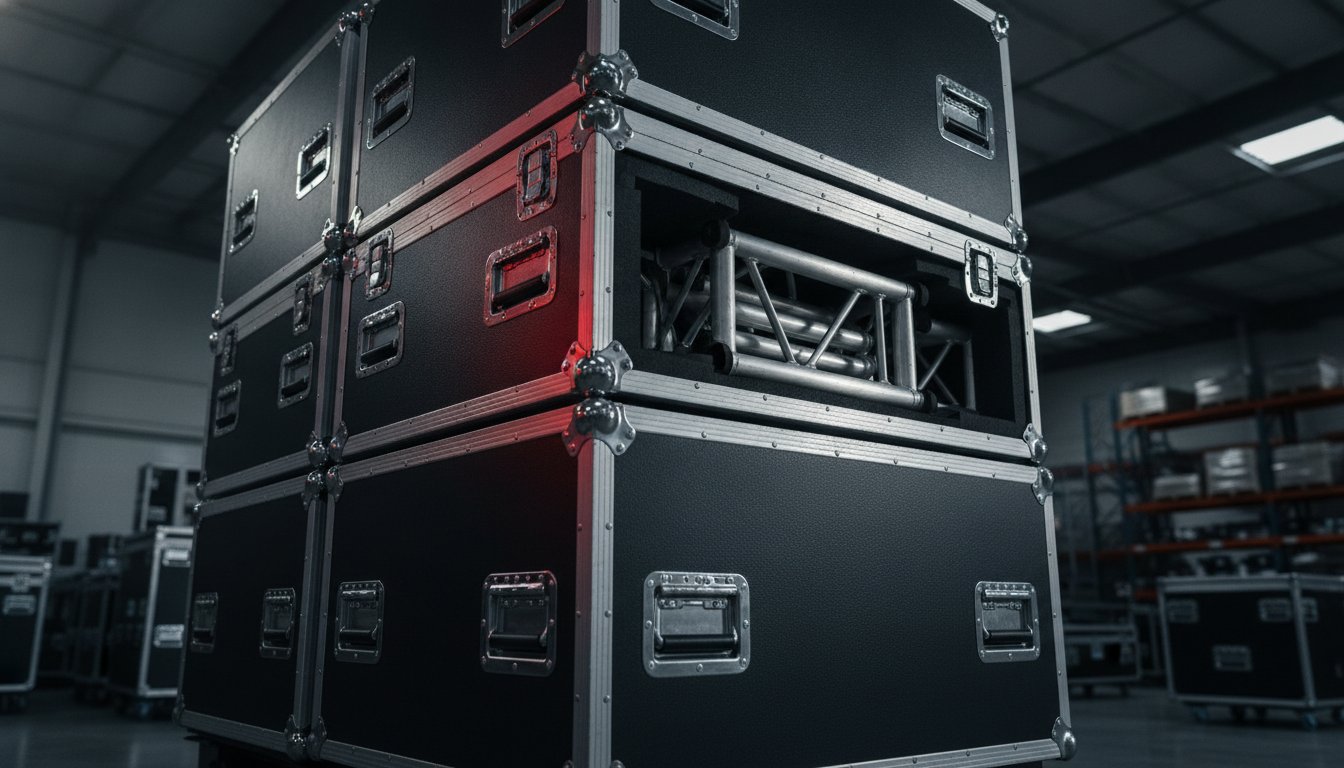
The integrity of a million-dollar production depends entirely on the structural state of its aluminum skeleton, yet most inventory degradation occurs during the transition between the venue floor and the trailer. With truckload spot rates rising 60 percent over the last year, every cubic inch of cargo space must be utilized with engineering precision. Standardizing your inventory with high-density Stage Truss and Base Plate Cases is no longer just about organization; it's a critical requirement for protecting your capital investment against the physical rigors of high-frequency touring.
You understand that handling uncased base plates and heavy truss segments is the primary cause of both equipment finish damage and preventable crew strain. This technical guide outlines the specifications for selecting, loading, and maintaining professional cases designed for heavy-duty logistics. We'll analyze how to achieve standardized truck pack dimensions, ensure compliance with updated ANSI E1.21-2024 standards, and implement maintenance protocols that prevent hardware failure under load. By prioritizing mechanical excellence in your transport strategy, you can significantly reduce strike times and ensure your gear meets the rigorous demands of the 2026 event season.
Key Takeaways
- Identify the structural requirements for industrial-grade protection, focusing on 3/8-inch to 1/2-inch plywood construction for high-weight staging loads.
- Learn how specialized Stage Truss and Base Plate Cases optimize truck pack density and significantly reduce labor hours during setup and strike.
- Compare internal architecture options for heavy base plate storage and the logistical trade-offs between horizontal and vertical truss loading configurations.
- Ensure compliance with updated ANSI E1.21-2024 standards by implementing secure transport protocols for ground-supported structures.
- Understand the advantages of precision-engineered solutions, including Santosom cases, for complex touring environments and bespoke staging needs.
The Logistical Challenges of Transporting Stage Truss and Heavy Base Plates
The "staging logistics gap" identifies a critical period in production where equipment is most vulnerable to damage: the interval between the warehouse shelf and the venue floor. While Entertainment rigging standards provide rigorous guidelines for the safety of suspended loads, the physical integrity of the structural components often degrades during the high-vibration environment of a semi-trailer. Transporting loose base plates and truss segments without dedicated protection leads to micro-fissures and surface abrasions that compromise the long-term load-bearing capacity of the system. Utilizing specialized Stage Truss and Base Plate Cases is a mechanical necessity for maintaining the safety standards required for professional 2026 event cycles.
Physical risks extend beyond the gear itself. Manual handling of uncased steel base plates, which can weigh between 35 and 100 pounds depending on dimensions, is a primary source of back injuries and crushed extremities for stagehands. Proper casing centralizes weight, provides ergonomic grip points, and utilizes industrial-grade casters to move mass efficiently. Without these engineered solutions, the financial cost of equipment replacement and the liability of personnel injury quickly outweigh the initial investment in professional protective cases.
Why Standard Utility Cases Often Fail for Staging Gear
Standard utility trunks lack the internal reinforcement required to manage the weight concentration of steel base plates. When multiple plates are stacked in a non-reinforced box, the cumulative pressure often exceeds the shear strength of standard fasteners, leading to floor blowouts. Professional staging cases address these specific engineering challenges:
- Weight Concentration: Heavy base plates require 1/2-inch plywood construction and reinforced caster boards to prevent floor sagging under static loads.
- Dimensional Compatibility: Standard boxes rarely account for the specific 290mm or 400mm widths of professional truss segments, leading to wasted truck space or dangerous shifting during transit.
- Hardware Integrity: Non-industrial latches and hinges often shear off when subjected to the lateral forces generated by heavy staging gear during hard braking or sharp turns.
The Impact of Transport on Truss Integrity
Aluminum is a relatively soft metal. When truss segments are transported without internal dividers, "aluminum-on-aluminum" friction occurs. This constant grinding during long-haul transit wears down the truss cords and webbing, potentially creating stress points that could fail under maximum load. Furthermore, aesthetic maintenance is a logistical priority. Powder-coated trussing is easily chipped by metal-on-metal contact, which projects an unprofessional image to high-end clients. Engineering-grade Stage Truss and Base Plate Cases utilize specialized cradles and non-marring dividers to isolate each segment, ensuring the structural and visual quality of the investment remains intact for years of service.
Engineering Standards for Professional Production Cases
Professional staging infrastructure requires a departure from generic storage solutions. High-load components like steel plates and aluminum segments exert extreme localized pressure on case floors. The engineering of professional Stage Truss and Base Plate Cases begins with material science. Standard storage boxes fail because they don't account for the high-density mass of steel and aluminum. For professional logistics, 3/8-inch to 1/2-inch plywood is the baseline requirement. This thickness provides the necessary shear resistance to prevent floor blowouts during vertical drops or high-impact transit. The plywood is typically finished with a high-pressure laminate that resists the abrasions common in heavy-duty staging environments.
Recessed hardware is another non-negotiable specification. Surface-mounted latches and handles create protrusions that prevent tight truck packs. By utilizing recessed butterfly latches and spring-loaded handles, the case maintains a clean, rectangular profile. This allows for interlocking stacking, which is vital for load stability in a moving trailer. Zinc-plated steel hardware is preferred for its corrosion resistance and mechanical strength under tension. Hardware must be recessed.
ATA 300-Style Construction and Structural Integrity
Touring professionals rely on the ATA 300-style designation to ensure equipment longevity. ATA 300-style protection designates a construction standard engineered to withstand a minimum of 100 round-trip shipments without structural failure. This level of durability is essential for Stage Truss and Base Plate Cases used in high-frequency rental environments, especially when following the ANSI E1.2-2012 Standard for the safe use of aluminum trusses. To meet these demands, internal bracing is often added to reinforce the corners and floor. This prevents the case from racking or losing its square shape when loaded with a full set of heavy base plates. Precision-cut internal dividers ensure that weight remains centered over the caster points, reducing stress on the plywood panels.
Caster Selection and Weight Distribution
The mechanical interface between the case and the floor is the caster. For professional staging gear, 4-inch heavy-duty casters are the industry standard. These casters provide enough ground clearance to navigate ramps and uneven loading docks while maintaining a low center of gravity. Total load capacity calculations must account for the static weight of the truss segments plus the dynamic forces encountered during transit. A standard 4-caster configuration on a truss case must support several hundred pounds without compromising the integrity of the 3/4-inch caster board. High-quality casters utilize ball-bearing swivels and non-marring rubber wheels to ensure smooth movement across venue floors.
Integrating these engineering standards ensures your staging inventory remains viable for years of high-frequency use. Professionals seeking these technical specifications often explore the range of specialized production cases designed for industrial applications.
Comparing Case Designs for Truss Segments and Base Plates
Efficiency in high-pressure production environments is dictated by the internal architecture of the transport solution. While external dimensions facilitate the truck pack, the internal configuration determines the speed of the load-in and the long-term viability of the hardware. Engineering-grade Stage Truss and Base Plate Cases must balance high-density storage with ergonomic access. For large-scale production fleets, standardized internal layouts ensure that any crew member can manage inventory without specialized training, reducing the margin for error during late-night strikes.
The choice between custom and standardized dimensions often depends on the specific truss profile in use. While a 290mm square truss is the industry standard, specialized 400mm or rectangular profiles require dedicated internal cradles to prevent lateral shifting. Hybrid case designs have also emerged as a logistical necessity, providing dedicated compartments for conical couplers, pins, and R-clips alongside the main segments. This consolidation prevents the loss of small hardware, which is a frequent cause of assembly delays on site.
Base Plate Case Architecture: Slots vs. Stacks
The management of heavy steel base plates presents a unique logistical challenge due to their high mass and thin profile. Vertical slotting is the preferred architecture for 24x24-inch and 30x30-inch plates. This design allows technicians to remove a single plate without disturbing the rest of the inventory, significantly reducing the risk of back injuries. Conversely, horizontal stacking with protective dividers is often used for smaller 12x12-inch plates to maximize case volume. Regardless of the orientation, internal dividers must be constructed from non-marring materials to prevent metal-on-metal friction that can degrade the plate's finish and lead to oxidation over time.
Truss Segment Cases for High-Volume Transport
Transporting 5-foot, 8-foot, and 10-foot truss segments requires a case design that accounts for both length and weight distribution. Horizontal loading is the standard for longer segments, utilizing internal felt or foam lining to protect the aluminum cords from abrasion. For high-volume tours, vertical loading cases allow for a smaller footprint on the truck floor but require more overhead clearance during the loading process. Ensuring compatibility between your transport solution and your professional truss inventory is essential for maintaining structural integrity. Cases engineered for these segments often include specialized lid stays and reinforced hinges to manage the frequent opening and closing cycles of a multi-city tour.
By selecting the appropriate internal architecture for your Stage Truss and Base Plate Cases, you optimize both the physical protection of the equipment and the operational efficiency of your crew. Standardizing these designs across your inventory allows for predictable load times and consistent truck pack density, which are the hallmarks of a professional production logistics strategy in 2026.

Optimizing Truck Pack and Load Safety for Heavy Staging Gear
Logistical efficiency in professional production relies on the mathematical optimization of cargo space. When transporting heavy structural components, the challenge shifts from simple storage to complex weight management. Engineering your fleet with standardized Stage Truss and Base Plate Cases allows for a predictable grid system within the trailer. This standardization is critical because inconsistent case dimensions lead to dead space, which increases fuel costs and requires more vehicles for the same amount of inventory. In an environment where truckload spot rates have risen 60 percent over the last year, maximizing volume is a financial necessity.
Securing high-weight cases requires an understanding of dynamic forces. Unlike lighting fixtures or cables, a case of steel base plates represents a concentrated mass that can compromise trailer stability if it shifts. Professional production workflows prioritize load balancing, ensuring that the heaviest cases are placed over the axles. This practice, combined with industrial-grade casing, ensures that the structural integrity of the gear and the safety of the transport vehicle remain uncompromised throughout the tour.
Calculating Truck Pack Density
Standardizing case footprints for 90-inch or 96-inch truck widths ensures that cases can be turned to fit three-abreast or two-abreast without leaving gaps. For instance, a 22.5-inch or 30-inch external width is designed to divide evenly into these common trailer dimensions. Utilizing TruckPaX™ Truck Pack Cases provides the engineering framework necessary for this level of logistical optimization. By eliminating the haphazard approach to loading, crews can achieve a 15 to 20 percent improvement in load-out speed while ensuring the load remains balanced. Consistent dimensions also allow for safer stacking, as the caster cups align perfectly with the wheels of the case above.
Loading Safety for Heavy Staging Infrastructure
The high mass of steel base plates requires rigorous safety protocols. A single case of 30x30-inch plates can easily exceed 600 pounds. Proper lifting techniques are secondary to the use of mechanical aids. Ramps and liftgates must be rated for the cumulative weight of the case and the technician. Once inside the trailer, high-density Stage Truss and Base Plate Cases must be secured using E-track systems and load bars. This prevents the shifting of mass during transit, which can cause trailer instability or damage the internal walls of the box truck. Standardizing your workflow around these safety requirements ensures compliance with load safety standards and protects your staging investment.
Implementing these logistical standards is the only way to maintain a professional production pace. If you are looking to upgrade your transport fleet, explore our professional logistics solutions to find cases engineered for these exact specifications.
ProX Engineering: Professional Solutions for Staging Infrastructure
Since 1984, ProX has operated at the intersection of structural engineering and logistical necessity. By manufacturing both the truss systems and the protective enclosures that house them, the brand ensures a level of mechanical compatibility that third-party manufacturers cannot replicate. This dual expertise is critical when designing Stage Truss and Base Plate Cases, as it allows for the integration of exact tolerances that prevent equipment movement during high-vibration transit. The ProX approach prioritizes functional excellence, utilizing a global dealer network to provide technical support and replacement parts for touring professionals who cannot afford downtime.
Standardized solutions meet the needs of most production fleets, but unique staging configurations often require a bespoke approach. ProX offers custom design-and-build services for specialized staging infrastructure, ensuring that even non-standard 400mm truss or oversized custom base plates receive the same level of industrial protection. This commitment to engineering precision builds a reliable backbone for the industry, allowing production managers to focus on the integrity of the build rather than the limitations of their transport gear.
The Santosom Advantage for Staging Logistics
The partnership between ProX and Santosom represents the pinnacle of engineering for touring professionals. Santosom cases are manufactured using precision CNC technology and advanced material science to meet the most rigorous European engineering standards. This level of precision is vital for global touring, where equipment must withstand diverse climate conditions and varied handling protocols across international borders. By integrating these high-end solutions into your inventory, you gain access to the Santosom Cases Pillar of technical excellence, which focuses on maximizing durability while minimizing case weight. This balance is essential for maintaining load safety standards without sacrificing the long-term protection of your staging investment.
Selecting the Right ProX Case for Your Inventory
Choosing the correct Stage Truss and Base Plate Cases requires a thorough evaluation of your current inventory and logistical constraints. A fleet primarily utilizing 290mm square truss has different volume requirements than one built around heavy-duty 400mm segments. You must also match the case capacity to your typical crew size and transport vehicle. A case that is too large for a standard liftgate or too heavy for a two-person team will create bottlenecks during the load-in.
- Inventory Assessment: Audit your ratio of truss segments to base plates to determine the ideal mix of specialized and hybrid cases.
- Logistical Compatibility: Ensure your selected case dimensions align with your truck pack strategy as outlined in previous sections.
- Weight Management: Verify that the caster ratings and floor reinforcement meet the requirements of your heaviest steel plates.
Properly engineered transport solutions are an investment in the longevity of your production gear. To find the specific models that match your technical requirements, consult the ProX Cases Catalog for the latest specifications and compatibility data. By standardizing your inventory with ProX engineering, you ensure that your staging infrastructure remains a reliable asset for the 2026 season and beyond.
Advancing Your Staging Logistics Strategy
Professional production in 2026 demands a shift from passive storage to active logistical engineering. By prioritizing rugged 3/8-inch to 1/2-inch plywood construction and standardized truck pack dimensions, you protect both your capital investment and your crew's safety. Implementing precision-engineered Stage Truss and Base Plate Cases ensures your inventory remains structurally sound and visually professional through years of high-frequency touring. These solutions eliminate the staging logistics gap by providing a reliable mechanical interface between the venue floor and the trailer.
ProX has been manufacturing performance gear since 1984, combining decades of field experience with Santosom engineering precision. Whether you're managing a local rental fleet or a global concert tour, our cases are designed to meet the rigorous demands of industrial use. Standardizing your transport strategy around these technical specifications is the most effective way to reduce strike times and maintain compliance with modern safety standards. We're here to support your infrastructure needs with durable, compatible solutions that stand up to the road. Explore the ProX Staging Case Catalog and Find a Dealer to upgrade your logistics today.
Frequently Asked Questions
What is the best way to transport heavy steel base plates?
Utilizing vertical slots within reinforced Stage Truss and Base Plate Cases is the most efficient method for managing heavy steel plates. This orientation allows for individual plate access without requiring the crew to lift the entire stack, which significantly reduces the risk of manual handling injuries. Engineering the case with 1/2-inch plywood and a reinforced caster board ensures the floor can withstand the concentrated mass of multiple 30x30-inch plates during transit.
How many truss segments can fit in a standard professional case?
The capacity of a professional staging case typically ranges from two to four segments, depending on the truss profile and case architecture. A standard case for 290mm square truss is often designed to house two segments side-by-side or four segments in a stacked configuration with internal dividers. Larger 400mm segments usually require a dedicated two-segment case to maintain manageable external dimensions for standard truck pack grids.
Are caster ratings important for stage truss and base plate cases?
Caster ratings are critical because staging gear represents some of the highest density loads in a production inventory. A single case of base plates can exceed 600 pounds, requiring 4-inch heavy-duty casters with a high static and dynamic load capacity. Using inferior casters leads to flat spots on the wheels or structural failure of the swivel bearings, which compromises safety during ramp navigation and load-ins.
Do I need custom cases for 400mm truss segments?
Standardized cases exist for 400mm truss, but they must feature internal architecture specific to that larger dimension. While 290mm segments are the industry standard, 400mm profiles won't fit securely in a case designed for smaller truss without causing lateral movement. Selecting a case engineered for the 400mm specification ensures that the internal cradles align with the truss cords, preventing structural degradation during long-haul transport.
How do I prevent truss finish damage during long-distance transport?
Preventing finish damage requires the use of non-marring internal dividers and felt or foam lining to eliminate aluminum-on-aluminum friction. Vibration during transit causes unshielded truss segments to grind against one another, which wears down powder coating and creates unsightly abrasions. Professional Stage Truss and Base Plate Cases utilize specialized internal cradles that isolate each segment, maintaining both the aesthetic and structural integrity of the aluminum.
Can I use standard utility cases for staging accessories like clamps and pins?
Standard utility cases are functional, but hybrid staging cases with dedicated compartments for conical couplers and pins are more efficient for inventory management. Consolidating small hardware within the same transport solution as the truss segments reduces the staging logistics gap and prevents assembly delays on site. This approach ensures that all necessary mechanical components arrive at the venue together, streamlining the setup process for the crew.
What is the difference between a standard case and an ATA 300-style case?
The primary difference lies in the engineering rigor, as ATA 300-style cases are designed to withstand a minimum of 100 round-trip shipments. Standard cases often lack the reinforced joinery, recessed hardware, and specific plywood thickness required for this level of durability. For high-frequency touring and rental applications, the ATA 300-style specification is the baseline for protecting expensive staging infrastructure from the physical rigors of the road.
Why is truck pack density important for event production companies?
Optimizing truck pack density is essential for managing rising logistics costs and ensuring trailer stability. Standardizing case dimensions allows for a tighter fit within 90-inch or 96-inch trailer widths, which eliminates dead space and prevents the load from shifting during transit. Effective density management can reduce the number of vehicles required for a production, directly impacting fuel consumption and overall operational overhead in a high-cost transport environment.
Disclaimer
Any trademarks, trade names or brand names appearing herein that do not belong to ProX are the property of their respective owners and/or companies, and such appearance doesn't and shall not constitute or imply endorsement, sponsorship or recommendation by ProX.


