
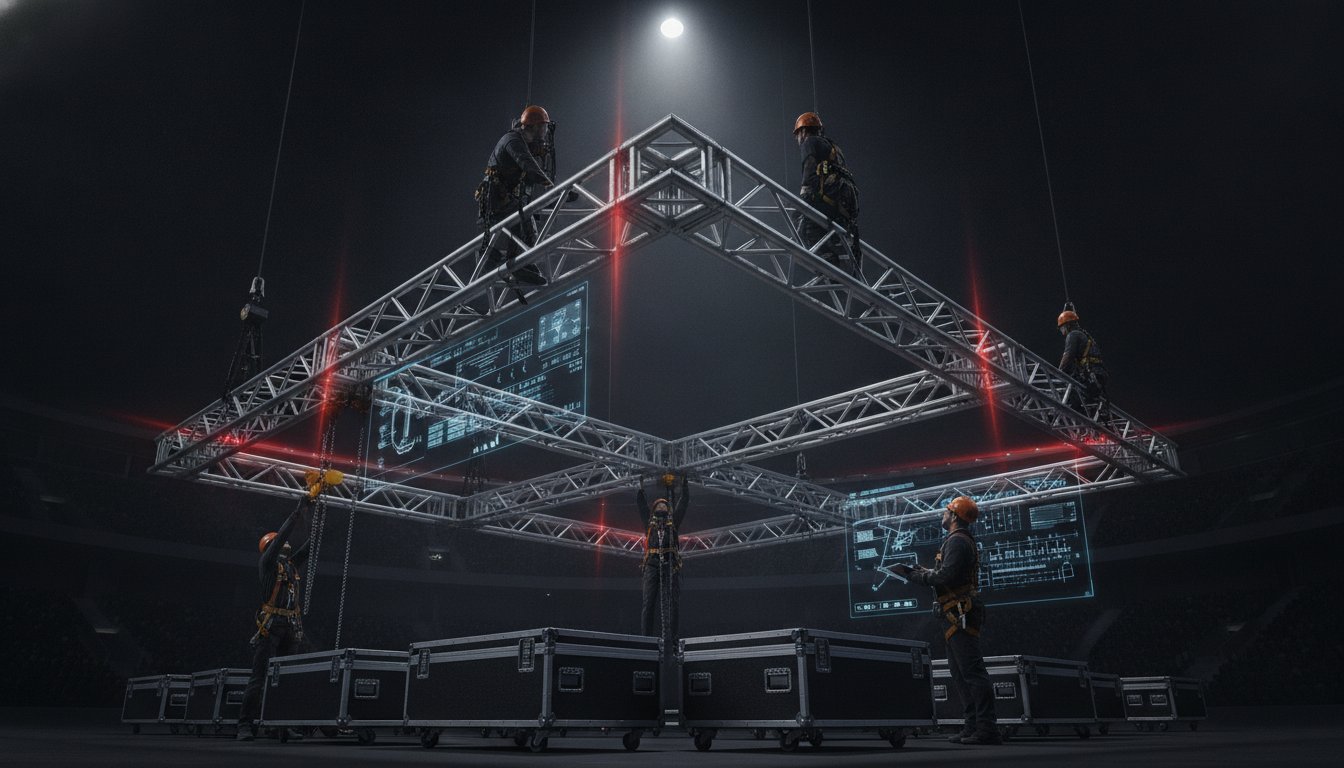
In the high-stakes environment of professional production, the most expensive truss you can buy is the one that fails under load. It's frustrating to navigate the ambiguity between low-cost imitations and certified engineering, especially when your rig's integrity is non-negotiable. Many professionals struggle to calculate a realistic truss system cost because they overlook hidden expenses like specialized hardware, shipping logistics, and the specific load requirements of modern lighting arrays.
You'll gain a clear understanding of the metallurgical standards and modular components that drive pricing in 2026. We'll break down the essential cost drivers in stage engineering, from TUV-certified hardware to the logistical protection required for touring. This guide provides a structured framework for budgeting a modular system, giving you the technical confidence to choose hardware that prioritizes both structural safety and long-term financial utility.
Key Takeaways
- Understand the metallurgical differences between 6082-T6 and 6061-T6 aluminum alloys and how these structural choices impact load capacity and long-term durability.
- Learn to calculate a comprehensive truss system cost by accounting for essential connection hardware, including conical couplers and pins, rather than focusing solely on linear segment prices.
- Identify the critical role of specialized Stage Truss and Base Plate Cases in protecting structural integrity and preventing depreciation caused by oxidation or transport damage.
- Evaluate the financial and safety benefits of TUV-certified welding and robotic consistency to ensure your rigging meets the rigorous standards of 2026 production environments.
- Discover how investing in modular, standardized components like the ProX Truss series provides a scalable backbone for diverse production needs while maximizing long-term ROI.
Analyzing Stage Truss System Cost: A Production Budgeting Overview
Budgeting for a professional production rig requires a departure from general construction estimates. A realistic truss system cost reflects more than the raw material price of aluminum; it represents a comprehensive investment in structural reliability and public safety. While residential roof trusses prioritize static load support over decades, stage trussing must withstand dynamic forces, frequent assembly cycles, and varying atmospheric conditions. This distinction is critical for production managers who need to justify equipment expenditures against the practical realities of live event logistics.
High-stakes live environments demand a "Cost of Safety" that is non-negotiable. For a mobile DJ, a basic goal-post rig might involve a modest hardware investment. Conversely, large-scale concert structures involving complex spans and heavy lighting arrays can reach significant price points. It's a common industry benchmark that the initial hardware purchase accounts for only about 60% of the total system investment. The remaining 40% covers essential logistical hardware, specialized protective cases, and compliance documentation required for professional venues.
Stage Truss vs. Roof Truss: Intent and Application
The fundamental engineering principles of a truss apply to both construction and entertainment, but the material execution differs significantly. Production rigs utilize high-grade aluminum alloys like 6082-T6 or 6061-T6 for their superior strength-to-weight ratios. Unlike structural timber used in home building, these modular systems provide the flexibility needed for rapid deployment and reconfiguration. While residential codes focus on permanent installation, professional rigging must adhere to rigorous ANSI and TUV standards to ensure compatibility and structural integrity across diverse venues.
Calculating ROI on Professional-Grade Hardware
Investing in a standardized truss system ensures long-term financial viability. Standardized modular components maintain high resale value because they integrate seamlessly with existing industry inventory. Non-certified or imitation equipment often carries a hidden cost in the form of increased insurance premiums and potential liability exposure. Aluminum structures engineered for performance gear offer the longevity required for the physical demands of professional use, making the initial expenditure a reliable backbone for years of service. Choosing TUV-certified components ensures that the equipment isn't just a purchase, but a durable asset that meets the highest engineering standards in the industry.
Engineering Factors That Dictate Aluminum Truss Pricing
Structural engineering precision determines the baseline truss system cost. High-grade aluminum alloys, specifically 6082-T6 and 6061-T6, are the industry standards for professional rigging. 6082-T6 is often preferred for its exceptional corrosion resistance and high structural strength, while 6061-T6 remains a staple in many manufacturing environments. The choice between these alloys isn't merely aesthetic; it dictates the maximum allowable stress and deflection parameters of the rig. Sourcing certified raw materials adds to the manufacturing overhead but ensures the metal hasn't been compromised by recycled impurities that weaken the structural lattice.
Welding precision represents another significant price driver. Professional manufacturers utilize certified AWS or TUV welders who follow strict procedures to ensure joint penetration and heat-affected zone integrity. Many top-tier facilities now employ robotic welding systems to achieve total consistency across every segment. This automation reduces human error but requires substantial capital investment in machinery. When you invest in a standardized truss system, you're paying for the documented reliability of these welds, which are the primary failure points in non-certified equipment.
The Role of Safety Certifications in Pricing
Safety certifications like TUV aren't just badges; they're the result of rigorous independent load testing and destructive analysis. Obtaining these certifications involves exhaustive documentation and recurring factory audits. This process ensures the gear complies with OSHA rigging equipment regulations regarding material handling and structural safety. Production insurance mandates often require TUV-certified hardware to cover liability. Unbranded trussing might look identical, but it lacks the verified load tables necessary for safe deployment in public spaces.
Structural Design: 2-Chord (Ladder) vs. 3-Chord (Triangle) vs. 4-Chord (Square)
Truss geometry directly correlates with cost-to-strength ratios. Ladder truss is the most economical but offers minimal lateral stability. Triangle truss provides a balance of aesthetics and strength, though it's more complex to align in certain configurations. Square truss, such as the industry-standard F34 series, offers the highest rigging versatility and load capacity. While square trussing carries a higher price point, its ability to handle significant point loads makes it the preferred choice for professional lighting grids and heavy LED wall support. Choosing the right geometry depends on whether the application is purely decorative or requires substantial load-bearing capabilities.
Breaking Down the Components: From Segments to Base Plates
A comprehensive truss system cost analysis requires looking beyond the primary structural spans. Total investment is determined by the sum of modular components, each engineered for specific structural roles. Linear segments form the foundation of any rig. These typically range from 0.5m to 3.0m in standard lengths. While longer segments often provide a lower price-per-foot ratio, shorter sections are essential for achieving precise geometric dimensions and meeting venue-specific height restrictions. Selecting the correct mix of lengths ensures the rig remains adaptable for various production environments.
The "Connection Cost" is a frequently overlooked variable in budgeting. Modern professional systems utilize conical couplers, tapered pins, and R-clips to create rigid, genderless unions. This hardware provides superior structural stability compared to legacy bolted systems. Although these precision-machined connectors increase the upfront hardware expense, they significantly reduce assembly and teardown time. This efficiency makes them a cost-effective solution for companies that prioritize rapid deployment and reduced labor overhead.
Modular System Standards: F34 vs. F32 Pricing
The 290mm (12-inch) square truss, often categorized as F34, is the global industry standard for professional production. Its four-chord design provides the necessary torsional rigidity for heavy lighting arrays and audio clusters. In contrast, F32 or ladder trussing is lighter and more economical but lacks the lateral stability required for complex grids. When you Browse ProX Truss Categories, you'll see that the price difference reflects the increased load capacity and rigging versatility of the square profile, which is a requirement for most concert-level applications.
Specialized Hardware and Rigging Accessories
Stability for ground-supported structures depends on high-mass steel base plates. These components represent a fixed cost that ensures the center of gravity remains within safe limits. For larger installations, budgeting must include ground support towers, sleeve blocks, and specialized hinges. These items allow for the safe lifting of pre-loaded grids. If your production involves heavy visual elements, specialized LED Video Panel Wall Support Solutions are necessary to manage the significant point loads and wind resistance associated with large-scale video displays. Small accessories like safety cables and rated clamps are also essential budget line items that ensure compliance with structural safety mandates.

Logistical and Hidden Costs: Storage, Transport, and Maintenance
Hardware acquisition is only the baseline. A realistic truss system cost must account for the logistical infrastructure required to move and maintain the rig. Aluminum is an ideal material for its strength-to-weight ratio, but it is physically soft compared to steel. Minor dents in a main chord or a diagonal brace aren't just cosmetic issues; they create stress concentrations that can compromise the structural load rating. Protecting the metallurgical integrity of the system during transit is a primary operational expense that seasoned production managers prioritize in their initial budgeting.
Shipping logistics for bulky aluminum structures are often calculated using dimensional (dim) weight rather than actual physical weight. Carriers charge based on the volume the equipment occupies in a trailer or cargo hold. Modular engineering helps mitigate these expenses by allowing for denser packing configurations. Additionally, the efficiency of the assembly system directly impacts labor costs. Systems that utilize precision-machined conical couplers reduce the time required for a crew to strike or build a rig, which significantly lowers the total project overhead compared to legacy bolted systems.
Protecting the Investment with Professional Cases
Replacing a single damaged three-meter square truss segment is significantly more expensive than the upfront cost of protective housing. Utilizing Professional Stage Truss and Base Plate Cases ensures that components remain free from dents, scratches, and structural deformation. Standardizing your case dimensions for truck pack efficiency is also critical. When cases are designed to fit standard trailer widths, you maximize space and reduce the number of vehicles required for transport. This methodical approach to storage extends the lifecycle of the hardware and maintains its resale value over time.
Long-Term Maintenance and Inspection Costs
Touring rigs in 2026 must adhere to strict annual safety inspection protocols to remain compliant with venue insurance mandates. These inspections involve checking for weld fractures, bolt hole elongation, and overall structural alignment. Maintenance budgets should also include the periodic replacement of high-wear hardware like pins, R-clips, and couplers. Aluminum components require regular cleaning to manage oxidation, especially when used in outdoor or high-humidity environments. Neglecting these small maintenance tasks can lead to hardware seizing or structural failure, which carries a much higher cost than a routine maintenance schedule. Secure your inventory today by exploring our full range of Professional Stage Truss and Base Plate Cases.
The ProX Advantage: Engineering Precision for Professional Rigging
ProX has designed and manufactured rugged, production-standard hardware since 1984. This longevity in the high-stakes entertainment industry allows for a deep understanding of the physical demands placed on structural gear. When calculating a realistic truss system cost, the compatibility of the modular components is a primary factor. A standardized system ensures that hardware purchased today will integrate seamlessly with future inventory. This protection of capital investment is a hallmark of the ProX engineering philosophy, prioritizing functional excellence over temporary trends.
Beyond standard linear segments and corner blocks, ProX provides custom engineering services for bespoke production requirements. This flexibility is essential for complex stage designs that fall outside the parameters of standard goal-post or box configurations. The brand's global dealer network provides localized technical support and helps manage the logistical challenges of large-scale equipment procurement. Utilizing a standardized backbone like the ProX Truss series minimizes the risk of equipment failure while ensuring that structural load ratings remain consistent across various rig layouts and venue environments.
Why Production Pros Choose ProX Truss
Production professionals prioritize hardware that offers a balance of durability and modular compatibility. ProX's meticulous engineering focuses on TUV-certified components that meet rigorous safety standards. The brand's comprehensive catalog includes everything from linear segments to specialized Stage Truss and Base Plate Cases. This holistic approach to equipment manufacturing means that every part of the rig is designed to work as a unified system. It's not just about the aluminum; it's about the entire ecosystem of support, including staging and protective housing, that ensures a professional result for every build.
Next Steps: Building Your Custom Quote
Building a custom quote involves more than selecting part numbers from a list. Working with an authorized dealer allows you to minimize shipping and logistics costs by sourcing from regional inventory. You can utilize the ProX catalog to access detailed technical specifications, including deflection data and point load tables required for venue approval. This data-driven approach ensures that your budgeting remains accurate and that the final rig meets all engineering requirements for the 2026 season. To begin your project, Contact a ProX Dealer to get a customized truss system quote and ensure your production is supported by industry-standard hardware.
Optimizing Your Structural Investment for 2026
Mastering the variables that dictate a total truss system cost allows you to move beyond simple hardware procurement toward a strategy of long-term structural reliability. You've seen how metallurgical standards like 6082-T6 aluminum and TUV-certified welding processes provide the necessary safety margins for high-stakes environments. A successful budgeting framework must also integrate the logistical protection of specialized cases and the operational efficiency of modular components. These elements work together to reduce labor overhead while maintaining the integrity of your hardware.
ProX has been engineering performance gear since 1984, providing a reliable backbone for the entertainment industry. Our commitment to technical superiority is backed by a global dealer network that offers localized support for your specific rigging needs. By choosing hardware with verified load capacities and standardized dimensions, you ensure your rig remains a durable asset for years to come. This methodical approach to equipment selection prioritizes safety and functional excellence over temporary cost savings.
Take the next step in securing your production infrastructure. Build Your Professional Rig with ProX Truss Systems and experience the precision of TUV-certified hardware. We look forward to supporting your next build with the engineering excellence your projects demand.
Frequently Asked Questions
What is the average cost per foot for professional aluminum stage truss?
Professional aluminum trussing is generally priced by the segment length rather than a linear foot rate. Factors such as chord diameter, wall thickness, and alloy grade, specifically 6082-T6 versus 6061-T6, cause pricing to fluctuate. While general construction aluminum has a linear rate, production-grade hardware accounts for the precision engineering of the conical connection systems and TUV-certified welds required for public safety.
Why is square truss more expensive than triangle or ladder truss?
Square trussing, such as the F34 series, requires twice the material and labor of ladder truss and more complex welding than triangle truss. The four-chord geometry provides superior torsional rigidity and load-bearing capacity. This increased structural capability is necessary for supporting heavy lighting arrays and LED walls, which drives the manufacturing investment higher than decorative or lighter-duty profiles.
Does the truss system cost include the conical couplers and pins?
Reputable manufacturers typically include a full set of conical couplers, pins, and R-clips with each linear truss segment. However, when calculating a total truss system cost, it is essential to verify if corner blocks or base plates include the necessary half-couplers. Specialized hardware like hinges or sleeve blocks are typically sold as separate line items and should be budgeted accordingly.
How much should I budget for shipping a standard 10x10 stage rig?
Shipping expenses are determined by dimensional weight rather than actual physical weight due to the bulky nature of aluminum spans. A 10x10 rig involves multiple three-meter segments and heavy steel base plates, often requiring LTL freight services. Working with a regional dealer network can significantly reduce these logistical expenses by sourcing inventory from closer geographic locations to minimize transport distances.
Are there hidden costs in maintaining TUV-certified truss systems?
The primary ongoing cost for TUV-certified hardware is the annual safety inspection required for touring compliance and venue insurance mandates. Maintaining these certifications also necessitates the periodic replacement of high-wear hardware like pins and couplers. While these are recurring expenses, they are essential for ensuring the structural integrity of the rig and protecting the long-term ROI of the equipment.
Is it cheaper to buy used trussing for permanent installations?
Used hardware may offer a lower initial price point, but it carries significant risk regarding structural history and metallurgical fatigue. It is difficult to verify if a pre-owned segment has been subjected to overloading or improper storage. New professional-grade hardware ensures that you have full documentation of the TUV certification and a known structural baseline, which is critical for safety-certified builds.
How do base plate weights affect the overall system pricing?
Base plate pricing is tied directly to the material mass and the engineering of the mounting points. High-mass steel plates are necessary for ground-supported structures to provide a stable center of gravity. Heavier plates increase the truss system cost through both the raw material price and the significantly higher shipping fees associated with transporting high-density steel components.
Can I mix different truss brands to save on costs?
Mixing truss brands is generally discouraged even if the conical connection dimensions appear identical. Structural load ratings and TUV certifications are only valid when the entire system is built using components from a single manufacturer. Mixing brands can void safety certifications and complicate insurance liability, as no manufacturer will certify the structural integrity of a hybrid rig under load.
Disclaimer
Any trademarks, trade names or brand names appearing herein that do not belong to ProX are the property of their respective owners and/or companies, and such appearance doesn't and shall not constitute or imply endorsement, sponsorship or recommendation by ProX.


