

Diesel fuel represents 35% to 40% of total operating costs for commercial carriers in 2026, making every cubic inch of a trailer a critical financial asset. For production professionals, this means that the choice of Pro Music Cases is as much about logistical optimization as it is about physical protection. You understand that a single equipment failure or a disorganized truck load can jeopardize an entire production schedule. It's a high-stakes environment where there's no room for structural compromise or non-standard dimensions that waste valuable space. Reliable gear transport requires a meticulous approach to material science and mechanical assembly.
This article demonstrates how engineering-led design and rugged materials define the industry standard for professional music cases in 2026. We'll analyze the technical requirements of the ATA 300 Category I specification and the mechanical advantages of standardized truck-pack footprints. By prioritizing precise engineering and high-grade components, you can ensure total equipment safety and long-term hardware reliability across global tours. We'll also examine how specialized solutions, such as ZCASE custom builds and the signature Honeycomb Digital surface design, provide the durability needed for the physical demands of professional gear transport.
Key Takeaways
- Understand the engineering requirements of ATA 300 Category I standards to ensure gear survives a minimum of 100 round-trip transits.
- Analyze the structural integrity provided by industry-standard plywood thicknesses and specialized scuff-resistant surface designs.
- Optimize logistics by selecting Pro Music Cases with standardized truck-pack footprints to maximize trailer volume and load stability.
- Learn how to utilize caster dishes and aligned corner hardware to enable secure, multi-level stacking during complex load-ins.
- Determine the most cost-effective path between standardized utility storage and bespoke, custom-engineered builds for high-value hardware.
Defining the Pro Music Case: Engineering Standards for 2026
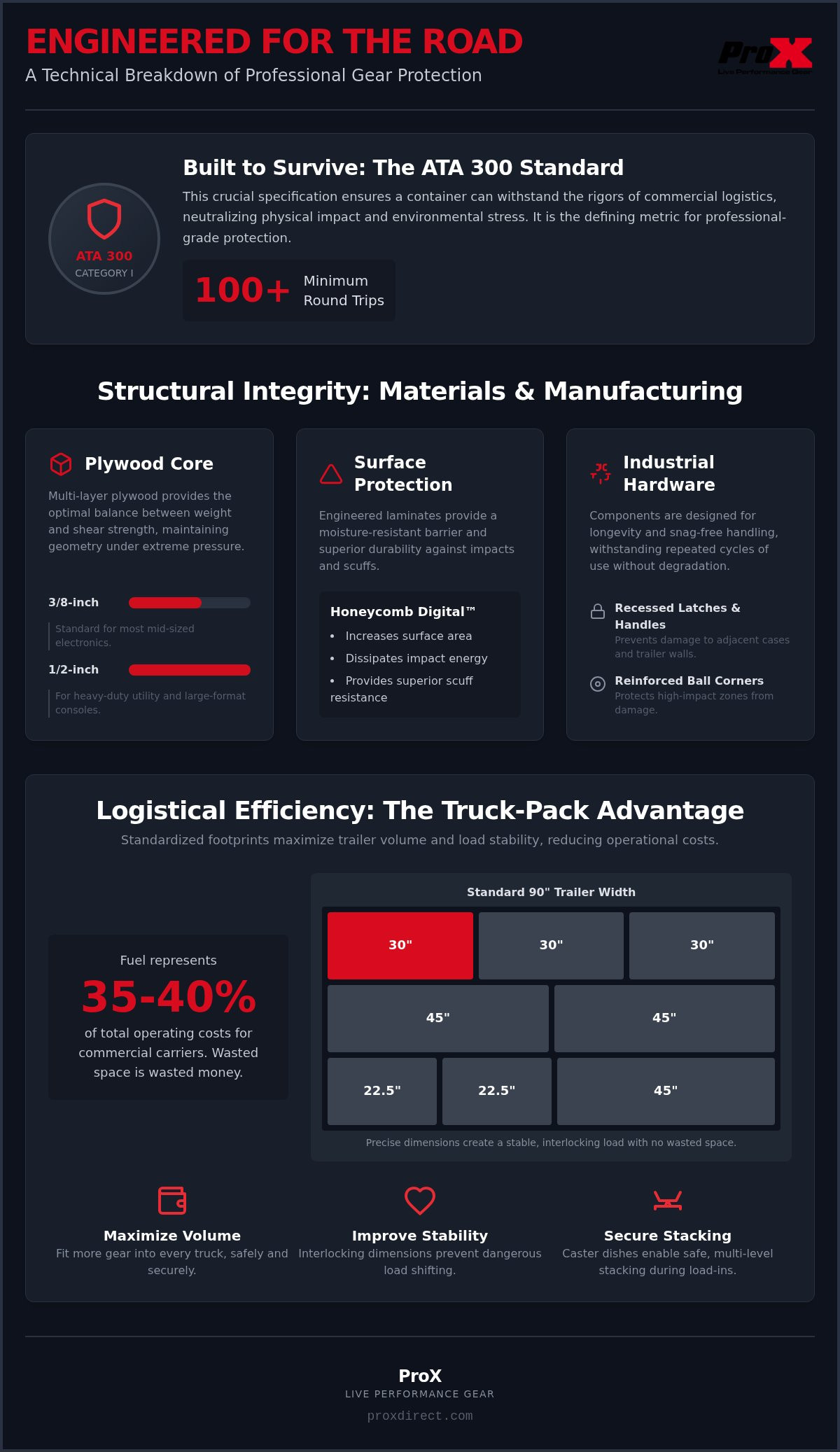
Engineering standards for 2026 prioritize the neutralization of physical impact and environmental stress during global transit. While consumer-level gig bags or soft cases offer basic scratch protection for local transport, they lack the structural rigidity required for the rigors of commercial logistics. Professional-grade housing, commonly known as a Road Case, is built to meet or exceed the ATA 300 Category I standard. This specification, which saw its latest revision in 2020.1, ensures the container survives a minimum of 100 round trips. Structural integrity remains the primary metric for touring safety because it dictates the case's ability to resist deformation under the weight of stacked loads and high-velocity impacts. Utilizing Pro Music Cases built to these specifications ensures that sensitive electronics remain isolated from external forces.
The Role of Protective Housing in Live Production
Operational downtime is a significant risk in professional production. Vibration dampening within the case prevents internal hardware failure, such as loose solder joints or misaligned optical components. Investing in high-quality housing is a strategic financial decision. The cost of emergency equipment repair or replacement far exceeds the initial capital expenditure for robust protection. A pro music case is a precision-engineered logistical tool designed to maintain equipment functionality through high-velocity transit and repeated mechanical handling. This focus on durability minimizes the likelihood of technical failures during soundchecks or live performances.
Key Performance Indicators for Touring Hardware
The efficacy of Pro Music Cases is measured by specific performance indicators. Impact resistance is achieved through the use of multi-layer plywood or advanced composite materials. Weight-to-strength ratios are critical because excess weight increases transportation costs, while insufficient strength leads to structural failure. Hardware longevity is another factor. Components must withstand repeated cycles of compression and release without mechanical degradation.
Recessed handles and latches are essential for snag-free loading within tight truck packs. These components are shielded within the case's profile to prevent damage to adjacent cases or the trailer walls. For a deeper technical analysis of these specifications, consult The Ultimate Guide to Flight Cases. Every design choice, from the density of the interior foam to the gauge of the aluminum extrusion, serves the singular goal of hardware reliability. Professional gear requires professional housing to survive the demands of the modern touring circuit.
Structural Integrity: Engineering Materials and Manufacturing
Structural integrity begins with the substrate. Industry standards for professional touring gear dictate the use of 3/8-inch or 1/2-inch multi-layer plywood. These thicknesses provide the optimal balance between weight and shear strength. While 3/8-inch panels are sufficient for most mid-sized electronics, 1/2-inch plywood is reserved for large-format consoles and heavy-duty utility cases that must support significant vertical loads. This material choice ensures that Pro Music Cases maintain their geometry even under the extreme pressures of a fully loaded trailer.
The signature Honeycomb Digital™ surface design is an engineering solution to the aesthetic and structural degradation typical of smooth plywood finishes. This hexagonal grid pattern increases surface area to better dissipate energy from impacts. It also provides superior scuff resistance, which prevents the case from becoming unsightly or structurally compromised after repeated handling. While some manufacturers experiment with polymers, as discussed in the SKB Pop-Up Mixer Flightcase review, traditional plywood remains the preferred benchmark for reusable transport containers due to its repairability and impact resistance.
Lamination and Surface Protection Technologies
High-pressure laminates are bonded to the plywood core to create a moisture-resistant barrier. This process prevents moisture ingress, which can lead to structural warping or delamination over time. Textured surfaces aren't just for grip; they're essential for maintaining case appearance across multiple tour cycles. Engineering-grade coatings are designed to withstand UV exposure and chemical spills, ensuring the protective housing remains functional in diverse environmental conditions. For those managing extensive inventories, exploring a standardized range of ProX Cases can streamline maintenance and replacement schedules.
Hardware and Assembly Precision
Mechanical assembly requires high-precision hardware to ensure long-term reliability. Dual-anchor rivets are used throughout the frame to secure aluminum extrusions to the plywood panels. This method prevents the hardware from pulling through the wood under heavy stress. Recessed butterfly latches are another critical component. They're designed to sit flush with the case surface, preventing them from snagging during load-ins. Reinforced steel ball corners act as the first line of defense, absorbing the initial shock of corner impacts and redistributing that energy through the aluminum frame. Internal protection is finalized with high-density Ethafoam, which balances cushioning for delicate components with the structural support needed for heavy hardware.
Specialized Categories for Every Musical Application
Precision protection isn't a generic requirement. A hard shell guitar case requires different internal bracing than a 48-channel mixer console. Pro Music Cases must be categorized by their mechanical application to ensure they meet the specific center-of-gravity and vibration-dampening needs of the equipment. For example, microphone cases utilize precision-cut foam arrays to isolate delicate transducers, while AV Broadcasting Cases prioritize rack-unit accessibility and thermal management. These designs adhere to ATA 300 Category I specifications, ensuring that specialized gear survives the mechanical stresses of high-frequency shipping cycles.
Santosom and ZCASE: Premium Engineering Solutions
High-end touring requirements often demand the Portuguese craftsmanship found in Santosom Cases. These units are engineered for environments where standard tolerances aren't sufficient. When production gear involves non-standard dimensions or unique ergonomic requirements, ZCASE Custom Build Cases provide bespoke engineering. These Polish-manufactured solutions include Flip Ready designs, which integrate the case structure directly into the workstation. This mechanical integration reduces setup time by allowing engineers to transition from transport to operation without removing the hardware from its protective housing. This level of specialization is what distinguishes professional Pro Music Cases from generic storage solutions.
Utility and Workstation Integration
Utility and storage cases serve as the logistical backbone for any professional production, housing everything from stage trussing to cable looms. These aren't merely boxes; they're engineered modules that maintain organized inventory. The evolution of the mobile workstation has transformed how FOH and monitor engineers manage their environments. Modern workstations integrate rack space, surface area, and cable management into a single, mobile unit. For those in the performance sector, the Professional DJ Equipment Case Purchase Guide offers a detailed breakdown of how to select housing that balances operational speed with engineering-grade protection. By choosing the correct category, production teams ensure long-term hardware reliability and logistical efficiency.
Logistical Efficiency: Optimizing Tour Loads and Truck Packs
Diesel fuel represents 35% to 40% of total operating costs for commercial carriers as of September 2026. This financial reality makes logistical efficiency a primary engineering objective for any touring production. Pro Music Cases are no longer just protective shells; they're modular units designed to maximize the volume of standard 90-inch and 96-inch trailers. Standardized dimensions, often referred to as "truck pack" footprints, eliminate wasted space and prevent load shifting during high-velocity transit. This approach aligns with current EPA and NHTSA Phase 3 GHG standards, which incentivize high-density, efficiently packed loads to reduce the carbon footprint of heavy-duty transport.
Standardization in Global Logistics
Standardization is the key to reducing tour transportation costs. By engineering cases in quarter, third, and half-pack footprints, such as 24x30 or 24x48 inches, production teams can achieve a high-density load that utilizes every cubic inch of floor space. The TruckPaX™ Truck Pack Cases: Engineering Logistical Efficiency guide details how these dimensions facilitate rapid load-in and load-out procedures. Weight management also plays a critical role. Selecting materials that provide high impact resistance without exceeding trailer axle limits is essential for maintaining regulatory compliance and maximizing fuel efficiency across long-haul routes.
Maneuverability and Ergonomics
Logistical efficiency is the intersection of protection and spatial optimization. Stacking integrity is achieved through the use of integrated caster dishes and precisely aligned corner hardware. These features allow for secure multi-level loading, effectively doubling or tripling the usable floor space within a trailer. Reinforced steel corners are designed to nest within these dishes, creating a locked vertical column that resists lateral movement during transit. The quality of the casters themselves is a critical specification. Heavy-duty, industrial-grade casters must navigate uneven surfaces, from cracked asphalt loading docks to steep backstage ramps, without mechanical failure or flat-spotting.
Strategic handle placement is equally important for team-loading scenarios. Spring-loaded, recessed handles are positioned based on the case's center of gravity to ensure safe lifting and maneuverability. This ergonomic consideration reduces the risk of personnel injury and prevents damage during high-pressure load-outs. When Pro Music Cases interact seamlessly within a truck or warehouse environment, the entire production timeline becomes more predictable. For those looking to optimize their fleet for 2026 standards, you can view the technical specifications for our complete inventory of Pro Music Cases.
Selecting Your Solution: From Standard to Custom Engineering
Selecting the appropriate housing requires an objective evaluation of equipment value and transport frequency. Off-the-shelf utility cases provide a reliable logistical backbone for general storage needs, such as cable management or stage hardware. These standardized solutions are readily available through the global ProX dealer network, allowing for rapid procurement and fleet expansion without the lead times associated with custom builds. However, when protecting non-standard hardware or high-value consoles, the engineering requirements shift toward bespoke solutions. Standardized Pro Music Cases offer excellent protection for common form factors, but custom engineering ensures that every internal support and vibration-dampening layer is optimized for a specific device's center of gravity and mechanical vulnerabilities.
The Custom Build Consultation Process
Bespoke engineering begins with the delivery of precise technical specifications. Providing accurate dimensions is critical for ensuring a secure fit that prevents internal movement during transit. During the consultation, engineers determine the optimal internal layout, which may include adjustable dividers, specialized trays, or multi-density foam inserts. For production teams managing unique or high-value hardware, ZCASE Custom Build Cases: Bespoke Protection offers a pathway to professional-grade security. These Polish-manufactured cases are built to the exact tolerances required for complex production environments, ensuring that custom-fitted foam contours provide maximum shock absorption for sensitive electronics.
Long-Term Value and ROI
The financial viability of Pro Music Cases is measured by their cost per tour. While lower-quality alternatives may have a lower initial price point, they often fail to meet the ATA 300 Category I standard of 100 round trips. A failure in the field results in costly hardware repairs and potential show-stopping downtime. Investing in high-grade materials and industrial hardware ensures a longer service life and better equipment protection. Maintenance is also a key factor in long-term ROI. Identifying and utilizing genuine ProX replacement parts allows for field repairs of casters, latches, or handles, extending the case's utility for decades. This modular approach to hardware ensures that your investment remains functional despite the rigors of the road. To find an engineered solution that meets your specific technical and logistical requirements, browse the ProX Cases Category.
Securing Your Production Infrastructure for 2026
Professional gear protection is a matter of material science and logistical precision. By adhering to ATA 300 Category I standards and utilizing standardized truck pack dimensions, you ensure that your equipment survives the mechanical stresses of global transit while minimizing transportation costs. Whether you require the specialized craftsmanship of Santosom and ZCASE or the modular efficiency of TruckPaX™ systems, the priority remains structural integrity and long-term hardware reliability.
Since 1984, ProX has been engineering performance gear that serves as a reliable backbone for the live production industry. Our global dealer network provides professional support for standard inventory and bespoke custom builds alike. Investing in high-quality Pro Music Cases protects your capital assets and prevents show-stopping technical failures in high-stakes environments. Maintaining a standardized fleet with genuine replacement parts ensures your investment lasts for decades of heavy-duty use.
Take the next step in optimizing your touring logistics by exploring our comprehensive range of engineered housing solutions. View the Full ProX Cases Catalog and secure your gear for the road ahead.
Frequently Asked Questions
What is the difference between a standard music case and an ATA 300 rated case?
An ATA 300 Category I case is engineered to withstand a minimum of 100 round-trip transits. Standard music cases often lack the material density and high-grade aluminum extrusions required to meet this specification. ATA 300 cases utilize specific interior cushioning, such as Ethafoam or Esterfoam, which must be permanently attached to the walls to ensure sensitive electronics remain isolated from mechanical shock during commercial shipping and repeated handling.
How do I determine the correct truck pack dimensions for my touring rig?
Truck pack dimensions are calculated based on the standard 90-inch or 96-inch width of commercial trailers. Most Pro Music Cases utilize quarter, third, or half-pack footprints to eliminate wasted space. To determine your needs, divide the total trailer width by the case dimensions to ensure they nest perfectly without lateral movement. This optimization reduces transport costs and aligns with current fuel efficiency regulations for heavy-duty commercial carriers.
Can I customize the interior foam of a standard ProX utility case?
Standard utility cases are designed for internal modification using high-density foam inserts or adjustable dividers. While the outer shell provides a standardized footprint, the interior can be reconfigured to secure specific gear arrays or delicate accessory looms. For high-value hardware requiring precision-engineered protection, ZCASE custom builds offer bespoke, CNC-cut foam interiors tailored to the exact mechanical vulnerabilities and center of gravity of your specific production equipment.
What materials are used in the construction of Santosom pro music cases?
Santosom cases utilize high-grade materials including multi-layer plywood substrates bonded with high-pressure laminates for moisture resistance. The construction features industrial-grade aluminum extrusions, reinforced steel ball corners, and recessed butterfly latches to ensure structural integrity. These materials are selected to meet the rigorous demands of global logistics, prioritizing a high strength-to-weight ratio that maintains case geometry under the weight of multi-level stacked loads in professional touring environments.
How do recessed handles and latches improve the longevity of a case?
Recessed hardware prevents mechanical components from snagging or sustaining direct impact during load-ins and load-outs. By shielding handles and latches within the case profile, the risk of shearing or bending is significantly reduced. This design also facilitates tighter truck packs, as cases can sit flush against one another or trailer walls without protruding hardware causing damage. This protection ensures the case remains functional and secure across hundreds of transport cycles.
Are custom cases necessary for standard instruments like keyboards or mixers?
While standard Pro Music Cases accommodate many common keyboard and mixer form factors, custom engineering is necessary when standard tolerances don't provide sufficient protection. Bespoke builds ensure that internal bracing and foam density are perfectly aligned with the device's center of gravity. For non-standard production gear or high-value workstations, the precision of a ZCASE custom build prevents internal movement that could lead to structural failure or technical downtime.
What is the benefit of the Honeycomb Digital™ surface design?
The signature Honeycomb Digital™ surface design utilizes a hexagonal grid pattern to enhance scuff resistance and surface durability. This textured laminate prevents the aesthetic and structural degradation typical of smooth plywood finishes after repeated handling. The increased surface area also helps dissipate energy from minor impacts, ensuring the case maintains its professional appearance and structural integrity throughout a long tour cycle without requiring frequent exterior maintenance or resurfacing.
How does ProX ensure the structural integrity of its stacking caster dishes?
Stacking caster dishes are engineered as integral components of the case's reinforced steel corners. These dishes are precisely aligned to receive the casters of a stacked unit, creating a locked vertical column that resists lateral shifting during transit. This mechanical alignment redistributes the vertical load through the aluminum frame rather than the plywood panels alone. This engineering choice ensures stability in multi-level truck packs, maximizing trailer volume while maintaining personnel safety.
Disclaimer
Any trademarks, trade names or brand names appearing herein that do not belong to ProX are the property of their respective owners and/or companies, and such appearance doesn't and shall not constitute or imply endorsement, sponsorship or recommendation by ProX.


