

The global equipment cases market is projected to reach $3.2 billion by 2035, reflecting a significant industry shift toward specialized protection standards. You've likely experienced the frustration of a delicate electronic component failing after a rough transit or the logistical headache of an inefficient truck load-out. These aren't just minor inconveniences; they're costly disruptions that threaten your professional reputation. We recognize that in the high-stakes world of professional production, the physical integrity of your gear is the foundation of your success. Therefore, investing in quality equipment cases is no longer optional for those managing high-value inventory.
This strategic guide will show you why professional-grade engineering is the most critical investment for protecting production gear and optimizing tour logistics. We'll examine the technical specifications that ensure zero transport damage and faster strike times. You'll gain insights into the structural advantages of high-density materials, the logistical precision of TruckPaX™ dimensions, and the elite engineering found in Santosom and ZCASE custom builds. By the end of this article, you'll understand how to transform your transport containers from simple boxes into essential logistical assets that enhance your professional stage presence.
Key Takeaways
- Understand how investing in quality equipment cases serves as a logistical safeguard against the high costs of gear failure and unexpected downtime.
- Learn the technical requirements of ATA 300 Category 1 standards to ensure your transport containers withstand the physical demands of repeated shipping.
- Discover how standardized dimensions like TruckPaX™ optimize truck loading and significantly reduce labor hours during load-ins and strikes.
- Identify critical protective features, such as specific foam densities and integrated ventilation, that preserve the lifespan of sensitive electronics.
- Evaluate the benefits of bespoke engineering, such as Flip Ready consoles and custom workstations, for improving technical efficiency on site.
The Strategic Value of Professional Equipment Protection
Professional equipment cases are not merely storage containers; they are engineered logistical tools designed to maintain the operational integrity of high-value assets. A standard Road case provides a baseline for transport, but professional-grade engineering addresses the specific mechanical requirements of sensitive production gear. For many production companies, investing in quality equipment cases represents a shift from viewing protection as a recurring expense to recognizing it as a critical capital investment. This transition is essential for businesses that prioritize functional excellence and long-term asset management. Asset protection is business protection.
In high-frequency touring environments, "good enough" protection often leads to catastrophic failure. When a case fails to absorb impact or isolate vibration, the hidden costs manifest immediately. These costs extend beyond simple repair bills. They include lost revenue from downtime, high premiums for emergency equipment rentals, and the potential erosion of professional reputation. By investing in quality equipment cases, you're securing the reliability of your entire production workflow. ProX has been engineering performance gear since 1984, understanding that technical superiority is built on the physical attributes and structural capabilities of the equipment.
The High Stakes of Live Production
During transit, gear faces a range of physical stresses including high-frequency vibration, sudden impacts, and fluctuating climate conditions. These factors are particularly hazardous for digital mixers and LED panels, where internal circuitry and delicate solder joints can fail without visible external damage. Professional cases utilize precision-cut foam and reinforced extrusions to isolate these components from external forces. Beyond protection, these cases ensure a uniform, professional stage presence. A cohesive, well-maintained inventory signals to clients that the production is managed with meticulous attention to detail and technical authority.
Insurance vs. Physical Protection
While equipment insurance is a standard business practice, it's a reactive measure. An insurance policy cannot replace a malfunctioning console thirty minutes before the house lights go down. Physical protection serves as the primary line of defense, ensuring that the gear is operational the moment it's uncased. By prioritizing structural integrity and material science, you mitigate the risk of show-stopping failures that insurance claims simply cannot resolve in real-time. To maintain this level of operational reliability, professionals should Browse professional ProX Cases to find solutions specifically engineered for high-stakes environments.
Engineering Standards: Beyond the Plywood Box
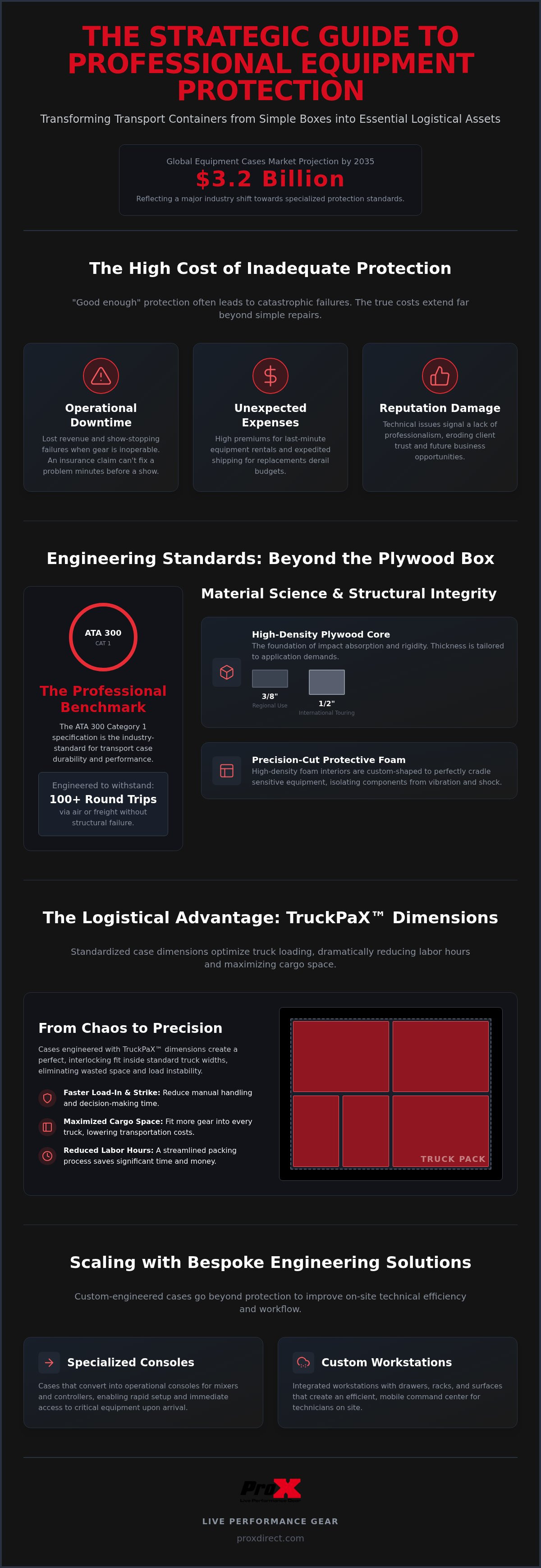
Professional case construction is defined by material science and mechanical precision. Investing in quality equipment cases requires an understanding of how distinct components work together to provide structural integrity. A high-performance case consists of high-density plywood, specialized laminates, and aluminum extrusions that create a rigid exoskeleton. This assembly must resist both static loads and dynamic impacts during transport. It's not simply about containment; it's about engineering a controlled environment for sensitive electronics.
The benchmark for durability is the ATA 300 specification, specifically Category 1. This industry standard dictates that a case must withstand a minimum of 100 round trips without structural failure. ATA 300 style protection is an engineering requirement for any gear that undergoes frequent air or freight transit, ensuring that internal tolerances remain consistent despite external pressure. Cases meeting this standard undergo rigorous testing for water resistance, impact absorption, and drop resilience to ensure they maintain their protective qualities over a long service life.
Material Science in Case Design
Material thickness is a primary variable in case engineering. While 3/8" plywood is sufficient for many regional applications, 1/2" plywood provides the necessary density and structural rigidity for large-scale international tours. High-density plywood offers superior impact absorption compared to thinner, budget alternatives. Many professional cases now feature honeycomb laminates. This hexagonal structure provides a high strength-to-weight ratio and superior scratch resistance, maintaining the case's structural integrity over years of heavy use. For those investing in quality equipment cases, these material specifications are non-negotiable benchmarks for quality.
Hardware Reliability and Precision
Hardware must be recessed to allow for efficient stacking and to prevent damage during truck loading and unloading. Spring-loaded handles and butterfly latches are essential for high-use scenarios. They ensure that the case remains securely closed under tension while allowing for rapid access during tight strike windows. Industrial-grade casters are perhaps the most critical yet underrated component of a case. High-quality casters utilize heavy-duty bearings and non-marring materials to ensure smooth movement across varied surfaces. You can explore professional-grade case options that prioritize these engineering benchmarks to ensure your gear remains protected in any environment.
Calculating the Long-Term ROI of Quality Engineering
The financial justification for selecting high-grade transport solutions extends beyond the initial procurement phase. Professional production firms evaluate these assets through the lens of Total Cost of Ownership (TCO). This metric accounts for the purchase price, maintenance requirements, and the operational efficiencies gained over the equipment's lifespan. By investing in quality equipment cases, companies significantly reduce the frequency of high-cost electronic repairs and premature gear replacement. A case engineered with precise internal tolerances ensures that delicate internal components, such as digital signal processors and power supplies, remain within their specified mechanical limits during transit. These direct savings on repair bills often pay for the case within its first year of service.
Logistical Efficiency and Truck Pack Density
Logistical precision is a primary driver of ROI in large-scale touring. Standardized dimensions, such as those found in TruckPaX™ Truck Pack Cases for Professional Touring, allow for maximum trailer density. When every case in a production inventory adheres to a mathematical grid, truck pack time is reduced and trailer space is utilized with 100% efficiency. This optimization can lead to direct savings by reducing the total number of vehicles required for a tour or allowing for smaller, more cost-effective transport options. Faster load-ins and strikes also translate to reduced labor hours, further improving the project's bottom line by maximizing the productivity of the technical crew.
Maintenance and Longevity
The structural integrity of professional engineering allows for a repairable rather than disposable lifecycle. Budget-tier cases often utilize inferior hardware and low-density materials that fail under stress, necessitating a complete replacement. In contrast, professional cases feature modular designs where casters, handles, and latches can be replaced as needed. This serviceability extends the functional life of the case into decades. When calculating the decade-long cost of ownership, the price of one high-quality case is significantly lower than the cumulative expense of purchasing three budget replacements over the same period. Additionally, reputable cases maintain a high resale value on the secondary market, providing a recovery of capital that budget alternatives cannot match.
Critical Features to Evaluate Before Your Next Purchase
Technical evaluation is the bridge between procurement and operational success. When investing in quality equipment cases, professionals must look beyond exterior aesthetics to analyze the physical interaction between the gear and its protective shell. This process involves assessing foam density, thermal management, and mechanical compatibility with specific hardware. Selecting a case with the wrong specifications can lead to internal component fatigue, even if the exterior remains intact. Precision is the primary requirement for long-term gear protection.
Foam density is a critical variable that is often misunderstood. While soft foam feels protective to the touch, it often lacks the structural resistance required for heavy electronics. Under high-impact loads, soft foam can bottom out, allowing the gear to strike the plywood interior. High-density, closed-cell foam provides the necessary deceleration to protect internal circuitry and delicate solder joints. Compatibility is equally vital. We maintain partnerships with industry leaders such as Pioneer DJ, QSC, and Roland to ensure that internal tolerances are exact. A precision fit prevents the gear from shifting, which is the leading cause of "internal collisions" during rough handling.
Internal Protection and Thermal Management
Thermal management is a non-negotiable feature for active components. Amplifiers, servers, and high-output effects units generate significant heat that must be dissipated to prevent thermal shutdown. Professional cases for these applications incorporate ventilation slots or removable panels to facilitate airflow. For mobile production teams, AV Broadcasting Cases for Mobile Production are engineered to balance this need for ventilation with high-level impact resistance. Custom-cut foam inserts further enhance this protection by isolating each component within its own dedicated cavity, ensuring that vibration from one device doesn't affect another.
Ergonomics and Safety
Ergonomics directly impact the safety and efficiency of your technical crew. Handle placement must be mathematically centered to ensure even weight distribution during lifting. This reduces the risk of workplace injuries and equipment drops. Reliable transport gear creates a safer work environment by providing predictable mechanical behavior. Locking casters are another essential feature, providing necessary stage stability once the gear is in position. When you are investing in quality equipment cases, you are also investing in the physical well-being of your team. High-grade hardware ensures that latches and handles won't fail under tension, preventing accidental openings during transit. To secure your inventory with these professional standards, you can explore the full range of professional-grade cases designed for the rigors of the industry.
Scaling Your Production with Bespoke Engineering Solutions
Custom engineering is the logical progression for production firms managing non-standard rigs or high-complexity signal chains. While standardized solutions address the majority of transport needs, bespoke builds solve specific logistical challenges that off-the-shelf options cannot. Investing in quality equipment cases that are custom-engineered allows for the integration of complex cable looms and fixed mounting points. This reduces the risk of connection failure during repeated setup and strike cycles. Technical precision in the design phase ensures that every millimeter of internal space is utilized efficiently.
The partnership with Santosom and ZCASE represents a tier of elite engineering. These brands bring a European standard of mechanical assembly to global logistics. ZCASE is particularly recognized for its Flip Ready designs. These allow consoles to remain semi-integrated with their transport housing during operation. This engineering approach eliminates the need for heavy lifting during the transition from the truck to the front-of-house position. For professionals managing unique production rigs, starting a custom build project begins with a detailed technical assessment. This includes evaluating the equipment's physical dimensions, center of gravity, and thermal requirements.
Innovative Case Formats for Modern Production
Modern production environments require cases that function as more than just shells. Workstations now integrate the gear directly into the transport format. This allows technicians to operate equipment without fully removing it from the case, which significantly decreases setup times. For large-scale visual displays, specialized protection is required to prevent pressure on delicate pixels. ZCASE Custom Build Cases for High-Value Gear provide the structural rigidity needed for LED video walls and large-format displays. These solutions ensure even the most sensitive visual assets remain protected across thousands of miles of transit.
The Future of Touring Logistics
The future of touring logistics is defined by standardization across global networks. As production companies expand their reach, the ability to maintain uniform case standards becomes a competitive advantage. Investing in quality equipment cases ensures your inventory remains compatible with international freight standards and diverse transport fleets. We support this growth by offering a comprehensive catalog of both standard and custom solutions. This technical support allows dealers and professionals to scale their operations with confidence. They know their gear's backbone is built on proven engineering precision. To secure your next production, Explore the full ProX Case catalog and find a dealer today.
Securing the Future of Your Production Inventory
Professional production requires a commitment to engineering precision that extends beyond the gear itself. We've examined how material science, standardized dimensions, and bespoke builds form a comprehensive defense against transport damage and logistical delays. By investing in quality equipment cases, you're transitioning from reactive repairs to proactive asset management. This strategic shift ensures that your inventory remains operational and your strikes remain efficient.
Since 1984, we've been engineering performance gear that meets the rigorous demands of the global industry. Whether you utilize our TruckPaX™ optimized dimensions for maximum trailer density or require custom ZCASE engineering for specialized rigs, our solutions are designed for functional excellence. These cases aren't just containers; they're the technical backbone of a successful production. You can secure your professional reputation and your bottom line by choosing equipment built for the physical realities of professional use.
Invest in Professional Protection: Browse ProX Cases
Build your inventory on a foundation of technical superiority and mechanical reliability.
Frequently Asked Questions
Why is plywood thickness important for equipment cases?
Plywood thickness determines the structural rigidity and impact resistance of a case. High-density plywood, typically found in 3/8-inch or 1/2-inch variants, provides the necessary mass to absorb mechanical energy during transit. Thicker panels prevent warping and ensure that aluminum extrusions remain securely fastened under heavy loads. Choosing the correct thickness is a primary factor when investing in quality equipment cases for long-term touring and high-frequency transport applications.
What does ATA 300 Category 1 mean for a protective case?
ATA 300 Category 1 is the highest industry standard for reusable shipping containers, established by Airlines for America (A4A). It specifies that a case must withstand a minimum of 100 round trips through commercial air transit without structural failure. This standard involves rigorous testing for water resistance, drop resilience, and impact absorption. Cases meeting this specification provide the most reliable protection for high-value production electronics in demanding environments.
How do standardized case dimensions save money on tours?
Standardized case dimensions, such as the TruckPaX™ system, optimize the internal volume of standard trailers. By utilizing a mathematical grid for case sizing, production teams can eliminate dead space in the truck pack. This efficiency can reduce the total number of vehicles required for a tour, directly lowering fuel and rental costs. Faster load-outs also reduce crew labor hours, providing a clear financial return on investment for logistical planning.
Is it better to get a custom case or a universal fit for my mixer?
Custom-engineered cases are superior for high-value mixers because they utilize precision-cut foam to eliminate internal movement. While universal cases offer flexibility, they often rely on adjustable foam blocks that can shift during rough handling. A custom ZCASE or Santosom build ensures that all ports and ventilation points remain unobstructed. For those investing in quality equipment cases, the added protection of a bespoke fit far outweighs the initial cost difference.
What are the most important hardware features to look for?
Look for recessed hardware, spring-loaded handles, and industrial-grade butterfly latches. Recessed components prevent snagging and allow for stable stacking in the truck. Latches must maintain high tension to prevent accidental openings during transit. Additionally, heavy-duty casters with non-marring wheels and high-load bearings are essential for smooth movement. These features ensure the case remains functional across years of intensive use in professional production environments where equipment failure is not an option.
How do I maintain my cases to ensure they last for years?
Regular maintenance involves inspecting all mechanical fasteners and cleaning the exterior laminates. Check that rivets remain tight and that aluminum extrusions haven't been bent out of alignment. Lubricate casters and latches with a dry silicone spray to prevent oxidation and ensure smooth mechanical operation. Cleaning the honeycomb surfaces with a damp cloth prevents the buildup of road grime, which can eventually degrade the material's aesthetic and structural integrity over time.
Can I replace individual parts like casters or latches on a ProX case?
Yes, ProX cases are designed for long-term serviceability with a full range of ProX Cases Replacement Parts available. We offer replacement casters, handles, latches, and rubber feet to extend the life of your investment. Unlike budget-tier cases that are often disposable after a hardware failure, our engineering allows you to swap out damaged components easily. This modularity is a key reason why professional production companies prefer our hardware for their inventory.
What is the difference between a utility case and a custom-engineered solution?
A utility case is a versatile, general-purpose container designed for cables, stands, or non-sensitive hardware. In contrast, a custom-engineered solution, such as a ZCASE custom build, is designed around the specific mechanical and thermal requirements of a single piece of gear. Custom solutions often include integrated workstations or Flip Ready designs that allow the equipment to remain in the case during operation, providing a specialized logistical advantage for complex technical setups.
Disclaimer
Any trademarks, trade names or brand names appearing herein that do not belong to ProX are the property of their respective owners and/or companies, and such appearance doesn't and shall not constitute or imply endorsement, sponsorship or recommendation by ProX.


