

A professional truss system is only as secure as its weakest connection point, and in live production, there's no margin for mechanical error. You're likely familiar with the underlying anxiety that accompanies a complex rig, where the fear of structural failure or inconsistent assembly methods among a crew can compromise safety. It's a high-stakes environment where equipment failure isn't an option. This truss system assembly guide serves as a technical foundation for engineers and technicians who demand absolute precision in their builds. We recognize that confusion over load-bearing calculations and component integrity often creates unnecessary risk on the job site.
This article promises to help you master the rigorous technical requirements and safety protocols necessary for professional stage truss systems. We'll provide a repeatable, safe assembly workflow that ensures compliance with the ANSI E1.2-2021 standards and the latest structural load requirements. You'll learn how to evaluate component integrity, understand the necessity of ETCP-certified rigging supervision, and recognize why protecting hardware during transit is vital for maintaining structural performance. This methodical overview covers everything from initial inspection to final bracing, providing the technical data required to maintain a reliable backbone for any professional production.
Key Takeaways
- Learn to evaluate the structural integrity of 6082-T6 aluminum truss components by inspecting chords and webbing for localized deformation or weld cracks.
- Utilize this truss system assembly guide to implement a standardized connection workflow using conical couplers and tapered pins for maximum mechanical stability.
- Understand the critical distinctions between Point Loads and Uniformly Distributed Loads to ensure your rig remains within safe engineering tolerances and deflection limits.
- Discover how specialized Stage Truss and Base Plate Cases prevent structural degradation during logistical transport, maintaining the long-term safety of your hardware.
- Align your production workflows with current ANSI E1.2-2021 standards and regional building codes to mitigate the risk of structural failure in high-stakes environments.
Understanding Truss Engineering and Structural Integrity Standards
Structural integrity in live production is a matter of mechanical engineering rather than simple assembly. This truss system assembly guide focuses on the physical properties that ensure a rig remains stable under load. Professional stage trusses primarily utilize 6082-T6 aluminum alloy. This specific alloy is selected for its high tensile strength and superior corrosion resistance, which are essential for modular components subjected to frequent transit and varying environmental conditions. Precision in the manufacturing process prevents catastrophic failure by ensuring every weld and connection interface meets exact engineering tolerances.
The Anatomy of a Professional Stage Truss
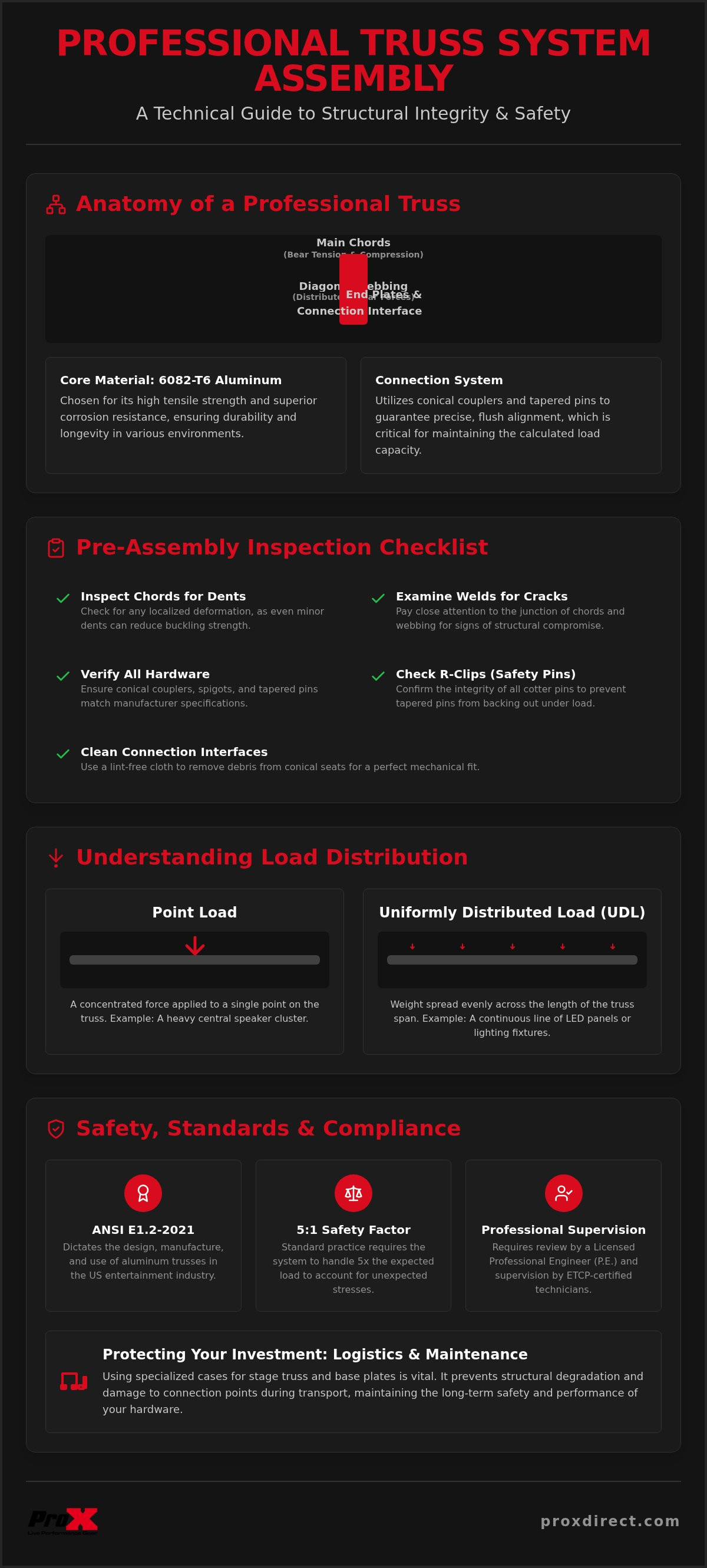
To understand What is a Truss? in a production context, one must analyze its three primary structural components. The main chords are the longitudinal members that bear the primary tension and compression forces. These are supported by diagonal webbing, which distributes shear forces across the structure to prevent the chords from buckling under stress. Finally, the end plates and connection interfaces provide the mechanical link between segments. Standardized ProX Truss systems use conical couplers to ensure flush alignment. This alignment is non-negotiable for maintaining the calculated load capacity of the entire span.
Regulatory Compliance and Safety Certifications
Compliance with international standards provides a verifiable baseline for safety. TUV certification is a critical indicator that a truss system has undergone rigorous third-party testing for load-bearing capacity and material quality. In the United States, the ANSI E1.2-2021 standard dictates the design, manufacture, and use of aluminum trusses in the entertainment technology industry. These regulations require that all designs be reviewed and sealed by a Licensed Professional Engineer (P.E.) in the state where the project is located. It's essential to verify that your rig documentation includes these professional stamps before elevating any structure.
Rigging professionals must also account for the distinction between static and dynamic loading. Static loads represent the constant weight of lighting fixtures or speakers. Dynamic loads occur when equipment moves or when external forces, like wind, impact the structure. A comprehensive truss system assembly guide must emphasize that these loads aren't interchangeable. Adhering to established safety factors, often 5:1 for standard rigging, ensures the system can handle unexpected stresses without compromising the structural integrity of the build. Periodic inspections are mandatory to identify localized bends or weld cracks that could lead to failure during a show.
Pre-Assembly Inspection: Component Identification and Verification
A rigorous pre-assembly inspection is the first line of defense against structural failure. This phase of the truss system assembly guide requires a systematic review of every component before it enters the rig. Technicians must differentiate between conical couplers, spigots, and tapered pins, ensuring each piece matches the manufacturer's load-bearing specifications. Even minor discrepancies in pin diameter or coupler seating can lead to uneven force distribution across the span. Precision at this stage is what separates a professional build from a hazardous one.
Visual verification is mandatory for all primary chords and diagonal webbing. Weld cracks, often found at the junction of the chord and webbing, indicate immediate structural compromise. Localized dents in the chords, even those that seem superficial, can significantly reduce the buckling strength of the aluminum. Additionally, technicians must verify the integrity of every R-clip. These safety cotter pins prevent tapered pins from backing out under vibration or dynamic loading. Cleaning the connection interfaces with a lint-free cloth ensures a seamless mechanical fit, preventing debris from obstructing the conical seat.
Hardware Inventory and Preparation
Logistical efficiency depends on the organization of high-tensile strength pins and couplers. Losing a single pin during a rapid load-in can stall the entire assembly process. Utilizing specialized Stage Truss and Base Plate Cases allows for the logical categorization of hardware, ensuring that couplers and pins are always accessible and accounted for. This methodical approach mirrors the safety-first mindset required by OSHA Fall Protection Guidelines when working at height during the final installation phases.
Identifying Structural Red Flags
Detecting subtle damage requires a trained eye. "Out-of-round" tubing is a common issue resulting from improper handling or overtightened clamps. If a conical coupler doesn't slide into the chord end with minimal resistance, the segment must be removed from service. Technicians should also look for signs of galvanic corrosion. This occurs when steel hardware remains in contact with aluminum in high-humidity environments, leading to material degradation. Any truss segment exhibiting localized bends, significant corrosion, or compromised welds must be decommissioned immediately. There's no acceptable "quick fix" for a compromised structural member. Maintaining a clean, organized inventory of professional truss components ensures that only verified, high-performance gear reaches the stage.
Step-by-Step Truss System Assembly and Connection Procedures
Precision assembly requires more than just connecting modular parts; it requires maintaining structural symmetry across the entire span. When following this truss system assembly guide, the technician's first priority is chord alignment. Webbing patterns must remain consistent across all segments. If the diagonal webbing on one segment doesn't line up with the next, it can create localized stress points that deviate from the engineered load calculations. Maintaining a uniform pattern ensures that shear forces are distributed exactly as the structural engineer intended.
Horizontal Assembly Workflow
Always perform the initial assembly on a leveled floor surface or utilize dedicated truss dollies to maintain a consistent plane. This prevents cumulative misalignment, where a millimetric gap at the first connection point becomes a significant structural deviation at the end of a 40-foot span. Technicians should connect professional truss segments in a logical sequence, checking the flushness of every interface before moving to the next. Securing base plates with the correct grade of hardware is mandatory before any vertical transition or tower elevation begins. A stable foundation is the only way to ensure the verticality of the entire rig.
Securing Conical Coupler Systems
The conical coupler system provides a high-strength, low-clearance connection that is essential for modern production. Start by seating the conical coupler fully into the chord end. The tapered pin must be driven through the chord and coupler using a "hammer and drift" technique. Use a copper or plastic-faced hammer to prevent marring the 6082-T6 aluminum surface. The pin's directional orientation is vital; the taper creates a friction-fit that tightens as it's driven home. You'll know the pin is correctly seated when it's flush against the coupler wall and provides a solid mechanical "thud" upon impact.
Final safety verification is the most critical step in the assembly process. Every tapered pin must be secured with an R-clip, also known as a safety cotter pin. This is a non-negotiable requirement. Under the vibration of a live performance or the dynamic loading of moving lights, a pin without an R-clip can back out of the coupler, leading to an immediate and catastrophic connection failure. Technicians should perform a "double-check" walk-through, physically touching every R-clip to confirm engagement. Organizing your hardware in specialized protection cases during this process helps ensure that no safety clips are overlooked or left behind in the work area.
Load Distribution and Rigging Safety Calculations
Engineering safety in live production relies on precise weight distribution and an understanding of how forces interact with the aluminum structure. A comprehensive truss system assembly guide must distinguish between Point Loads and Uniformly Distributed Loads (UDL). A point load represents a single concentrated weight, such as a large moving head fixture or a speaker array, placed at a specific junction. Conversely, a UDL spreads weight evenly across the entire span. Centering a heavy point load on a long horizontal span creates the maximum amount of deflection, which can lead to permanent deformation of the 6082-T6 aluminum chords if engineered limits are exceeded.
Monitoring environmental factors is equally vital for outdoor trussing. Wind loads act as dynamic forces that can significantly increase the total stress on a rig. Technicians must account for the surface area of suspended equipment, such as banners or video panels, which act as sails in high-wind conditions. Adhering to the ANSI E1.2-2021 standards ensures that the structure can withstand these external pressures without compromising the safety of the crew or the audience. All rigging plans for suspended structures must be reviewed by an ETCP-certified rigging supervisor to verify that the calculations align with the physical realities of the site.
Managing Span Deflection
Vertical deflection is the visible "sag" in a truss span under load. While some deflection is expected, exceeding safe limits can introduce unintended stress into the connection points. Standard industry guidelines often reference a deflection limit of L/360, which means the span should not deflect more than its total length divided by 360. However, high-end productions are increasingly adopting more stringent standards, such as L/480, to prevent a "springy" feel and ensure maximum stability. Using load cells for real-time weight monitoring allows technicians to observe the impact of hoist synchronization, ensuring that no single motor bears more than its calculated share of the weight.
Rigging Best Practices for AV Integration
Integrating complex AV systems requires advanced slinging techniques to maintain even weight distribution. When protecting LED video walls, the high density of the panels creates a significant UDL that requires a robust support structure. Technicians should utilize secondary safety bonds for all suspended equipment, providing a redundant fail-safe in the event of a primary attachment failure. Proper slinging ensures that the load is applied to the truss chords at the junction points of the webbing, which is where the structure is strongest. For professionals demanding the highest levels of structural reliability, utilizing engineered modular truss components is the only way to ensure the integrity of a high-stakes build.
Protecting Your Investment: Logistics and Maintenance
The lifecycle of a professional rig extends far beyond the final curtain call. While this truss system assembly guide has focused on the mechanical precision required for setup, the long-term structural integrity of your gear depends on rigorous logistical management and post-event maintenance. Aluminum 6082-T6 is exceptionally durable. However, it's susceptible to surface abrasions and localized deformations during transit. These minor damages, often referred to as "road rash," can create stress risers that eventually lead to weld failure or chord buckling under load. Protecting these assets during transport is a fundamental safety requirement.
Specialized Truss and Base Plate Protection
Standardized case dimensions offer more than just efficient truck packing. They provide a controlled environment that isolates structural members from impact. Utilizing Engineering Excellence for Stage Truss and Base Plate Cases ensures that chord ends and connection interfaces remain perfectly circular and free of debris. Unlike soft carry bags, which offer negligible protection against heavy-duty logistical demands, rugged cases prevent the metal-on-metal friction that degrades the material over time. When you Browse ProX Truss Solutions, you'll find that modular reliability is only maintained when components are stored in a manner that preserves their engineered tolerances.
Long-Term Storage and Maintenance
Environmental factors are a persistent threat to aluminum structures. While aluminum doesn't rust like steel, it's subject to oxidation. This process can create a dull, abrasive surface that interferes with the flush fit of conical couplers. Post-event maintenance should include a thorough cleaning of all connection points. Use a non-corrosive lubricant on couplers and tapered pins to ensure they continue to seat with minimal resistance. This is also the ideal time to update your structural inspection log. Documenting every deployment allows you to track the service life of each segment and identify hardware that requires replacement before it reaches a critical failure point.
Hardware fatigue is a reality in professional production. Always replace worn pins, R-clips, and couplers with original equipment manufacturer (OEM) parts to ensure compatibility and maintain load-bearing certifications. An annual professional certification of your entire truss inventory is a best practice that aligns with ANSI E1.2-2021 standards. By treating your trussing as a precision-engineered asset rather than a commodity, you ensure that every build follows the safety protocols established in this truss system assembly guide. This methodical approach protects both your crew and your capital investment over years of professional use.
Advancing Structural Safety in Live Production
Maintaining a safe production environment requires more than just following assembly steps; it demands a deep understanding of structural engineering and material science. This truss system assembly guide provides the technical foundation needed to build reliable rigs that meet ANSI E1.2-2021 standards. By prioritizing rigorous pre-assembly inspections and precise load calculations, you mitigate the risk of catastrophic failure. It's also vital to remember that structural integrity is preserved through superior logistical management. Specialized Stage Truss and Base Plate Cases offer the rugged protection necessary to prevent chord deformation during frequent transport.
ProX has been engineering performance gear since 1984, providing industry-standard solutions for professionals who prioritize functional excellence. Whether you're managing complex AV integrations or standard stage setups, your commitment to safety ensures the long-term reliability of your hardware. Explore Professional ProX Truss and Staging Solutions to find components designed for the high-stakes demands of the modern production industry. Your dedication to precision builds a stronger, safer foundation for every show.
Frequently Asked Questions
How do I know if my truss segment is safe to use?
A truss segment is safe to use only if it passes a rigorous visual inspection for structural anomalies. You must check for localized dents in the chords, cracks in the weld points, or any signs of "out-of-round" tubing at the connection interfaces. Any segment exhibiting these structural red flags should be decommissioned immediately. Regular documentation in a structural inspection log ensures that every component in your inventory remains within engineered safety tolerances.
What is the difference between a conical coupler and a plated connection?
The primary difference lies in the mechanical interface and assembly speed. A conical coupler system utilizes tapered pins and couplers to create a high-strength friction fit that minimizes clearance between segments. This is the industry standard for modern modular setups. In contrast, a plated connection uses flat end plates secured by bolts and nuts. While plated systems are common in permanent installations, conical systems are preferred for live production due to their superior structural rigidity.
Can I mix truss segments from different manufacturers?
Mixing truss segments from different manufacturers is generally not recommended and can void structural certifications. Even if dimensions appear identical, variations in aluminum alloy grades, weld penetration, and conical tolerances can create weak points in the span. Using a consistent truss system assembly guide across a single-brand inventory ensures that load-bearing calculations remain accurate. Always verify compatibility through manufacturer documentation before attempting to integrate components from different sources to prevent mechanical failure.
How much weight can a standard 12-inch box truss hold?
The weight capacity of a 12-inch box truss depends entirely on the span length and the type of loading applied. A 10-foot span can typically support significantly more weight than a 40-foot span. You must consult the specific manufacturer's load table to differentiate between Uniformly Distributed Loads (UDL) and Point Loads. For example, center-point loading reduces the total capacity compared to an even distribution. Never exceed the engineered limits provided by the manufacturer's technical data.
What tools are required for professional truss assembly?
Professional truss assembly requires a specific set of tools designed to protect the hardware. A copper or plastic-faced hammer is essential for driving tapered pins into conical couplers without marring the 6082-T6 aluminum surface. You should also utilize a drift for pin removal and maintain a supply of R-clips for every connection. Personal Protective Equipment, including gloves and steel-toed footwear, is mandatory. Organizing these tools in specialized protection cases prevents loss and ensures efficiency during high-pressure load-ins.
Do I need a structural engineer for every truss rig?
You need a Licensed Professional Engineer to review and seal plans for any suspended structures or complex ground-supported rigs. According to the 2025 California Building Code, which becomes effective January 1, 2026, many jurisdictions require plans for overhead assemblies to be submitted for professional review. While a simple ground-supported goalpost might not always require a stamp, any rig that suspends equipment over an audience or crew must be approved by an ETCP-certified rigging supervisor.
How should I store truss segments when they are not in use?
Truss segments should be stored in a dry, temperature-controlled environment to prevent aluminum oxidation. Utilizing specialized Stage Truss and Base Plate Cases is the most effective way to protect the chords from impact during storage. These cases ensure that connection interfaces remain clean and circular. When not in cases, segments should be stored on leveled racks or dollies to prevent localized stress points that could lead to permanent structural deformation over time.
What is the lifespan of a professional aluminum truss?
The lifespan of a professional aluminum truss is determined by its usage history and maintenance rather than a set number of years. With proper handling and regular lubrication of couplers, high-quality 6082-T6 aluminum can last for decades. However, hardware fatigue and localized damage from improper transport can shorten this duration. Following a comprehensive truss system assembly guide and performing annual professional certifications are the best methods for ensuring the long-term structural viability of your inventory.
Disclaimer
Any trademarks, trade names or brand names appearing herein that do not belong to ProX are the property of their respective owners and/or companies, and such appearance doesn't and shall not constitute or imply endorsement, sponsorship or recommendation by ProX.


